Skip to content
DevMeme
4160 of 7435
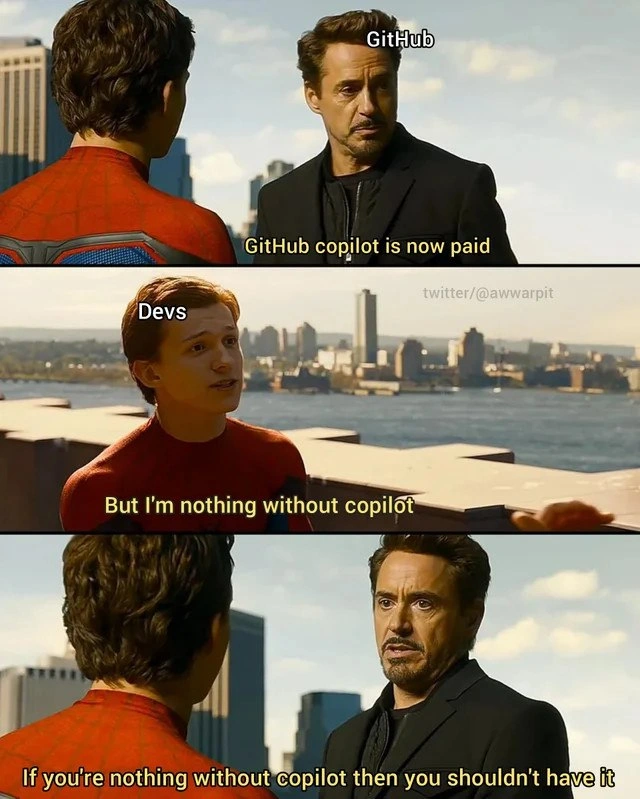
Developers panic as GitHub Copilot turns paid in Spider-Man meme
AI ML Post #4542, on Jun 23, 2022 in TG

Developers panic as GitHub Copilot turns paid in Spider-Man meme

Why is this AI ML meme funny?

Level 1: Without Training Wheels

Imagine a little kid who always uses training wheels on their bike. Those extra wheels keep the bike steady, so the kid never learned to balance on just two wheels. One day, the parent says, “We need to take off the training wheels.” The kid gets scared and says, “But I can’t ride without my training wheels! I’ll fall – I’m nothing without them.” The parent gently but firmly replies, “If you’re really nothing without your training wheels, then you shouldn’t be using them.” In other words, the child needs to learn to ride the bike on their own, without that extra help. It’s a moment of tough love: the parent knows the kid might be wobbly at first, but also that relying on training wheels forever won’t make them a better rider. The feeling here is both funny and relatable – we’ve all felt a bit lost when a helpful tool or shortcut was taken away. But the message is simple: you have to believe in your own ability and practice the basics, or else the fancy helper wasn’t actually helping you grow.

Level 2: Training Wheels Off

Let’s break down the scenario in simpler terms. GitHub Copilot is an AI helper for coding – think of it like an auto-complete system in your code editor that’s supercharged with AI. You start writing a function or a comment describing what you need, and Copilot suggests the next lines of code automatically. It’s as if you had a smart “co-pilot” (hence the name) sitting next to you, who has read a million open-source code examples and is whispering solutions. Initially, Copilot was free for developers during its preview period, and many devs got used to having this AI assistant constantly helping out. Now GitHub (the company that provides Copilot) has announced that Copilot is switching to a paid subscription service. In other words, after a free trial, you’ll have to pay a monthly fee to keep using this coding assistant (unless you’re a student or open-source contributor who gets it free).

The meme captures how a lot of developers reacted to this news. In the images, we see a scene from a Spider-Man movie: Tony Stark (Iron Man) is labeled “GitHub”, and young Peter Parker (Spider-Man in his homemade suit) is labeled “Dev”. This is a classic mentor-student moment. GitHub (Tony) says, “GitHub Copilot is now paid,” basically telling the developer about the change. The Dev (Peter) looks up, upset, and says, “But I’m nothing without Copilot!” – meaning “I feel useless as a programmer without my AI helper.” It’s a dramatic way to say the developer has become very dependent on this AI tool for coding. Now comes the zinger: GitHub (the mentor) replies, “If you’re nothing without Copilot, then you shouldn’t have it.” That’s a bit of tough love. The idea is similar to a teacher saying, “If you can’t solve math problems without a calculator, you need to learn to do it by hand first.” In coding terms, GitHub is telling the dev: “You should still be able to write code on your own. If losing this tool makes you completely helpless, that’s a sign you relied on it too much.” It’s like taking the training wheels off a bike – if you’ve been riding with training wheels the whole time, you might panic when they’re removed, but the only way to truly learn to balance is to ride without them. Similarly, this meme is pointing out (in a humorous way) that developers should be careful not to let an AI tool become a crutch. Yes, Copilot can make coding faster and easier (it was a big boost to developer experience when it was free!), but you still need to know how to code without it, because you can’t always guarantee you’ll have it (especially now that it costs money or could even be unavailable at times).

So the meme uses a fun superhero analogy to deliver a real message: don’t lose your core skills just because an AI helper is available. It pokes fun at how some devs might act overly dramatic (“I’m nothing without it!”) when a convenience is taken away. At the same time, it’s kind of a reassurance: a good mentor (or platform like GitHub) wants you to be a solid coder first. Copilot should be a boost to your powers, not the source of them. In short, GitHub is being like Tony Stark here – reminding the young developer that true coding ability comes from themselves, not from an AI plugin.

Level 3: Tough Love from GitHub

The meme brilliantly repurposes a famous Spider-Man: Homecoming scene to poke fun at developer reliance on AI assistants. In the original, Tony Stark (Iron Man) tells young Peter Parker, “If you’re nothing without the suit, then you shouldn’t have it.” Here, GitHub takes Tony’s role as the mentor/boss figure, and the “suit” is replaced by GitHub Copilot – the AI pair-programmer many developers had grown attached to during its free trial. The developer (Spidey in his rookie years, labeled "Devs" in the meme) pleads, “But I’m nothing without Copilot!” It’s a tongue-in-cheek dramatization of how some devs felt upon hearing Copilot’s now a paid product. This panic highlights a worrisome dependency on AI code completion – as if the very ability to code was being yanked away behind a paywall. The humor comes from the exaggeration: are we developers really so dependent on an AI autocomplete engine that we feel powerless without it? The meme suggests that for some, the answer is “maybe yes” – which is both funny and a bit alarming. It highlights a classic developer pain point: getting too comfy with a high-tech tool that suddenly isn’t free or available, prompting a “panic” akin to Spider-Man losing his fancy suit. The mentor’s retort – “If you’re nothing without Copilot, then you shouldn’t have it” – is a slap of reality (or tough love) from GitHub/Microsoft, almost as if the platform is saying: “rely on your own skills first, kid, the AI is just a bonus.” This twist delivers a dose of AI humor with an edge of truth that seasoned devs recognize. The scenario is funny because it’s exactly the kind of developer humor that makes you laugh and cringe at the same time – we chuckle at the over-the-top dependence, but cringe a little because we’ve all felt a tinge of that reliance on our tools.

From a senior developer’s perspective, this meme nails an AI hype vs reality lesson about developer reliance on AI in a fun way. We’ve seen waves of must-have dev tools and helpers come and go. Remember when everyone half-joked about being “nothing without Stack Overflow,” or when IDE auto-complete first became widespread and newbies relied on it for every snippet? Experienced engineers chuckle because we’ve all been that “Dev” at some point – frantically Googling error messages or leaning on a tool to do the heavy lifting – only to have a grizzled teammate remind us, “you need to understand this without the training wheels.” The mentorship tough-love analogy here is on point: a good mentor (or an organization like GitHub in this case) knows that over-reliance on any one tool can make you a weaker programmer. It’s reminiscent of a senior dev temporarily banning a junior from using Google for a day, just to force them to learn the fundamentals. In the context of Copilot’s pricing change, GitHub is effectively playing the tough mentor by putting Copilot behind a paywall – a classic instance of paid subscription tooling disrupting our workflow. The message is clear: if a developer literally can’t code anything without AI holding their hand, that’s a sign they need to go back and build up their own skillset. The community’s reaction – half panic, half parody – reveals how quickly Copilot became integrated into the developer experience (DX). In less than a year, many devs went from “AI code assistant? Sounds neat” to “I can’t live without my AI pair-programmer!” That dramatic shift is both comical and a cautionary tale. The meme is a gentle roast of those who got a bit too cozy with this new tooling. Seasoned devs are laughing, but also nodding in agreement: it’s a reminder that as helpful as Copilot is, no one should let their core coding skills atrophy. The best developers treat tools like Copilot as boosts to productivity, not as crutches for the basics. After all, if an AI assistant suddenly vanishes behind a paywall (or goes down, or gets banned by your boss due to policy), you’ll need to be your own hero – just like Spider-Man learning to be a hero without his high-tech suit.

Level 4: Autopilot Under the Hood

GitHub Copilot isn’t just a random code snippet generator – it’s powered by a large-scale AI under the hood. Specifically, Copilot uses a Transformer-based language model (OpenAI’s Codex, a descendent of GPT-3) that was trained on billions of lines of source code from public repositories on GitHub. This means the AI learned statistical patterns of how code is written across countless projects. In essence, it’s performing context-aware code completion: you write a comment or start a function, and the model infers what you're likely trying to implement by analyzing your context and predicting the next chunk of code. It’s like an extremely advanced auto-complete engine, one that writes whole functions or classes as if it absorbed the collective experience of GitHub. Senior developers will recognize that under the hood this is just pattern matching at an immense scale – the model doesn’t truly understand code logic or have consciousness. It leverages patterns (for example, common loops, API calls, or data structure usage it saw during training) and tries to statistically “guess” what comes next. This can feel magical when it correctly autocompletes a tricky algorithm, but it can also produce bizarre or insecure code if the prompt is ambiguous or if it mimics flawed examples from its training data.

Running such a neural code oracle is computationally expensive. Each time Copilot suggests code, it’s essentially running a massive neural network in the cloud to predict your next few lines – not something that comes cheap like traditional IDE auto-suggestions. During the free beta, GitHub (backed by Microsoft’s cloud) footed the bill for all those GPU cycles every time a dev asked their AI pair-programmer for help. The decision to move GitHub Copilot to a paid subscription model reflects the reality that providing this AI as a service incurs ongoing costs for hardware and maintenance of the model (not to mention the huge research investment to train it). Experienced devs weren’t shocked by the Copilot pricing change – if you’ve seen the price tag on GPU cloud instances or the electricity draw of a deep learning rig, you know AI magic isn't free. There’s also a less obvious angle only seasoned folks might recall: Copilot’s training on open-source code raised license and ethics questions. Some in the community joked that now developers might be paying monthly to use code that was originally open-source (and free) before being digested by the AI. This highlights an AI hype vs reality moment: as amazing as these AI assistants are, they ride on the back of our existing code and computing power. The AI/ML techniques here are cutting-edge, but they still have limitations – they can suggest solutions and even write boilerplate faster than a human, yet they won’t truly understand your specific problem domain or architecture constraints. So the tech behind Copilot is bleeding-edge, but it’s essentially a powerful prediction engine. And like any autopilot, it works best when the pilot (the developer) is skilled enough to correct course when the AI goes off-target.

Description

Three-panel meme using a Spider-Man: Homecoming rooftop scene. Panel 1 shows the back of a red-suited hero facing a suited mentor figure; a white caption above the mentor reads "GitHub" and a subtitle at the bottom says "GitHub copilot is now paid." Panel 2 is a closer shot of the hero, now labelled "Dev" over his head, replying with the subtitle "But I'm nothing without copilot" while a city skyline and the watermark "twitter/@awwarpit" appear behind him. Panel 3 returns to the mentor’s face as he retorts "If you're nothing without copilot then you shouldn't have it." The meme humorously portrays developers’ dependency on GitHub Copilot, highlighting concerns about paid AI coding assistants and the need for core coding skill retention
Comments

6
Anonymous ★ Top Pick Copilot going paid is the spiritual successor to left-pad vanishing - if your pipeline grinds to a halt, the invoice isn’t the scary part
  1. Anonymous ★ Top Pick

    Copilot going paid is the spiritual successor to left-pad vanishing - if your pipeline grinds to a halt, the invoice isn’t the scary part

  2. Anonymous

    After 20 years of Stack Overflow copy-paste driven development, we've successfully automated the process of not understanding our own code - now with enterprise pricing and vendor lock-in!

  3. Anonymous

    The real plot twist: GitHub Copilot went from 'free beta that occasionally suggests your own code back to you' to 'paid subscription you can't live without' faster than most startups pivot to blockchain. Now we're all just one expired license away from remembering what 'for loop syntax' actually looks like - turns out the real technical debt was the autocomplete we made along the way

  4. Anonymous

    If your throughput halves when Copilot hits a paywall, you didn’t adopt AI - you just moved your bus factor to a corporate credit card’s expiration date

  5. Anonymous

    Copilot went paid; engineering wants seats, security wants IP indemnity, finance wants a cost center - somehow autocomplete ended up on our critical path

  6. Anonymous

    Copilot went paid, so now we're auditing our own ASTs instead of hallucinated imports

Use J and K for navigation