Skip to content
DevMeme
4161 of 7435
From Software Engineer to VC: The Pokémon Evolution of Tech Careers
Career HR Post #4543, on Jun 23, 2022 in TG

From Software Engineer to VC: The Pokémon Evolution of Tech Careers

Why is this Career HR meme funny?

Level 1: From Builder to Boss

Imagine you start out doing something you love, and as you grow up, your role completely changes. Let’s use a simple playground example:

Suppose you really enjoy building sandcastles at the beach. At first, you’re the one getting your hands dirty, stacking sand and filling buckets – you’re the builder. A few years later, you’re not just making one sandcastle, but you’re leading a team of friends to create a whole sandcastle city. You decide where each tower should go and make sure everyone has the right tools, but you might not pat every tower into shape yourself – now you’re the planner or boss of the project. Finally, imagine many years after that, you’re not on the beach building at all. Instead, you give other kids the shovels and buckets and money to buy better sand, and you say, “I’ll support you while you build the coolest sandcastles ever!” You’ve become more like a sponsor or investor – you’re helping make it happen by providing resources, even if you’re not molding the sand with your own hands anymore.

This is exactly what the meme is joking about, but with tech jobs. It’s funny because it shows one person changing roles in a big way – from the one who builds things (the engineer, like the kid playing in sand), to the one who plans and tells others what to build (the product manager, like the kid leading the team), to the one who just provides the money and support for projects (the venture capitalist, like the sponsor buying the buckets). It’s like watching a small cute Pokémon creature evolve into a big different creature: surprising, a bit absurd, but also a natural progression in that world. In real life, seeing someone go from coder to big investor is a bit like seeing your little friend Charmander eventually turn into Charizard – it’s a big change! The meme makes us laugh because it takes this serious career journey and shows it in a fun, cartoonishly simple way. Even if you don’t know the exact jobs, you can giggle at the idea of a person “levelling up” through job titles as if they’re a character in a video game. It’s a playful reminder that in the tech world (just like in stories and games), people can transform a lot as they grow.

Level 2: Gotta Promote ’Em All

This meme is comparing a tech career path to a Pokémon’s evolution journey in a very literal way. If you’re newer to the tech world (and possibly to Pokémon), here’s what’s going on:

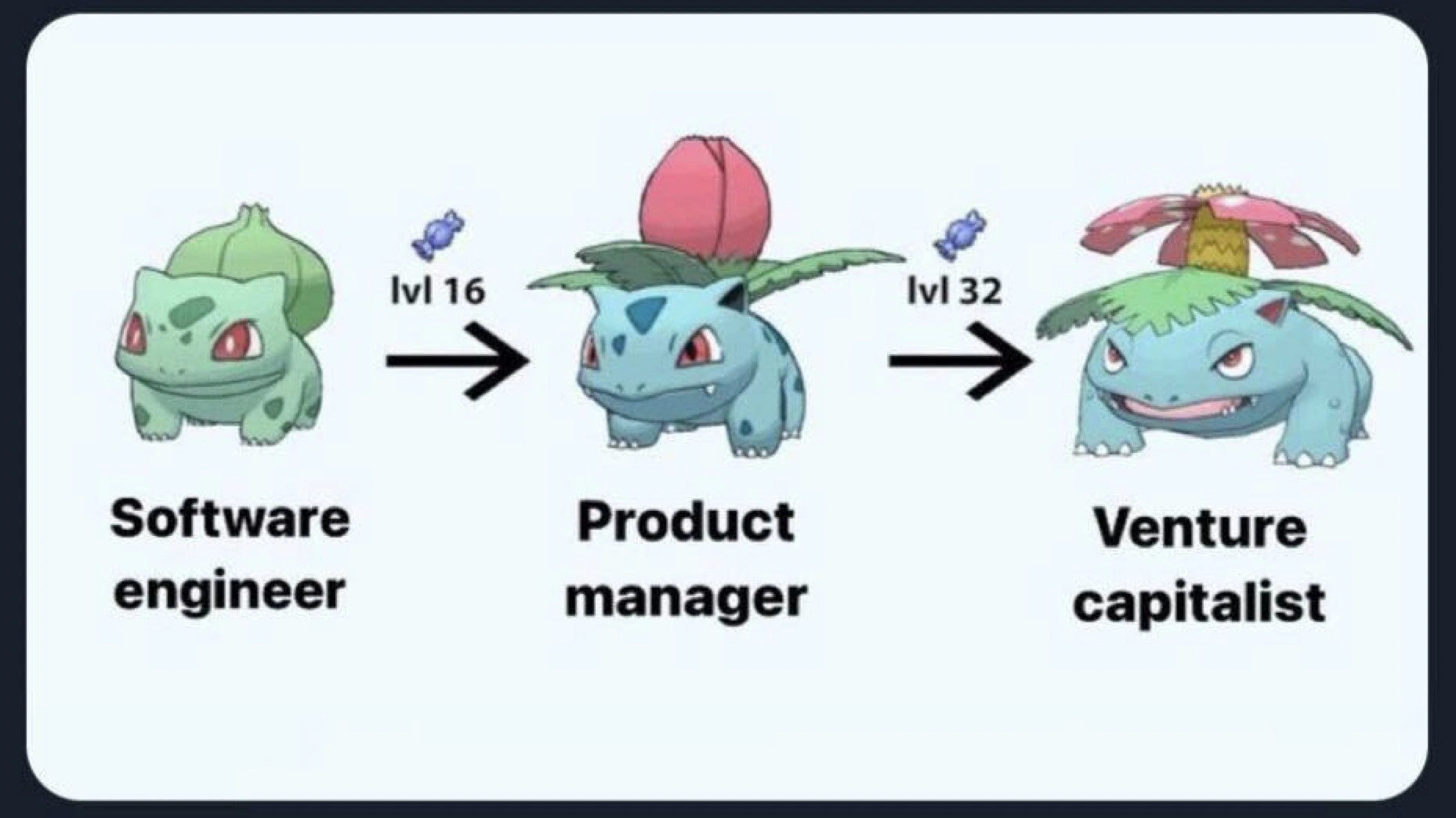
In the image, we see three familiar Pokémon characters:

  • Bulbasaur – the small green creature on the left – labeled “Software engineer.”
  • Ivysaur – the middle evolution with a bud on its back – labeled “Product manager.”
  • Venusaur – the large final evolution with a big flower – labeled “Venture capitalist.”

Above the arrows between them, it says “lvl 16” and “lvl 32” with a tiny candy icon. In Pokémon games, each creature evolves when it reaches a certain level. For Bulbasaur, it evolves into Ivysaur at level 16, and Ivysaur evolves into Venusaur at level 32. The little candy is a Rare Candy, an item that gives a Pokémon a free level-up. So the meme is copying that exact evolution formula and applying it to job titles: as if a Software Engineer who “levels up” enough (gains experience) will evolve into a Product Manager by level 16, and then into a Venture Capitalist by level 32. It’s a playful metaphor for career evolution in the tech industry.

Now, what do these job titles mean in real life?

  • Software Engineer: This is someone who writes code and builds software. They are like Bulbasaur at the start of an adventure – hands-on, doing the fundamental work. For example, a software engineer might write the code for a mobile app or a website. This is often an entry or early-career role in tech (though you can be a software engineer your whole career, of course). In the meme, Bulbasaur (the engineer) is small but mighty, just starting out and doing the “nitty-gritty” of making a product work.
  • Product Manager: This role is a bit more senior (hence shown as an evolution). A product manager doesn’t usually write code themselves (at least not as their main job). Instead, they decide what features the software should have, create a plan or strategy for the product, and coordinate the team of engineers, designers, etc., to build it. Think of them as the person who says, “We need to build a red bicycle because that’s what our customers want,” and then the engineers figure out how to build the bicycle. In the meme, the Ivysaur represents this role. Ivysaur is bigger and more complex than Bulbasaur – similarly, a Product Manager has a broader responsibility than just coding. Many product managers in tech actually started out as engineers and “evolved” into a planning and leadership role after they gained experience (in Pokémon terms, after gaining XP from a lot of battles!). The “lvl 16” with Rare Candy suggests that around a certain point (not literally age 16, just a metaphor), an engineer might get promoted or choose to become a product manager. It could be after a number of years (like say 5-8 years into a career) or after showing aptitude for big-picture thinking. The Rare Candy could be something like getting an MBA or just being really good at communication – something that helps them level-up faster into management.
  • Venture Capitalist: This is quite a leap from the previous two – it’s a different kind of job in the tech ecosystem. A venture capitalist (VC) is someone who invests money in startup companies. They usually work at a venture capital firm or start their own fund, and their job is to find promising young companies and provide funding (money) to those companies in exchange for a stake (ownership share). The idea is that if those startups succeed and grow, the VC’s share will become very valuable – that’s how the VC makes money. Now, why would a tech person become a VC? Often, people who have been in tech for a while (maybe they founded a startup or were early employees at a successful company) accumulate wealth and experience. Then they “evolve” into mentors/investors for the next generation. In the meme, Venusaur is big, strong, and kind of sits there with its flower — which is a funny way to visualize a venture capitalist. Unlike the engineer or the product manager, the VC isn’t in the day-to-day building of one product; instead, they might be supporting many projects at once by funding them and giving advice. The “lvl 32” implies this is an even later stage of one’s career (perhaps after a decade or two in the industry, or after a big success). The Rare Candy here might represent a big success or windfall that allowed the person to jump into investing. For example, if as a product manager you helped launch a product that made a lot of money or you sold a startup – that “experience candy” boosts you to VC level without necessarily climbing a traditional corporate ladder any further.

The overall joke is a bit of CareerHumor and StartupHumor rolled together: it’s saying a tech worker’s life cycle might go from writing code, to managing products, to funding companies – as if that’s the natural progression, just like a Pokémon naturally evolves in stages. It’s a parody of the idea of career growth (hence the tag career_evolution and tech_career_path_parody). In reality, not every software engineer wants to become a product manager, and certainly not everyone ends up a venture capitalist. These are three distinct careers. But in the fast-paced Startup world, it’s not uncommon to see, for instance, a young engineer join a startup, then a few years later take on product management responsibility, and eventually, after maybe founding their own startup or making some money, switch to the investing side to help new startups. The meme exaggerates this pattern by compressing it into a cute RPG-like graphic.

Also, there’s an undercurrent of ManagementHumor here: many developers jokingly fear that as they get more senior, they’ll be forced to stop coding and start attending meetings (that’s the product manager life – lots of meetings, planning, and emails instead of coding). And some joke that the ultimate endgame is becoming a venture capitalist where you don’t work on a single product at all – you just sit in fancy meetings and decide whose project to fund. It’s satire – meaning it’s using humor to critique or poke fun at something. In this case, it’s poking fun at how the tech industry often equates career advancement with moving away from the actual engineering work. The Pokémon analogy makes it lighthearted and instantly recognizable because many of us grew up knowing that Bulbasaur eventually turns into a big old Venusaur. Seeing job titles beneath those sprites is unexpected and silly, which is why it’s amusing.

Contextual elements explained: The pale-grey panel and the sprites give it that classic meme format and a retro gaming vibe. The fact that it’s Pokémon specifically (with Bulbasaur, etc.) is key because those evolutions are well-known. If it were random images of, say, a junior dev, a manager in a suit, and a rich investor, it wouldn’t have the same geeky charm. Using Pokémon instantly taps into nostalgia and shorthand for “small to medium to big progression.” The bulbasaur_evolution_metaphor tag is exactly describing this: using Bulbasaur’s evolution line as a metaphor for career evolution.

Why do tech folks find this relatable? Many people in software have seen colleagues or famous figures make this transition. For example, someone might start as a programmer at Google, later become a product lead at a startup (or Google itself), and years later join a venture capital firm to fund new startups. So it’s taking a real phenomenon and giving it a comic twist. It also jabs at the mentality that every step up the ladder is an “evolution” (implying improvement). A Software Engineer might jokingly feel, “Hey, am I just a Bulbasaur who everyone expects to evolve? What if I want to stay a Bulbasaur (coder) and not become a big Venusaur (investor)?”. The meme isn’t saying one is actually better, but it mimics how some people talk about careers as if bigger title = evolved form. This is CareerGrowth parody: like a game, you gain XP (experience points) in your job, and instead of just leveling up within the same role, you morph into a whole new creature with a new title.

So, in simpler terms: the meme is a tech industry inside-joke. It uses the language of Pokémon to make fun of how tech careers often progress. SoftwareEngineer to ProductManager to VentureCapitalist is like saying you go from building somethingoverseeing the building of thingsinvesting in people who build things. Each arrow with “lvl” is like a checkpoint in experience. It’s a fun way to visualize climbing the career ladder (another term for moving up in jobs). And because it’s done with cute Pokémon images, it comes off as light and humorous rather than boastful or critical. It’s something you’d chuckle at and perhaps share with your coworkers, especially if you’ve had conversations about whether to go into management or what life might be like after years in the industry. In short: DeveloperHumor meets Pokémon nostalgia, resulting in a perfect little piece of TechIndustrySatire that both new and seasoned techies can giggle at (even if junior folks might not yet have seen the full evolution happen in real life, they’ll recognize it as a common storyline in tech career talks).

Level 3: Rare Candy Career Path

This meme cleverly uses a Pokémon evolution chain as a satire of the tech industry career ladder. It maps Bulbasaur → Ivysaur → Venusaur onto Software Engineer → Product Manager → Venture Capitalist, implying that a programmer’s “final form” is a venture capitalist. It’s funny to seasoned developers because it exaggerates a real trend in tech: as people advance, they often move away from coding and into leadership or investment roles. The humor comes from framing this as an inevitable level-up sequence, complete with level 16 and level 32 milestones and even Pokémon’s Rare Candy items (which in the games instantly boost your level). This mix of childhood gaming and corporate satire hits close to home for anyone who’s watched colleagues “evolve” out of engineering roles.

In the world of Pokémon, when a creature reaches a certain level, it evolves into a new, more powerful form. Here that concept is applied to job titles:

  • Bulbasaur as “Software Engineer” – the starting stage, a bit green (literally and figuratively). The engineer is hands-on, writing code and building the actual product. This is akin to a beginner Pokémon starting its journey, gaining experience by coding features and fixing bugs.
  • Ivysaur as “Product Manager” – at “level 16”, Bulbasaur evolves. In tech terms, after accruing experience (and maybe eating a Rare Candy or two, like an MBA or internal promotion), the engineer transforms into a product manager. As an PM, they’ve grown a bulb on their back – symbolically carrying the budding vision of a product. Instead of coding, now they set feature priorities, write specs, coordinate developers, and align the product with business goals. It’s a bigger role on paper, often considered a promotion in the Career_HR sense, though it requires a different skill set.
  • Venusaur as “Venture Capitalist” – by “level 32”, the Ivysaur reaches its final evolution. The once-engineer, now with substantial experience (or perhaps a successful startup exit as a Rare Candy boost), evolves into a VC. As a venture capitalist, they no longer build products or manage teams directly – instead, they invest money in startups and guide founders from a distance. Venusaur is a huge, heavyweight Pokémon with a flower that’s fully bloomed; analogously, a VC is often seen as a “big player” in the tech ecosystem with financial weight and broad influence. The humor is that the tiny coding creature has turned into this giant money-powered beast.

Bulbasaur writes code, Ivysaur writes specs, Venusaur writes checks.

Experienced devs chuckle at that line because it encapsulates the shifting nature of work: the engineer’s commit log gives way to the manager’s PRD (Product Requirements Document), and finally the investor’s term sheets and checks. The meme pokes fun at title inflation and the prevailing Startup culture mindset that moving out of engineering is somehow “levelling up.” In many tech companies, the only path to higher status or pay seems to be going into management or business roles – an idea both embraced and lamented in equal measure. Seasoned engineers know the classic irony: often the reward for being a great engineer is getting promoted into a role where you don’t engineer anymore. This evolution chain humorously illustrates that bittersweet trajectory.

The inclusion of the little blue Rare Candy icon under each arrow is a sly detail. In Pokémon games, a Rare Candy instantly raises a Pokémon’s level by 1. Translating that to careers suggests there are “shortcuts” or boosts to jump ahead in job evolution. Perhaps a sudden startup success, a well-timed MBA, or being part of a high-profile project acts like a Rare Candy, propelling a developer to a PM role (level 16) or from PM to an investor (level 32) faster than normal. It’s a tongue-in-cheek way to say: in the tech world, sometimes rapid ascension happens – you get that promotion or new title quicker than expected, almost like using a cheat code. Of course, in reality there’s no guaranteed linear path from coder to VC (many engineers happily stay technical, and not every PM becomes an investor), but the meme exaggerates it for comedic effect. It’s TechIndustrySatire at its finest, compressing years of CareerGrowth into a Pokémon timeline we can all nostalgically understand. The Entrepreneurship angle is highlighted too – many venture capitalists are former tech entrepreneurs or early employees at startups who “evolved” after their company got acquired or went public (that big success gave them the experience and capital, i.e. the XP and Rare Candy, to become VCs).

For a veteran in tech, the meme also carries a hint of cynicism wrapped in humor: each evolution step moves further away from the hands-on creation that draws many into software engineering in the first place. It’s like watching your cute little Bulbasaur friend gradually turn into a grumpy Venusaur that just sits there (on a pile of cash) and funnels money to younger Bulbasaurs to do the work. The “SoftwareEngineer-to-VC” trope is well-known in Silicon Valley – think of engineers-turned-CEOs or ex-developers who eventually start their own venture funds. This image playfully suggests that is the natural progression of gotta catch ’em all but for job titles: you catch some code, then you catch some product market fit, then you catch some equity in other companies. It resonates because it lampoons both Management_Humor (the engineer evolving into a manager) and StartupHumor (the endgame of making it big and funding other startups). In summary, the meme works on multiple levels of tech insider knowledge: it’s simultaneously a nod to childhood gaming culture and a wink at the very adult game of climbing the tech career ladder.

Description

The meme shows a pale-grey panel with three classic Pokémon sprites arranged left to right as an evolution chain. Beneath the green Bulbasaur sprite is the bold caption “Software engineer”. A black arrow with a tiny blue rare-candy icon is annotated “lvl 16” and points to an Ivysaur sprite captioned “Product manager”. A second arrow with another candy and “lvl 32” points to the final Venusaur sprite captioned “Venture capitalist”. By mapping Bulbasaur→Ivysaur→Venusaur onto job titles, the image humorously suggests that a developer ‘levels up’ into product management and ultimately venture funding, poking fun at career ladders, title inflation, and startup culture in the tech industry

Comments

6
Anonymous ★ Top Pick Eat enough of those “rare candy” equity grants and you evolve from merging PRs to merging cap tables - the debugger’s gone, but you’ll still spend all day tracing TAM
  1. Anonymous ★ Top Pick

    Eat enough of those “rare candy” equity grants and you evolve from merging PRs to merging cap tables - the debugger’s gone, but you’ll still spend all day tracing TAM

  2. Anonymous

    The real evolution happens when you realize the rare candies are just stock options, and by level 32 you're more concerned with term sheets than tech stacks - though unlike Venusaur's Solar Beam, your PowerPoint presentations rarely one-shot anything

  3. Anonymous

    The meme perfectly captures the tech career path where you start debugging segfaults at 2 AM, evolve into debating whether a button should be blue or slightly different blue, and finally reach your ultimate form: asking founders 'but does it scale?' while having forgotten what a for-loop looks like. Each evolution trades technical depth for broader influence - and just like in Pokémon, you can't go back to Bulbasaur once you've tasted that sweet, sweet carried interest

  4. Anonymous

    At level 32 you respec from on-call to cap-table management; your new move set is pattern_match(term_sheets), raise_series_a(), and the passive delegate_oncall()

  5. Anonymous

    From debating CAP theorem trade-offs to negotiating cap tables - true distributed systems mastery

  6. Anonymous

    Career evolution: at level 16 you stop merging code and start merging roadmaps; at level 32 you stop shipping features and start shipping term sheets - same sprint cadence, but now the outages are human and the rollback is a down round

Use J and K for navigation