Skip to content
DevMeme
2033 of 7435
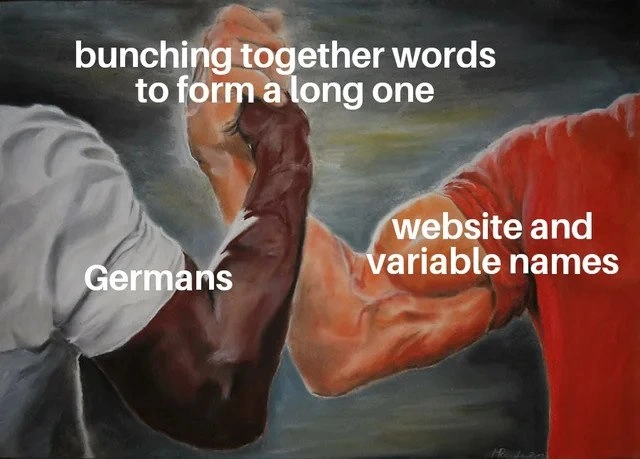
German compound words meet dev variable naming in iconic arm handshake meme
CodeQuality Post #2266, on Nov 8, 2020 in TG

German compound words meet dev variable naming in iconic arm handshake meme

Why is this CodeQuality meme funny?

Level 1: One Big Word

Imagine you have a big box of LEGO pieces, but instead of building separate little models, you snap all the pieces together into one giant thing. It might be a bit clunky, but it’s all one piece now. This meme is funny because it’s saying that both German people and programmers do something like that with words.

Think of it this way: suppose you want to name your new puppy and you can’t decide on just one word. You love that he’s fast, you love that he’s fluffy, and he’s a puppy… so you decide to call him “FastFluffyPuppy” as one single word! 😄 Now you’ve bunched all the ideas into one long name. Kinda silly, right? But everyone does understand that “FastFluffyPuppy” means a puppy who is fast and fluffy. In real life, German words can be a bit like that – they sometimes smush words together to make a super-specific new word. And people who build websites or write computer programs do it too when they name things (because they aren’t allowed to use spaces in those names).

So the picture is showing a handshake between “Germans” and “website/variable names” because both of them are saying, “Yep, we love making one big word out of a bunch of little ones!” It’s funny and kind of cute – like two very different folks finding out they have this quirky habit in common. Even if you’re not a programmer or not German, you can laugh because the idea of ridiculously long mashed-together words is just plainly amusing!

Level 2: Bunching Words 101

So, what’s going on here? The meme is comparing how German compound words and programming names often look like one super long word. If you’re a newer developer (or just new to this joke), let’s break it down in simpler terms.

In the German language, it’s totally normal to take two or more words and stick them together to make a new word. No hyphens, no spaces – just one big linguistic train. For example, “Brezel” means pretzel and “Automat” means machine, stick ’em together and you get “Brezelautomat”, a pretzel-vending-machine! Germans do this to be really specific (why invent a brand new word when you can just combine existing ones?). It’s like linguistic LEGO: words as building blocks. Sometimes the results get really long, which can be funny to people who aren’t used to it.

Now, in coding and web development, we have a similar habit. When we name a variable or a function, we can’t use spaces (computers wouldn’t understand that). So we use techniques like camelCase or snake_case to join multiple words into one identifier. CamelCase meansWritingWordsLikeThis, using capital letters to show theStartOfEachWord. Snake_case_means_using_underscores_between_words (like a snake slithering between each term). Either way, the result is a bunch of words bunched together into one long string of characters.

  • Variable naming: Programmers try to make names meaningful. For example, instead of just calling a variable n (very vague), a beginner is taught to prefer something like numberOfStudents – which is two words (“number of” and “students”) squashed together in camelCase. It’s more understandable at a glance. The trade-off is it’s longer to type, but it conveys its purpose.
  • Website names and URLs: Websites can’t have spaces in their addresses. Ever notice how multi-word sites like Facebook or StackOverflow have capital letters smushed in one word? That’s the CamelCase trick again (Facebook = Face + Book). Some sites use dashes in URLs (like best-recipes-ever.com), but many just run all the words together (BestRecipesEver.com). If you’ve seen a super long URL where it feels like a whole sentence of text got concatenated, you’ve witnessed this phenomena. It might look daunting, but each part of the big string is an individual word or acronym packed in there for clarity or SEO (search engine optimization, where they want keywords in the URL).

CodeQuality & readability: In coding, there’s a constant push-and-pull between being clear and being concise. You want names long enough to make sense, but not so long that they become hard to read. A NamingConvention is basically a set of rules or guidelines for how to name things in code. For instance, JavaScript and Java developers often use camelCase for variables (userLoginCount), while Python developers prefer snake_case (user_login_count). These conventions help everyone on the team read code the same way. A well-chosen name can make code self-documenting, meaning you don’t even need a comment to explain what maximumUploadFileSizeInBytes means — the name itself tells you its role. But if you go overboard, you get unwieldy names that feel like a paragraph. It’s a bit like the German words: they do carry a lot of info, but a newcomer might need to slow down and parse them piece by piece to understand.

Let’s look at a small example in code. Say we want to name a variable for a customer’s first name:

customerFirstName = "Alice"   # camelCase style: "customer" + "First" + "Name"
customer_first_name = "Alice" # snake_case style: "customer_first_name" with underscores

Both customerFirstName and customer_first_name are essentially combining the words “customer first name” into one token that the computer treats as a single identifier. In either case, we’ve done what the meme describes — bunching together words to form a long one — just like a German compound word!

The left side of the meme says “Germans” because German speakers famously do this in everyday language. The right side says “website and variable names” because in programming (and especially in web development for things like domain names or CSS classes), we also end up creating long mashed-together names. The text they’re shaking hands under, “bunching together words to form a long one,” is literally describing this common behavior. It’s a lighthearted jab at the fact that one of the hardest parts of programming is often naming things. There’s even that humorous proverb among programmers: “There are only two hard things in Computer Science: cache invalidation, naming things, and off-by-one errors.” (Yes, it intentionally lists three things to poke fun at itself!). The meme zeroes in on the naming part of that joke.

If you’re a newer dev, you’ve probably noticed how much emphasis is put on picking good names for your variables, functions, and classes. It’s a key part of writing clean, understandable code. This meme takes that somewhat dry concept and makes it funny by drawing an analogy to something outside coding — the German language — that coincidentally has the same quirk. It’s the kind of joke that makes you go “oh, I get it!” and maybe even feel a bit better that we programmers aren’t the only ones who create mega-words when we need to be specific.

Level 3: When Words Collide

At first glance, this meme brings together an unlikely alliance: the German language and developer naming conventions. It uses the iconic arm clasp image (from the movie Predator, turned meme) to show two muscled arms labeled "Germans" and "website and variable names" gripping hands in solidarity. The text above their handshake — "bunching together words to form a long one" — highlights their shared superpower: creating ultra-long compound words. Why is this funny to tech folks? Because it cleverly equates Germany’s knack for compound nouns with programmers’ habit of squishingmultiplewords into one identifier. It’s a nerdy high-five over a very specific quirk.

In software development, there's a running joke that “Naming things is one of the two hard problems in Computer Science.” Developers strive to pick clear, descriptive names for variables, functions, and URLs. Often we end up gluing several words together to capture a very specific meaning. For example, a variable might be named totalAnnualRevenueAfterTaxes – conveying a lot in one go. This looks ridiculously long, but it's born from a desire for precision and CodeReadability. We laugh because it’s true: programmers routinely create one-word monsters, much like some German words. (Fun fact: one infamous real German word was Rindfleischetikettierungsüberwachungsaufgabenübertragungsgesetz, a now-obsolete law about beef labeling. It’s a linguistic unit test for your tongue!)

Let’s break down why this meme resonates:

  • German Compound Words: German is famous for compounding nouns. Need a word for glove? Combine Hand (hand) + Schuh (shoe) = Handschuh (“hand-shoe”). Want to describe an airplane’s black box? Flugzeug (airplane) + überwachungs (monitoring) + gerät (device) gives you Flugzeugüberwachungsgerät. Germans don’t shy away from length; they embrace it to convey precise meaning. The result: legitimate 30+ letter words that look daunting to non-speakers.
  • Developer Variable and URL Names: In WebDev and programming, we also smash words together out of necessity. Variables in most languages can’t have spaces, and good NamingConventions say names should be descriptive. The result? userProfileViewLastUpdatedTimestamp – one long identifier carrying a ton of info. Website domains and URLs do this too: ever seen a blog article with a URL like myblog.com/how-to-cook-perfect-pasta-every-time or a domain like ThisIsWhyImBroke.com? They’re basically sentences squashed into one long string. It’s done for clarity, SEO, or just because naming_things_is_hard and we want to cover all bases.

Both approaches aim for clarity through completeness. The humor is that while this can be helpful, it often overshoots into the absurd. A senior developer will chuckle at this because they've encountered that mile-long function name or a class called DatabaseConnectionPoolManagerFactoryImpl (hello Java!). They know the CodeQuality trade-off: a name should be as long as necessary but no longer. Seeing “Germans” and “variable names” clasp hands playfully suggests: “We are not alone in our tendency to create obnoxiously beautifully long words!” It’s a bit of shared comic relief across linguistics and tech.

To illustrate the parallel, consider this quick comparison:

Germans 🇩🇪 Developers 💻
Form compound words by joining multiple nouns into one big word.
Example: Kindergarten (Kinder = children + Garten = garden) becomes “children’s garden” (preschool).
Form compound identifiers by joining multiple words into one variable, function, or URL.
Example: getUserProfileData (get + user + profile + data) as one long camelCase name.
Why? To express a very specific idea in one term. The language structure happily allows unlimited word-bunching. Why? To make code self-descriptive and meet syntax rules (no spaces in names). The compiler/website will accept one long token, so we cram in context.
Pro: Precise meaning is captured fully. No ambiguity – a Donaudampfschiff is specifically a steamboat on the Danube River. Pro: Clear intent in code. totalNumberOfActiveUsers leaves no doubt what it holds. Easy for developers to understand at a glance (in theory!).
Con: Words can become über long and intimidating to read. Newcomers might go “😵 what does Freundschaftsbezeugung mean?!” (It means demonstration of friendship, ironically what a handshake is!). Con: Names can get comically long and hard to type or debug. Ever had to horizontally scroll because a variable name was a whole sentence? That’s a CodeReadability nightmare and an IDE line-wrap party.

The meme perfectly captures this overlap in a DeveloperHumor way. It’s essentially pointing out a relatable developer experience: Both German speakers and programmers sometimes create tongue-twisters (or keyboard-twisters) by concatenating words endlessly. Seasoned devs grin because they’ve battled unwieldy code like:

// A wild long variable name appears!
let dontEverMakeYourVariableNameThisLongBecauseItsHardToRead = true;

(Truth be told, we've all seen something like theAboveLine in a legacy codebase and muttered, "Ach du lieber!" under our breath.) The senior perspective appreciates the irony and the gentle ribbing: we poke fun at ourselves for writing function sendCustomerOrderConfirmationEmail() when sendEmail might do, just as one might chuckle at German’s 80-letter creations. In both cases, the goal is noble – clarity – but the execution can be hilariously extra.

Description

Painting-style meme shows two muscular forearms clasping hands against a dark, smoky backdrop. Centered above the clasp is white text: "bunching together words to form a long one". The left, darker-skinned arm (wearing a white sleeve) is labeled "Germans", while the right, lighter-skinned arm (wearing a red sleeve) is labeled "website and variable names". Humor arises from comparing the German language’s noun-compounding with developers jamming words together into long domain slugs or camelCase identifiers, a familiar code-readability and naming-convention struggle for engineers

Comments

13
Anonymous ★ Top Pick Everything was fine until our German teammate named the REST endpoint /kundenauftragsrückabwicklungsfehlermetrikexport - now the API gateway throws 414s and the SREs have tagged it “excessive Teutonic camelCase.”
  1. Anonymous ★ Top Pick

    Everything was fine until our German teammate named the REST endpoint /kundenauftragsrückabwicklungsfehlermetrikexport - now the API gateway throws 414s and the SREs have tagged it “excessive Teutonic camelCase.”

  2. Anonymous

    The only difference is Germans have official grammar rules for their concatenation, while we're still debating whether getUserAccountDetailsFromDatabase() is too long or just descriptive enough for the next poor soul doing code archaeology

  3. Anonymous

    After 20 years in the industry, I've realized that Germans and senior engineers share the same superpower: the ability to create impossibly long compound words that are somehow still more readable than 'tmp2' or 'data_final_FINAL_v3_actually_final'. At least 'getUserAccountPreferencesFromDatabaseByEmailAddressAndTimestamp()' tells you exactly what sins you're about to commit, unlike the German word for 'the law concerning the delegation of duties for the supervision of cattle marking', which is merely 63 characters of linguistic efficiency

  4. Anonymous

    Self‑documenting names are great - until your SEO slug and DDD aggregate hit Postgres’s 63‑byte identifier limit and the ORM silently truncates them into the same thing

  5. Anonymous

    SEO slugs and DDD identifiers shake hands like Germans: glue nouns until the intent is unambiguous - then Nginx replies 414 URI Too Long and the linter quietly reminds you about 80 columns

  6. Anonymous

    The dev-German pact: variable names so descriptive, your IDE's autocomplete union-finds a new graph just to render them

  7. @doorhinge 5y

    chinese characters

    1. @zaspirin 5y

      lol, true

  8. @obemenko 5y

    Rappers

  9. @atom_ix 5y

    Who the fuck are Germans?!

  10. @p4vook 5y

    A variable in German language be like

    1. @x_Arthur_x 5y

      Oh no... Naming should be in English

  11. @AmindaEU 5y

    whateverYouCouldPossiblyMean also Finns use longer combination words

Use J and K for navigation