Skip to content
DevMeme
2034 of 7435
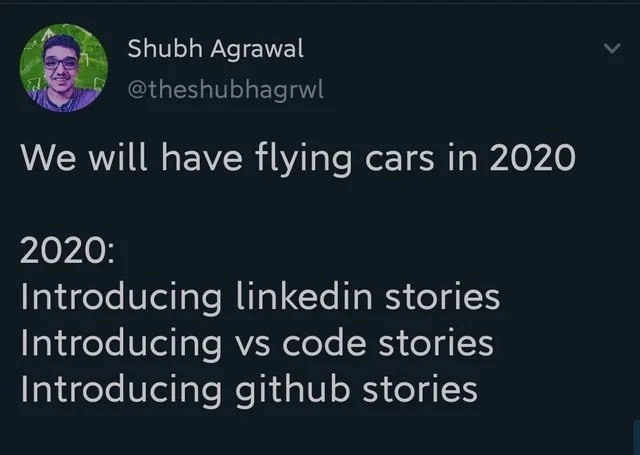
2020 Reality Check: every tech platform launched Stories instead of flying cars
IndustryTrends Hype Post #2267, on Nov 8, 2020 in TG

2020 Reality Check: every tech platform launched Stories instead of flying cars

Why is this IndustryTrends Hype meme funny?

Level 1: Where Are the Flying Cars?

Imagine everyone kept telling you that by this year, you’d have a magic flying bicycle to ride around. You’re super excited, picturing yourself zooming through the sky to school. Now the year arrives, and you eagerly look outside… but no flying bike. Instead, you find out all the bike shops just did the same little thing: they put a fancy new bell on every regular bike and act like it’s a big deal. Each shop is like, “Ta-da! Introducing the new SuperBike with a bell!” But you’re looking at them thinking, “It’s still just a normal bike… and I’ve now got three of the same bell.” You feel a bit let down and kind of laugh because it’s so silly. They promised you something amazing and futuristic, but you ended up with three identical bells on the same old bikes.

This meme is just like that story. We all thought 2020 would be the year of something incredible – like flying cars – but when 2020 came, all the tech companies were basically just adding a little “Stories” feature to their apps (like that bell on the bikes) and announcing it proudly. It’s funny and a bit disappointing at the same time. We were dreaming about zooming through the sky, but instead we got a bunch of apps bragging, “Look, now you can post a 10-second story here too!” It’s the contrast between what was promised and what we got that makes it humorous. Even if you’re not a tech expert, you get the idea: big dreams turned into small, copycat changes – and that gap is the joke.

Level 2: Copy-Paste Innovation

Let’s break down the meme in simpler terms. The meme is showing a tweet with two parts: an expectation and a reality. The expectation says, “We will have flying cars in 2020.” That represents all the big, exciting technology people thought we would have by the year 2020. The reality (listed under “2020:”) is three lines, each announcing a new Stories feature: “Introducing LinkedIn Stories”, “Introducing VS Code Stories”, “Introducing GitHub Stories.” In other words, instead of amazing things like flying cars, what we actually got in 2020 was a bunch of apps adding the same social media feature.

First, what does “flying cars in 2020” mean? It’s a shorthand for futuristic innovation. For decades, people imagined that by the 2020s we’d have science-fiction stuff like flying cars or jetpacks. It’s the kind of promise you read in old magazines or hear in sci-fi movies: “In the year 2020, cars will fly!” It symbolizes a huge technological leap that, in reality, still hasn’t happened (designing a real flying car is very hard!). So that’s the expectation: 2020 = ultra-high-tech future.

Now, what are all these Stories the meme lists as reality? A “Story” in tech refers to a feature originally from social media apps. Snapchat first introduced the idea of letting users post photos or videos that vanish after 24 hours. Instagram copied this idea and called it “Instagram Stories,” and it became super popular. Soon, many apps wanted their own version of this ephemeral story format to keep people engaged. By 2020, the trend had gone a bit overboard: even apps that weren’t social networks tried adding story-like features. For example, LinkedIn, which is a professional networking site typically used for resumes and work-related posts, launched LinkedIn Stories. This let users share casual 24-hour posts like short videos or tips about their workday. It was surprising because LinkedIn usually has a more serious tone, but they didn’t want to miss out on the trend. (Fun fact: LinkedIn Stories didn’t last long; it was removed later after people didn’t really use it. 🚀)

The meme jokingly takes this trend to the extreme by mentioning VS Code Stories and GitHub Stories. Now, in reality, Visual Studio Code (often just called VS Code) never had a “Stories” feature – neither did GitHub. VS Code is a source-code editor developers use to write programs, and GitHub is a website where developers store and collaborate on code (version control platform using git). These are developer tools, not social apps, so the idea of them having “Stories” is intentionally silly. It’s like saying your calculator or your IDE suddenly got a feature to share daily selfie videos – it just wouldn’t happen (and it didn’t happen; the meme is making it up to be funny). By including VS Code and GitHub in the list, the tweet is poking fun at how every product seemed to be copying the Stories idea in 2020. It humorously suggests, “What’s next? Even our coding tools will have Stories now?”

So why is this funny to developers and tech folks? It’s highlighting a big expectation vs. reality gap. We entered 2020 with wild expectations (flying cars!), but the actual news in tech felt pretty underwhelming: just another app adding some gimmicky feature. It’s a form of tech humor or satire: making fun of the tech industry’s habit of following hype. If you’re a newer developer, you might recall learning about user stories in Agile (where “story” means a software requirement), but here “Stories” means something completely different – a flashy app feature. The joke is that instead of focusing on big innovations or solving hard problems, many companies in 2020 just copied whatever was trendy to keep users logging in. It’s like noticing all your apps suddenly have the same button or feature, and thinking, “Huh, they’re all just copying each other.” There’s a bit of disappointment mixed with humor: we hoped for flying cars, but got fancy slideshows in every app instead.

In simple terms, the meme is saying: 2020 didn’t live up to the sci-fi hype. Instead of groundbreaking inventions, we mostly saw tech companies imitating each other with the same little feature. For a junior developer or anyone new to tech, it’s a funny reminder that not every year in tech brings a revolution – sometimes it just brings a trend that everyone jumps on. You can almost imagine a checklist in 2020 where every product manager wrote, “Add Stories feature” instead of “Build flying car.” 😜 It’s a lighthearted take on how the tech world can sometimes prioritize short-term ideas (like social media engagement features) over the big ambitious stuff. And that shared realization is what makes people in tech chuckle when they see this meme.

Level 3: Hype Cycle Hangover

In the tech industry, lofty predictions about the future often crash into mundane reality. A classic example is the hopeful promise, “We will have flying cars in 2020.” Fast-forward to the real 2020, and instead of engineering marvels like personal flying vehicles, we saw a flood of copycat software features. The meme highlights this contrast: after decades of hype about Jetsons-level innovations, the real trend of 2020 was every major platform launching its own clone of Instagram’s Stories feature. It’s a tongue-in-cheek reality check for anyone who expected world-changing tech but got ephemeral content bubbles instead.

Stories (in app design) are short photo or video posts that disappear after 24 hours – popularized by Snapchat, then shamelessly copied by Instagram and others. By 2020, the stories_feature_proliferation was in full swing. Tech companies went into a frenzy adding Stories to everything. Facebook did it on all their apps, then even professional networks jumped in (yes, LinkedIn Stories became a real thing), and Twitter rolled out “Fleets” (their own Stories clone). The meme exaggerates this trend to absurdity by joking that even developer tools like Visual Studio Code (VS Code) and GitHub introduced Stories. Imagine opening your code editor and seeing disappearing video updates from developers — totally what every programmer needs, right? It’s an absurd thought that draws a laugh because it feels like every product team was slapping Stories onto their platform whether it made sense or not. One could jokingly express this copy-everything mindset in pseudo-code:

["LinkedIn", "VSCode", "GitHub"].forEach(
  platform => launchStoriesFeature(platform)
);
// TODO: implement flyingCarFeature() someday...

For seasoned engineers, this scenario is a textbook TechHypeCycle hangover. We expected revolutionary technology (like personal flying cars) by this milestone year, but companies delivered engagement gimmicks instead. Why did this happen? Because adding a Stories UI is trivial compared to solving the engineering challenges of a flying car. Copying a proven user-engagement feature is low-risk and yields instant bumps in metrics, whereas building a real flying car is expensive, risky, and decades in the making. In corporate terms: it’s much easier to ship an Instagram-like update and tout “increased user engagement” than to invest in a moonshot. The result: product managers chasing quick wins over ambitious innovation. It’s a cynically familiar pattern in our industry – essentially innovation by imitation. The meme’s humor cuts deep because it’s pointing out that in 2020, instead of realizing sci-fi dreams, the tech world was busy reimplementing the same trendy feature over and over.

The tweet format itself parodies clichéd product announcements. Each line “Introducing <Platform> Stories” reads like a proud press release headline. To a veteran dev, it’s hilarious because we’ve seen those exact tone-deaf announcements in real life. It’s corporate satire: Great, another app brags about adding the exact same thing as everyone else. We’ve all been in meetings where someone says, “Users love feature X in that other app, so let’s add it too!” – even if it doesn’t fit. The meme lists LinkedIn, a professional networking site, VS Code, a code editor, and GitHub, a code collaboration platform. These are serious tools/platforms, not social playgrounds, which makes the copycat behavior even more absurd. VS Code is an IDE for writing and debugging code; picturing it with a “Stories” panel (maybe showing off snippets of code that disappear in 24 hours) is ridiculously out of place. And GitHub is a platform for version control and code sharing – its users care about commit histories and pull requests, not ephemeral video stories. The very idea of “Introducing GitHub Stories” is so wrong for a developer tool that it perfectly satirizes how out-of-hand the trend got. It’s a bit of TechIndustryHumor that jabs at the herd mentality of product teams.

Ultimately, this meme is a slice of TechSatire capturing the flying_cars_expectation_vs_reality gap. Those of us who remember past futurist promises can’t help but smirk. By 2020 we were all half-joking, “Where are the flying cars we were promised?” Instead, we got notifications about colleagues posting 15-second story updates on LinkedIn. The grand future we imagined turned out to be a bunch of apps all cloning the same feature to keep us glued to our screens. It’s funny in a bittersweet way: the contrast between IndustryTrends_Hype (like bold future tech) and MarketingVsReality (the actual features we got) is just so stark. In short, the meme uses humor to remind us that tech’s big hype cycles sometimes end not with a bang, but with a bunch of identical “Stories” bubbles popping up everywhere.

Description

Dark-mode screenshot of a tweet. The avatar is a green-background profile photo with the face blurred. Display name: “Shubh Agrawal”; handle: “@theshubhagrwl”. Tweet text reads line-by-line: “We will have flying cars in 2020” followed by a blank line and then “2020:” and three bullet-like lines: “Introducing linkedin stories”, “Introducing vs code stories”, “Introducing github stories”. The meme contrasts lofty technological predictions (flying cars) with the mundane 2020 reality of every product team copying the Instagram-style Stories feature - even professional and developer tools like LinkedIn, Visual Studio Code, and GitHub. It jokes about industry hype cycles, feature cloning, and how developer tooling trends sometimes prioritize marketing over groundbreaking innovation


Comments

25
Anonymous ★ Top Pick 2020 innovation roadmap: we’ve ported Instagram to every surface - next sprint is cronjob stories in /var/log so ops can swipe up to acknowledge the outage
  1. Anonymous ★ Top Pick

    2020 innovation roadmap: we’ve ported Instagram to every surface - next sprint is cronjob stories in /var/log so ops can swipe up to acknowledge the outage

  2. Anonymous

    We spent decades optimizing database queries and building distributed systems, only to realize the real scalability challenge was convincing developers they needed disappearing content in their IDE. Next up: VS Code introducing 'Reels' where you can watch your code compile in slow motion with trending audio

  3. Anonymous

    We promised flying cars but delivered Stories to every platform instead - because nothing says 'innovation' like adding disappearing content to your code repository. At least when your deployment fails, the evidence vanishes in 24 hours

  4. Anonymous

    2020: when every PM learned it’s easier to move the KPI from p99 latency to “daily story starts” - and suddenly my IDE was a social network

  5. Anonymous

    2020 product strategy: we asked for flying cars; the OKR said “boost DAU,” so we got Stories in everything - including GitHub, where history is the one thing not supposed to be ephemeral

  6. Anonymous

    Flying cars grounded; instead, 'stories' in GitHub - because nothing says 'immutable history' like 24-hour commit regrets

  7. @mvolfik 5y

    I believe this is a joke and everyone please let me go to bed peacefully

    1. dev_meme 5y

      https://www.linkedin.com/help/linkedin/answer/119760/linkedin-stories-overview?lang=en

      1. @mvolfik 5y

        I was talking about the github ones

  8. @zaspirin 5y

    Waiting for Telegram stories 🌚

    1. dev_meme 5y

      Actually at some point they promised to make them

      1. @bit69tream 5y

        telegram -> instagram

  9. dev_meme 5y

    There a lot of people who don’t want to see any stories, so Tg team does a great job by postponing such features for years 😂

    1. @obemenko 5y

      That's actually true, so lets just say "thanks" to Telegram developers

  10. @doorhinge 5y

    i love vscode stories

  11. @AmindaEU 5y

    That would justify me calling GitHub and other Git forges as social medias

  12. @x_Arthur_x 5y

    GitLab FTW anyway

    1. @AmindaEU 5y

      I kind of prefer Gitea, Git with a cup of tea 😛

      1. @x_Arthur_x 5y

        Oh, did you know Keybase have their own encrypted Git service?

        1. @AmindaEU 5y

          Yes, but I don't know how long Keybase is going to be a things under Zoom's ownership and closed source server as the development has mostly stopped

          1. @x_Arthur_x 5y

            Wait, it's all closed source?

            1. @AmindaEU 5y

              Server is closed source, client is open source

              1. @x_Arthur_x 5y

                "Always has been"

          2. @x_Arthur_x 5y

            Looks like Zoom don't care about Keybase and want the devs to do other jobs. I think most of Keybase users will have to ditch it soon and create their own websites to protect their identity, just like before Keybase was a thing. TrustNo1, I guess...

  13. @x_Arthur_x 5y

    Looks like you prefer self-hosted solutions anyway, I guess Keybase wouldn't mean much to you then

Use J and K for navigation