Skip to content
DevMeme
3279 of 7435
Hacking Genie's API with Asynchronous Wish Execution
CS Fundamentals Post #3603, on Aug 27, 2021 in TG

Hacking Genie's API with Asynchronous Wish Execution

Why is this CS Fundamentals meme funny?

Level 1: Tricking the Genie

Imagine you’re playing a game where a magical genie will grant you three wishes, but with one strict rule: you’re not allowed to wish for more wishes. In our meme, the person uses a super sneaky strategy to get around this rule without technically breaking it. First, they use their 1st wish to change the order of the next two wishes – kind of like asking, “Can my third wish happen before my second wish?” This is a bit like playing a UNO reverse card on the genie! Now, because of that, they get to use their 3rd wish second. And that 3rd wish is a big one: they wish to become a genie themselves. So now the person suddenly has all the magic powers of a genie. Finally, thanks to the reordered sequence, their 2nd wish goes last, and that wish is to be free. In genie stories, wishing to “be free” means a genie doesn’t have to listen to anyone or stay in a lamp anymore. So the person who just turned into a genie uses that wish to free themselves from any rules. The end result? The person basically becomes an all-powerful being with no restrictions – which is pretty much the same as having infinite wishes! The poor original genie is shown grabbing his head in disbelief, totally shocked. He set a rule to prevent cheating, but the clever wisher found a loophole and tricked the genie at his own game. It’s funny on a basic level because we love stories where a clever hero outsmarts the more powerful rule-maker by simply being a bit crafty with the rules. The genie’s stunned reaction is like a teacher caught off-guard when a student figures out a way to get the prize without breaking the official rules – it’s the astonishment of someone thinking, “Wow, I did not see that coming!”

Level 2: Out-of-Order Wishes

Let’s break down the meme in simpler terms. The top text is like a conversation between a genie and a very clever wisher (labeled with λ, the Greek letter lambda). In programming, λ often represents an anonymous function or ties to lambda calculus (a math system behind computing), so it’s hinting that the wisher is using a nerdy programming trick. The genie starts by laying out the one rule: “You can wish for anything but infinite wishes.” In other words, no cheating by just asking for endless more wishes. The wisher (λ) then uses three wishes in a very particular way:

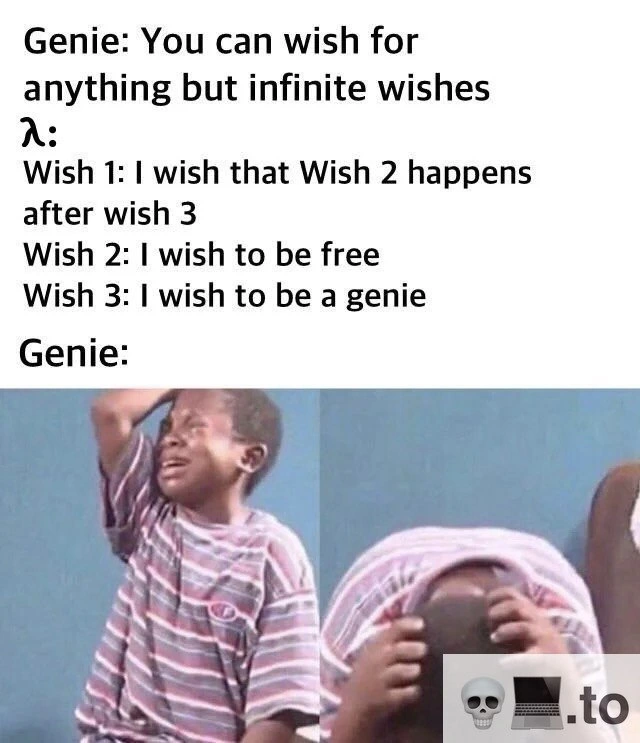
Genie: You can wish for anything except infinite wishes.
λ:
Wish 1: I wish that Wish 2 happens after Wish 3.
Wish 2: I wish to be free.
Wish 3: I wish to be a genie.
Genie: [speechless]

Normally, one would expect Wish 1, then Wish 2, then Wish 3 to be granted in that order. But Wish 1 here isn’t a typical wish for a thing or a state – it’s a wish about the order of the other wishes. By saying “Wish 2 happens after Wish 3,” the wisher is effectively telling the genie, “Hey, don’t do Wish 2 next; do Wish 3 next and do Wish 2 last.” The genie, bound to grant (almost) any wish, has to comply with this instruction. So after Wish 1 is granted, the genie’s order of execution is altered: the next wish to fulfill will be Wish 3, and then finally Wish 2. In plainer terms, the wisher used the first wish to rearrange the sequence of the wishes. This is the order_of_execution_trick that the meme’s text highlights. It’s as if the wisher wrote a little note in the genie’s task list saying “swap the next two tasks.”

Now consider Wish 3: “I wish to be a genie.” This means the person making the wish wants to become a genie themselves – gaining all a genie’s magical powers. Thanks to the reordering, this Wish 3 actually gets executed second. So the sequence actually goes: Wish1 (set up the order), then Wish3 (become a genie), and then Wish2 (to be free). When Wish 3 is fulfilled, the wisher is turned into a genie. They now have phenomenal cosmic power (and maybe an itty-bitty living space… the lamp). Immediately after that, Wish 2 is executed: “I wish to be free.” Typically in genie lore, wishing a genie free means freeing a genie from their lamp or servitude – essentially releasing them from the rules and bonds that constrain them. Here’s the genius: at the moment Wish 2 is granted, the person who made the wish is currently a genie (because Wish 3 just made them one). So Wish 2 effectively frees the wisher (now a genie) from all the limitations of being a genie. They won’t be tied to a lamp or obligated to serve someone else. In one swoop, the wisher has become a powerful genie and then immediately liberated themselves. They’ve essentially achieved the equivalent of infinite wishes: since as a free genie, they presumably can use magic on their own with no master, they no longer need to ask for wishes at all! It’s a sneaky end-run around “no infinite wishes” – they didn’t wish for endless wishes, they wished to be the wish-granter and then removed the shackles.

This leaves the original genie absolutely stunned. The bottom half of the meme shows a child (standing in for the genie) holding his head in anguish and disbelief. That’s the genie realizing he’s been outsmarted by a loophole. In programming terms, imagine a service or function that never expected the user to manipulate call order like this – it’s a big genie_edge_case that wasn’t caught in the “requirements”. The genie’s expression is basically “I can’t believe that actually worked!” It’s both funny and relatable to developers because it’s like seeing a program get twisted by a crafty input.

To put it in a coding analogy: think of each wish as a function call or command. The wisher basically did something like:

# Pseudocode illustrating the wish ordering trick
# Original plan: execute wish1, then wish2, then wish3 in order.
# Wish1's effect: modify the plan so that wish3 will run before wish2.
execute(wish1)   # Wish 1: schedule Wish 3 to happen next, before Wish 2.

execute(wish3)   # Wish 3: user wishes to become a genie (now the user has genie powers!).

execute(wish2)   # Wish 2: user wishes to be free (now that user *is* a genie, this frees them).

In this pseudo-code, wish1 acts kind of like a function that changes the order of what’s coming next – much like a scheduler or a trick with callbacks in programming. By the time we run wish2, the user has already become a genie, so setting them “free” at that point breaks the system’s rule in spirit, but not in wording. This is similar to a concept of dependency injection: Wish 1 injected a new dependency (Wish 3 must precede Wish 2) into the execution sequence. It also shows how mutable state can creep into a system – the genie’s “state” about which wish is next got mutated by Wish 1. In straightforward code, things happen in the order you call them; but if you allow self-referential tricks like this, you can get surprising results.

So, in summary, the meme’s text and images together tell a nerdy but clear story: A programmer-minded person defeats the classic “no infinite wishes” rule by reordering two wishes. They become a genie and free themselves, effectively gaining unlimited wishing capability. The genie is left figuratively with a crashed brain, just as any system would be if a user found such a crazy loophole_exploit. It’s both a fun thought experiment (for those into algorithmic tricks or FunctionalProgrammingConcepts) and a comedic “gotcha” moment that anyone can chuckle at once they see the trick. The genie got programmatically outsmarted!

Level 3: Deadlocking the Genie

For seasoned developers, this meme is a hilarious example of an edge-case exploit that causes an unexpected system state. The genie starts with a rule – “no infinite wishes” – essentially a safeguard in the “API contract” of wish-granting. Our wisher, thinking like a programmer, doesn’t violate the rule outright; instead, they exploit a gap in the spec by making one wish about the order of the other wishes. It’s the wish-equivalent of finding a bug in the genie's code. Wish 1 introduces a scheduling twist that the genie’s spec never forbade: it’s not asking for more wishes, just cleverly rearranging the order of the existing ones. This is like discovering that an application will do something crazy if you call its functions in a particular unexpected order. The genie is essentially hit with an undefined behavior scenario – something not anticipated by the “unit tests” for wish logic.

The humor here resonates with any developer who’s seen a system get deadlocked or confused by a cunning input. The genie’s stunned reaction (head in hands, speechless) is exactly how a program might “freeze” or how an engineer might facepalm when a user finds a loophole that breaks the system’s logic. We’ve all experienced that “uh-oh, I didn’t think anyone would try that” moment. In this case, the wisher has performed a kind of privilege escalation attack in fairy-tale terms: they used Wish 3 to become a genie (gaining all the power) and then Wish 2 to free themselves from the rules. It’s like obtaining admin rights and then removing all restrictions on your account. By the end, the original genie has effectively been outsmarted and possibly rendered obsolete – analogous to breaking out of a sandbox or gaining root access in a restricted environment. No wonder the genie’s looking like a broken process!

This scenario lampoons real RelatableDeveloperExperience. For example, think of a time you have a sequence of operations that must happen in order, but a clever hack or bug causes them to run out-of-order, yielding a crazy outcome. It’s reminiscent of a transaction or callback hell where doing things in the wrong order leads to a logical paradox. Here, the system (genie) ends up in a state where the “user” (wisher) has effectively taken control of flow. The meme specifically evokes functional programming concepts like controlled side-effects: in a well-behaved system, you shouldn’t be able to just reorder operations arbitrarily. Yet, we know that with enough ingenuity (or abuse of mutable state), it’s possible to break the expected flow – much like using a sneaky global flag or exploiting a race condition. The genie just encountered the wish-granting equivalent of a race condition or a dependency inversion it wasn’t prepared for. The result: a logically consistent sequence of wishes that nonetheless violates the spirit of the rules. The genie’s rule said “no infinite wishes,” but by chaining these requests, the wisher didn’t need infinite wishes – they changed the game entirely. This is both a clever loophole and a nightmare for the genie’s “spec maintainers.” It’s as if the genie’s code threw an exception it doesn’t know how to handle. In short, the meme brilliantly compresses a senior-level inside joke: that feel when a carefully constructed rule (“no infinite wishes”) is blown up by a creative workaround, leaving the all-powerful system dumbfounded.

Level 4: Topological Wish Sort

At the most theoretical level, this meme plays out like a lambda calculus thought experiment on managing side-effects and execution order. In pure functional computation (à la Alonzo Church’s lambda calculus), the order of independent operations shouldn’t affect the final result – this property is known as confluence (Church-Rosser theorem). But here each wish is a side-effect that changes the state of the world (like I/O operations in a program), so the order of execution definitely matters. The wisher (represented by the symbol λ) basically constructs a dependency graph of wishes. By declaring Wish 1 as “I wish that Wish 2 happens after Wish 3”, they introduce a custom partial ordering: Wish 3 must occur before Wish 2, instead of the normal sequential order. The genie now has to perform a topological sort of the wishes to satisfy this constraint. In algorithmic terms, the original sequence 1 → 2 → 3 gets transformed into 1 → 3 → 2 because Wish 1 imposes 3 → 2 as a prerequisite. This is a clever application of graph theory in a fairy-tale context – the wishes form a tiny directed acyclic graph!

From a Functional Programming perspective, the wisher is effectively doing a manual control of evaluation order, akin to how one might use monads or continuations to sequence operations in a pure language. In Haskell (a purely functional language grounded in lambda calculus), you can’t just decide to run actions out of order unless you explicitly encode that logic. Here, Wish 1 is acting like a custom monadic bind or a scheduler: it doesn’t directly wish for an object or outcome, but rather mutates the “execution state” of the genie. This is analogous to introducing mutable state or an out-of-band control in a system that’s supposed to be straightforward and sequential. The result is a non-commutative ordering of operations – Wish 2 and Wish 3 produce entirely different outcomes depending on which comes first, much like non-commuting functions or non-idempotent operations in programming. The wisher exploited this by forcing the beneficial order. It’s a bit like injecting a piece of code at runtime to reorder function calls. In formal terms, they’ve treated wishes as first-class operations that can be manipulated, achieving something close to continuation-passing style: the first wish essentially says, “continue with Wish 3, then after that continue with Wish 2.”

This theoretical trick highlights a fundamental CS_Fundamentals concept: the difference between declarative wish specification and imperative execution. It’s a genie-oriented demo of the difference between a program’s specification and its execution order. The genie’s normal contract (“one wish after another in order”) was subverted by turning Wish 1 into a meta-wish that redefines the contract itself. It’s similar to dependency injection in that Wish 1 injects a new dependency (Wish3-before-Wish2) into the system. The genie now faces a scenario comparable to an unexpected out-of-order execution in a CPU or a scheduler: something requested that the normal sequence be rearranged. And just like a processor pipeline facing a tricky branch prediction, our magical “processor” (the genie) is left baffled by this loophole exploit in its wish-handling algorithm. The meme packs all this theory into a joke: it’s essentially treating the genie’s wish-granting like a Turing-complete system that can be hacked via carefully crafted instructions – a nod to the idea that even magical systems have to respect logical constraints (and those constraints can be used against them by a crafty “programmer” of wishes).

Description

A two-part meme. The top part consists of black text on a white background, outlining a dialogue. The Genie states the rule: 'You can wish for anything but infinite wishes.' A character represented by the Greek letter lambda (λ), a symbol for anonymous functions in computer science, responds with three strategically ordered wishes: 'Wish 1: I wish that Wish 2 happens after wish 3', 'Wish 2: I wish to be free', and 'Wish 3: I wish to be a genie'. The bottom part of the meme uses the 'Crying Black Kid' meme format, showing a young boy looking distressed and then burying his face in his hands, representing the Genie's reaction of utter defeat. A small watermark with a skull, a laptop, and the text '.to' is in the bottom right. The joke is a classic example of applying a programmer's mindset to a logical problem. By using the first wish to define the execution order (like a callback or promise in programming), the user ensures they first become a genie (Wish 3) and then immediately gain freedom (Wish 2), successfully circumventing the spirit of the 'no infinite wishes' rule to achieve ultimate power
Comments

12
Anonymous ★ Top Pick This is just asynchronous programming with promises. Wish 1 sets up the `.then()` callback. The Genie's mistake was exposing a blocking API without validating the execution chain, leading to a race condition on his own existence
  1. Anonymous ★ Top Pick

    This is just asynchronous programming with promises. Wish 1 sets up the `.then()` callback. The Genie's mistake was exposing a blocking API without validating the execution chain, leading to a race condition on his own existence

  2. Anonymous

    Functional architect move: declare Wish 1 as the orchestrator, topologically sort the side-effects so Wish 3 promotes you to genie before Wish 2 grants freedom - privilege escalated without violating the API quota

  3. Anonymous

    This is basically every distributed system's consensus protocol when you forget to implement proper leader election - everyone becomes the coordinator, nobody is free, and the whole cluster just sits there sweating while trying to figure out who's actually in charge

  4. Anonymous

    This is essentially a distributed transaction with circular dependencies that would make any dependency resolver throw a 'CyclicDependencyException'. The lambda symbol suggests someone's been reading too much functional programming theory and decided to apply topological sorting concepts to wish fulfillment. The genie's constraint system clearly didn't implement proper cycle detection - a classic case of 'works on my lamp' syndrome. Any senior architect recognizes this as the same nightmare that happens when Service A depends on Service B, which depends on Service C, which needs Service A to initialize. The genie is now stuck in an infinite loop, probably burning CPU cycles trying to resolve this DAG that isn't actually acyclic

  5. Anonymous

    Classic Free Monad pattern: sequence the side effects so after bind you become a genie and then call free() on yourself - the spec forbids infinite wishes, not monads

  6. Anonymous

    Classic wishes sans base case - genie's recursion depth just hit maximum, stack overflow incoming

  7. Anonymous

    Genie: “No infinite wishes.” λ-dev composes a continuation, reorders the calls, escalates to “genie,” frees the resource - turns out your wish API is reentrancy‑vulnerable

  8. @kitbot256 4y

    I splork for infinite splorks! https://languagelog.ldc.upenn.edu/nll/?p=4204

  9. @Grond79 4y

    because you should test requirements too

    1. @sylfn 4y

      Please use English as a main language in this chat. This means that every message should be understandable by English speaker — they should have a translation.

  10. @dsmagikswsa 4y

    Callback wish

  11. @AhmedSphere 4y

    Genie: You are now free of debt

Use J and K for navigation