Skip to content
DevMeme
1683 of 7435
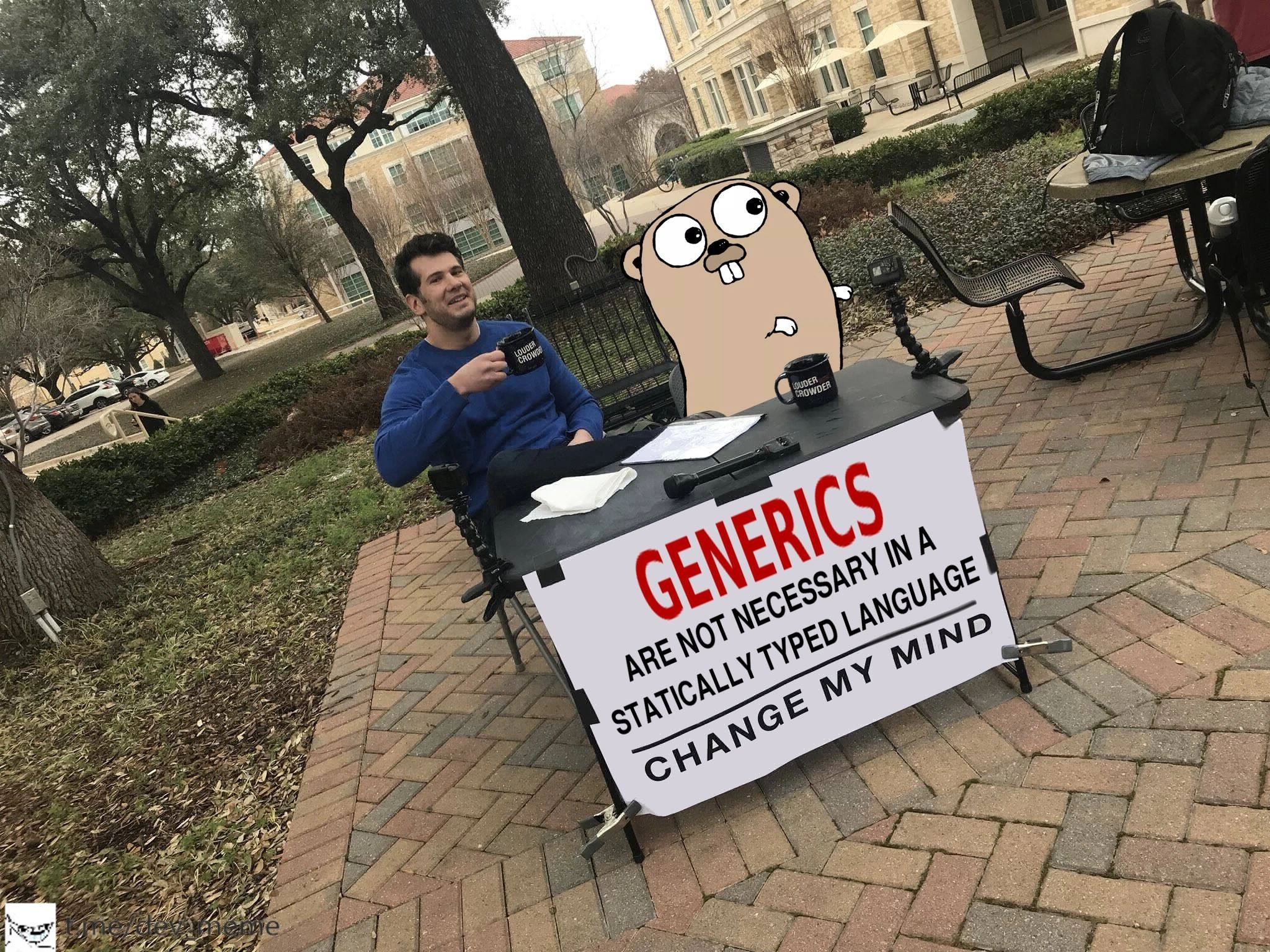
Go gopher at a “Generics aren’t needed, change my mind” debate table
Languages Post #1879, on Aug 7, 2020 in TG

Go gopher at a “Generics aren’t needed, change my mind” debate table

Why is this Languages meme funny?

Level 1: One Size Fits All, or One for Each?

Imagine you have a magic toolbox that can transform to fit any tool you need – a hammer, a screwdriver, a paintbrush, anything – versus having a different toolbox for each type of tool and carrying all of them around. The debate in this meme is a bit like someone saying, “I don’t need that magic adjustable toolbox. I’m fine lugging 10 separate toolboxes everywhere I go!”

In everyday kid terms, think about remote controls for a TV or game console. A universal remote can be programmed to work with any device, so you only need one remote. But here comes a person at a table saying, “Nah, you don’t need a universal remote in a house with lots of gadgets. Just keep a different remote for each one.” They’re sitting there with a sign boldly proclaiming this opinion, basically daring someone to prove them wrong. Meanwhile, the little Go gopher character beside him is like your friend making a 😨 face, clutching the table as if to say, “Whoa, seriously?! That sounds so inconvenient!”

The humor comes from how obviously most people would disagree. We know it’s a pain to juggle a bunch of remotes (or carry multiple toolboxes). Of course having one that adapts to everything would make life easier! In the programming world, generics are like that flexible, one-size-fits-all solution. And a statically typed language without that flexibility is like insisting on separate remotes for the TV, DVD, speakers, and so on, because “that’s how we’ve always done it.” The gopher (which represents Go, the programming language in question) looks worried because it has lived without that one-size-fits-all feature and it knows how clumsy it can be.

So this meme is funny in a friendly, nerdy way: it takes a heated coding debate and makes it as plain as a guy at a table yelling out a silly claim. Even if you don’t know Go or generics, you can relate to the vibe: someone saying they don’t need a convenient all-in-one solution, and everyone else doing a double-take. The gopher’s wide eyes are basically the universal “Did he really just say that?!” look. It’s the kind of scene you could imagine in a schoolyard or at lunch – one kid says something outrageous like “Homework is totally unnecessary, change my mind,” and all the other kids either laugh or rush to argue. Here the topic is just a bit more niche: it’s about a programming tool that makes coder’s lives easier. But at its core, it’s poking fun at stubbornness and the silly fights we get into about “the right way” to do things, whether it’s managing our toys or designing programming languages. The meme makes you chuckle because you sense the coming comedic clash: the gopher (and the whole crowd of developers it represents) is definitely going to try to change his mind!

Level 2: The Copy-Paste Conundrum

Let’s break down the technical bits for those newer to programming or not deep into programming language design. Go (often called GoLang) is a programming language that is statically typed. Statically typed means every variable and function in Go has a specific type (like int, string, etc.) determined at compile time, and the compiler won’t let you treat (say) a number as a text string by accident. This is great for catching errors early. However, Go for a long time did not have generics, which are a way to write code that can work with any type without losing that compile-time safety.

Think of generics as writing a recipe where you leave certain ingredients as blanks that can be filled in later. For example, without generics, if you wanted to write a function to get the first element of a list, in Go you had to specify the type of list, like so:

// In Go before generics (pre-2022):
func FirstInt(items []int) int {
    return items[0]
}
func FirstString(items []string) string {
    return items[0]
}

Here we have two functions, one for a slice of ints and one for a slice of strings. If you needed it for []float64 or any other type, you’d have to write yet another function. This is the copy-paste conundrum: you’re duplicating the same logic over and over, just changing the types. It’s tedious and error-prone – if you fix a bug in one copy, you have to remember to fix it in all the others. Plus, maintaining all those near-duplicate functions is a nightmare as a codebase grows. In DevCommunities, new Go users would often ask “isn’t there a way to avoid rewriting this for every type?” and the answer at the time was basically “not really, not elegantly.”

Generics solve this by allowing one function to handle many types. Here’s what that might look like in a language with generics (or Go after generics were introduced):

// With generics (using Go 1.18+ syntax or pseudocode for illustration):
func First[T any](items []T) T {
    return items[0]
}

Now First is a single function that works for a slice of any type T. T is a type parameter. When you call First() with a slice of ints, T becomes int for that call; with a slice of strings, T becomes string, and so on. The compiler will enforce that whatever T is, the logic inside the function is type-safe (here it just returns the first element, which is fine as long as the slice and return type match). No need to copy-paste new versions of the function for each type. LanguageFeatures like this make life easier and code DRYer (Don’t Repeat Yourself).

The person in the meme is claiming “Generics are not necessary in a statically typed language.” To translate: they’re saying, “Even though Go (a statically typed language) doesn’t have generics, it’s fine – we don’t actually need that feature.” Why might someone say that? Well, Go’s designers provided a few alternatives:

  • Interfaces: In Go, an interface can kind of act like a generic placeholder. For example, interface{} (pronounced “empty interface”) can represent “any type” – it’s a type that every other type automatically satisfies. You could write a function FirstInterface(items []interface{}) interface{}, which takes a slice of empty interfaces. It would technically accept a slice of anything. The catch: when you take an element out, you just get an interface{} back – basically a box you have to unwrap. You’d have to do a type assertion or reflection to use it as the real type. That moves the type checking to runtime, which is not as safe or convenient.
  • Code generation: Go has a tool called go generate that can auto-write code for you. Some folks made generic-like libraries or scripts that would literally generate versions of your code for each type you needed. For instance, you could write a generic-looking function with a placeholder, and a code generator would spit out FirstInt, FirstString, etc., by substituting types. It works, but it’s a bit clunky – you end up with a lot of generated code in your project, and it’s not as seamless as having the language handle it.
  • Just write it out: For small cases, people would simply write separate functions or structures for each type. Senior Go devs often joked that if you want a generic data structure, you might as well use Python or C++… or wait for Go to maybe add generics in the future.

So, is it true that generics “are not necessary”? Technically, you can get by without them. Go did for a decade. But “necessary” is doing a lot of work in that sentence. Without generics, Go programmers found themselves writing a lot of repetitive code or doing awkward things to compensate. Meanwhile, languages like Java, C#, and Rust all have generics and their developers happily use one function or class to handle many types in a safe way. The golang_without_generics era was a bit of a running joke outside the Go community – other language users would tease Go for being behind the times (“aww, your language can’t do generic collections? How cute”). Inside the community, it was a mix: some defended the simplicity (“generics will make the language too complicated, we’ve done fine so far!”), while others yearned for them (“I love Go, but writing container XYZ for the 5th time is exhausting”).

The meme nails this generics_debate by literally setting up a debate table. The Go gopher’s concerned look is how many Go programmers felt whenever this topic came up – concerned or exasperated. If you’re a junior developer or new to Go, imagine you just learned about this cool idea of generics in a CS class or from using another language, and then you find out Go doesn’t support it. You might be puzzled: “Why not? Isn’t having a statically_typed_language with generics a good thing?” The sign in the meme is basically one side of that argument written down. It’s provocative because it goes against what you learn in programming courses (reusing code is good, avoiding repetition is good, type safety is good – generics help with all of those). The “change my mind” part invites someone (perhaps a professor-like figure or an experienced dev) to argue the other side.

For context on the meme format: the “Change My Mind” table is a famous image used in many memes. Typically, someone states a strong opinion on the sign and sits waiting for people to debate them. It became a template to poke fun at controversial opinions. Here, the controversial opinion is about a programming language feature. It’s funny to tech folks because we rarely see our nerdy LanguageWars topics make it into mainstream meme formats. It almost legitimizes our internal squabbles as meme-worthy culture. The picture even has little details a junior dev might not catch at first: the text “LOUDER WITH CROWDER” on the mug references the original meme source (a talk show host named Steven Crowder who did the real “Change My Mind” segment). But the gopher having a similar mug adds a nerdy twist – as if the language itself is pulling up a chair to hash this out over coffee.

In simpler terms: this level is showing what the meme is literally about. A guy is publicly declaring “We don’t need generics in a language that checks types strictly” and the Go mascot is super worried because that’s a big point of contention. We’ve explained what generics are (reusable code templates for any type), what a statically typed language is (one that insists on knowing types at compile time), and why someone would argue against generics (to keep things simple, perhaps). If you’ve just started coding, you can think of it this way: Without generics, if you had a toy box for action figures and one for dolls, you’d need a separate box type for each kind of toy. With generics, you could have one “toy box” design that works for any kind of toy as long as you specify which kind when using it. Which leads us to…

Level 3: The Gopher’s Generics Grievance

Picture a seasoned Go programmer or language designer sitting at that campus patio table, confidently sipping coffee from a “Louder with Crowder” mug, and publicly declaring: “Generics are not necessary in a statically typed language.” This is the Change My Mind meme format applied to the Go community’s most notorious flame war. The sign is a direct dare to all developers who have spent late nights writing nearly identical code for each data type: Fight me on this. Prove me wrong. It’s humorous because everyone in the GoLang community recognizes this exact generics_debate scenario – it’s practically a reddit cliché at this point. By 2020, the Go forums, Twitter threads, and conference talks had been filled with heated language_feature_arguments about whether Go’s lack of generics was a wise simplicity or a painful omission. The meme captures that energy: one side smugly asserting “No generics needed!” and countless gophers (Go fans) popping out of the woodwork to indeed change his mind.

The cartoon Go gopher mascot is pasted in with wide, nervous eyes, clutching the table as if bracing for impact. This gopher represents the Go community (and perhaps the language’s own conscience) reacting to that bold statement. It’s as if the gopher is saying, “Oh boy, here we go again...” The gopher’s alarm is the punchline: it knows this proclamation is about to unleash a torrent of arguments and passionate rebuttals. Any seasoned developer or community member sees the absurdity – it’s bait. The humor is that the statement on the sign is provocatively one-sided, bordering on trolling. It’s like going to a JavaScript meetup and announcing “Types are pointless in JavaScript, change my mind” – you’re guaranteed to get some spirited responses! Here, “Generics aren’t necessary in a statically typed language” targets Go’s unique stance, effectively poking a sensitive rib in the DevCommunities of language enthusiasts.

From a senior developer’s perspective, the debate encapsulated by this meme is so familiar it’s almost nostalgic (or traumatic, depending whom you ask). Go was famously designed without generics initially, bucking the trend followed by Java, C#, C++, and most modern statically-typed languages that include some form of parameterized types. The man at the table is echoing Go’s original designers like Rob Pike and Ken Thompson, who argued for years that you could have a productive, simple language without the complexity of generics. They weren’t completely crazy – they provided alternatives: interfaces (which provide runtime polymorphism and some compile-time checking via method sets) and tools like go generate to auto-produce type-specific code if needed. Many internal libraries relied on code generation or the empty interface{} type (Go’s version of a generic “any” type) to get by. This worked, but it came with costs that experienced Go developers felt daily. For example:

  • Boilerplate & Code Duplication: Without true generics, you often ended up writing the same data structure or algorithm multiple times for different types. Need a Stack<int> and a Stack<string>? In pre-generics Go, that meant literally writing two stacks or using interface{} and casting, which is neither efficient nor type-safe. Senior devs have war stories of maintaining near-duplicate code because of this.
  • Runtime Type Checks: Using interface{} as a workaround moves type checking to runtime. Seasoned engineers know this is risky: you lose the compile-time guarantees. A stray type that doesn’t belong can slip through and cause a panic (runtime error) down the line. That’s ironic in a statically-typed language – it undercuts the very safety static typing is supposed to provide. Many a Go programmer grumbled that using interface{} everywhere felt like reverting to dynamic typing (what some called “Go’s pseudo-generics”).
  • Performance and Complexity: Veterans also recognized the trade-offs involved. True generics could increase compile times or add complexity to the language spec. Go’s simplicity was a selling point – no complex type parameter syntax, no templates generating sprawling error messages. A cynic might joke that fewer features meant fewer ways to shoot yourself in the foot. But the cost was adaptability: for certain tasks (like writing a reusable collection library), Go made you choose between ugly workarounds or ignoring the problem. As the language matured and the LanguageAdoption skyrocketed, these pain points became more evident.

This meme is also funny because it’s meta-commentary on the LanguageWars that happen whenever someone compares language features. LanguageEvolution often shows a pattern: a language starts minimalistic for clarity (e.g., Python initially lacked type hints, JavaScript lacked modules), but as it grows, the community demands more features to handle complex use-cases, forcing the language to evolve. Go was no exception. The “change my mind” guy here is stubbornly holding onto the original minimalist philosophy, while the gopher (and by proxy the community) has largely had its mind changed by experience. In fact, a well-informed senior reader in 2020 would smirk knowing that the Go team was already drafting a design for generics due to overwhelming demand. The statement on the table was becoming more tongue-in-cheek than true; even Go’s creators had started to relent by exploring proposals to add type parameters. There’s a layer of ironic humor: the meme freezes the moment in time when one could still (with a straight face) defend “no generics needed,” even as the winds were clearly shifting.

All the little details amplify the inside joke:

  • The “Change My Mind” table format is iconic for sparking debate. Seeing Generics plastered in red on that sign instantly tells any programmer, “Oh, we’re courting controversy!” This format usually features deliberately contentious opinions, and this one nails it for Go.
  • The gopher’s coffee mug likely says “Louder with Gopher” or something similar, mirroring the man’s mug. It’s a playful nod that the gopher, too, is ready to sip coffee and listen (or more likely, unleash a well-caffeinated rant about type systems). The presence of two mugs implies a conversation is about to happen – the gopher might be the challenger sitting down to rebut the claim, cup in paw.
  • The campus-like setting under oak trees with scattered papers gives a vibe of an impromptu debate or a college CS fundamentals discussion. It’s a calm scene contrasting with the intellectual tension of the topic. One can imagine passersby (perhaps other programmers) coming up to engage: “Excuse me, what did you say about generics?!” This mirrors real life at tech conferences or meetups, where one provocative statement can draw a crowd.
  • The humor also comes from recognition. Anyone who’s spent time in DevCommunities online (Hacker News, Stack Overflow, Go forums) has seen some variant of this exact claim and the ensuing paragraphs-long arguments. The meme distills that experience into a single image. It’s funny because it’s true – people really have taken this extreme position, and the community has really reacted with that much intensity.

In essence, Level 3 sees this meme as a witty snapshot of a community argument reaching meme status. It’s the Go gopher’s grievance made visual: “How can you seriously say we don’t need generics?!” The joke lands because it’s simultaneously poking fun at the guy at the table (for being provocatively obtuse) and teasing the Go community’s famously strong reactions. It’s a shared laugh at our own tendency as developers to hold court on language design hilltops, ready to defend or attack a feature like it’s a matter of personal honor. The gopher’s expression says it all: static typing without generics? – you done messed up, and I’m about to explain why! 😅

Level 4: The Parametric Polymorphism Paradox

At the heart of this meme is a deep type theory concept: parametric polymorphism. In academic terms, generics enable functions and data structures to operate on type parameters – an abstraction studied in languages as far back as ML and Ada. In the 1970s, logician Jean-Yves Girard and computer scientist John C. Reynolds independently developed the Polymorphic Lambda Calculus (a.k.a. System F), which proved that you could have a single algorithm work uniformly over an infinite range of types. This is the theoretical bedrock of generics: one generic function, many possible concrete instantiations. It’s a cornerstone of type system design in statically-typed languages, allowing compile-time guarantees of type safety without duplicating code for each type.

In a statically-typed language without generics (like Go was at the time of this meme), you hit what we might call the parametric polymorphism paradox: you want the safety and performance of static typing and the flexibility of code reuse across types, but you’ve intentionally omitted the primary feature that offers both. The meme’s bold proclamation – “Generics are not necessary in a statically typed language” – flies in the face of decades of programming language research. It’s a bit like declaring “We don’t need the lambda calculus; we have loops!” – technically you can work around it, but you’re forgoing a powerful abstraction. Go’s designers initially chose to forgo generics, prioritizing simplicity and fast compilation. Under the hood, this meant Go relied on ad-hoc polymorphism and subtype polymorphism instead: interfaces, reflections, and good old copy-paste served where parametric polymorphism normally would. From a theoretical lens, Go’s approach was intriguing: could a modern compiled language succeed using only classic inheritance-style patterns and runtime polymorphism (interfaces) for generality?

The insistence that generics “are not necessary” in a static language touches on formal trade-offs. For instance, without generics you might resort to an empty interface or void* (void pointer) paradigm, effectively treating values as type-erased at runtime. This introduces potential runtime errors that true generics would catch at compile time – undermining the very benefit of static typing. On the flip side, adding generics increases language complexity: parametric polymorphism can complicate type inference and bloats compiled code if each type instantiation generates a new version of a function (see: C++ templates). There’s a famous result in type theory that fully polymorphic type systems (like System F) are so powerful they make type checking undecidable in the general case, which is why practical languages restrict how generics work. In other words, languages must balance expressiveness with decidability and compilation cost. The Go team’s largely unprecedented stance (“let’s omit generics for now”) became a fascinating experiment in this balance, one that PL theorists and engineers alike followed closely.

So, in pure CS terms, this meme humorously pits a well-understood CS fundamental (parametric generics, a proven method for LanguageFeature reuse and safety) against a contrarian philosophy of language minimalism. It’s highlighting the tension between theoretical elegance and pragmatic simplicity. When the Go gopher appears flabbergasted by the sign, it’s essentially the embodiment of academic and industry consensus going “Wait... you’re denying parametric polymorphism? Bold move!” The debate isn’t just bikeshedding – it touches on core questions: How powerful should a statically-typed language’s type system be? and What costs in complexity are justified by the benefits? The generics debate in Go became almost philosophical, raising points about compiler implementation complexity, potential LanguageEvolution hazards, and whether idiomatic patterns (like interface-based designs or code generation) could satisfactorily substitute for true generics. In summary, the meme’s humorous setup belies a serious computational paradox: it’s mocking the idea that we might reject a mathematically proven good idea (generics) in the name of simplicity, and the astonished gopher hints that eventually, theory and practice may team up to change this stubborn mind.

Description

Outdoors on a university-looking patio, a man in a blue sweater (face blurred) sits at the classic “Change My Mind” folding table meme. A large white sign on the table reads, in block lettering: “GENERICS” (bright red), then “ARE NOT NECESSARY IN A STATICALLY TYPED LANGUAGE” and, on the bottom line, “CHANGE MY MIND” in black. Beside the man, the cartoon Go gopher mascot is photoshopped in, clutching the table edge with wide-eyed concern. Two black mugs with white text (one in the man’s hand says “LOUDER WITH CROWDER”, another sits near the gopher with partially obscured lettering) and a small GoPro on a flexible mount rest on the tabletop along with loose papers and a pen. The meme riffs on Go’s long-standing community debate over the absence of generics in the language’s static type system, poking fun at language-design trade-offs and the heated discussions that erupt among developers
Comments

6
Anonymous ★ Top Pick “Go doesn’t need generics” - spoken confidently by the engineer whose repo has 8,000 lines of go:generate boilerplate and a Makefile that’s basically a second compiler
  1. Anonymous ★ Top Pick

    “Go doesn’t need generics” - spoken confidently by the engineer whose repo has 8,000 lines of go:generate boilerplate and a Makefile that’s basically a second compiler

  2. Anonymous

    The same engineer who spent 2009-2018 writing interface{} everywhere and defending it as "simple" just discovered TypeScript and won't shut up about type safety at standup

  3. Anonymous

    Ah yes, the pre-Go 1.18 era when Gophers insisted that `interface{}` and type assertions were 'good enough' and that generics would ruin the language's simplicity. This is the programming equivalent of arguing that you don't need a dishwasher because you have two perfectly good hands - technically true, but you're still going to spend an awful lot of time manually type-casting your dishes. The irony is that after Go finally added generics in 2022, the same folks who set up these tables are now writing `func Map[T any, U any](slice []T, f func(T) U) []U` and wondering how they ever lived without it

  4. Anonymous

    Pre-1.18 Go: we didn’t need generics; post-1.18 review: please delete the reflect hacks, six copy‑pasted functions, and the go:generate template

  5. Anonymous

    Generics: Compile-time type safety theater, runtime Object free-for-all

  6. Anonymous

    Refusing generics in Go just means reimplementing them with interface{}, reflect, and codegen - now with runtime surprises instead of compile-time guarantees

Use J and K for navigation