Skip to content
DevMeme
1682 of 7435
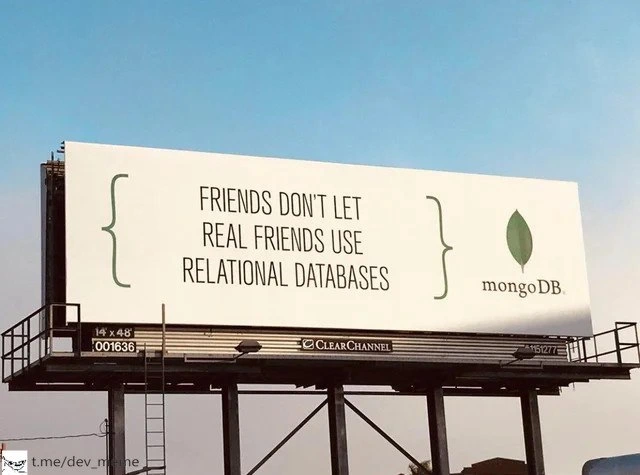
MongoDB billboard jokes that real friends avoid relational databases entirely
Databases Post #1878, on Aug 7, 2020 in TG

MongoDB billboard jokes that real friends avoid relational databases entirely

Why is this Databases meme funny?

Level 1: A Friendly Intervention

Imagine you have a friend about to do something you think is a bad idea, and you care about them. Maybe they’re reaching for a rotten apple to eat, and you quickly swap it with a fresh banana saying, “Whoa, a real friend wouldn’t let you eat that!” You’re exaggerating to make them laugh, but also trying to help them choose something better. That’s exactly the joke here, just with databases instead of snacks. In the big sign, MongoDB (a type of database) is joking that using an old-style relational database is like picking the “rotten apple,” and a true pal would stop you. It’s like a buddy yelling, “Hey, real friends don’t let friends use that old broken tool – try this shiny new one instead!” The humor is in the over-the-top “I care about you, man, don’t do this crazy thing!” vibe. You don’t literally tackle your friend for choosing a database, of course, just like you wouldn’t actually wrestle an apple out of their hand – it’s an affectionate, playful ribbing. The big sign with curly braces is basically a friendly intervention in public: one friend (MongoDB) teasingly telling everyone, “Only a real friend would save you from the mistake of using the other kind of database.” Even if you don’t know what a database is, you can sense the playful tone – it’s saying good friends look out for each other by steering each other away from bad choices. In simple terms: the sign is a techie way of looking out for your buddy, with a wink and a smile.

Level 2: SQL vs NoSQL 101

Let’s break down the basic terms and visuals in this meme. Relational databases are the classic kind of databases where data is stored in tables (rows and columns, much like spreadsheets). Each table has a defined structure (a schema), and you use a language called SQL (Structured Query Language) to store and retrieve information. Common examples of relational databases are MySQL, PostgreSQL, and Microsoft SQL Server. If you’ve ever seen a table of users and another table of orders linked by a user ID, that’s relational design: it emphasizes relationships between data. For instance, in a relational database design, you might have one table for Users and another for Orders, and you use a foreign key (like a user ID) to connect an order to the user who made it. This approach is great for ensuring data is consistent and not duplicated – every piece of data is stored one place (e.g. user info in the user table), and you link it via relationships. When you need something, you might write an SQL query with a JOIN to combine info from multiple tables. An example SQL query could be as simple as:

SELECT name, email 
FROM Users 
WHERE id = 42;

This would fetch the name and email from the Users table for the user with ID 42. If you wanted that user’s orders too, you’d query the Orders table and join it with Users on the user ID.

NoSQL databases, on the other hand, is a broad term meaning “Not Only SQL”. It refers to various non-relational data stores. There are a few types (document stores, key-value stores, wide-column stores, graph databases, etc.), but this meme is specifically about document databases (MongoDB is one). In a document database, instead of tables, you have collections of documents. A “document” is basically a big JSON-like object – think of it as a flexible record that can contain many fields, sub-fields, and lists of data. Unlike a relational DB, you don’t have to define the schema upfront or split the data into many related tables. You can stick a lot of related info in one document, even if some entries have extra fields or slightly different structure. This is called schemaless or schema-flexible design. The curly braces { } you see on the billboard reference JSON syntax – JSON (JavaScript Object Notation) uses braces to enclose data. So the sign’s design is shouting “JSON inside!” as a nod to MongoDB’s document format.

Here’s a simple conceptual contrast: imagine we want to store info about a user and their orders. In a relational database, you’d typically do something like this:

  • Users Table: each row is a user (ID, name, email, etc.).
  • Orders Table: each row is an order (order ID, item, date, and a user_id that references the Users table).

You might have two separate tables and then use SQL joins to link a user with their orders when you need to get that info together. In a NoSQL document model, you might just store one document for the user that includes an array of orders inside it.

For example, using MongoDB (a document database), Alice’s data with her orders might be one JSON-style document:

{
  "_id": 42,
  "name": "Alice",
  "email": "[email protected]",
  "orders": [
    { "orderId": 101, "item": "Laptop", "date": "2020-08-01" },
    { "orderId": 102, "item": "Mechanical Keyboard", "date": "2020-08-05" }
  ]
}

Here, all of Alice’s info and her list of orders are embedded in one place (within those curly braces). There’s no separate Orders table; instead, her document holds an array of order objects. This makes it really easy to grab Alice and all her orders in one go. If you wanted to find Alice by name in MongoDB, you’d do something like db.users.find({ name: "Alice" }) in the Mongo shell or a driver – notice it looks like querying with a JSON object as the filter. By comparison, in SQL you’d do SELECT * FROM Users WHERE name = 'Alice';. Both get the job done, but the style and underlying mechanism differ.

To summarize some key differences in a concise form:

Aspect Relational (SQL) NoSQL (MongoDB)
Schema Pre-defined, fixed tables and columns (strict schema) Flexible or schemaless (JSON documents can vary in shape)
Data Linking Uses multiple tables and JOIN operations to link related data Usually no joins – related data is embedded in one document
Transactions Strong ACID guarantees for consistency (all-or-nothing updates) Historically limited transactions (newer versions improved); often relies on eventual consistency for scalability
Scalability Traditionally scaled vertically (bigger servers); clustering is possible but complex for high write scales Designed to scale horizontally (sharding data across many servers easily) for large workloads
Querying Uses SQL (a declarative query language) to retrieve and manipulate data Uses imperative, code-like queries (e.g., db.collection.find({...})), sometimes with map-reduce or special APIs for complex queries

Now, what does the billboard’s phrase actually mean in plain terms? “Friends don’t let real friends use relational databases” is saying, as a joke, that no true friend would advise you to use an old-fashioned SQL database. In other words, “If someone cares about you, they’ll stop you from using a relational DB and steer you to a modern solution like MongoDB.” It’s basically an exaggerated endorsement for MongoDB (a NoSQL database) at the expense of the traditional approach. The sign is implying that using a relational database is a mistake or a suboptimal choice – so much so that a good buddy should step in and save you from it!

This is rooted in a slice of developer culture. Among programmers, you’ll hear playful maxims like “friends don’t let friends use Internet Explorer” or “friends don’t let friends copy-paste code from StackOverflow without understanding it.” It’s a way to jokingly say “that thing is bad, and if I care about you I’ll warn you off it.” Here, the “bad thing” is the relational SQL database, and the recommended alternative (implied by the huge MongoDB logo) is a NoSQL database – specifically MongoDB’s document store. The humor lands because it’s obviously a one-sided statement. In reality, SQL databases are still very widely used and loved for their reliability and strong guarantees. But MongoDB and other NoSQL databases gained popularity for certain tasks (like handling big volumes of unstructured or rapidly changing data, or scaling across many servers). This billboard is basically coming from the MongoDB camp saying, “Our way is the future; the old way is so wrong that it’d be betrayal to let your friend stick with it.” It’s tongue-in-cheek, meant to get a chuckle and maybe provoke a little “database debate” among tech folks.

For someone new to this whole nosql_vs_relational saga, the main takeaway is: there are two broad approaches to databases - the traditional one (relational/SQL) and the newer one (often called NoSQL, with MongoDB as an example). Each has its pros and cons. The meme (or ad) exaggerates the rivalry between these approaches for comedic effect. It’s like a friendly spat in the tech world. MongoDB’s marketing team is using that spat to say “we’re the cool new friend, and those old databases are the stodgy old-timer.” And by phrasing it as “Friends don’t let friends…”, they made it relatable and funny, because it’s the kind of dramatic, slightly silly thing developers joke about.

So if you’re a junior developer or a student, don’t worry – using a relational database isn’t actually a horrible offense! 😅 It’s just that within the developer community, there was a period of loud enthusiasm for “ditching SQL” in favor of NoSQL solutions. This billboard took that enthusiasm and turned it into a bold punchline. The fact that it’s on a huge billboard makes it even funnier, almost like the core of an online meme got funded to be plastered beside a highway. It’s both an advertisement and a nerdy joke rolled into one. The key concepts to know are just:

  • MongoDB is a popular NoSQL/document database (company logo is a green leaf).
  • Relational databases use SQL and tables (think of classic databases you learn about in school).
  • There’s been a debate about which approach is better for different situations.
  • The sign jokingly claims the NoSQL approach is so much better that a real friend wouldn’t let you choose the other.

In practice, good developers learn both and choose what fits the job. But understanding this meme means understanding that devs have strong opinions on their tools – so strong that they make jokes like this. It’s a bit of database humor: you might not laugh until you’ve experienced someone passionately advocating for one database over another. Once you’ve seen a few Twitter fights or Reddit threads on SQL vs NoSQL, you’ll appreciate why this billboard got chuckles. It’s basically a punchline for those in the know, wrapped up as a piece of tech advertising.

Level 3: The NoSQL Rebellion

“FRIENDS DON’T LET REAL FRIENDS USE RELATIONAL DATABASES”
On its face, this giant billboard delivers a provocative, cheeky one-liner that every experienced backend developer immediately recognizes as part of the long-running NoSQL vs. SQL feud. It’s essentially a developer_marketing_humor campaign by MongoDB, using an inside joke as a guerrilla marketing tactic. The phrase riffs on the familiar saying “Friends don’t let friends [do something foolish]” – implying that using a relational database (the traditional SQL kind) is such a regrettable mistake that a true friend should intervene. The humor comes from the extreme hyperbole: it equates choosing a SQL database (like MySQL, PostgreSQL, Oracle, etc.) with an act so perilous or uncool that caring friends simply wouldn’t allow it. It’s an absurd exaggeration, and that’s why it elicits a laugh from those who get the reference. Essentially, the ad is roasting relational databases to elevate MongoDB, and doing so with a wink and a nod to developers who have seen these “database holy wars” play out.

This resonates with senior engineers because it satirizes a real industry hype cycle. In the late 2000s and early 2010s, the tech world saw what you might call a NoSQL rebellion – a surge of database_evangelism claiming that the old relational ways were obsolete for modern, scalable applications. Back then, you’d hear bold declarations at meetups and on blogs: “SQL doesn’t scale!”, “Join the revolution, go schemaless!”, “Relational databases are dinosaurs, we need web-scale!”. This billboard is basically that entire era distilled into a single snappy slogan. The anti_sql_sentiment it displays was very much in vogue for a while: many devs were excitedly dumping their tried-and-true RDBMS in favor of the new MongoDB-style document stores, graph databases, and key-value stores. It became almost a tribal identity – the giant_curly_braces on the sign are like a bat-signal for the NoSQL tribe, proudly displaying JSON syntax as their banner. Meanwhile, the relational camp had their own defenders (veteran DBAs who’d mutter that these new kids would come running back to SQL when they hit real issues). This communal experience – the debates, the successes, the spectacular failures – is what makes the meme “too real” and funny to those who lived through it.

The design of the billboard itself is dripping with insider references. The text is in a monospace typewriter-style font, flanked by oversized green { } braces. This isn’t just a random aesthetic choice: it’s explicitly invoking the look of code and JSON documents. Any coder driving by will instantly associate braces with code blocks or JSON objects, subconsciously reading the slogan as if it were a snippet from a config file or a console log. It’s saying, “Hey devs, this message is for you.” Compare that to typical billboard ads – this one is unintelligible to non-tech folks (your average person might read it and go “Huh?”). That exclusivity is deliberate: MongoDB is positioning itself as the cool, in-joke-savvy option, strengthening its brand among developers by speaking their language (literally and figuratively). Seeing a tech_billboard_ad that basically says “Skip SQL, use MongoDB” in joke form is surprising and amusing; it’s like the enterprise software version of a meme escaping onto the highway.

Behind the humor lies a bit of truth seasoned with a lot of marketing spice. MongoDB was one of the poster children of the NoSQL wave, often touted for being “web scale” (an ambiguous buzzword famously parodied in the tech community). The joke in the ad plays on the idea of a “real friend” looking out for you. In reality, experienced devs know that picking a database is all about using the right tool for the job. The slogan implies MongoDB is categorically the right tool — so much so that a good friend would stop you from even considering anything else (especially those stodgy SQL databases). Senior developers laugh because they recall countless arguments and team decisions around this. Maybe you’ve been in an engineering meeting where a junior enthusiast, hyped up on blog posts, declares, “We should never use SQL, I read that it doesn’t scale horizontally and Mongo will solve all our problems.” It’s both amusing and exasperating. The billboard basically echoes that zealotry, but tongue-in-cheek. Developer_marketing_humor like this works because it validates the experiences of one group (“I too remember when everyone thought NoSQL was the magic bullet!”) while also gently poking at it.

Real-world war stories give this joke its edge. Plenty of veteran engineers chuckle remembering how some project jumped on the MongoDB bandwagon and later hit a wall. For example, a startup might have ditched a reliable PostgreSQL setup for MongoDB after seeing ads like this, only to discover down the line that MongoDB’s lack of JOINs and initial absence of multi-document transactions made certain operations hellish. (Cue the senior DBA saying, “told you so.”) Some teams drank the NoSQL Kool-Aid and ended up with data models that were hard to query or inconsistent. Others absolutely benefited from using Mongo in the right context (like flexible schemas for evolving data or scaling out reads across many nodes). The point is, the boldness of “friends don’t let friends use relational databases” reflects a kind of overconfident tech hype that experienced folks have seen come and go. We’ve witnessed the pendulum swing: from “SQL is the only way” in the early 2000s, to “SQL is dead” in 2010, and nowadays a balance where people use a mix of both (polyglot persistence). In fact, it’s funny to note that after years of pushing schemaless design, MongoDB eventually added features like schema validation and ACID transactions for multi-document operations – basically incorporating some RelationalDatabaseDesign principles they initially shunned. The cynical veteran in us smirks at that: after all the trash talk on that billboard, even the cool new kid admitted later that a bit of the old-school discipline is necessary.

By using a friends intervention scenario as the joke format, the ad also taps into the camaraderie of developer culture. There’s an unwritten rule in engineering teams that you watch out for your colleagues – whether it’s doing code reviews to catch mistakes or advising them not to use a tool that burned you before. The line “friends don’t let real friends use relational databases” satirically elevates MongoDB to the status of common sense or moral duty: if you truly care about your fellow dev, you’d never let them make the horrible mistake of picking, say, an Oracle database for a new app. It’s hyperbole, and everyone reading it knows it – even the MongoDB marketing folks know that we know – and that’s the wink. It’s a tribal joke, almost like graffiti from the “NoSQL club” spray-painted where all the SQL folks can see it. This playful rivalry is a staple of tech culture (think vi vs emacs, tabs vs spaces, etc.), and the billboard is basically inflating one side’s bravado for comedic and promotional effect.

Finally, consider the context: in 2020 when this ad was up, the database world had largely settled from the frenzy of the early NoSQL days. Most seasoned engineers had come to realize that relational and NoSQL databases each have their place. That makes the ad even more knowingly facetious. It’s not likely to actually convince a CTO to abandon PostgreSQL just by itself. Instead, it’s developer_marketing_humor meant to get attention, create buzz, and reinforce MongoDB’s brand identity as the edgy alternative to “your dad’s database.” In fact, the meme became a bit self-referential; developers shared photos of the billboard on Twitter and forums, joking about the anti_sql_sentiment on display. It sparked conversations (and yes, arguments) – which is exactly what the marketing intended. A senior dev who’s been around the block will chuckle at the sign and maybe comment, “Heh, I remember when people actually said things like this with a straight face.” The humor lands because it’s an exaggeration rooted in real attitudes from our collective memory. It’s funny, a tad cringe, and a nostalgia trip all at once – much like looking back on any IndustryTrends_Hype once the dust has settled. In the end, the “friends don’t let friends” MongoDB billboard is both a joke and a jab in the database realm’s friendly rivalry, and experienced tech folks appreciate it as a clever nod to a debate that shaped a decade of software architecture discussions.

Level 4: From Codd to CAP

At the deepest technical level, this meme touches on fundamental database design theory and the trade-offs between relational and NoSQL systems. Relational databases (RDBMS) are rooted in E. F. Codd’s relational model from the 1970s – a mathematically rigorous approach where data is organized into tables (relations) and operations follow formal relational algebra. This design emphasizes normalization (eliminating duplicate data by spreading it across related tables) and strong consistency via ACID transactions (ensuring Atomicity, Consistency, Isolation, Durability). In contrast, MongoDB and its NoSQL brethren embrace a more document-oriented model: instead of strictly structured tables, you store information as JSON-like documents (hence those giant curly braces on the billboard). This lets you keep related data nested together (denormalization), trading some theoretical purity for practicality in certain scenarios.

From a distributed systems perspective, the NoSQL vs relational debate invokes the CAP theorem – a fundamental conundrum described by Brewer’s theorem. CAP says in a distributed data system you can only reliably have two out of three: Consistency, Availability, and Partition tolerance. Traditional relational databases prioritize consistency (and typically run on a single node or tightly-coupled cluster to avoid network partitions), whereas many NoSQL databases sacrifice strict consistency (allowing eventual consistency) to remain available even when parts of the system can’t communicate. This is often summarized as ACID vs. BASE – where BASE (Basically Available, Soft state, Eventual consistency) describes the looser guarantees many NoSQL stores provide. In practice, this means a document database like MongoDB might accept writes on multiple servers even if they haven’t synced up, trusting that all copies will reconcile eventually. It’s a conscious trade-off: you're favoring horizontal scalability and uptime over instant absolute accuracy across the whole system.

The meme’s monospace text and curly braces visually scream JSON, implicitly championing the schemaless, flexible-document philosophy. The subtext is that old-school RelationalDatabaseDesign – with its fixed schemas, JOINs, and normalized tables – can be a burden in the era of web apps that need to scale out fast. There’s an academic irony here: after decades of teaching that data integrity and schema are paramount, the NoSQL movement cheekily says, “relax those rules, we’ve got other priorities.” To a veteran architect, the slogan on this tech billboard ad pokes at a real theoretical tension: in theory, NoSQL databases resolve certain limitations of relational systems (like sharding across many servers and handling huge, schema-variant datasets easily). But they do so by bending or breaking some of the rules that relational theory holds dear. The result is a classic computer science paradigm clash – one side armed with formal set theory and ACID guarantees, the other wielding the CAP theorem and JSON flexibility.

Even the mongodb_leaf_logo on the billboard – a green leaf – suggests “fresh” or “organic” data models, a subtle dig that relational databases are more like stiff, cultivated gardens with strict rows. By putting {curly braces} front and center, the ad evokes the structure of a JSON document, implicitly arguing that data represented in a hierarchical, nested form is more natural than rows and columns. This deep level of the joke resonates with those who know the under-the-hood differences: how a MongoDB engine might store and retrieve an entire object graph in one go, versus an SQL database which might perform multiple JOIN operations across normalized tables to assemble that same object. It’s a humorous nod to the engineering philosophies behind these systems – one JSON document vs. many related tuples – reflecting fundamental design decisions. In essence, the billboard quip arises from the nosql_vs_relational schism at the theory level: when scaling and flexibility are paramount, the constraints of the relational model can feel like shackles (leading to the “friends don’t let friends use SQL” hyperbole). Yet, any hardcore database theorist might smile (or cringe) because they know those “shackles” exist for good reasons like data integrity. The meme lives right in that theoretical tension, distilling a nuanced technical debate into a one-liner punchline. It’s rare for a highway billboard to allude to things like CAP theorem trade-offs or data normalization – but for those in the know, that’s exactly the nerdy subtext that makes this funny.

Description

Outdoor photo of a large white billboard against a blue sky. In green typewriter-style text, centered between two oversized green curly braces, it reads: “FRIENDS DON’T LET REAL FRIENDS USE RELATIONAL DATABASES”. To the right of the text is the green leaf logo and wordmark “mongoDB.” The minimalist layout, monospace font, and brace imagery evoke JSON documents, reinforcing MongoDB’s document-oriented model while humorously disparaging traditional SQL systems. Technically, the ad taps into the long-running NoSQL vs. relational debate familiar to backend engineers and illustrates how developer-focused marketing uses inside jokes to position technology choices

Comments

6
Anonymous ★ Top Pick “Friends don’t let friends use relational DBs” - real friends stay up at 3 a.m. helping you re-implement JOINs, foreign keys, and transactions in JavaScript because Mongo decided “eventual” meant next quarter
  1. Anonymous ★ Top Pick

    “Friends don’t let friends use relational DBs” - real friends stay up at 3 a.m. helping you re-implement JOINs, foreign keys, and transactions in JavaScript because Mongo decided “eventual” meant next quarter

  2. Anonymous

    The real joke is when your MongoDB cluster loses data consistency at 3am and you realize your 'friend' forgot to mention eventual consistency means 'eventually, maybe, if you're lucky' - suddenly those ACID-compliant relational databases with their boring foreign keys don't seem so bad after all

  3. Anonymous

    Ah yes, the infamous MongoDB billboard that launched a thousand Slack arguments and HackerNews flame wars. Nothing says 'we understand nuanced architectural decisions' quite like a billboard implying your entire ACID-compliant, normalized schema is a friendship dealbreaker. Meanwhile, seasoned architects know the real answer: 'It depends on your access patterns, consistency requirements, and whether you enjoy explaining eventual consistency to your product manager at 3 AM when the inventory count is off by 47 units.'

  4. Anonymous

    Friends don’t let friends use relational, until your schema-less users collection has 47 shapes and you ship a JoinService to reinvent foreign keys

  5. Anonymous

    “Friends don’t let friends use relational” - until the CFO asks for an ad‑hoc cross‑entity report and your schema‑less microservice quietly becomes a nightly ETL into Postgres with JOINs and regrets

  6. Anonymous

    MongoDB's billboard nails it: real friends skip schemas now, then co-debug your denormalized data swamp later

Use J and K for navigation