Skip to content
DevMeme
5784 of 7435
Gen Z Engineer's Update Baffles Management with 'Skibidi Code'
Communication Post #6340, on Oct 20, 2024 in TG

Gen Z Engineer's Update Baffles Management with 'Skibidi Code'

Why is this Communication meme funny?

Level 1: Grandpa vs Teen Lingo

Imagine a grandpa and his teenage grandson talking. The teen excitedly says something like, “Yo that was sigma grindset fr, you gave my XP mad buffs!” – basically a bunch of made-up-sounding words. Grandpa has no idea what that means. He feels like the kid just spoke in an alien language! Grandpa gets so confused and frustrated that he jokes, “I’m gonna blow this phone up from outer space if you don’t talk normally!” (He doesn’t really mean it; he’s just super lost and kidding around.) In the end, the teenager was just trying to say “Wow, thanks, you really helped me a lot, you’re awesome,” but he said it in such a weird way that poor Grandpa couldn’t understand. It’s funny (and a little silly) because they both speak English, but it’s like they’re speaking completely different languages. This little story is just like the meme: a young engineer used crazy internet slang to thank a senior engineer, and the senior felt totally lost in translation – so lost that he joked about calling in an “orbital strike” (an extreme silly response) out of sheer confusion. The humor comes from that big misunderstanding between generations, even though everyone meant well.

Level 2: Gen Z Lexicon 101

Let’s decode that mysterious Slack message and bridge this generational gap in communication. The junior engineer’s message was essentially an over-the-top thank you note, dressed up in trendy internet slang. Here’s a breakdown of the key phrases (a crash course in gen_z_slang):

  • “sigma grindset” – This term is meme-speak praising a hard-working, self-motivated mindset. The word sigma refers to the “sigma male” concept (an internet trope about an independent, lone-wolf type who succeeds without seeking approval). Grindset is a mashup of “grind” (meaning to work hard, hustle) and “mindset.” So saying someone has a sigma grindset is jokingly admiring their hustle and independent drive. In this context, the junior is complimenting the colleague’s determination or skill in fixing the issue. It’s like saying, “you’ve got a boss-level work ethic.”

  • “type shi fr” – This is shorthand texting lingo. “fr” stands for “for real,” used to stress that one is serious. The phrase “type shi” is a clipped way of saying “type of sh (using a censored swear to mean “thing” or “stuff”). When someone says “X type sh** fr,” they mean “that’s some X kind of thing, seriously.” So “sigma grindset type shi fr” translates to “that’s some real sigma grindset kind of stuff, for real.” In plain English, the junior is emphasizing: “Seriously, that was an epic hustle move.” It’s informal, emphatic praise.

  • “fixed my skibidi code” – Here, the junior acknowledges that their code was fixed by the colleague. The funny part is calling their buggy code “skibidi code.” This is a skibidi_reference to a popular absurd meme (the “Skibidi Toilet” videos that went viral on TikTok). By labeling the broken code skibidi, they’re self-deprecatingly saying the code was goofy, chaotic, or nonsensical – much like the meme. So, “fixed my skibidi code” just means “you fixed my ridiculous mess of a bug.” It’s a playful way to admit one’s code was bad or silly, softened by a humor reference.

  • “+100 aura” – This phrase borrows from video game terminology. In many games or fantasy settings, aura might refer to a character’s presence, mana, or general vibe/power. Saying someone gains “+100 aura” is like awarding them experience points or reputation. Here, the junior is effectively saying “you just earned 100 greatness points in my book.” It’s a flamboyant way to express massive thanks and respect. Instead of just “thanks, you’re awesome,” they quantified the awesomeness with a big number, RPG style. This is pure TechHumor meets gamer talk in a workplace setting.

  • “Based” reaction (emoji) – In the Slack screenshot, below the message, there’s a small blue badge that says “Based 6.” This means six people reacted with a “based” emoji on that message. Based is contemporary slang for “cool and confidently correct.” Calling a statement “based” means you think it’s spot-on or admire the boldness of it. It ironically originated from hip-hop (Lil B’s “Based God”) and came to mean “being yourself and not caring what others think,” and now in internet culture it’s an approving nod. So, six coworkers found the junior’s slangy praise funny or agreeable enough to upvote it with a “based” reaction. Essentially, a bunch of colleagues were saying “👍 love that” in meme language. There’s also a grey smiley emoji reaction visible, which likely means at least one person reacted with a laugh or smile, indicating they found it humorous. All these reactions show that within that team’s culture, this message landed as a joke everyone enjoyed – well, everyone except the bewildered senior, perhaps!

Now, imagine you’re a new developer (maybe not up-to-speed on TikTok memes) seeing “sigma grindset type shi fr” pop up in your work chat. It might feel like reading gibberish. This is a classic case of Miscommunication potential in a multi-generational workplace. The junior’s intent was positive – they were hyped and thanking a teammate in a very Gen Z way. But the wording is so drenched in niche slang that anyone outside that circle could be totally lost. Workplace chat etiquette usually suggests keeping things clear, especially when you’re collaborating with folks of different backgrounds. While Slack (or any office chat) often encourages a bit of personality and fun, there’s a line between friendly informality and utter confusion. In this scenario, the junior basically wrote a line of inside-joke code that not everyone can compile. The senior’s over-the-top tweet – “About to order an orbital strike on my Gen Z engineer” – humorously implies “I have no clue what my junior just said, and I’m this close to losing it.” It’s an exaggerated response out of confusion, essentially saying “please, speak plain English!”.

This highlights the GenerationalGap: younger developers (Gen Z, born roughly in the late 1990s to early 2010s) have grown up with rapidly evolving internet slang (from Twitch streams, TikTok trends, Discord chats), whereas senior devs (often Gen X or older millennials) might stick to more straightforward communication. Neither side is wrong per se – it’s just different subcultures. But when working together, teams have to find a common language. For a junior engineer, it’s great to bring energy and humor, but it’s also important to ensure you’re understood. And for seniors, it can be eye-opening (and yes, even amusing) to see how internet culture infiltrates office life. In fact, a lot of DeveloperMemes thrive on exactly this kind of scenario: the tension between formal tech work and the chaotic slang-filled world of online humor. This particular meme is a gentle reminder that, in a professional setting, a message should not require a slang dictionary or an Enigma machine to decode. Otherwise, you might end up with teammates joking about deploying airstrikes out of sheer bewilderment! Keeping communication clear across experience levels isn’t just polite – it saves time and sanity. After all, if a thank-you message needs this much analysis, imagine if a critical production alert came through in cryptic meme-speak – half the team might be busy Googling “skibidi meaning” instead of fixing the server. So, the takeaway for juniors: a little context goes a long way (you can always say “thanks for fixing my crazy bug!” and then add a fun meme reference for flavor). And the takeaway for seniors: internet culture moves fast – no harm in asking “Translation, please?” or even learning a few new phrases for the next stand-up, just to see the look on the juniors’ faces. 😉

Level 3: Lost in Slacklation

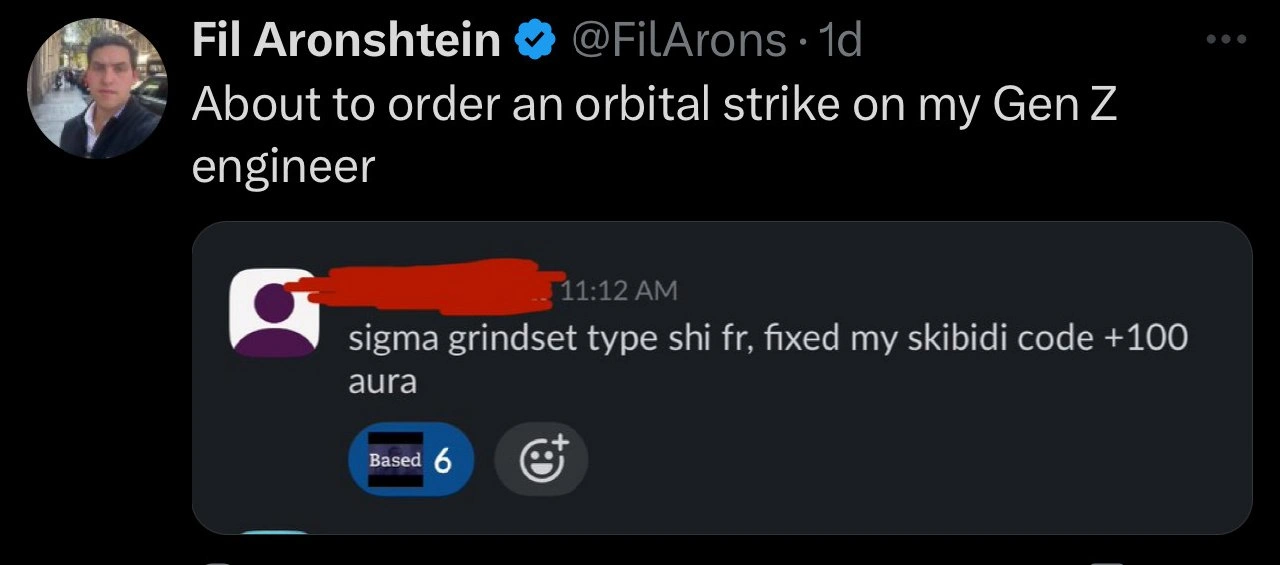
In this meme, a battle-hardened senior developer is staring down a Slack message that reads like an alien transmission. The meme itself is structured as a Twitter screenshot (in dark mode, naturally) where the senior quips: “About to order an orbital strike on my Gen Z engineer.” Beneath that, a Slack chat screenshot shows the offending message, timestamped 11:12 AM, from a junior teammate:

sigma grindset type shi fr, fixed my skibidi code +100 aura

To a seasoned engineer, this line might as well be base64-encoded. It’s a textbook communication breakdown on a software team, presented as a joke. The senior’s dramatic “orbital strike” remark is obviously hyperbole – a memetic way to say “I’m so frustrated I could nuke something from orbit”. This dark humor exaggerates how bewildering the slang is: the poor mentor feels like they need literal air support to handle a simple thank-you message. It’s a humorous take on Senior vs Junior Developers and the generational culture clash in tech. The junior intended to praise the colleague’s help with bug-fixing, but did so in such Gen Z slang that the compliment required decryption. The result? A flabbergasted senior who momentarily fantasizes about solving the problem with extreme prejudice (in jest, of course). The juxtaposition is gold: a polite workplace thank-you hidden inside a phrase that sounds like a glitching NPC dialogue from a video game, and an exasperated veteran ready to rage-quit the chat (or the planet) in response.

From a senior engineer’s perspective, this scenario highlights the importance of clear communication on teams. In code, we value readability; in chat, we expect the same. Here we have a message that violates the unwritten workplace chat etiquette of “know your audience.” It’s loaded with niche internet vernacular that’s not in the company handbook (you won’t find “sigma grindset” or “+100 aura” in the HR onboarding materials). The result is essentially a protocol mismatch: the junior is speaking Slacklish 1.0, and the senior is only fluent in Professional English 0.9. In technical terms, it’s like an API version difference – the client (senior) sends a normal request (“What did you just say?”) and the server (junior) responds in a new format (“sigma grindset…”) that triggers a parsing error. The senior’s brain throws a HTTP 418 – I’m a Teapot because it refuses to brew this unusual request. Miscommunication in a dev team can be as crippling as a null pointer exception in production: one wrong interpretation and things grind to a halt. Here it’s played for laughs, but the struggle is real (fr, as the kids say). The senior is essentially experiencing a generational Babel moment, where two engineers share a common goal but not a common lingo.

The meme also nods to how corporate culture evolves. Not so long ago, a junior might have simply typed, “Thanks for fixing that bug, much appreciated!” Now we have a culturally enriched remix: “fixed my skibidi code +100 aura” – meaning roughly the same thing but filtered through TikTok and gamer slang. It’s GenerationalHumor at work: each generation of developers brings its own slang and social references into the office. The seasoned devs of today remember when “👍” or a simple “lol thanks” in chat was the norm; suddenly they’re confronted with a cascade of terms like sigma, skibidi, and based. It’s akin to how programming languages evolve – imagine a C++ veteran suddenly reading a modern codebase full of Python one-liners and emoji variable names. The ingredients are recognizable, but the syntax is wild enough to cause a double-take. In the Slack screenshot, we even see a blue badge that says “Based 6”, indicating six coworkers reacted with a “based” emoji. For context, based in Gen Z-speak is high praise (essentially “defiantly cool and correct”). So not only did the junior drop a galaxy-brain meme sentence, half a dozen peers upvoted it as good banter. That’s like six people in the office crowd cheering for an inside joke that you, the senior in the room, didn’t even realize was told. No wonder the senior’s joking about calling in fire from above – it’s part frustration, part feeling out-of-touch, and wholly relatable to any dev who’s opened Slack in the morning and wondered if the team installed a new language pack overnight.

Technically speaking, nothing is “wrong” here – the junior is actually praising the senior’s help debugging (“fixed my code, you rock”), and the senior isn’t really about to drop an AWS orbital laser. But the humor lands because effective engineering requires shared understanding, and here that understanding is lost in a haze of Zoomer-speak. It’s a commentary on how even in high-tech workplaces dealing with precise code and algorithms, human language can still be the hardest protocol to maintain. The DeveloperHumor hits close to home: we spend all day ensuring microservices communicate seamlessly in JSON, yet we can’t parse a message from a coworker because it’s in Gen Z meme-speak. Cue the eye-rolls and the tongue-in-cheek “target locked” jokes. In summary, CommunicationBreakdown in a dev team isn’t always about misunderstood technical requirements or ambiguous JIRA tickets – sometimes it’s literally not speaking the same (natural) language. And as any cynical veteran will tell you with a smirk, it’s always the communication issues — if it’s not DNS, it’s the darn slang. This meme captures that absurd truth and wraps it in a generational TechHumor package that both old-timers and new devs can laugh at (albeit for slightly different reasons).

Description

A screenshot of a tweet from user Fil Aronshtein (@FilArons). The tweet's text humorously states, 'About to order an orbital strike on my Gen Z engineer'. Below this is an embedded image of a chat message from a team member. The message, sent at 11:12 AM, reads: 'sigma grindset type shi fr, fixed my skibidi code +100 aura'. The message has a custom emoji reaction 'Based' with a count of 6. The visual contrast is between a professional-looking profile picture and the utterly incomprehensible, slang-filled message. The meme derives its humor from the massive generational and cultural gap in communication within the tech workplace. A younger, 'extremely online' Gen Z engineer is using niche internet slang (sigma, grindset, skibidi, aura, based) to report a work update, causing comical frustration and bewilderment for their manager. It highlights the evolving nature of professional communication and the culture clash between different generations of developers
Comments

21
Anonymous ★ Top Pick HR calls this a 'communication style difference.' The SRE on call at 3 AM calls it 'the root cause identified in the post-mortem.'
  1. Anonymous ★ Top Pick

    HR calls this a 'communication style difference.' The SRE on call at 3 AM calls it 'the root cause identified in the post-mortem.'

  2. Anonymous

    Today I had to spin up a microservice whose only job is translating “sigma grindset skibidi fix +100 aura” into “null dereference patched in auth” - turns out backward-compatibility with Gen-Z is harder than supporting Java 6

  3. Anonymous

    The real bug here is that the senior engineer now needs to add 'Gen Z to English translator' as a required dependency in their mental build system, right after the coffee module but before the will-to-live package

  4. Anonymous

    When your Gen Z engineer submits a PR with 'skibidi code +100 aura' as the commit message, you realize the real technical debt isn't in the codebase - it's the generational translation layer you now need to implement between TikTok slang and actual engineering terminology. At least they didn't request a standup in Roblox

  5. Anonymous

    PR description: “sigma grindset, fixed skibidi code +100 aura.” Added a pre-commit hook that rejects vibes - our CI only ships root causes and p99, not “fr.”

  6. Anonymous

    Skibidi code: infinite aura, zero Big O guarantees

  7. Anonymous

    We enforce Conventional Commits; they enforce Conventional Memes - adding a junior‑to‑English transpiler to CI before CAB signs off

  8. P S 1y

    I'm genz and this is gen alpha language.

    1. @callofvoid0 1y

      can confirm as a genZ

    2. Kademlia 1y

      Yes but doesn't stop gen z from also using it sometimes

  9. @callofvoid0 1y

    where the hell all these come from I've never heard such things

    1. @ilia_esmaili 1y

      what about skibidi?

      1. @slnt_opp 1y

        Remember good ol' times when it was just a fat Turkish guy bod-dancing...

      2. @callofvoid0 1y

        skibidi toilet

        1. @ilia_esmaili 1y

          I know, but what does "skibidi code" mean in this context?

          1. @callofvoid0 1y

            spaghetti code maybe?

          2. @azizhakberdiev 1y

            It might be just a reference to skibidi toilet that is strangely popular among kids, so mb childish code

  10. @theu_u 1y

    Bros be Russians and wonder why don't they hear such a slang ☠☠☠

    1. @callofvoid0 1y

      Not Russian

      1. @theu_u 1y

        Idk, foreign media is filled with that crap, so maybe you are simply out of that env

  11. @azizhakberdiev 1y

    there might be some real references with meaning, but skibidi toilet is totally meaningless brainrot, and people who use this brainrot need to go f themselves instead of confusing everyone around

Use J and K for navigation