Skip to content
DevMeme
5783 of 7435
The 'Voops' Engineer: An Origin Story for DevOps
DevOps SRE Post #6339, on Oct 18, 2024 in TG

The 'Voops' Engineer: An Origin Story for DevOps

Why is this DevOps SRE meme funny?

Level 1: Mistakes Make Masters

Imagine you’re learning to ride a bicycle. The very first time you try, you might lose balance and fall down. Maybe you skin your knee a little and say “oops!” because it hurt and the fall was a mistake. But then you get back up and try again. After a few oopsies and a lot of practice, you learn how to keep your balance, and soon you can ride the bike smoothly without falling. In other words, you became good at riding by making mistakes and learning from them. This meme is saying the same thing about people who work with computers. A DevOps engineer is just a fancy term for someone who makes sure websites or apps run reliably (like keeping all the wheels on a bike turning). The joke in the meme says that before someone becomes really good at that job, they were a “voops engineer” — which is a silly made-up way to say they were a person who said “whoops!” a lot because they messed things up. The little smiling crab in the picture is like a friendly cartoon character who just made a mistake but is still happy. It’s as if the crab is saying, “Oops, I did it wrong, but now I’ll do better next time!” So the funny message here is: even the experts started by messing up. You have to have those “oops” moments to eventually become a pro. The path to being great at something (whether it’s riding a bike or running computer systems) is paved with little mistakes that teach us how to do it right.

Level 2: Whoops 101

A DevOps engineer is basically an IT jack-of-all-trades who handles both developing software and keeping it running on the servers. In plain terms, if you imagine a big website or app, a DevOps engineer is the person who helps write the code and makes sure that code runs properly on real machines (or in the cloud) when users are using it. That means they do a bit of everything: setting up servers or cloud services, deploying (releasing) new versions of the software, monitoring it to catch any issues, and rushing to fix things if the website or service goes down. This role bridges the gap between development (making the software) and operations (running the software). In some companies, these folks might also be called SREs (Site Reliability Engineers), but the idea is similar.

Now, to become good at this kind of job, you generally have to go through a learning curve — and that often involves making mistakes. The meme jokingly calls this out by saying to create a DevOps engineer, you need a "voops engineer" first. The term "voops" isn’t something you’ll find in a textbook or on LinkedIn; it’s a made-up word for the meme. It’s playing on the word "oops" (what you exclaim when something goes wrong) and sticking a "v" in front to echo the word "DevOps." So, voops engineer is like a pretend title meaning "whoops engineer" or "oops engineer" – essentially, a person who’s new in ops and keeps messing things up. This is a wordplay on DevOps to poke fun at the idea that before you become an expert, you’re kind of a walking disaster 😅. Every time something went wrong, you could say "Voops!" (very oops). The meme is using humor to say: making those mistakes is an essential step in learning.

Think of it like training. Early in their career, an engineer might accidentally cause a ProductionIssue – that’s when something goes wrong in the live product that real users are using. For example, they might deploy an update to a website without realizing a bug is in it, and suddenly the site crashes or behaves badly (that’s a real-life DeploymentFailure). Or maybe they misconfigure a server — say they put the wrong settings in, and the application can't run — causing downtime (meaning the site/app is unavailable). Perhaps they run a command on the wrong database and delete important data (the ultimate "oops!"). These are all big "voops" moments. When such things happen, the situation can be pretty stressful. The engineer on duty (the one on call) will get an alert and has to jump in to fix it ASAP. We call this OnCallLife: being the person who might get a phone call or pager alert at 3 AM because something broke in production. If you caused the break, then you’re doubly frantic — you’re both the firefighter and the one who accidentally lit the fire.

Let’s break down a few typical newbie mistakes (the kind of ops mistakes that turn a "voops engineer" into a wiser DevOps engineer):

  • You deploy an update without enough testing. It works on your machine, but when it's live for everyone, users start getting errors or the site crashes. This is an example of a deployment gone wrong (a DeploymentFailure). You quickly learn why thorough testing and gradual rollouts are important.
  • You accidentally run a dangerous command on the production database instead of the test database. For instance, you intended to wipe test data but ended up wiping real user data. That’s an oops of epic proportions. Next thing you know, you’re trying to restore backups – if they exist – and sweating bullets. After this, you double-check which database you’re connected to, every time.
  • You change a server setting or release a new configuration that you thought was harmless, but it actually shuts down a critical service. Imagine turning off an important process or opening the wrong network port, and suddenly no one can use the app. Cue the scramble to revert that change. Lesson learned: even small tweaks can have big consequences in production, so you learn to be extra cautious and have a rollback plan.

Each of these situations gives a young DevOps practitioner a big scare, but also a big lesson. The next time, you bet they’ll be more careful. That nervous feeling you get before hitting the "Deploy" button – that’s DeploymentAnxiety, and it’s super common once you know what can go wrong. Over time, though, you take those lessons and start building habits and tools to avoid the mistakes. You might set up automated deployment pipelines (so the computer does the deploy steps the same way every time, reducing human error). You start using checks or approvals for dangerous actions (so you can’t, say, delete a database without somebody else confirming it or at least typing "YES, I MEAN IT"). You monitor the system closely, so if something’s about to go wrong, you catch it early. Essentially, each "oops" helps you improve and become more like a DevOps maestro instead of a voops newbie.

The phrase "blameless postmortem" is a big part of DevOps and SRE culture. It's how teams deal with mistakes. After a major incident (like one of those examples above), the team comes together to discuss what happened in a postmortem meeting. "Blameless" means no one is there to yell or point fingers, even if someone made a mistake that caused the problem. Instead, they talk about how the process failed or how the system could be improved so that the mistake either doesn’t happen again or is caught sooner. For instance, if an engineer ran a command on the wrong database, a solution might be to add a safety prompt on production databases or separate credentials so it's harder to mix them up. The idea is to fix the system, not punish the person. This way, everyone is encouraged to be honest about what went wrong, and all those lessons turn into action items that make things better. Over time, through many cycles of this, a once clumsy "voops engineer" becomes a seasoned DevOps engineer who has seen a lot of failure but also knows how to prevent it or respond to it calmly.

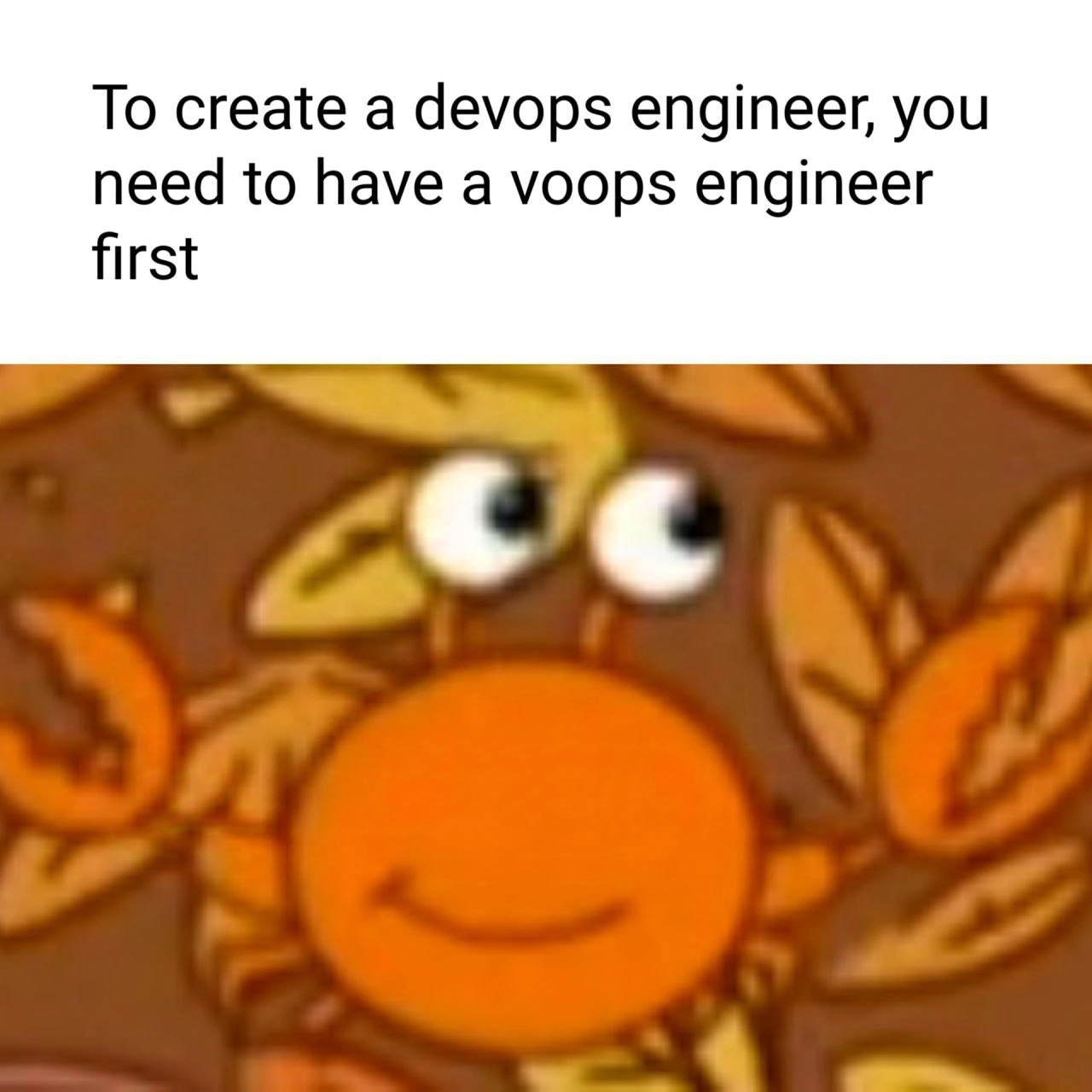
Now, about the meme’s picture: it’s pretty goofy, right? The top half is just the caption text, but the bottom half is a zoomed-in cartoon image of a bright orange crab with big eyes and raised claws, smiling away in some leafy background. This crab doesn’t symbolize a server or a bug or anything technical – it’s just a fun, random image to make you laugh. Memes often use such random images to add humor. The crab looks cheerful and a bit clueless, which perfectly matches the tone of the joke. It’s like saying, "Whoops, I messed up!" with a big goofy grin. The crab could be seen as the "voops engineer" in that moment of messing up: things are falling apart (leaves swirling around) but they have this innocent smile like, "I have no idea what I just did, but oops!". The fact that it’s blurry makes it even more absurd and funny – it's a common meme style to blur or zoom images for comedic effect. All of this turns a stressful concept (messing up in IT) into something you can chuckle at. It’s a form of TechHumor that helps IT folks not to stress too much: yes, these problems are serious, but we can still make light of our human errors and learn from them.

In summary, the meme is pointing out that mistakes are teachers. Every skilled DevOps engineer you see was once a beginner who caused an outage or screwed up a deployment – and through those errors, they learned how to do things the right way. The phrase "every DevOps engineer was a VoOps engineer first" is just a funny way to say "experts start out as newbies who mess up." It resonates in the tech community because it’s a shared experience: if you ask any experienced developer or ops person, they’ll have at least one good "I really messed something up once" story. And instead of being ashamed, we often wear it as a badge of honor and humor (once the dust has settled). This meme wraps that life lesson in a pun and a cute crab picture, making it easy to remember and laugh about. It's basically saying: Don’t worry if you hit some bumps (or major potholes) on the road to mastering DevOps – that’s how you get there!

Level 3: From Oops to Ops

"To create a devops engineer, you need to have a voops engineer first"

This meme drops a clever bit of wordplay on DevOps, swapping in an extra "v" to turn DevOps into "VoOps" (which sounds like "whoops"). The caption is basically saying you go from oops to DevOps – and seasoned engineers laugh because it's true. Behind every smooth-running system today, there’s a trail of ops mistakes from yesterday. In other words, before someone can proudly wear the DevOps title, they’ve likely been a voops engineer – the person who’s said “uh-oh, oops!” while frantically fixing a broken deployment at 2 AM. For those of us who’ve lived the on-call grind, this joke hits home like an inside joke about our production firefighting origin story. It’s funny and painfully relatable: experience in DevOps is just accumulated “voops” wrangled into lessons learned.

In classic DevOpsHumor style, the meme highlights a core truth about DevOps/SRE culture: DevOps expertise is forged in the crucible of failure. As a battle-scarred ops veteran might quip, back in the day we didn’t have fancy “DevOps engineer” titles – we just had one poor sysadmin cleaning up after deploys gone wrong. Only after enough midnight disasters did the industry realize we needed better practices (and a fancier name). The extra “v” in voops isn’t an acronym – maybe it stands for "very oops" – emphasizing that these aren’t tiny slip-ups, but colossal DeploymentFailures you hopefully only make once. The joke lands because every senior dev or SRE has a war story of some system they accidentally broke. Each OnCallLife nightmare – whether it was a database deletion or a misconfigured server – became a lesson on what not to do next time. The whole DevOps movement (and Google’s formalization of SRE, Site Reliability Engineering) grew out of countless such “voops” moments across the industry. We learned the hard way that a script can save you from the mistake you made last month, and that automation and monitoring aren’t luxuries – they’re responses to real past blunders.

The meme captures those unspoken DevOpsPainPoints that make veterans smirk. We've all shared that dark OpsHumor of "Remember when I took down prod with one command?" It’s a laugh to keep from crying. Here are a few classic “voops” scenarios that every experienced DevOps engineer can recognize:

  • The Friday Deploy Fiasco: Deploying a big update late on a Friday and heading home – only to have everything crash minutes later. Instead of a relaxing weekend, you’re doing an emergency rollback while everyone else is off. After one of these, you develop serious DeploymentAnxiety (and maybe a rule to never deploy on Friday 5 PM again).
  • The Mistaken Identity: Running a destructive command on the wrong server or database because you thought you were in a test environment when you were actually in production. That heart-stopping moment when you realize the whoops is on the production system is a rite of passage. From then on, you triple-check your terminals and set up safeguards (like colored prompts and access restrictions) to avoid a repeat.
  • The Missing Backup Lesson: Deleting or corrupting something important and then discovering the backups either failed or were nonexistent. Cue the cold sweat and frantic scramble to recover data. Nothing teaches the value of backups and careful change management better than the day you have to tell your boss, "Um... we might have lost some data." You can bet that after this incident, you're the one championing better backup routines and recovery drills.

Each of these cringe-worthy scenarios is a universal gotcha that turns into wisdom. They’re the DevOpsPainPoints that hurt in the moment but later harden into experience. In fact, we often joke that the definition of a senior engineer is someone who has already made all the major mistakes at least once. Eventually, the anxious newbie who shouted "voops!" becomes the calm seasoned engineer who has seen it all and has automated safeguards for everything. Like a phoenix rising from the ashes of a server meltdown, a skilled DevOps engineer emerges from these failures with new scripts, stricter checklists, and smarter processes to ensure that particular catastrophe never happens again.

To really illustrate the kind of nightmare we're talking about, consider one legendary one-liner that haunts every ops team:

$ sudo rm -rf /                 # The classic one-line tragedy: erase EVERYTHING on the server (yes, the whole OS) - oops!

That tiny command is basically the nuclear option — if you run it on a live server in the wrong way, you’ve just obliterated your entire system. 😨 It's an extreme example of a voops: nobody does this on purpose, but the fact that it’s a well-known joke in ops circles shows how real the fear is. Everyone in ops has double-checked their commands, terrified of a stray -rf in the wrong place. We laugh about it now (precisely because most of us have nervously checked, "Did I just do something like that?"), but it represents the kind of catastrophic error that keeps you humble.

What makes this meme TechHumor gold is that it wraps a hard-earned truth in a silly package. The bottom panel’s blurry crab meme exemplifies the absurdity: it’s a cute orange crab with big googly eyes and raised claws, smiling as if nothing’s wrong, surrounded by autumn leaves. The image is delightfully out-of-place — it has zero to do with servers or code, and that’s the point. Meme culture loves pairing serious text with an oddly cheerful or goofy image to amplify the irony. Here, the crab’s innocent grin is like the comic relief: "Oops, I did something bad, but look how happy I am learning from it!" It’s as if the crab is the embodiment of a naive engineer cheerfully deploying to production, unknowingly about to cause chaos. The contrast is hilarious: the caption is basically about catastrophic failure as a prerequisite for success, and then you have this happy little crab obliviously waving its claws. This is a hallmark of OpsHumor and DevOpsHumor – we cope with high-stress, high-stakes jobs by sharing memes that say “yeah, this is fine 😅.” The crab softens the punch of the message, reminding us not to take ourselves too seriously. After all, if you can smile (like that crab) after a night of firefighting, you’re on your way to DevOps enlightenment.

In the end, the meme is a tongue-in-cheek nod to the truth that nobody is born a DevOps guru. Every shell script wizard or Kubernetes sage you meet has a collection of horror stories from their early days. We sometimes call it "scar tissue." The OnCallLife with those 3 AM emergencies, the failed deploys, the inadvertent outages – those are exactly what mold a cautious, competent engineer. "Voops" is just a fun way to admit our blunders. So the next time you meet a confident DevOps engineer, remember: somewhere in their past is a smiling “voops” crab moment (or three) that taught them the hard lessons. We’ve all been that person saying “whoops!” before we became the person who automates away the whoops. This meme gets a knowing chuckle because it celebrates that rocky journey from oops to DevOps.

Description

A two-part meme featuring text and an image. The top section, on a plain white background, displays the black text: 'To create a devops engineer, you need to have a voops engineer first'. The bottom section shows a low-resolution, blurry image of a simple, cartoon orange crab. The crab has large, slightly misaligned eyes, a gentle smile, and its claws are raised in a friendly gesture. The background is a muddled mix of autumn colors, like brown and orange leaves. The humor comes from the pun 'voops engineer,' a blend of 'voops' (a playful version of 'whoops' or 'oops') and 'ops'. It satirizes the idea that the highly specialized role of a DevOps engineer is often created in reaction to a major operational mistake or system failure. The cheerful, slightly clueless-looking crab enhances the meme's lighthearted and absurd tone, personifying the innocent mistake that necessitates a fundamental change in process
Comments

14
Anonymous ★ Top Pick A 'voops' engineer is the one who writes a script that accidentally deletes the production database. The DevOps engineer is the one they hire to build a CI/CD pipeline that prevents anyone, especially that person, from ever running a script like that again
  1. Anonymous ★ Top Pick

    A 'voops' engineer is the one who writes a script that accidentally deletes the production database. The DevOps engineer is the one they hire to build a CI/CD pipeline that prevents anyone, especially that person, from ever running a script like that again

  2. Anonymous

    Career ladder: nuke prod with a fat-fingered kubectl (VoOps), spend the weekend wiring a self-healing Terraform + ArgoCD pipeline so it can never happen again (DevOps), then put “pioneered chaos engineering” on the résumé

  3. Anonymous

    After 20 years in tech, I've seen DevOps, DataOps, MLOps, GitOps, AIOps, and FinOps... but nothing prepared me for the existential dread of discovering that VoOps (Voodoo Operations) was the missing prerequisite all along - where you sacrifice a Jenkins server to the CI/CD gods before every deployment

  4. Anonymous

    Ah yes, the classic chicken-and-egg problem of modern infrastructure: you need a voops engineer to create a DevOps engineer, but to get a voops engineer, you probably needed a doops engineer, who required an oops engineer, who emerged from the primordial ooops of manual deployments. It's turtles - or rather, increasingly abstracted operational roles - all the way down. This perfectly captures the industry's obsession with rebranding and fragmenting roles: we went from sysadmins to DevOps to SRE to Platform Engineering, each requiring 'prior experience' in the role that didn't exist yet. The crab's expression mirrors every hiring manager's face when they realize their job posting requires 10 years of experience in a 5-year-old practice

  5. Anonymous

    If your DevOps transformation can be expressed as sed -E 's/^ops$/devops/', expect voops in staging and oops in prod

  6. Anonymous

    DevOps starts as VoOps - the moment your oops has a commit hash, a rollback plan, and a blameless postmortem, HR calls it “platform engineering.”

  7. Anonymous

    Infinite recursion in role creation: voops() calls voops()... no base case, expect stack overflow in hiring

  8. @callofvoid0 1y

    oops

  9. @Nefrace 1y

    https://www.youtube.com/watch?v=_6ISBgmhUqA

  10. @Alx0_0a 1y

    That's NTR, yoo

  11. @RRALL100 1y

    PV Coin! Only 170 Holders, MarktCap only 35K $! While the price is at the bottom! Pump is coming soon!

  12. @mira_the_cat 1y

    yay hyperinflation why would anyone want to hold it after that? 😁

  13. Seyi Tffft78ə8 1y

    İ7pguuuun

  14. @wielki_arcymistrz 1y

    ...not sure what happened in this thread, but I just wanted to add: DevOps is not a job position

Use J and K for navigation