The Unread Bible of System Design on Every SWE's Shelf
Why is this DevCommunities meme funny?
Level 1: Just for Show
Imagine you have a big, important-looking book that everyone says is the best way to learn something hard. You buy it and put it on your shelf to show everyone you’re super serious about learning that thing... but then you never actually read it. It just sits there, looking impressive and collecting dust. Now, picture a sneaky friend who comes over, sees that fancy book sitting untouched, and secretly takes it away. Days and weeks go by, and you don’t even realize the book is missing – because, well, you weren’t using it anyway! That’s the joke in this meme.
It’s like if all your classmates bragged about owning a big math workbook, but nobody did the exercises inside. One prankster kid could borrow those workbooks from their houses without them noticing. Later, he shows a giant pile of those books he “borrowed” and says, “See? None of them actually use these books, they just want a gold star for having it.” When he says “that’s why the modern web is trash,” he’s playfully scolding those people, saying the websites and apps they build are bad because they never truly learned the important lessons from the book. In simple terms, the meme is funny because it’s a gotcha moment: it reveals people caring more about looking like they’re learning rather than actually learning. It’s poking fun at showing off. Even if you’re not a tech expert, you know the idea of someone who wears a lab coat to look smart but doesn’t know science. Here it’s someone who buys a big programming book to seem smart but doesn’t read it. The prank of taking the book “just for show” makes us laugh and also nod, thinking, “Yeah, some people do that!”
Level 2: Bookshelf Trophy
Now, let’s break this down for a newer developer (or someone outside the bubble). The meme is about a famous programming book called “Designing Data-Intensive Applications” (often abbreviated DDIA). This is a well-respected guide for engineers working with large-scale applications, the kind that handle huge amounts of data or millions of users. It covers how to design reliable distributed systems – meaning systems where data is spread across many computers or servers (think of something like how Facebook or Google is built on many machines working together). The book teaches how to keep data correct and systems running even if parts of the system fail. It’s published by O’Reilly, a company known for their programming books that almost always have an animal on the cover (that’s why you see that black boar-like creature on DDIA’s cover). In the software world, having O’Reilly books on your shelf has long been seen as a sign you’re learning serious stuff – they’re kind of iconic in developer Learning circles.
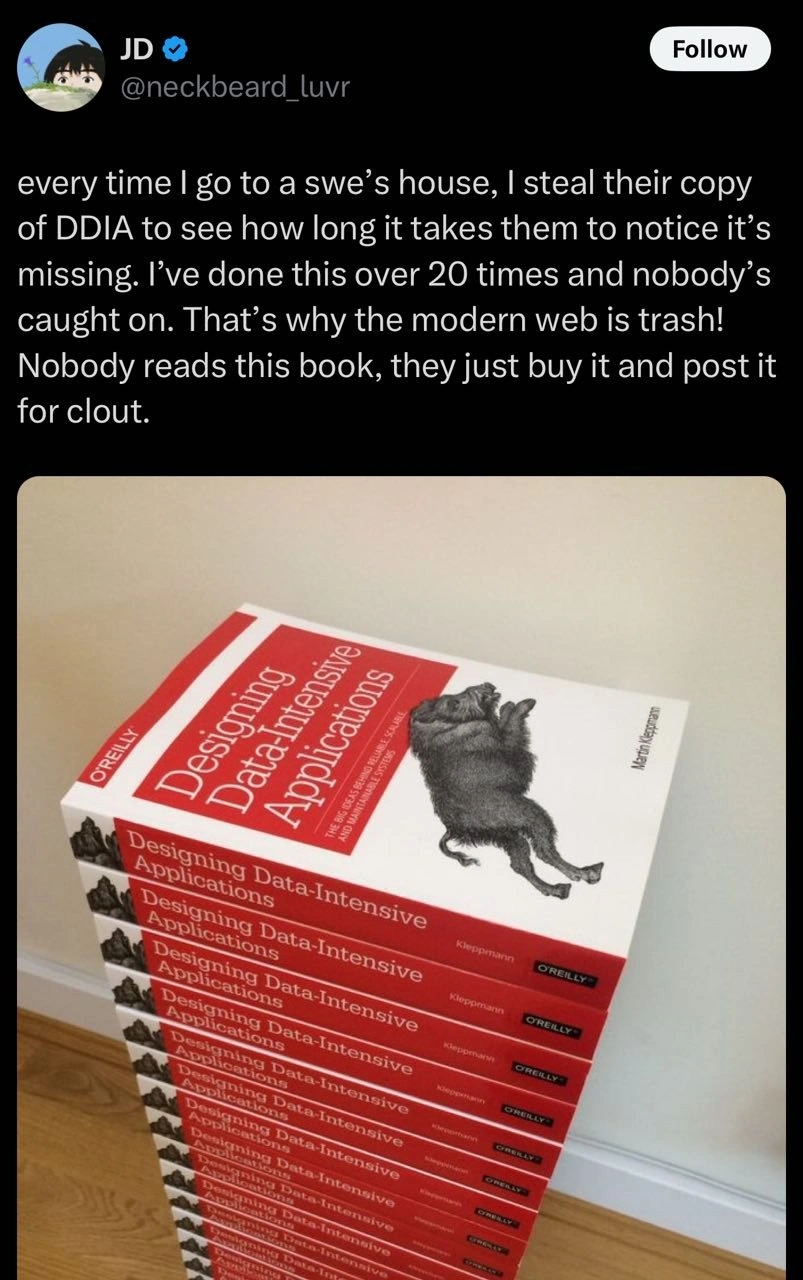
So what’s happening in the meme? The text is presented as a tweet (a post on Twitter, which many developers use to share jokes and hot takes). The person jokingly claims that whenever they visit a software engineer’s house, they steal that engineer’s copy of DDIA just to see how long it takes for them to notice it’s gone. They say they’ve done this over 20 times and nobody has caught on or complained about a missing book yet. Below that, there’s an image showing a giant stack of identical Designing Data-Intensive Applications books, presumably the “stolen” copies piling up. Then the tweet’s punchline: “That’s why the modern web is trash! Nobody reads this book, they just buy it and post it for clout.”
Let’s unpack the humor and terms:
- “post it for clout”: Clout means influence or prestige. In online communities (including dev communities), doing something “for clout” means you’re only doing it to look good or impress others, not necessarily because you genuinely care. So the tweet accuses developers of buying this big important book just to show off (maybe posting a photo of it on social media or keeping it on their shelf to look smart), rather than to actually study from it. It’s like a student who frames their diploma but never actually learned anything in class.
- Nobody reads this book: This is an exaggeration, but it taps into a real stereotype: developers often purchase highly-recommended technical books but don’t finish reading them. Designing Data-Intensive Applications is known to be excellent learning material, but it’s also quite dense and long. Many devs will admit they own it because it’s “the thing you should read,” but they might only have skimmed a chapter or two. The meme jokes that everybody has it, nobody truly uses it.
- Modern web is trash: “Modern web” refers broadly to today’s web technologies and websites. Saying it’s trash is a very exaggerated, grumpy opinion that websites/apps these days are poorly made – maybe they crash a lot, feel slow or bloated, etc. The joke’s “reason” for this trash quality is that developers aren’t actually educating themselves with foundational knowledge (like the stuff in DDIA). In reality, building a good web application is hard for many reasons, but the tweet humorously blames it on devs being lazy with learning. This line is delivered in a ranty, comedic tone – it’s the memer’s grand conclusion after revealing their prank.
- Software engineer’s house: The tweet says “every time I go to a SWE’s house.” SWE stands for Software Engineer. The idea is that whenever this person visits a developer friend or acquaintance, they’ll find a copy of DDIA on their bookshelf (since it’s so common) and sneakily take it. This part is almost certainly made-up for comedy – it’s unlikely someone is literally doing this as a hobby! But it sets up the joke scenario.
- Stack of books photo: The image attached (the waist-high stack of identical red-spined books) is there to add absurd visual proof. It implies “look, I’ve collected all these from different developers who never even noticed they were gone.” The sheer number of copies (20+) all the same is ridiculous, which makes it funny. It reminds one of a prankster’s “trophy wall,” except it’s a pile of the same tech book. This is the bookshelf_prank element of the meme – the prank being stealing books that were just decor.
For a junior dev or someone just learning, the underlying message is poking fun at a part of developer culture: owning fancy resources vs. actually using them. Think of it like this: imagine all your programmer friends say “Oh, you have to read this book, it taught me everything about scaling databases,” and everyone proudly displays it. You, wanting to fit in and learn, buy it too. But maybe you find it hard or boring and set it aside... yet you still keep it on your shelf. The joke is saying this happens so often that a mischievous person could steal the book from 20 different people and none of them would notice, because none of them were actually reading it or referencing it at the time. It’s a humorous exaggeration of the idea that sometimes tech folks care about the appearance of being knowledgeable (having the right books, talking about the right buzzwords) more than actually gaining the knowledge.
Additionally, the mention of the “modern web” being trash is part of a common tongue-in-cheek complaint among experienced developers. They sometimes say modern websites have too many libraries, too much JavaScript, or are built by people who rely on copy-paste without understanding fundamentals. This tweet humorously blames that on devs not doing their homework (like reading DDIA). Whether or not that’s true, it’s a funny oversimplification that fits a meme format. In essence, this meme is a form of TechHumor or TechSatire where insiders laugh at one of the quirks of the industry – here, the gap between learning ideals and reality. Even if you’re new to programming, you might recognize the scenario of buying a textbook or tutorial series and not finishing it. The meme just amplifies that scenario to an extreme to get a laugh from folks in the know.
Level 3: Clout-Driven Development
Zooming out to a senior dev’s perspective, this meme pokes fun at DeveloperCulture and an all-too-familiar pattern in DevCommunities: performative learning. In many tech circles, Designing Data-Intensive Applications is regarded as required reading – a staple for understanding DistributedSystems and big-scale architecture. It’s common to see developers brag on Twitter or LinkedIn about buying this hefty red book with the wild boar cute animal on the cover. Owning it has become a status symbol, a bit of developer clout that says, “Look, I’m serious about scalable systems!” But the joke here is that many never get past chapter 1 (if they even open it). They display the book on their bookshelf or in their Zoom background like a trophy – evidence of their aspiration rather than their achievement. This tweet calls them out in a hilarious (if brutal) way. By stealing these untouched copies to see if anyone notices, the prankster exposes that the book’s presence was mostly for show. As the tweet hyperbolically concludes: “That’s why the modern web is trash!” – implying today’s web apps are poorly built because engineers bought the wisdom but never actually consumed it. It’s a spicy take, essentially saying the industry pays lip service to best practices but doesn’t follow through.
Why do experienced devs find this hilarious and painfully relatable? It’s an IndustryIrony turned up to 11. We’ve all seen the phenomena of resume-driven development or, in this case, clout-driven development – choosing tools, frameworks, or reading material based on what will impress peers or look good on a CV, rather than what fits the problem. DDIA is a fantastic book, but it’s dense; a busy engineer might buy it with good intentions and then… get distracted by deadlines and never finish it. Meanwhile, they might still be building a “high-scale” system by cobbling together Stack Overflow answers and half-understood tech blog advice. Senior engineers chuckle because they know how that ends: systems that work fine in dev and trash out in production when a bit of load or a network glitch hits. It’s a form of TechSatire: everyone promotes sound architectural principles (maybe even dropping references to CAP theorem in meetings for extra DeveloperInJokes cred), but in reality, the codebase is held together with duct tape and technical debt.
This meme also resonates with the exhaustion of seasoned devs who’ve been on-call for those fragile systems. The Cynical Veteran outlook hears “nobody reads this book” and immediately nods – how many times have we seen a root cause analysis where the postmortem essentially says “We reinvented a flawed version of something we should have known, had we read the literature”? Perhaps the team decided to roll their own caching layer or queue, not realizing they were replaying well-documented mistakes in DDIA. The tweet’s prank is an extreme illustration of a real frustration: there’s a culture of LearningCurve theater. Teams proudly list that they own certain O’Reilly animal books or took some elite course, but the knowledge partition (to reuse the distributed pun) remains – the knowledge never made it into their brains or code.
The stack of 20 identical Designing Data-Intensive Applications books in the photo is basically physical evidence of the gag. It’s absurd and comical: this person has accumulated a mini-library of a single title by pilfering it from many engineers’ homes. The fact that none of those engineers ran frantically to reclaim their precious reference guide speaks volumes. It suggests that, to them, the book was more decorative than functional. In DeveloperHumor fashion, it exaggerates to make a point: many of us buy highly-recommended books like DDIA, Clean Code, or Introduction to Algorithms, but they end up gathering dust while we continue Googling simple questions those books answer in depth. Senior devs find this funny because it’s a self-own – we recognize a bit of ourselves or our colleagues in that scenario. We invest in knowledge outwardly, but day-to-day we might cut corners. This disconnect between what we say we value and what we actually do is prime material for TechHumor.
Also, the meme riffs on the ongoing modern_web_rant trope. There’s a popular narrative (especially among veteran programmers) that “the modern web is over-engineered and inefficient.” They blame things like heavy JavaScript frameworks, countless microservices, and no one truly understanding what’s under the hood. Here the tweet humorously blames that state on engineers not doing the reading. It’s obviously satire – the modern web’s complexity has many causes – but it playfully suggests a straightforward reason: developers have all the resources to build things right (like this acclaimed book), yet nobody actually uses them nobody actually reads them. In a way, it’s also poking fun at dev_twitter_memes culture itself: the poster @neckbeard_luvr adopts a smug, ranty tone common in tech Twitter hot takes, complete with an outrageous confession (stealing books!) to drive the point home. Senior folks know not to take it literally, but appreciate the hyperbole that exposes a real industry folly. In summary, this level of the joke lands because it resonates with our collective experiences in software: the difference between looking knowledgeable and being knowledgeable can have real consequences, and it’s both funny and frustrating to see that gap laid bare.
Level 4: Clout vs Consistency
At the most technical layer, this meme shines a light on distributed systems theory and the gap between possessing knowledge and actually applying it. Designing Data-Intensive Applications (DDIA) is essentially a bible of building BigData systems that are scalable, fault-tolerant, and consistent. It covers heavy-hitting concepts like the CAP theorem (Consistency, Availability, Partition Tolerance) – the fundamental trade-off triangle for any distributed database or service. The irony here is thick: these developers proudly display a book that explains how to handle network partitions and maintain data consistency, yet they haven’t cracked it open. In the world of distributed systems, if you don’t internalize things like “you can’t have 100% consistency and 100% uptime in a partitioned network”, you end up with fragile systems. The meme implies that many modern web developers are skipping this theoretical homework.
Consider what DDIA teaches: how replication works to keep data safe on multiple servers, how consensus algorithms like Paxos or Raft ensure multiple nodes agree on the same truth, and why designing a system for eventual consistency (where data might take time to sync) is very different from designing for strong consistency (where every read sees the latest write). Not reading the book means missing out on those lessons. It’s like a dev building a house on sand because they skipped the chapter on laying a foundation. The result? Flaky architectures that crumble under real-world conditions like high traffic or partial outages.
A veteran engineer would tell you that ignorance of distributed systems theory inevitably leads to painful 3 AM incidents. For instance, a dev who hasn’t learned about idempotency or exactly-once message processing might create a payment system that accidentally charges users twice when a network hiccup occurs. Or a team that glossed over linearizability vs serializable isolation (topics DDIA discusses in depth) could ship a database setup that returns stale, inconsistent data under load. These are the kind of data engineering pitfalls the book warns about. But on the “modern web,” many are winging it with high-level frameworks and copy-pasted code, blissfully unaware of the distributed systems dragons hiding beneath.
The tweet’s prank of stealing Designing Data-Intensive Applications from shelves is a Byzantine (pun intended) test of whether those devs even notice a partition in their knowledge. Twenty times, no one noticed their O’Reilly book was gone – effectively proving they never reference it. The deep cut of the joke is that having this book but not reading it means those devs likely never learned the classic fallacies of distributed computing (like “the network is reliable” – spoiler: it isn’t). In other words, they might be designing systems assuming nothing will ever fail, which every seasoned distributed systems engineer knows is a recipe for disaster. The meme suggests that the modern web is trash partly because folks are chasing hype clout instead of studying the underpinning computer science. The fundamental laws of distributed data (from the CAP theorem to consensus and beyond) don’t care about your Twitter flex; if you don’t respect them, your app will eventually break in mysterious ways. The humor (tinged with despair) comes from that academic truth: you can’t cheat the laws of distributed physics by simply owning the textbook.
Description
A screenshot of a tweet from the user JD (@neckbeard_luvr). The tweet text reads: 'every time I go to a swe's house, I steal their copy of DDIA to see how long it takes them to notice it's missing. I've done this over 20 times and nobody's caught on. That's why the modern web is trash! Nobody reads this book, they just buy it and post it for clout.' Below the text is a photograph of a very large stack of the book 'Designing Data-Intensive Applications' by Martin Kleppmann, published by O'Reilly. The book has a distinctive red cover with a black-and-white illustration of a wild boar. The meme satirizes the culture within software engineering where possessing certain highly-regarded, dense technical books is a form of status signaling. 'Designing Data-Intensive Applications' (DDIA) is considered an essential, almost canonical text for system design and backend engineering. The joke implies that many developers own it to appear serious and knowledgeable but haven't actually read it, using the tweeter's anecdotal theft as humorous 'proof' that this lack of fundamental knowledge contributes to poor software quality

Comments
20Comment deleted
That book is the senior engineer's equivalent of a Peloton. Everyone has one, but you can tell who's actually using it by whether they can explain the difference between two-phase commit and two-phase locking without checking the index
I’ve swiped so many unattended copies of DDIA that I now have enough for a full Raft quorum in my living room - still faster than getting any of the original owners to commit to chapter one
The real distributed system failure here isn't split-brain or network partitions - it's 20+ engineers achieving perfect consensus that they definitely read DDIA last quarter while their bookshelf silently implements eventual consistency
Ah yes, the infamous 'Designing Data-Intensive Applications' - the distributed systems equivalent of having a gym membership you never use. Every senior engineer's bookshelf has one, pristine and uncracked, serving its true purpose: proving to visiting engineers that you *totally* understand CAP theorem and could architect the next Cassandra if you weren't so busy with sprint planning. The real distributed system here is the network of software engineers collectively pretending they've read past chapter 3, achieving eventual consistency in their shared delusion that buying the book counts as learning. Meanwhile, production is held together with Redis as a message queue and a prayer, because nobody actually implemented any of Kleppmann's patterns - they just know the book exists, which is apparently enough to ship features
DDIA is the coffee table’s Kafka: an append-only log of good intentions, highly replicated, zero consumers
This DDIA stack nails fault tolerance: 20+ replica removals, zero downtime alerts, perfect eventual consistency for observers
The most accurate DDIA deployment I have seen is the bookshelf: infinite write throughput (purchases), near-zero read throughput, and an SLO of 'eventually consistent after the next outage'
Why did they go to 20 SWE's houses? Comment deleted
Sex Comment deleted
gay sex, to be more precise Comment deleted
Checks out Comment deleted
React devs hanging out Comment deleted
What does a swe mean? Oh, software engineer? Comment deleted
O really? Comment deleted
Nobody reads PAPER books for information nowadays. Paper books are purely status symbols. Comment deleted
commits crime calling out clout chasers posts on social media to chase clout truly remarkable Comment deleted
How good is that book ? And between 1 and 10 how's the pain ? Comment deleted
Book is amazing, pain progressivly gets worse from 2 to 8 i would say Comment deleted
late chapters when they talk about async stuff is pretty hard to comprehend Comment deleted
Interesting, I'll try that in a few months, thanks ^^ Comment deleted