Clippy Offers the Ultimate Haskell Code Review
Why is this Languages meme funny?
Level 1: Too Hard? Try Something Else
Imagine you’re trying to solve a really hard puzzle – like a giant jigsaw with tiny pieces that all look the same. You’ve been staring at it, totally confused. Then a funny cartoon helper (a talking paperclip with googly eyes, no less!) pops up and basically says, “Wow, this puzzle is super tricky. Want to throw it out and do a different one instead?” 😅 It’s silly, right? He’s not actually helping you solve the hard puzzle at all; he’s just suggesting you give up on it and start a new, easier puzzle! That’s exactly the joke here. The “hard puzzle” is like a very complicated chunk of code (written in a tricky style), and the paperclip character (named Clippy) is offering to ditch it and do it over in another way. It’s funny because it’s an overreaction: instead of helping figure out the tough parts, the cute helper’s idea is basically “let’s not even try with this, let’s just use a different toy.” Anyone who’s felt frustrated by a tough task can relate – it’s like if your homework is too confusing and someone says, “Why not just start a completely new assignment?” It might make you grin because it’s such an extreme, cartoonish piece of advice for dealing with something difficult. The humor comes from that contrast: big complicated problem meets an absurdly simple solution – just do something else!
Level 2: Clippy and the Code Rewrite
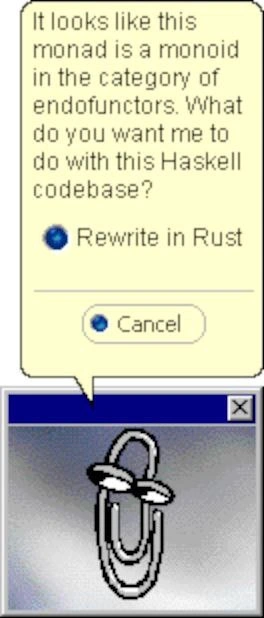
Let’s break down what’s happening in plain terms. The image is styled like an old Windows 98 dialog, featuring Clippy – the Microsoft Office assistant shaped like a smiling paperclip. Clippy was a cartoon helper from late-90s Office software that would pop up in a little window and offer help or tips (often interrupting you with “It looks like you’re writing a letter...”). In this meme, Clippy is appearing in a programmer’s context. The speech bubble text he’s showing is, “It looks like this monad is a monoid in the category of endofunctors. What do you want me to do with this Haskell codebase?” That sentence is a mouthful because it’s referencing a very advanced concept from functional programming – basically a high-level math way to describe something in Haskell.
Now, Haskell is a programming language known for being purely functional and for using a lot of abstract, math-like ideas to handle tasks. For example, Haskell developers talk about monads, which are a kind of design pattern or structure that helps handle things like computations, chaining operations, or side effects in a controlled way. (If you’ve heard of the “Maybe” type for optional values or the “IO” type for input/output in Haskell, those use monads under the hood to make handling missing values or doing IO easier and safer.) The phrase about “monad is a monoid in the category of endofunctors” is essentially a super-academic description of what a monad is — something you’d see in a theoretical computer science discussion. It’s famous for sounding smart but not helping a newcomer at all. Think of it as an inside joke among Haskell folks: if someone asks “What’s a monad?” and you reply with that definition, you’re technically correct but you’ve used even more confusing terms (monoid, endofunctor) to explain it! A monoid in simpler words is just an algebraic structure where you can “add” things together and there’s a do-nothing element (like how 0 is do-nothing for addition, or an empty string is do-nothing for string concatenation). An endofunctor is an even more abstract math concept — basically just a transformation that takes something and returns the same kind of thing (in programming, think of a type constructor that takes a type and gives you a new type, like taking “Int” and returning “Maybe Int”). Don’t worry if that still sounds confusing: the key point is that the text in Clippy’s bubble is intentionally over-the-top, signifying “this code is using some seriously abstract Haskell stuff!”
So Clippy sees this complicated Haskell jargon and asks, “What do you want me to do with this Haskell codebase?” Beneath that question, the meme shows two options you can choose: a radio button for “Rewrite in Rust” and another for “Cancel.” And “Rewrite in Rust” is already selected, as if Clippy is strongly suggesting that as the fix. This is the crux of the joke: Rust is another programming language, one that’s very popular right now, and known for different reasons than Haskell. Rust is a system-level language that’s loved for its performance and memory safety (it prevents things like crashes due to bad memory access). It has a very different philosophy from Haskell. While Haskell is all about pure functional programming and abstract mathy concepts to ensure code correctness, Rust is about safe manual control – you manage memory but the compiler ensures you don’t shoot yourself in the foot with bugs like buffer overflows or null pointer dereferences. In simpler terms, Haskell is like a high-tech science lab for programming (with complex rules that guarantee purity), and Rust is like a well-engineered workshop (with power tools that have safety guards). Both are highly regarded, but they attract different communities and solve different problems.
Refactoring usually means improving code without changing what it does, but what Clippy is suggesting here is more extreme than refactoring – it’s a full-on rewrite: tossing out the Haskell code and reimplementing everything in Rust. Why would someone suggest that? In real life, it happens when a codebase is hard to maintain or understand (maybe because it’s too advanced or “clever” like using lot of monads and category theory stuff) or if the team is more comfortable with another language. Rust has become famous as a tool to rewrite older systems (for example, replacing some C or C++ components with Rust for safety). So “Rewrite in Rust” has kind of become a meme on its own in developer circles: whenever something is wrong or complicated, people joke “just rewrite it in Rust!” as a one-size-fits-all solution. Here, the Haskell codebase is the “something complicated.” Haskell code can be tough for engineers who aren’t familiar with its very abstract concepts – it might even be considered legacy code if the original authors left and now nobody wants to touch that monadic wizardry. From a practical standpoint, a team might say, “We can’t deal with this obscure functional code, let’s start over in a language we know better (and hey, Rust is cool, right?).”
The use of the old Windows 98-style Clippy interface is part of the humor. It adds a nostalgic flair. For one, it’s visually funny: a grainy, pixelated dialog with a cartoon paperclip feels absurd in today’s era of sleek IDEs and AI code assistants. It’s mixing eras – 90s office software meets 2020s programming trends. Clippy offering to handle a codebase is itself ridiculous (he was meant to help with Word docs, not code!). And instead of suggesting something mild like “fix grammar” he’s suggesting a massive engineering decision: changing programming languages completely. The Cancel button at the bottom implies that if you don’t want to rewrite in Rust, your only other option is to dismiss Clippy – there’s no button for “Keep it in Haskell” or “Explain the monad,” which pokes fun at how these suggestions sometimes skip over understanding the problem and jump straight to drastic action.
So for a newcomer or junior dev, what’s funny here is the contrast and exaggeration. You have an old cute helper (Clippy) spouting a super scholarly line about Haskell code (monads and monoids – basically fancy words for how Haskell handles certain patterns). Then, without missing a beat, he suggests using a completely different language, Rust, to rewrite everything. It’s like if you showed a complicated trick and your solution is “eh, let’s not even try to understand that, let’s do it in some other way.” This plays on the common tech humor theme of language wars or rewriting code. Developers often debate: “Should we rewrite this in a new language or framework, or stick with the old one?” Here, the meme takes a clear (tongue-in-cheek) stance by having Clippy essentially say, “Yup, too complex – Rust will save us!” That’s why the first (and highlighted) option is “Rewrite in Rust.” It’s over-the-top advice, which is why it’s amusing. Even if you don’t fully get the monad talk, you can see that Clippy is confronting something confusing and defaulting to a drastic measure. For any junior dev learning about Haskell or Rust, it’s also a lighthearted reminder: Haskell can get very abstract, and Rust is currently the popular kid on the block that people might turn to when they’re frustrated with other languages.
Level 3: When Rust Is Your Hammer
Now let’s zoom out from the math and look at the scenario through a seasoned engineer’s eyes. We have a Haskell codebase full of advanced functional patterns (monads, category-theoretic abstractions) – the kind of code that can make even experienced developers furrow their brow. Enter Clippy with his suggestion: “Rewrite in Rust.” This is a playful jab at a real industry tendency: whenever a codebase is complex, hard to maintain, or just written in a language that not everyone groks, someone inevitably suggests “Let's rewrite it in [trendy language of the year].” Lately, that trendy hammer for every nail is Rust. Rust has a stellar reputation for performance and memory safety, so it’s become the go-to silver bullet in many engineers’ minds. Here, the meme exaggerates that reflex. Clippy’s dialog presents “Rewrite in Rust” as the default (and almost only) option – notice how the radio button for it is pre-selected, while the only other choice is “Cancel.” This framing humorously implies that rewriting the whole thing in Rust is obviously the correct action, as if there’s no real debate. It’s poking fun at senior devs who have a slight Rust fetish: no matter what the problem is, their answer is “Rust will solve it.”
From a senior perspective, this hits close to home because large-scale rewrites are both tempting and terrifying. We’ve all inherited a legacy codebase at some point – perhaps an old Haskell system full of esoteric monads that only the original authors truly understand. The immediate impulse might be “ugh, let’s scrap this and build it from scratch in a newer, more familiar language.” It’s almost cathartic to imagine starting fresh without all the accumulated quirks. Rust, being a modern systems language with a strong type system (inspired partly by Haskell’s type ideas, but geared toward low-level control), often enters that conversation as a candidate for a rewrite. The meme nails this scenario: faced with bewildering Haskell abstractions (like a monad that even Clippy describes using dense math jargon), the knee-jerk solution is to hit the big red Rewrite Button.
Experienced devs see the humor because they know rewriting is seldom that simple or obviously right. A senior engineer has likely experienced the “Let’s rewrite it!” cycle and knows it comes with huge trade-offs. Sure, Rust could eliminate certain classes of bugs (memory leaks, null pointer dangers, etc.) and might run blazing fast – but a full rewrite means reimplementing every feature, months (or years) of work, and inevitably introducing new bugs and new learning curves. Plus, Haskell and Rust are very different beasts: Haskell is a lazy, pure functional programming language with an emphasis on high-level abstractions (like monads) and elegance in logic, whereas Rust is an eager, compiled systems language emphasizing ownership and borrowing rules for memory safety. Migrating a codebase from Haskell to Rust isn’t trivial; it’s like converting a fancy bakery into a high-tech kitchen – both make food (results) but with totally different ingredients and processes. Seasoned devs are chuckling because they recall countless meetings or online threads where someone proudly suggests a Rust rewrite as the cure-all, often without fully understanding the original problem. It’s the modern twist on “if all you have is a hammer, everything looks like a nail” – here Rust is the hammer, and a convoluted Haskell codebase is the nail.
The Clippy character itself adds an extra layer for the veterans. Clippy is pure 90s/2000s nostalgia – the anthropomorphic paperclip from Microsoft Office that would pop up with questionable advice. He’d say things like, “It looks like you’re writing a letter...” and then offer comically basic help. Seeing Clippy in a programmer meme instantly tells older devs this is a tongue-in-cheek scenario. Instead of offering to format your document, Clippy is applying his “help” to your code. And true to form, his assistance is a bit off-target and simplistic: he sees something complex (monad ... monoid ... endofunctors – which he phrases as if he barely understands it) and his grand solution is essentially throw it away and use Rust. That’s hilarious to those of us who remember Clippy’s often unhelpful suggestions. It’s like Clippy has evolved from Office assistant to architectural consultant, but he’s still giving one-size-fits-all advice!
There’s also an inside joke about the Rust community hidden here. Rust’s tooling includes a linter called Clippy (named after the very same Office assistant as a lighthearted tribute). Rust’s Clippy normally gives you tips on how to improve your Rust code, but here we have Office Clippy cheekily telling you to convert Haskell code into Rust entirely. Senior engineers appreciate this double reference – it’s a mashup of tech generations. The meme blends the old-school annoyance of a cartoon paperclip with the new-school trend of “Rust everywhere.” It highlights a cultural moment: the perennial language debate. Once upon a time, C++ or Java might have been the proposed salvation for messy code; today it’s Rust. And in true cyclic fashion, the suggestion is often made with a mix of earnestness and overconfidence. The humor lies in knowing that real wisdom isn’t “always rewrite in Rust,” but seeing Clippy make that simplistic call-out is just too perfect. It captures the absurdity and the allure of the rewrite impulse in one image.
Level 4: Monadic Monoid Magic
At the deepest level, this meme hides a category theory Easter egg. The text in Clippy’s popup, “It looks like this monad is a monoid in the category of endofunctors,” is a notoriously highbrow description of monads in Haskell. In mathematical terms, a monad can indeed be defined as a monoid in the category of endofunctors on a category (such as the category of types). Let’s unpack that: In category theory, a category consists of objects (e.g. types in programming) and arrows (e.g. functions) between those objects. A functor is a mapping between categories that preserves their structure (Haskell’s type constructors like Maybe or IO are functors on the category of types— they map each type T to a new type like Maybe T). An endofunctor is just a functor that maps a category to itself (hence “endo” meaning within; Haskell’s type constructors map the category of Haskell types back into Haskell types). Now, a monoid in abstract algebra is a simple but powerful concept: it’s an entity with an associative binary operation and an identity element. For example, strings form a monoid under concatenation (with the empty string as the identity), or numbers form a monoid under addition (with zero as the identity). So what does it mean to be a “monoid in the category of endofunctors”? It means we treat functors a bit like values that can be combined and have an identity functor. In Haskell, a monad is an abstraction defined by two primary operations usually called return (or pure) and join (or bind >>=). These correspond to the identity and composition (binary combine) in a monoid, but lifted to the world of functors (endofunctors on the type system). Formally, if T is our endofunctor (like Maybe or IO), monad laws say:
return(the unit) lifts a plain value into the monadic context (analogous to an identity element).>>=(bind) orjoincomposes two monadic operations (analogous to a product or composition operation).
Just as a monoid’s operation is associative and has an identity, a monad’s bind is associative (different ways of parenthesizing binds lead to the same result) and return is the identity for bind. We can even line up the formal laws side by side:
-- Monoid laws (generic form)
mempty <> x == x -- identity on left
x <> mempty == x -- identity on right
(x <> y) <> z == x <> (y <> z) -- associativity
-- Monad laws (Haskell pseudocode for intuition)
return a >>= f == f a -- left identity (return does nothing before f)
m >>= return == m -- right identity (return does nothing after m)
(m >>= f) >>= g == m >>= (\x -> f x >>= g) -- associativity of binds
These monad laws mirror monoid laws, but in the realm of composed computations instead of plain values. The meme’s phrase is actually a famous tongue-in-cheek “definition” from the Haskell community: it’s mathematically precise, originating from category theory as popularized by programming language theory research (fun fact: this line “a monad is just a monoid in the category of endofunctors” is often quoted to poke fun at how unhelpful it sounds to someone who just wants to understand monads). Haskell was designed by academics who loved category theory, so a lot of Haskell’s abstractions (like Monoid, Functor, Monad) have roots in these mathematical concepts. When Clippy references this, it’s nodding to the fact that Haskell programmers sometimes drop scary-sounding math explanations for code concepts. It’s the ultimate over-engineered description – something a PhD student might say, not your usual Office Assistant tip! By including this abstruse line, the meme sets the stage: we have an insanely theoretical concept front and center. And even Clippy, the chirpy helper, appears stumped or bemused by it. It’s the equivalent of Clippy saying, “Wow, that’s some heavy abstract algebra in your code!” before offering help. This deep-cut reference signals to seasoned functional programmers that we’re dealing with high-level functional programming theory. In short, the meme is winking at those who know that under the hood, monads are backed by elegant math… and it’s precisely that elegance (or complexity) that often confounds and intimidates developers.
Description
The image features 'Clippy,' the iconic and often-parodied paperclip assistant from older versions of Microsoft Office, in its classic Windows UI element. Clippy is shown with a speech bubble that contains a highly technical and esoteric statement: 'It looks like this monad is a monoid in the category of endofunctors. What do you want me to do with this Haskell codebase?'. Below this complex analysis of a functional programming concept, two radio button options are presented: 'Rewrite in Rust' and 'Cancel'. The humor is multi-layered: it uses the nostalgic Clippy as a vehicle for a very specific developer in-joke. The phrase about monads is a famous, almost cliché, example of the perceived academic complexity of Haskell and category theory. The punchline is the suggestion to 'Rewrite in Rust,' which satirizes the relentless trend and evangelism within the tech community to rewrite any and all software in Rust, regardless of the original problem domain. The meme hilariously juxtaposes an abstract functional programming problem with a blunt, trendy, and completely different systems-language solution

Comments
11Comment deleted
I'm not sure what's more terrifying: the cryptic Haskell type error, or the fact that Clippy's default solution is a full rewrite and a fight with the borrow checker
When your code review bot speaks fluent category theory yet still defaults to the universal fix-all: `cargo new .`
After 20 years in tech, I've learned that 'a monad is just a monoid in the category of endofunctors' is both the most technically correct and least helpful explanation possible - kind of like Clippy suggesting you rewrite your entire codebase because you typed 'IO String'
Ah yes, the classic enterprise decision tree: encounter abstract functional programming concepts that actually work perfectly fine, immediately suggest rewriting the entire codebase in the language-du-jour. Clippy's just trying to help you justify that six-month rewrite to management by invoking category theory - because nothing says 'business value' like explaining to your VP that your monad is indeed a monoid in the category of endofunctors, but it would be *so much better* with Rust's borrow checker. At least Clippy had the decency to offer a Cancel button, unlike your tech lead who's already opened the JIRA epic
Clippy recognizes a lawful monad, but the only morphism the org respects is Haskell->Rust - hoping the borrow checker replaces specs and tests
Clippy can reason about monoids in endofunctors yet still proposes a greenfield rewrite - proof the borrow checker doesn’t protect schedules
Clippy groks category theory just to lure you into borrow-checker purgatory via Rust rewrite
https://paul.bone.id.au/pub/pbone-2016-haskell-sucks.pdf Comment deleted
Yeah it's a bit of a meme at the expense of the Functional Programming community Comment deleted
The PDF I linked does some archeology on that meme. Comment deleted
I’ll read it! Comment deleted