Game dev workaround: add a sign when the swim animation isn’t finished
Why is this GameDev meme funny?
Level 1: Please Do Not Swim
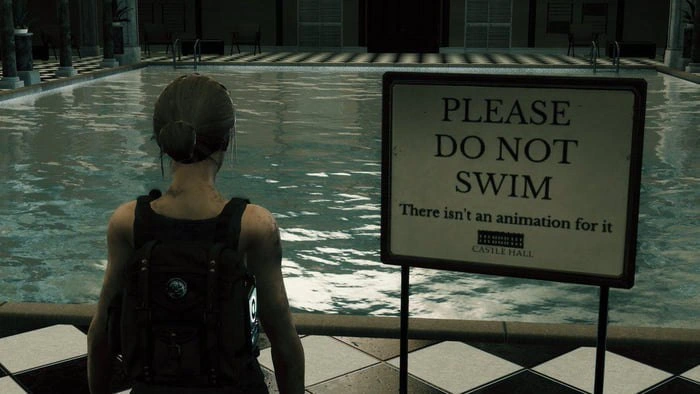
Imagine you’re at a swimming pool, all ready to jump in, but then you see a big sign that says, “PLEASE DO NOT SWIM – We didn’t finish building the deep end.” It would be pretty funny, right? Basically, it’s saying “don’t do this because we didn’t do our part.” That’s exactly what’s happening in this meme, but inside a video game. The game has a beautiful pool, but the people who made the game didn’t have time to teach the game’s hero how to swim. So, just like a quick fix, they put a sign next to the pool in the game that literally tells players not to swim. It’s as if in a fantasy world, someone put up a very honest warning sign. It’s funny because the sign gives away the secret: the creators didn’t finish that part of the game.
Think of it like building a go-kart for fun but forgetting to install the brakes. Instead of fixing the brakes (which is hard and time-consuming), you just stick a note on it that says, “Do not drive – no brakes yet.” It’s a silly solution, but it works: it stops people from driving something that’s not ready. In the game, the “PLEASE DO NOT SWIM” sign is doing the same thing. It stops the player from trying something the game can’t handle, and it makes them laugh because the reason is written right there: “There isn’t an animation for it.” That line is like the game developers joking with you, saying, “Sorry, we didn’t make a swimming motion for our hero.” Instead of the game glitching or the character doing something weird in the water, the player gets a little chuckle and moves on. The humor comes from how blunt and honest that sign is. It’s not a fancy excuse; it’s the actual truth presented in a playful way. Even if you’re not a tech person, you get the joke: they solved a complicated problem (no swimming ability) with a ridiculously simple answer (a sign telling you not to swim). It’s a reminder that sometimes, whether in games or real life, the easiest fix is just to clearly say, “Hey, we’re not doing that thing – carry on!”
Level 2: No Swimming Allowed
For a newer developer or someone early in their career, let’s break down what’s going on in this meme. In a video game, when you see a pool of water, usually the game has to support the character going into that water and swimming around. That means there should be a swimming animation (the character model moving arms and legs like a swimmer) and game logic to handle being in water (maybe slower movement, floating, etc.). In this case, the sign “PLEASE DO NOT SWIM” is literally telling the player: we didn’t add the swimming ability. The text under it, “There isn’t an animation for it,” is basically the developers admitting they never created the swim animation or mechanics. It’s a humorous way of saying, “you can’t do that action because we didn’t make it possible.” Usually, games would just invisible-wall you or give a generic “You can’t go there” message. Here they chose to be very direct and in-universe with a sign.
Now, why wouldn’t they add a swim animation? Often in GameDevelopment, teams have limited time and resources. Creating a high-quality animation and new gameplay feature (like swimming) is a lot of work. It involves an animation pipeline: artists have to model how the character looks while swimming, animators have to either hand-craft or motion-capture realistic swim movements, and programmers must integrate these with the game’s physics (so the character floats and moves correctly in water). Then you have to test it thoroughly. If the team is near the end of the project (close to release) and they realize this pool area would require all that extra work, they might decide it’s not worth delaying the whole game just for one pool. This is where resource constraints and deadlines come in. Instead of crunching for weeks to add one minor feature, they opted for a dev shortcut: just put a “no swimming” sign so players know not to even try. It’s actually a form of scope management – controlling the scope of the game’s features so the project stays on track. Cutting a feature last-minute is very common; doing it with a funny in-game sign is a creative twist.
Let’s talk about technical debt in simpler terms. Technical debt is like when you do something the quick and easy way in code or design, knowing that later on it might cause problems or need to be improved. It’s like a “debt” because you save time now, but you (or someone) will have to “pay” that time back later to fix or complete it properly. In this scenario, not implementing swimming is a form of technical debt. The “debt” here is that the game world is a bit less complete (you have a pool you can’t use). The quick fix was the sign. Maybe later, if they update the game or in a sequel, they’ll “pay off” this debt by actually adding swimming. But for the initial release, they lived with the incomplete feature. The sign is basically a big TODO note, but presented as part of the game’s environment. It’s as if the developers put a sticky note on the pool saying “finish this later” – except visible to players as an in-world object. New developers can learn from this that sometimes shipping a product means making tough calls about what not to include. It’s better to disable or clearly mark something unfinished than to leave a broken feature in. In software, you might hide a button that doesn’t work; in this game, they hid the whole activity of swimming behind a polite “do not swim” request.
The tag FeatureCreep also comes into play. Feature creep is when more and more features or ideas keep getting added to a project, often making it balloon in complexity and delaying completion. It’s possible someone early on said, “Hey, let’s have a beautiful pool in this level!” – but nobody realized that having a pool would imply the need for a swimming feature (or at least some way to handle water). The environment artists built a great pool (that’s the pool_level_asset, the actual 3D asset of the pool), and late in development someone testing the game probably tried to jump in, only to discover the character can’t swim. Oops! At that point, fully implementing swimming would have been feature creep — it wasn’t planned from the start and would take a lot of last-minute work. So the team wisely avoided adding that new feature so late. Instead, they controlled the situation with a narrative tweak: a “No Swimming Allowed” sign that fits the scene. It’s a bit of an immersion_break (because realistically, a facility would say “No Swimming – Pool closed” not “there isn’t an animation”), but the developers were clearly having a bit of fun with it. They even branded the sign “CASTLE HALL,” making it look like an official notice in that game’s world.
For someone who hasn’t worked on games, this might be surprising: aren’t games supposed to let you do anything that looks doable? In theory, yes, but practically, developers have to pick their battles. Not every object or area can be interactive. If you’ve ever played a game and hit an invisible wall or seen a door that doesn’t open, that’s the same idea – the devs didn’t create content past that point. Here they just chose to communicate it humorously rather than hide it completely. It’s a fun example of how gameplay edge cases are handled. A pool you can’t swim in is an edge case (most players might not even try, but some will). By putting the sign, the devs ensure anyone who tries to be adventurous gets a laugh instead of a glitch. And from the developers’ perspective, it’s much better than having the character walk on water, sink to the bottom, or freeze in a T-pose because of a missing animation. In short, this meme shows a lighthearted solution to a common game development problem: sometimes, due to time or budget, a feature isn’t finished – so you creatively flag it off. Even if you’re new to coding or game design, you can appreciate the ingenuity: rather than leave a bug, they turned it into a joke.
Level 3: Sign-Driven Development
Seasoned developers can almost feel the scenario that led to this funny in-game sign. It’s the final weeks of a project, there’s an indoor pool area in the level design, and someone realizes: “Wait, what happens if the player jumps in the water?” The answer is… nothing good, because there’s no swim animation or water mechanics. The animation team either ran out of time or the task got deprioritized. A lack of swim animation and a looming ship date collided head-on. Instead of coding a whole new swimming system frantically trying to build out swimming abilities at the eleventh hour, the team did what any scrappy dev under pressure might do: slap a quick fix on it. In this case, they literally put a sign in front of the pool that diegetically says “Don’t even try it.” This is Technical Debt made visible in the game world. Technical debt is basically when you take a shortcut or dev shortcut to meet a deadline, knowing full well you’re leaving a kludge in place. Here, rather than properly implementing a complex swimming feature, they left a comical in-world note saying, “Yeah, we didn’t do this.” It’s akin to shipping a product with a giant TODO stuck on the front – bold and honest.
Every experienced engineer recognizes this pattern. We’ve all had those “uh-oh” moments late in development where a feature isn’t finished. The usual solutions aren’t pretty: disable the button, put up a “coming soon” message, hard-code some fallback. In game development, you might block off a zone entirely or make the water area inaccessible via invisible walls. The twist here is the developers turned the omission into a bit of developer humor. The sign’s smaller text, “There isn’t an animation for it,” reads like a direct patch note or a developer comment inserted into the game’s lore. It transforms a potential bug (“player falls into water and T-poses”) into a silly feature (“there is a polite sign from the fictional authorities”). It’s both a scope control measure and a wink to those who understand GameDev struggles. The phrase essentially translates to: “We didn’t have time to make swimming, so please just don’t try.” By doing this in-world, they maintain the veneer of the game’s reality (it’s a sign in a castle pool that a character might actually see), even as they break the fourth wall with the explanation.
This approach is a classic case of cutting scope to hit a deadline. Implementing a fully functional swimming mechanic late in development is risky and expensive. You’d need to animate the character’s swim strokes, deal with water physics and buoyancy, possibly alter level design (what if players swim out of bounds?), and ensure the AI or gameplay systems all handle water properly. That’s a huge effort for what might be a minor part of the game. Far easier to treat the pool as decorative and prevent the player from diving in. We often call these last-minute preventive measures “designing around a problem.” The devs effectively said, “If we can’t afford to let players swim, we’ll make sure they know not to.” It’s funny because they didn’t even try to disguise it with an in-lore excuse like “Pool closed for maintenance.” They went full honesty mode. It’s a bit of an inside joke for the community: anyone who’s worked on games or software knows the smell of a hastily applied patch.
In fact, we can imagine the pseudo-code behind this decision:
// If swimming isn't implemented, put up a warning sign in the game world
if (!animationExists("swim")) {
world.placeSign("PLEASE DO NOT SWIM\n(There isn't an animation for it)");
}
Rather than a subtle flag in a config file, the “feature flag” here took the form of a big signpost in the level. It’s a sign-driven development moment – literal signage to handle a missing feature. It’s both slightly embarrassing and incredibly relatable to developers. On one hand, it’s a bit of a shame: a grand swimming pool that the hero can’t even dip a toe into, all because of cut corners. On the other hand, by owning up to it with humor, the devs turned it into a memorable moment. It’s essentially the patch notes delivered via an in-game placard. Long-time devs are nodding knowingly (and laughing) because this embodies the eternal struggle between feature creep and deadlines. You can almost hear the project manager saying, “We’ll add swimming in the next update or sequel, but for now, just put something there to prevent bug reports.” And thus, a simple sign saves the day – or at least saves the schedule. It’s a sign of both clever triage and collective developer fatigue, one that says: We know we didn’t finish this, and we’re just gonna roll with it. In the end, the players get a chuckle, the game ships on time, and the dev team gets a legendary anecdote of how they once solved a problem with a virtual yard sign.
Level 4: Diegetic Feature Flag
At the highest technical level, this meme highlights how game developers cleverly handle missing features by blending development constraints into the game’s diegetic reality. In game design terms, diegetic elements are things that exist within the game world itself (as opposed to menus or pop-ups). Here, the “PLEASE DO NOT SWIM” sign is a diegetic workaround—the developers literally put a warning inside the environment to guide player behavior. This is effectively a feature flag manifested as an in-game object: rather than a config toggle in code, it’s a physical sign saying “swimming is off.” The humor comes from how unapologetically the sign’s subtitle breaks the fourth wall, stating “There isn’t an animation for it.” That line is deliberately comedic meta-text on a regal-looking sign, like a castle caretaker suddenly speaking with a programmer’s honesty.
From a systems perspective, this speaks to the complexity of animation state machines in a modern game engine. A playable character’s actions are governed by a finite set of states (idle, walk, run, jump, etc.), and transitions between them. Introducing a new state like swimming isn’t trivial; it means defining animations for swimming, transitions into and out of water, physics for buoyancy, interactions with the environment, and so on. If the state for “in water” or the swim animation is missing, the engine has no defined behavior when the player steps into the pool. In formal terms, the game’s finite state machine for player movement has a hole in its state graph. Attempting to enter that state (going into the water) would yield undefined behavior (think of a character suddenly T-posing or just walking underwater as if it were land). Rather than risk a glitch or spend weeks filling that gap properly, the developers constrained the game world itself to prevent that undefined transition. It’s like adding a rule to the simulation: players shall not enter water because we haven’t modeled that. In the language of software architecture, they’ve added a guard rail at the content level instead of adding a new branch in the code logic.
This solution also reflects the resource constraints and triage decisions in game development. High-fidelity character animations are expensive: they require 3D artists to create models and rigs, animators (possibly motion capture sessions) to produce realistic movement, and programmers to integrate those animations with game physics and controls. All of that has to be refined and tested in the animation pipeline. If a feature like swimming wasn’t absolutely essential, a team under a tight deadline might cut it to save time and budget. The technical debt gets externalized as a narrative element. It’s an engineer’s version of the old theater adage, “if you can’t fix it, feature it.” Here the missing feature is literally featured as a joke.
Of course, doing this flirts with breaking the player’s immersion (the feeling of being “in” the game world). A fancy indoor pool in a realistic game world would normally be a tantalizing gameplay area, but the giant explicit sign saying “no swimming – not implemented” sticks out. It’s certainly an immersion break — an explicit nod from the devs that pops the fantasy bubble (an example of ludonarrative dissonance). Yet, because it’s presented with tongue-in-cheek humor, players are invited to laugh with the developers. In a way, the sign becomes an Easter egg of honesty. Rather than hide the limitation completely, the devs chose a path of least resistance and maximum wink-to-the-audience. In the broader context of Game Development history, this aligns with how games often use creative barriers to mask incomplete content: invisible walls, “under construction” tunnels, NPCs that say “The door is locked,” and so on. This meme just makes the subtext explicit. The game world’s fiction bends to accommodate a development shortfall – a sophisticated little example of engineering pragmatism merging with game design. It’s a reminder that behind every seamless virtual world is a pile of clever tricks ensuring that what hasn’t been built stays unseen, or in this case, is playfully acknowledged with a polite notice.
Description
The image shows a third-person game character standing beside an indoor pool rendered in muted, realistic colors. A freestanding sign in the foreground reads, in all caps, “PLEASE DO NOT SWIM” followed by the smaller subtitle “There isn’t an animation for it,” with a small “CASTLE HALL” logo beneath. The scene humorously reveals a production shortcut: rather than implementing the complex swimming animation state machine, the developers blocked the action diegetically. For seasoned engineers, it’s a tongue-in-cheek nod to shipping deadlines, animation pipeline costs, and the ever-present temptation to patch over missing features with in-world warnings - an embodiment of technical debt and scope control in game development

Comments
6Comment deleted
If the swim state machine isn’t ready, just deploy a diegetic feature flag - a poolside sign. Jira closed, tech debt rebranded as “environmental storytelling.”
When the product owner asks why we can't just "quickly add swimming" to the game three weeks before launch, and you realize they've never seen the 47-file state machine that barely handles walking without T-posing through walls
This is the game development equivalent of 'TODO: implement later' making it to production - except instead of a code comment buried in a repository, it's a literal sign in the game world. It's refreshingly honest: why spend three sprints implementing fluid dynamics, buoyancy physics, and swimming animations when you can just... not? The sign perfectly captures the eternal tension between ambitious feature lists and shipping deadlines. Every senior engineer has been in that architecture review where someone suggests 'just add swimming' and you have to explain that 'just' involves rigging, animation blending, state machines, collision detection in water volumes, and probably breaking save game compatibility. Sometimes the most elegant solution is a well-placed sign and moving on to features that actually matter for the core gameplay loop
The animator’s swim transition didn’t make the cut, so we shipped a diegetic NotImplementedException - aka a sign by the pool
Gamedev triage: infinite sign LOD, zero swim spline budget
Peak MVP: supportsSwimming=false in config, and the error message shipped as environmental storytelling - “Please do not swim.”