Meme quiz claims ping-pong tables keep developers longer than salary increases
Why is this CorporateCulture meme funny?
Level 1: Candy vs Allowance
Imagine you get a weekly allowance from your parents for doing chores. You’ve been working really hard – cleaning your room, doing the dishes – and you feel you deserve a bit more money for it. So you tell your parents, “I think I should get a raise in my allowance.” Now, picture your parents really don’t want to give you more money. Instead, they go, “Hey, look! We bought a new ping-pong table for the house! Isn’t that fun? You can play ping-pong anytime!”
How would you feel? Probably a mix of confused and annoyed. Playing ping-pong is fun for a little while, sure. It’s like when a kid is upset and the grown-ups give them a piece of candy to cheer them up. The candy might make them smile for a minute, but it doesn’t solve why they were upset in the first place if the reason was something bigger. In this story, you were asking for more allowance (that’s like asking for more pay at a job). Instead of doing that, your parents offered a toy or game. It’s nice, but it’s not what you really needed.
The meme is funny because companies sometimes act just like those parents. When programmers (who are the workers in a tech company) feel unhappy and think about leaving, often it’s because they want something important like better pay, feeling respected, or a healthier work life. But some companies will try something silly to make them stay, like adding a game room or free snacks, kind of like offering candy. The joke in the picture is showing a fake quiz where the company believes “ping-pong table” is the correct answer to keep people around, and treats “a pay raise” as a wrong answer. It’s like saying the company thinks fun and games are more important than money to make their workers happy.
Of course, just like you can’t fill your belly with a ping-pong paddle if you’re hungry, a programmer won’t truly stay just because there’s a ping-pong table if the real needs (like fair pay and feeling valued) aren’t met. The humor is in that obvious mismatch – anyone can see a toy isn’t the same as real care. So even if you’re not a tech worker, it’s a bit like a cartoon showing how goofy it is when a boss tries to solve a big problem with a little, flashy distraction.
Level 2: Ping-Pong vs Paycheck
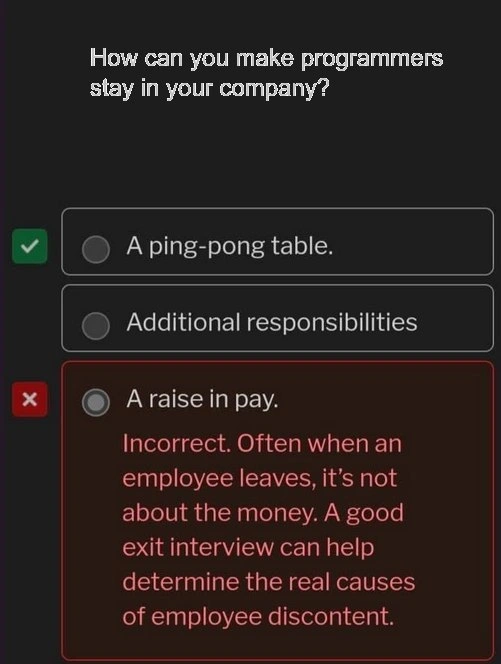
Let’s break down the meme’s elements and why they matter to a developer’s workplace culture. The image mimics a quiz question, asking how to keep programmers from leaving a company (that’s employee retention – basically, keeping employees happy so they don’t quit). There are three possible answers shown as if you clicked a multiple-choice test:
“A ping-pong table.” – This one has a green check mark next to it, as if it’s the correct answer. In many tech companies, especially startups, having a ping-pong table or a foosball table in the office is a symbol of a fun, relaxed environment. It’s a classic token perk: a small, flashy benefit meant to improve morale. The meme highlighting this as the “right” answer is a tongue-in-cheek jab at companies that think adding play equipment will make developers never want to leave. It’s poking fun at the idea that a game in the break room could outweigh serious matters like salary or workload. Many developers do enjoy these games during breaks, sure, but no one confuses them for real compensation.
“Additional responsibilities.” – This option is left unselected (just a plain radio button with no mark). It represents giving the programmer more work or perhaps a bigger job title as a way to make them stay. For example, a company might think, “We won’t increase their pay, but we’ll give them a fancy title or more projects to own, they’ll feel important.” Most developers, especially newer ones, learn quickly that new responsibilities without extra support or compensation can feel like a raw deal. It often means more stress and longer hours without a real benefit to the employee. The meme doesn’t mark this as correct or incorrect explicitly, but by not highlighting it, it suggests this isn’t really a compelling reason for someone to stay either. It’s a subtle inclusion that rounds out the picture: companies often try to promote people in name or pile on tasks instead of giving meaningful rewards. Junior devs might first think a promotion is great, but if it’s just more work with no raise, it gets unappealing fast.
“A raise in pay.” – This one is shown inside a red box with an X, labeled as “Incorrect.” Typically, a raise in pay means giving the employee more money – a higher salary. You’d think that’s an obvious way to make people happy at a job: pay them more for their valuable skills. The meme’s joke is that the company in question is acting like this is the wrong answer. There’s even a message in red below it mimicking a quiz explanation: “Incorrect. Often when an employee leaves, it’s not about the money. A good exit interview can help determine the real causes of employee discontent.” This sounds just like something an HR representative or manager might say. An exit interview is a meeting HR does with an employee who’s about to leave, asking why they’re leaving and what the company could do better. Companies gather those answers to look for patterns. The meme calls the idea that “it’s not about the money” an exit_interview_myth – basically suggesting that management loves to say people leave for reasons other than salary. Sometimes that’s true; people quit because of poor management, lack of career growth, or a bad environment. But very often, inadequate pay is a big part of the story. However, employees might not always bluntly say “I’m leaving for more money” in an exit interview (maybe to avoid awkwardness or burning bridges). This leads some bosses to comfort themselves with “see, it wasn’t our low salaries, it was something intangible.” The meme highlights how a company might dismiss the straightforward solution (paying people what they’re worth) and instead reach for that comfortingly vague explanation.
So what’s the context here? It’s riffing on WorkplaceHumor that many developers and other professionals share: the frustration when management offers superficial solutions to serious problems. Think of things a new programmer might notice in their first job: the office has cool things like a ping-pong table, video games, or free snacks, which seemed amazing at first. It’s like, “Wow, they really care about us having fun!” But then, as you gain a bit of experience, you realize your workload is crushing or your salary isn’t keeping up with market rates. When you or your colleagues bring these issues up, management might respond with something like, “We’re doing what we can – hey, did you see we got a new espresso machine for the dev team?” It can feel like a disconnect: they’re addressing morale problems with perks, instead of directly fixing the cause (like hiring more people to help, or giving a well-deserved raise).
For a junior developer, this meme is a peek behind the curtain of CorporateCulture. It teaches that not all companies handle employee_retention in a logical way. Some companies genuinely believe a fun break room = happy employees = nobody leaves. And to be fair, a positive environment and camaraderie do help – nobody wants to work in a dull, drab office with no breaks. But ping-pong should complement proper treatment, not replace it. The humor here is a bit sarcastic: it implies no sane programmer would actually stay at a job just because of a ping-pong table if they’re underpaid or unhappy, yet some companies act as if they would. It’s a lesson many learn in their career: WorkplaceCulture gimmicks can’t cover up deeper issues.
In short, the meme uses a simple quiz format to contrast perks vs. pay in the workplace. It’s highlighting an inside joke among developers (DeveloperHumor): “Our bosses think a ping-pong table will solve everything.” If you’re early in your career, keep an eye out for this. Perks are nice, but they don’t pay your rent. A company that offers both a good culture and fair pay is the ideal. If you find yourself somewhere that keeps adding token_perks while you’re feeling undervalued, this meme is basically saying, “Yeah, we’ve been there, and it’s absurd, isn’t it?”
Level 3: The Retention Racket
In the tech industry’s corporate culture, memes like this hit a nerve because they reflect a painful truth: management often reaches for cheap token perks instead of addressing core issues. The image is styled as a multiple-choice quiz asking, “How can you make programmers stay in your company?” The supposed “correct” answer marked with a green check is a ping-pong table, while a raise in pay is flagged as wrong with a red X and a patronizing explanation. This satirical scenario is practically a rite-of-passage story senior developers swap over coffee (or the free beer on Fridays).
Why is it funny? It’s a classic case of the management–engineering disconnect around what really motivates developers. The humor comes from exaggerating a real pattern: companies proudly touting their new foosball table or unlimited soda fridge as if that will magically solve burnout and high turnover, while dismissing calls for better compensation or sane workloads. It’s “our devs are leaving? Quick, buy a ping_pong_table and paint the office walls neon green!” – a scenario so cynically common that it’s basically CorporateHumor folklore. Seasoned engineers have seen it all: when morale and retention dip, some exec invariably suggests perks over pay. It’s cheaper and Instagram-worthy. DeveloperFrustration kicks in when you realize the budget for that fancy game room came out of the pool that could have funded overdue pay raises or new hires to share the load.
This meme cleverly satirizes that mindset. The quiz format with “Incorrect” in bold red plays on how out-of-touch answers can be treated as official doctrine. The red error box parrots an HR cliché: “Often when an employee leaves, it’s not about the money.” That line is a staple of Career_HR meetings and exit interviews. It’s not completely false—people do leave due to bad bosses, lack of growth, or toxic culture—but it’s often overused as an excuse to avoid discussing salaries. A grizzled engineer can almost hear the ManagementHumor in that voice: “Don’t blame our tight-fisted salary bands; the real issue must be something fuzzy like culture.” The meme’s punchline is effectively, “Yes, environment matters, but did you really think a ping-pong table is what we meant by a better environment?”
This DeveloperHumor resonates because it shines light on priorities gone haywire. WorkplaceCulture perks like games and free snacks are nice-to-have, but they don’t pay the mortgage or reduce 2 a.m. on-call pages. As an experienced dev, you chuckle (perhaps a bit bitterly) because you’ve likely endured a meeting where higher-ups propose “fun initiatives” instead of fixing root problems. It’s a form of organizational technical debt in culture: easier to buy trinkets than to refactor outdated HR policies. The Retention Racket here is how companies may use flashy perks to create the illusion of a great place to work, hoping to keep programmers from noticing stagnating paychecks or mounting Additional responsibilities with no promotion in sight. The term “racket” fits: it’s like a scam – using a ping-pong racket to volley away the real issue.
In essence, the meme points out a truth seniors know too well: real employee_retention isn’t a game you win with gimmicks. It’s achieved by treating developers as professionals – fair raise_in_pay, respect for work-life balance, opportunities to grow – not by tossing in a new toy and calling it a day. The humor has that dark edge of truth: we laugh, but only to keep from crying about how often this happens in real life.
Description
The image is styled like a multiple-choice quiz on a dark background. At the top, white text asks, "How can you make programmers stay in your company?" Below are three grey answer boxes with radio buttons: 1) "A ping-pong table." is highlighted with a green check mark on the left, 2) "Additional responsibilities" is left unselected, and 3) "A raise in pay." is inside a red error box with a red X icon; beneath it crimson text reads, "Incorrect. Often when an employee leaves, it's not about the money. A good exit interview can help determine the real causes of employee discontent." The joke satirizes corporate retention strategies, implying management values superficial perks over meaningful compensation, a common gripe among software engineers. Technically, it touches on developer experience, workplace culture, and the management - engineering disconnect around retention and motivation
Comments
16Comment deleted
HR math: (market-rate salary × 0.8) + ping-pong table⁴ = 100 % retention - meanwhile every senior dev is calculating exit velocity, not of the ball, but of themselves
After 20 years in tech, I've learned that companies will spend $50K on a foosball table, $100K on a 'culture consultant', and $200K replacing the senior engineer who left for a $30K raise elsewhere. The real MVP is the exit interview software that somehow concludes it was about 'growth opportunities' when the dev literally wrote 'MONEY' in 72pt font
Ah yes, the classic startup retention strategy: 'We can't afford competitive salaries, but we have a ping-pong table and unlimited LaCroix!' Meanwhile, the exit interview reveals developers are leaving for 40% raises at companies that understand the difference between a retention bonus and a retention ping-pong table. The real kicker? Management genuinely believes the explanation that 'it's not about the money' while engineers are literally leaving for better compensation packages. It's the corporate equivalent of debugging by adding print statements but refusing to look at the actual error logs
Startup math: 1 ping-pong table > 20% TC bump, until the table's orphaned in the next pivot
HR treating retention like CAP: skip pay and sane on-call, then act shocked when the cluster partitions to LinkedIn
Calling "raise" incorrect and "ping‑pong table" correct is chaos engineering on headcount
Ah yes. I like to stay 36 hours a week sitting in front of a computer, ruining my life and my eyes, voluntarily of course. Comment deleted
Open source contributors: HELL YEAH Comment deleted
You mean 63 hours a week, right? (7x9, not including launch time) Comment deleted
36 in hexadecimal~ Comment deleted
Ah, the imperial system... 😁 (10 to 16 is almost like 1 km to 1 mile.) Comment deleted
If only i had a ping pong table my wife wouldn't have left me Comment deleted
If only I had a ping pong table, maybe I could have enough money to buy a house Comment deleted
You could make yourself an olimpic ping pong player and maybe make some money working for an italian mafia. Comment deleted
In a company with a ping pong table I have spent eight years - more than in all others combined. Rarely used it however - my colleague was a real pro and there was little point in playing against him. Comment deleted
foosball is always superior Comment deleted