The Architect's Dilemma: He's Thinking About Other Entities
Why is this GameDev meme funny?
Level 1: The Other Woman Is Code
Imagine a couple in bed, and the girlfriend is worried because her boyfriend seems really distant and quiet. She’s thinking, “Hmm, I bet he’s daydreaming about another lady.” But actually, his mind is completely elsewhere – he’s thinking about building his video game! He’s trying to figure out a tricky way to organize all the little parts of his game (kind of like figuring out the best way to build a big LEGO castle in his head). In simple terms, the joke is that she suspects he’s not loyal, but in reality he’s totally loyal – just to his code project! The “other woman” stealing his attention isn’t a person at all; it’s the idea of how to make his game work better. It’s funny and sweet because it shows how geeks can be in love with their projects. The poor girlfriend is jealous of an imaginary rival, when really he’s just lost in nerdy thoughts. In the end, nobody’s cheating on anyone – except maybe he’s cheating on sleep by staying up late thinking about programming!
Level 2: Entity of His Affection
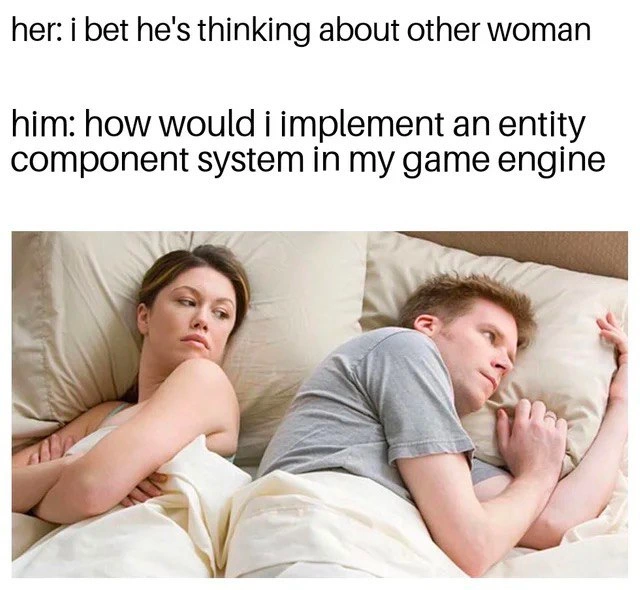
At this level, let's break down what an Entity-Component System (ECS) actually is, and why it would consume a game developer’s thoughts. The meme shows a common scenario: a couple in bed, the woman looks annoyed and assumes "he’s probably thinking about another girl". But the text reveals the man is actually thinking: "How would I implement an entity component system in my game engine?". This is a popular meme template where the punchline is that the guy’s mind is on something extremely nerdy or mundane instead of romance. Here, the nerdy thing is an ECS for a game engine. Classic developer relationship humor – the partner feels ignored because the developer's brain is still in debug mode even off the clock.
So, what is an ECS in simpler terms? It's a way to organize code for games (a kind of software architecture design). Instead of making one big class for each object type in a game, you separate data and behavior. Here's how it works:
An Entity is basically a game object, but usually it's just an ID or an empty container. Think of an entity as an empty bucket or an index that will hold traits. For example, Entity #42 could eventually represent a player or a monster, but by itself it's just an ID number with nothing attached yet.
A Component is one specific kind of data or attribute you can attach to an entity. It’s like a trait or property. For instance, you might have components like
Position(x,y)for location,Velocity(vx,vy)for movement speed,Sprite(image)for appearance, orHealth(points)for hit points. Each component typically holds data only (no big functions). So if Entity #42 is our player, we might attach aPositionComponentand set its coordinates, aSpriteComponentto give it a graphic, aHealthComponent, etc. Essentially, components are the pieces that you mix and match to give an entity its features. It’s similar to how you equip a character in a game with various items, but here you’re equipping the entity with data modules.A System is the logic that runs over all entities with a certain set of components. Think of systems as global managers or functions that operate on every entity that has the components the system cares about. For example, a PhysicsSystem might look for every entity that has a Position and Velocity component and update their position each frame based on velocity (applying the formula new_position = old_position + velocity * deltaTime for all of them). A RenderSystem might find every entity with a Position and Sprite component and draw them on the screen. Each system focuses on one aspect of the game (physics, rendering, AI, sound, etc.) and updates all relevant entities together.
In code, a super simplified ECS loop might look like this:
// Pseudocode for an ECS update loop
for (Entity e : entitiesWith<PositionComponent, VelocityComponent>()) {
// This loop runs for each entity that has both a Position and Velocity
auto& pos = e.get<PositionComponent>();
auto& vel = e.get<VelocityComponent>();
pos.x += vel.vx * deltaTime;
pos.y += vel.vy * deltaTime;
// (The PhysicsSystem is moving each entity based on its velocity)
}
In this snippet, entitiesWith<PositionComponent, VelocityComponent>() represents a query that returns all entities containing those two components. We then update each entity’s position using its velocity. This is how an ECS system processes data from components. Notice how we didn’t need to know if e was a "Player" or "Enemy" or "Bullet" explicitly – as long as an entity has the right components, the system will update it. That’s the beauty of ECS: flexibility. Any entity that can move (has Position + Velocity) will be moved by the physics system, whether it's a player, enemy, or even a moving platform.
Now, why would implementing this keep someone up at night? For a game developer (especially one building their own engine), choosing to use an ECS is a big architectural decision. It promises cleaner organization and often better performance for lots of game objects, but it's tricky to get right. The developer in the meme is basically lying in bed designing in his head: "How should I code this? Should I use a list or map for components? How do entities find their components quickly? How do I avoid slowing down the game if there are thousands of entities?" These thoughts can snowball. If you’re a relatively new programmer, imagine trying to plan a big class project in your head—now multiply that complexity. A game engine is huge, and an ECS touches all parts of it (game objects, logic, rendering, etc.), so he’s essentially mentally juggling a lot of moving pieces.
Let’s also acknowledge the relationship angle: anyone who’s dated a software developer or been one knows that distant stare when we’re lost in thought. You might be having dinner or lying in bed, and suddenly the dev’s eyes glaze over—they're debugging something in their mind or brainstorming a solution to a coding problem. The meme plays this out: the girlfriend assumes the topic must be another woman (a common worry or trope in relationships), but ironically it’s something super technical. The contrast is what makes it funny. She’s concerned about love and fidelity, while he’s concerned about ECS architecture and fidelity of his game design. It’s an exaggerated way to show how deeply developers can get pulled into their work or hobby.
From a junior perspective, it’s also a bit educational about priorities in game dev. You might think game programmers just worry about fancy graphics or gameplay ideas, but a lot of their time is spent on how to structure code under the hood. An EntityComponentSystem is one of those under-the-hood things that isn't flashy to players but makes life easier for developers when done right. Big engines like Unity or Unreal have similar component-based designs because games often have tons of objects, and ECS is great for handling that complexity. So our guy in the meme is essentially pondering: "How do I build a system that can handle maybe hundreds or thousands of game objects efficiently and flexibly?" That’s a serious engineering puzzle – and yes, it’s engaging enough that it might distract you even when you’re supposed to be relaxing.
In simpler analogy, think of an ECS like constructing a character out of interchangeable parts, kind of like a Mr. Potato Head toy or LEGO set. The entity is the base potato (or a blank LEGO figure), and all the components are the attachable parts – eyes, hats, shoes, etc. You can create a cowboy, a pirate, or a doctor just by plugging different pieces into the same potato base. In a game, you might create a monster by giving an entity a Position, a Sprite (appearance), a Health component, and an AI component. Or create a treasure chest entity by giving it a Position, a Sprite, and maybe a Loot component. The systems are like the person playing with all the Potato Head dolls at once, making sure each one gets the right accessory or action: one system might be responsible for moving everything that has legs, another system might handle any entity that can talk, etc. This modular approach is very different from a one-size-fits-all class for each thing. It’s both powerful and a bit mind-bending if you haven’t seen it before.
The man in the meme is essentially daydreaming about his "LEGO kit" of game development, figuring out how to organize those pieces. He’s not unusual among developers – many of us find ourselves designing systems informally in our downtime. The joke tickles developers because it’s extremely relatable: our loved ones might think we’re emotionally distant or hiding secrets, but truthfully, we’re often just stuck on a coding problem like how to optimize that database query or, in this case, how to implement a fancy game architecture. It’s a lighthearted reminder that sometimes the biggest competition in a relationship with a developer isn’t another person at all – it’s their passion for coding.
Level 3: Design Pattern Devotion
Her: "I bet he's thinking about other women..."
Him: "How would I implement an Entity-Component System in my game engine?"
This meme flips a classic jealousy scenario into a GameDev inside joke. Instead of daydreaming about romance, the guy is mentally debugging his game engine architecture. The humor hits home for developers because, let's face it, we've all had those midnight software architecture musings. Here the "other woman" is actually an alluring technical challenge: designing an Entity-Component System (ECS). An ECS is a powerful software architecture pattern used in game development. It breaks game objects into entities (unique IDs or objects with no behavior), components (pure data like health, position, or sprite graphics), and systems (systems are the logic that operates on all entities with certain components). This design is a form of composition over inheritance, meaning you build game objects by mixing and matching components, rather than relying on deep class hierarchies.
Why is this significant? In traditional Object-Oriented game engines, you might have an inheritance tree like GameObject -> Vehicle -> Car -> SportsCar, which can get messy and rigid. By contrast, ECS lets you compose a Car entity on the fly by giving it a PositionComponent, a PhysicsComponent, a RenderComponent, and maybe an EngineSoundComponent. No single monolithic Car class needed. This leads to highly flexible designs: want to make a flying car in the game? Just add a FlyComponent to the same entity and a system will handle flight mechanics. With ECS, adding new behaviors feels as simple as plugging in LEGO blocks (which is exciting enough to keep a coder up at night!).
For an experienced developer, implementing an ECS from scratch is both a holy grail and a headache. They’ll be pondering questions like:
- Data layout: Should components be stored in contiguous arrays for speed (better CPU cache use) or in scattered objects for flexibility?
- Entity management: How to efficiently create/destroy game entities at runtime without memory leaks or fragmentation?
- System processing order: Physics before rendering, or vice versa? How to ensure systems don't conflict when they run concurrently?
- API design: How should other parts of the code add or query components? Perhaps something like
entity.addComponent<PhysicsComponent>(gravity)or a query system likeworld.getEntitiesWith(PositionComponent, RenderComponent).
All these musings can swirl in a developer's brain incessantly. The meme is funny because instead of a spicy affair, it’s an obsession with code architecture. The girlfriend’s face in the image is suspicious, expecting the worst, but the text reveals the boyfriend is fiercely loyal… to his code. Many seasoned programmers chuckle at this because they've been guilty of the same "infidelity": lying in bed, staring at the ceiling, refactoring code in their head while their partner wonders what's wrong. The caption encapsulates that common geek experience: our brains often keep crunching on engineering problems long after we leave the keyboard. In the world of game dev, an elegant engine design can be irresistibly seductive – a puzzle more captivating than any soap-opera romance.
On a deeper level, the meme points out how passionate developers can be about SoftwareArchitecturePatterns. Crafting a robust ECS is a point of pride in modern game development. It’s the kind of design decision that can make or break a game engine’s flexibility and performance. No wonder he's deep in thought: implementing ECS means rethinking how every game object is defined and updated. It's a big mental project, akin to reorganizing an entire architectural framework in his head. And yes, that can be far more engrossing than any late-night text message drama. The joke lands because those of us in tech recognize that spark – when a coding problem or a new design pattern becomes so intriguing that it monopolizes our thoughts. The EntityComponentSystem pattern in particular is famous for doing that to game programmers; it’s a paradigm shift from the old ways, and once its possibilities click, it's hard not to mentally apply it everywhere.
In summary, this level captures the humor through a senior developer's lens: the GameEngine developer isn't unfaithful to his partner, but he is a bit unfaithful to the idea of a work-life boundary. His true mistress is the next big refactor. And ironically, the ecs_architecture he's pondering is all about entities and components, not companions. The girlfriend in the meme might never guess that the “other woman” occupying his thoughts is actually a fancy code design – but every programmer reading it smiles and thinks, “Yup, been there.”
Description
This image uses the 'I Bet He's Thinking About Other Women' meme format. It features a stock photo of a man and a woman in bed. The woman, on the left, looks suspiciously and resentfully at the man, who is lying awake next to her, staring thoughtfully into the distance. The text above the image reads 'her: i bet he's thinking about other woman' (sic). Below that, it reveals the man's thoughts: 'him: how would i implement an entity component system in my game engine'. The humor stems from the vast difference between the woman's relational suspicion and the man's deeply technical, abstract problem-solving. An Entity Component System (ECS) is a complex architectural pattern primarily used in game development to manage game objects and their properties in a flexible and performant way. For senior engineers, especially in game development or high-performance computing, this meme is highly relatable. It captures the experience of being completely consumed by a challenging design problem, to the point where it intrudes on personal time and thoughts, a common sign of deep engagement in the craft
Comments
8Comment deleted
The hardest part of implementing an ECS isn't cache coherency; it's explaining to your partner that 'data locality' isn't a new-age spiritual retreat you're planning to visit alone
She thinks I’m emotionally distant; I’m really just benchmarking whether an archetype-chunk ECS will eliminate enough cache misses to hit 60 FPS without rewriting the job system - turns out marriage counseling doesn’t cover false sharing
She's worried about other women, but he's actually having an affair with cache-friendly memory layouts and wondering if his component arrays are hot enough to avoid L3 misses
He'll spend four years perfecting the ECS and ship zero games - composition over inheritance, procrastination over completion
The real question isn't whether to use ECS - it's whether his mental architecture supports multithreading relationship concerns while his main thread is blocked on game engine design patterns. Classic case of premature optimization: he's refactoring his entire mental model before even prototyping the conversation
She thinks it’s another woman; I’m just choosing between archetype ECS with SoA chunks and deterministic updates, or sparse sets where the event bus becomes the new god object
Monogamy is easy - deciding between archetype and sparse‑set ECS when you’ve got 16 ms and a cache line to impress is the real commitment
Wife fears other women; he's just chasing archetype cache coherence over inheritance drama