Galactic Overkill for Integer Multiplication
Why is this CS Fundamentals meme funny?
Level 1: Spaceship for a Short Walk
Imagine you want to do something simple, like walk to the store down the street, and your friend says: “Hang on, let’s take a rocket ship!” That’s what’s going on in this joke. Multiplying two ordinary numbers is like a tiny errand – even a pocket calculator or a phone can do it instantly. But the meme suggests doing it with an incredibly complicated method, like using a whole galaxy’s worth of math power for a little task. It’s a silly exaggeration. We find it funny because it’s obviously overkill – kind of like using a huge spaceship just to cross the road. The big cosmic meditating figure in the picture is a humorous way to show someone absurdly over-thinking a basic task. So the meme is basically laughing at doing something the hardest and craziest way when you really don’t have to.
Level 2: Great in Theory
Let’s break down the joke in more straightforward terms. This meme is about an algorithm – basically a method or recipe for doing a computation – that is theoretically the fastest way to multiply two really large numbers. The catch is that this fancy method is only faster for unimaginably huge numbers, far beyond anything we’d ever actually use. In other words, it’s great in theory, but useless in practice.
First, what’s a Fourier transform? That’s a mathematical tool used to break a signal or data into waves (frequencies). You might have heard of it from signal processing or physics – it’s how you find the different notes in a sound, for example. In computer science, a fast version of this transform, the Fast Fourier Transform (FFT), is a clever way to multiply polynomials or big numbers. Basically, instead of doing every multiplication one by one, you change perspective (using the transform) so that the math becomes easier, do the multiplication in that transformed space, and then transform back. It’s like translating a hard problem into a different language where the problem is easier to solve. The FFT is often used in algorithms to multiply large integers much faster than the plain old method you learned in school.
Now, the meme mentions a 1729-dimensional Fourier transform. Dimensions here refer to how many independent directions or axes the transform operates over. We’re used to 2D or 3D for images or physical space, but 1729 dimensions is mind-bogglingly higher. You can’t visualize that, and you don’t need to – it’s just an enormous number of dimensions. The idea is that some highly advanced multiplication algorithm found a way to use a really high-dimensional transform to speed up multiplication even more. More dimensions could mean you can pack more information in and combine it in ways that reduce the number of steps needed as the numbers get extremely large.
However, there’s a huge downside: doing anything in 1729 dimensions is insanely complicated. The setup cost (the amount of work just to get the process going) and the constants involved are enormous. So if you’re multiplying two numbers that are, say, a few thousand or a few million digits long (which is already huge for most real tasks like cryptography), a simpler algorithm would still be faster. This super-algorithm, which we humorously call galactic, only becomes worthwhile when each number has at least $2^{1729}$ digits – that’s a 2 raised to the power 1729. To give a sense of scale, $2^{10}$ is about a thousand (roughly $10^3$). $2^{1729}$ is roughly $10^{520}$ – that’s a 1 followed by 520 zeros! It’s an astronomically large number of digits. For comparison, a 64-bit number (the kind a typical computer uses) is about 19 digits long, and even a gigantic RSA encryption key might be a few hundred digits. $10^{520}$ digits is beyond colossal. There aren’t even that many atoms in the known universe. So we will never have to multiply two numbers that size in any real scenario.
Because of that, this algorithm is called a galactic algorithm – meaning it’s faster than any other algorithm if your problem size is as big as a galaxy, but for any normal problem (on Earth, in our lifetime, in this universe), it’s overkill. The term was coined half-jokingly by computer scientists to describe these far-fetched scenarios where an algorithm has a better theoretical growth rate (Big-O notation) but is impractical due to ridiculous requirements. It’s a bit of a cautionary tale in computer science fundamentals: just because an algorithm has a better formula for large $n$ doesn’t mean it’s the best choice for small or even medium $n$. Real-world efficiency is about more than just Big-O – constant factors and realistic limits matter a lot.
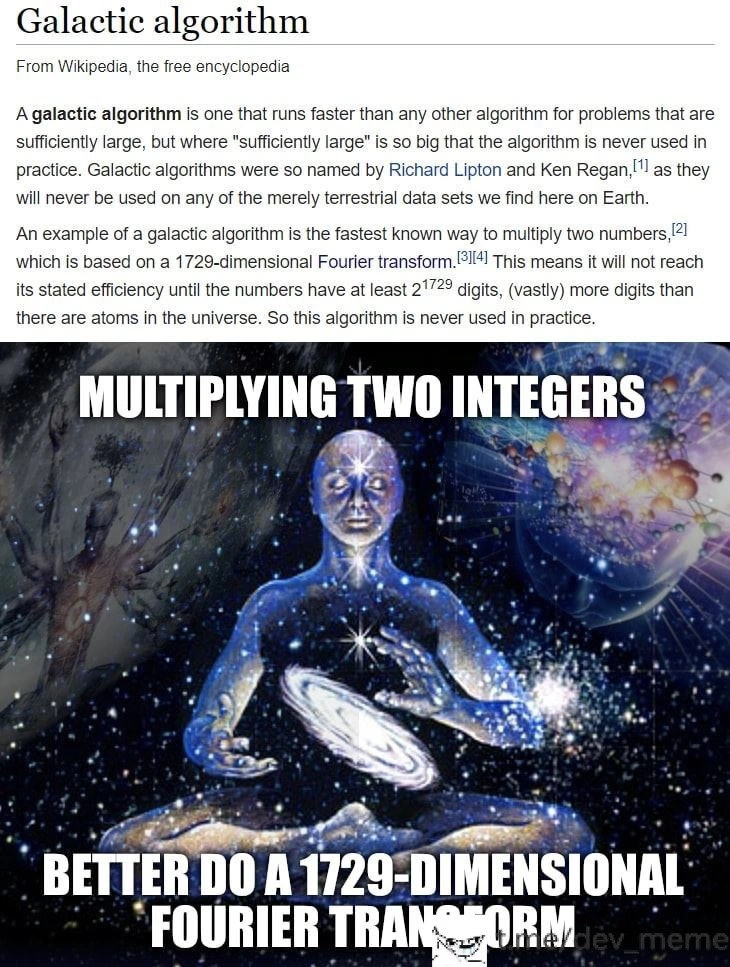
So the meme shows two panels: the top is a Wikipedia article explaining what a galactic algorithm is (using the integer multiplication example), and the bottom is a funny dramatic image. The bottom image has a cosmic, meditating figure – a meme symbol for achieving an absurdly high level of insight or power (often called the “galaxy brain” meme). The text over it says: “MULTIPLYING TWO INTEGERS – BETTER DO A 1729-DIMENSIONAL FOURIER TRANSFORM.” This is the joke. It’s like the figure has achieved some higher-plane thinking and decides that even a simple task (multiplying two numbers) should use the most insanely advanced method possible.
Why is this funny to developers or math geeks? Because it’s a classic case of over-engineering or premature optimization. That’s when someone uses a super complex solution for a simple problem well before it’s needed (if ever). We usually poke fun at that because it’s inefficient and silly in practice. It’s as if someone had to nail two pieces of wood and they built a robot arm with AI to hammer the nail – technically impressive, but completely unnecessary. In the world of algorithms, the meme’s scenario is an extreme exaggeration of that: using a near-mythical algorithm that belongs in theory textbooks for a task that any basic programming language can do with the * operator in nanoseconds.
In summary, the meme is highlighting the gap between theoretical computer science vs. practical programming. The “1729-D Fourier galactic algorithm” is a stand-in for a solution that’s technically the most efficient for unbelievably large cases, but for anything we will ever do, it’s a laughable overkill solution. It teaches (with humor) that just because something is the “best” in theory doesn’t mean you should actually use it in real life, especially if it’s absurdly complicated for the job at hand.
# Pseudo-code illustrating the absurd "galactic algorithm" usage:
def multiply_integers(a, b):
# Let's pretend we check if numbers are astronomically large
if len(str(a)) >= 2**1729 and len(str(b)) >= 2**1729:
return galactic_multiply_using_1729D_Fourier(a, b) # the overkill path
else:
return a * b # just do normal multiplication for anything in this universe
# In reality, no one writes code like this because the condition will never be true.
(The code above jokes that only when the number of digits of a and b exceed 2^1729 would we bother with the galactic algorithm – which effectively means “never.”)
Level 3: Not in This Universe
The seasoned developer takes one look at this meme and cracks a wry smile. It’s satirizing the kind of overkill solution that only ever exists in theory, not in any real codebase in this universe. We have a straightforward task – multiplying two integers – and the meme’s punchline is to apply the most galactically over-engineered method imaginable to it. It’s like someone read an academic paper about a groundbreaking $O(n \log n)$ multiplication algorithm (with insane overhead) and exclaimed, “Eureka, let’s use that for everything!” – completely ignoring the practical reality that you’d never reach the input size where it wins.
This speaks to a classic disconnect between theoretical CS and on-the-ground engineering. In practice, when we multiply numbers (even big ones), we use algorithms that are efficient for the sizes we actually deal with. High-precision math libraries and languages’ big integer implementations do get clever – they’ll switch from the basic grade-school method (O(n^2)) to faster algorithms like Karatsuba multiplication (O(n^{1.585})) or FFT-based methods (like Schönhage-Strassen, about O(n log n)) once numbers pass certain size thresholds. But a 1729-dimensional Fourier transform? That’s beyond excessive; no engineer is coding that up for production. It’s the definition of “you ain’t gonna need it.” In fact, if a junior dev submitted a pull request implementing a galacticMultiply(a, b) that kicks in at 10^520 digits, the seniors would probably think it’s an April Fool’s joke. 🤣
The meme’s top panel is an actual Wikipedia entry describing galactic algorithms – pointing out that they’re faster only for absurdly large inputs and literally “never used on any merely terrestrial data set.” The bottom panel, with its cosmic meditating figure, is a visual gag often used to depict galaxy-brain enlightenment. Here it represents a programmer achieving a transcendental level of over-engineering: “Multiplying two integers? Better invoke interdimensional cosmic math!” It’s poking fun at premature optimization and over-engineering in our field – when someone applies ultra-complex techniques without regard for real-world practicality. Every experienced dev has seen this in some form: from the colleague who insists on a complex microservice architecture for a simple script, to the one who tries to incorporate an enterprise-grade machine learning library to optimize a ten-item list. The meme just takes that impulse to the extreme, using an example from theoretical computer science where the gap between algorithmic elegance and reality is hilariously wide.
Another layer to the humor is the number 1729 itself – a wink to those in the know. It’s famous in mathematics (the Ramanujan number), and seeing it used as the dimensionality of a Fourier transform is absurdly funny and arbitrary, underlining how ridiculously specific and high that count is. It’s as if the meme says, “We’re not just doing a multi-dimensional transform – we’re doing it in 1729 dimensions, baby!” By throwing out such an outrageous detail, it lampoons the way computer scientists might tout their record-breaking algorithm without admitting it’s useless below cosmic scales.
In essence, this meme resonates with senior devs because we’ve learned that theoretical speedups often come with devilish details. It’s a nod to the war stories of chasing micro-optimizations that turned out to be pointless. It reminds us of the times we’ve had to tell someone, “Sure, that approach has a better Big-O, but not in any scenario we care about.” The phrase “Not in this universe” captures it perfectly – you’d need a computer the size of a galaxy and inputs larger than the observable cosmos for this algorithm to matter. It’s a hyperbolic lesson: Don’t reach for a galactic solution when a simple one works on planet Earth.
Level 4: 1729-Dimensional Overkill
At the cutting edge of theoretical algorithm complexity, this meme invokes a concept straight out of academic computer science: the galactic algorithm. In complexity analysis we often focus on Big-O notation to compare how algorithms scale. Here we have an algorithm that is asymptotically faster than all others for multiplying huge integers – but with a catch so large it’s practically astronomical.
In theory, the fastest known integer multiplication algorithm (as of around 2019) runs in better than $O(n \log n)$ time by using an ingenious multi-dimensional Fourier transform technique. Specifically, it’s jokingly said to use a 1729-dimensional Fourier Transform to multiply two numbers. This isn’t your everyday 2D or 3D transform for images or signals – it’s an incredibly high-dimensional mathematical operation. The idea is to generalize the FFT (Fast Fourier Transform) method for multiplying polynomials: by transforming numbers into a high-dimensional frequency space, one can convolve (multiply) them faster than with lower-dimensional methods. The 1729 here is tongue-in-cheek (and yes, 1729 is famously a Hardy–Ramanujan number, an Easter egg for math nerds[^1]) symbolizing an absurd number of dimensions. Each extra dimension in the transform theoretically reduces the multiplication complexity a tiny bit more, but adds enormous overhead. The result is an algorithm with dazzlingly good asymptotic performance — on paper.
However, the term “galactic algorithm,” coined by theorists Richard Lipton and Ken Regan, exists because such an algorithm’s benefits only appear at problem sizes on a galactic scale. The Wikipedia snippet in the meme spells it out: “sufficiently large” in this case means numbers with at least $2^{1729}$ digits. For comparison, $2^{1729}$ is about $10^{520}$ – that’s a 1 followed by 520 zeros, vastly more digits than there are atoms in the observable universe. Only beyond that unfathomable threshold does this 1729-D Fourier method overtake simpler algorithms. Below that, its gargantuan constant factors and setup cost make it slower. In other words, this supposed “fastest” algorithm will never actually be faster for any number we could ever handle in practice. It’s a brilliant theoretical triumph that exposes the gulf between asymptotic optimality and real-world usefulness.
The humor and awe here come from the extreme over-engineering of using a universe-scaled approach for a mundane task. It highlights a fundamental lesson in algorithm design: the optimal solution in theory can be utterly impractical. Yes, we have an algorithm that beats all others as $n \to \infty$ — but when “infinity” starts at a number of digits beyond this universe, it firmly belongs in the realm of theoretical computer science (or science fiction!). This cosmic-level optimization is a reminder that Big O notation alone can’t capture when an algorithm becomes useful; constant factors and real-world limits matter immensely.
[^1]: 1729 is known as the Hardy–Ramanujan number, famous in math as the smallest number expressible as the sum of two cubes in two different ways. Its appearance here is likely a nod to its legendary status — a bit of extra nerd humor layered into the already astronomical joke.
Description
A two-part meme. The top section is a screenshot of the Wikipedia article for "Galactic algorithm," defining it as an algorithm that is asymptotically superior but practically unusable due to the immense scale required for it to become efficient. The article cites an algorithm for multiplying two numbers using a 1729-dimensional Fourier transform that only becomes practical for numbers with more digits than there are atoms in the universe. The bottom section uses the "Galaxy Brain" meme format, showing a cosmic, meditating figure surrounded by stars and galaxies. White impact-font text is overlaid, reading: "MULTIPLYING TWO INTEGERS" at the top and "BETTER DO A 1729-DIMENSIONAL FOURIER TRANSFORM" at the bottom. The meme humorously contrasts the simple task of multiplication with an absurdly complex, theoretical solution, mocking academic over-engineering and the pursuit of theoretical performance over practical application. This resonates with experienced engineers who have seen simple problems get over-architected with needlessly complex solutions

Comments
7Comment deleted
The junior dev suggests using a galactic algorithm for the login page. The senior dev agrees, noting it will be the most performant solution once our user base exceeds the number of Planck volumes in the observable universe
Lead dev: “Sure, Karatsuba is fine for MVP, but wait until product asks for 10^520-digit SKUs - better ship the 1729-D Fourier multiplier now and call it ‘future-proofing.’”
Ah yes, the classic senior engineer move: spending six months implementing a 1729-dimensional Fourier transform for multiplication because 'it has better asymptotic complexity,' only to discover your production integers never exceed 64 bits and the naive approach would've been 10^400 times faster. But hey, at least the whiteboard interview went great!
Ah yes, the galactic algorithm - proof that in computer science, you can be technically correct (the best kind of correct) while being cosmically useless. It's the ultimate 'well actually' of algorithmic complexity: sure, your O(n²) multiplication works fine for every number humanity will ever compute, but have you considered that for numbers with more digits than there are atoms in the observable universe, this 1729-dimensional Fourier transform would be *slightly* faster? It's like optimizing your startup's database queries for when you have more users than sentient beings in the galaxy - technically sound architecture, questionable product-market fit
Great news - the asymptotically optimal multiplier kicks in right after 2^1729 digits; until then we’ll ship Karatsuba and save the cluster for the heat death sprint
Galactic algorithms: Big O nirvana for inputs larger than the heat death of the universe - every CTO's favorite 'scales perfectly' white lie
Galactic algorithm thinking: 1729‑D FFT to multiply two ints - provably faster once n has more digits than the universe; practically, the ALU’s MUL finishes before Kubernetes even schedules the pod