Skip to content
DevMeme
744 of 7435
The Hypocrisy of Saving: Gaming vs. Git Commits
VersionControl Post #843, on Nov 22, 2019 in TG

The Hypocrisy of Saving: Gaming vs. Git Commits

Why is this VersionControl meme funny?

Level 1: Better Save Than Sorry

Imagine you’re drawing a big picture and every few minutes you hit the “save” button so you won’t lose your work if the computer freezes. Gamers do this in their video games all the time – they save their progress constantly so if something bad happens, they don’t have to start all over. Now think about writing code like building a giant LEGO castle. Saving your code with Git is like taking a picture of your LEGO castle at each step, so you can rebuild from that point if a disaster happens.

This meme jokes that the same person who is super careful in a game (saving every five minutes) might be pretty careless when coding. It’s as if a student wrote an entire 10-page story and only then hit “save” once at the very end – risky, right? In the tweet, the coder only “saves” their code after making a huge pile of changes (imagine adding 647 LEGO bricks and removing 1049 without a single save!). They even label that save point as “some changes,” which is like writing “did stuff” in a school project log – not helpful at all!

The funny part is the contrast: we expect someone careful in a game to also be careful with important work, but often they’re not. It’s saying, “You’d never forget to save your game, so why do you forget to save your code?” It makes us laugh because we recognize a bit of ourselves in it – sometimes we all gamble and hope nothing crashes before we finally hit save. The lesson underneath the humor: whether it’s a game or code, it’s better to save often so you won’t be sorry later!

Level 2: Save Points for Code

Let’s break down the joke in simpler terms. In video games, saving every five minutes is a cautious habit. Gamers hate losing progress – imagine defeating a tough boss, forgetting to save, and then dying in-game; you'd have to replay it all. So, frequent saving is just common sense. Now, in programming, saving your work’s progress is done through version control systems like Git. A commit in Git is basically a snapshot of your code at a given time – just like a game save point. When you run git commit -am "some changes", you’re telling Git: "record all my current changes (the -a flag means add all modified files) and label this snapshot with the message "some changes"."

Why is it funny that the commit says "some changes" and shows (+647, -1049)? Those numbers are a diff summary – +647 means 647 lines of code were added, -1049 means 1,049 lines were removed in that one commit. That’s huge! It signals that the programmer worked a long time without committing, then bundled a ton of edits into one big batch. And the message "some changes" is comically underwhelming for such a big update. It’s like writing a single sticky note for an entire textbook of changes.

This is considered poor_commit_hygiene:

  • Large diff: Normally, you’d commit smaller chunks of work. Think of writing an essay – you’d hit Ctrl+S (save) after a paragraph, not only once after 10 pages. Huge commits make it hard for others (and your future self) to understand what you did. If something breaks, you have to untangle 600+ lines to find the issue.
  • Vague message: A good commit message acts like a diary entry for your code. “Refactor user login flow to fix memory leak” is clear. But "some changes"? That could be anything from a minor tweak to a total rewrite. It’s a running gag in coding humor because it shows the dev didn’t bother to explain their work.

The meme tags like video_games_vs_coding highlight the irony: in games vs. in coding. Gamers act cautiously, saving often; some developers, ironically, act recklessly with commits. Every developer can relate to getting “in the zone” and forgetting to commit. You might be debugging or adding a feature and two hours later realize you haven’t made a checkpoint. This tweet exaggerates it humorously: save often in games, commit rarely in code. It’s funny because it shouldn’t be that way – we have the tools to save our code progress safely!

In summary, the meme is a reminder wrapped in a joke: use version control wisely. Git is there so you don’t lose work and so you can collaborate with others. Commit early, commit often – and please write a message that actually tells you (and your team) what you changed. Your fellow developers (and future you) will thank you. Just like a game, you never know when things might "crash," so it's best to have that recent save to fall back on.

Level 3: Commitment Issues

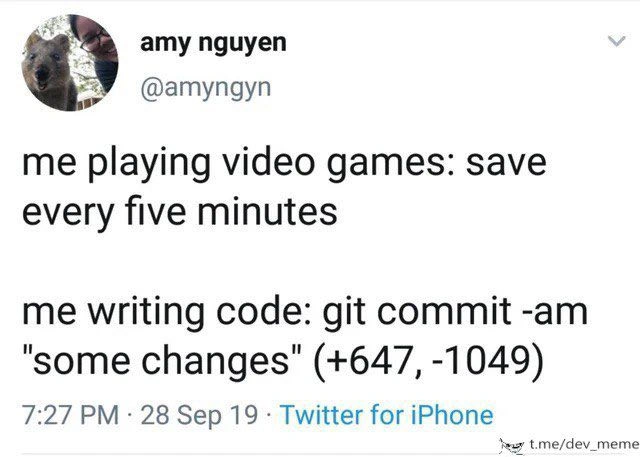
Version control is like a gamer's save system for code, yet we often see developers ironically ignoring it until it's almost too late. In this meme (a tweet by @amyngyn), the contrast is clear:

me playing video games: save every five minutes
me writing code: git commit -am "some changes" (+647, -1049)

This punchline lands because experienced devs know they should treat commits like save points, but reality often looks like that massive (+647, -1049) diff. A senior engineer chuckles (or cringes) here, recalling painful code reviews or merge conflicts caused by poor commit hygiene. Why is a large diff with 600+ additions and 1000+ deletions funny? Because it’s too real – we’ve all seen (or written) that monolithic "everything in one go" commit. It usually comes with a vague commit message like "some changes", which tells future readers absolutely nothing. This is the version control irony: the same person who hits save obsessively in a game will gamble hours of coding without a checkpoint.

From a seasoned perspective, this meme spotlights a common anti-pattern. Huge, single commits are a nightmare for CodeQuality:

  • Atomic Commits (small, focused changes) are easier to test, revert, and understand. A commit with +647/-1049 lines is the opposite – it's a grab bag of who-knows-what. Code review for that is like diffusing a bomb with hundreds of wires.
  • The commit message "some changes" is a running joke in dev circles. It's as informative as a blank label. Senior devs preach descriptive messages (“Fix race condition in user auth” > “some changes”). Seeing some_changes_commit_message in a real repo history is a face-palm moment.
  • The tweet’s timestamp (7:27 PM) and the post caption joking about Friday hint at another inside joke: never push giant changes late on Friday. Deploying or merging that big diff at week’s end is practically begging to spend your weekend fixing production issues.

So the humor here has layers: it’s relatable developer experience (we’ve been reckless with commits), it’s VersionControlHumor (playing on Git habits), and it lightly shames our Git practices. The seasoned dev laughs, possibly recalling the 3 AM bug hunt through an ambiguous commit. In games, failing to save means you lose progress; in coding, failing to commit means you might lose code or can’t pinpoint when a bug crept in. The meme wittily highlights that gap between what we know (save/commit often) and what we actually do. It’s a gentle poke at our GitCommands habits, prompting a nod and a chuckle – and maybe an impulse to git commit more frequently with a proper message next time.

Description

A screenshot of a tweet from user Amy Nguyen (@amyngyn). The tweet presents a humorous contrast in behavior. The first line reads: 'me playing video games: save every five minutes'. The second line reads: 'me writing code: git commit -am "some changes" (+647, -1049)'. The profile picture for the tweet shows a quokka. The meme highlights a common and relatable hypocrisy among developers: being extremely cautious and saving frequently in a low-stakes context like a video game, while being reckless in a professional context by making a massive, multi-faceted code change (over 1700 lines affected) and summarizing it with a completely unhelpful git commit message, 'some changes.' This practice goes against version control best practices, which favor small, atomic commits with descriptive messages for maintainability and easier code reviews

Comments

7
Anonymous ★ Top Pick In gaming, we save often to avoid losing a few minutes of progress. In coding, we avoid committing for hours to avoid admitting to ourselves that the last 1,700 lines of changes were a terrible idea
  1. Anonymous ★ Top Pick

    In gaming, we save often to avoid losing a few minutes of progress. In coding, we avoid committing for hours to avoid admitting to ourselves that the last 1,700 lines of changes were a terrible idea

  2. Anonymous

    I quick-save before every jump in Celeste, yet my “trunk-based” workflow is a single Friday push to main: git commit -am "oops_more_fixes" (+1,842 −1,309). Seniority just means I’ve rebranded living dangerously as CI velocity

  3. Anonymous

    The irony of meticulously saving game progress every 5 minutes while casually obliterating git history with 1600-line atomic bombs labeled 'some changes' - because apparently, losing 30 seconds of gameplay is more catastrophic than making the next developer contemplate career changes during code review

  4. Anonymous

    The classic developer paradox: religiously quicksaving before every minor decision in a game, but casually yeeting 1,696 lines of changes into a single commit with a message that would make any code reviewer weep. At least when you rage-quit the game you can reload; when you rage-quit that PR review, you're archaeology-ing through git blame for the next three sprints trying to figure out what 'some changes' actually broke

  5. Anonymous

    Games: save every five minutes; Git: a single “some changes” (+647/-1049), turning code review into theology, rollback into disaster recovery, and git bisect into archaeology

  6. Anonymous

    Save checkpoints every boss fight, but ship a single "some changes" with +647/-1049 - aka the diffstat that turns code review into archaeology and makes git bisect weep

  7. Anonymous

    'Some changes' (+647/-1049): the commit message that turns code review into an archaeological dig

Use J and K for navigation