The Fourth Forbidden Wish: Good Documentation
Why is this Documentation meme funny?
Level 1: Forbidden Wish
Imagine you got a new LEGO set, but when you open the box, there are no instructions inside. You have all these pieces to build a cool spaceship, but no booklet telling you how to put them together. You feel totally lost, right? Now, picture you meet a friendly magic genie who can grant wishes. You say, “Genie, I just want the instruction book for this LEGO set so I can build it!” But the genie shakes his head and says, “Sorry, kid, I can’t grant that wish.” Sounds silly, doesn’t it? You’d probably laugh because getting an instruction book seems like such a simple, normal thing – why would even magic say no?
This is exactly the joke of the meme: in the world of computer programmers, having a really good instruction book (they call it documentation) for your toys (their software tools) is strangely rare. The meme shows a genie telling a programmer that asking for good documentation is against the rules, just like the usual crazy rules like “no wishing for unlimited wishes.” It’s funny and a bit frustrating at the same time. It’s like saying, “Good instructions are as hard to get as impossible magic wishes!” That feeling when you can’t find any guidance and you’re stuck figuring things out by yourself — the meme takes that feeling and turns it into a genie’s forbidden wish. So even if you’re not a coder, you can relate: it’s joking that sometimes getting clear instructions is so difficult, it might as well be magically forbidden. You can’t help but chuckle at how exaggerated it is, and maybe feel better knowing lots of people think not having instructions is a ridiculous problem too.
Level 2: Documentation Woes
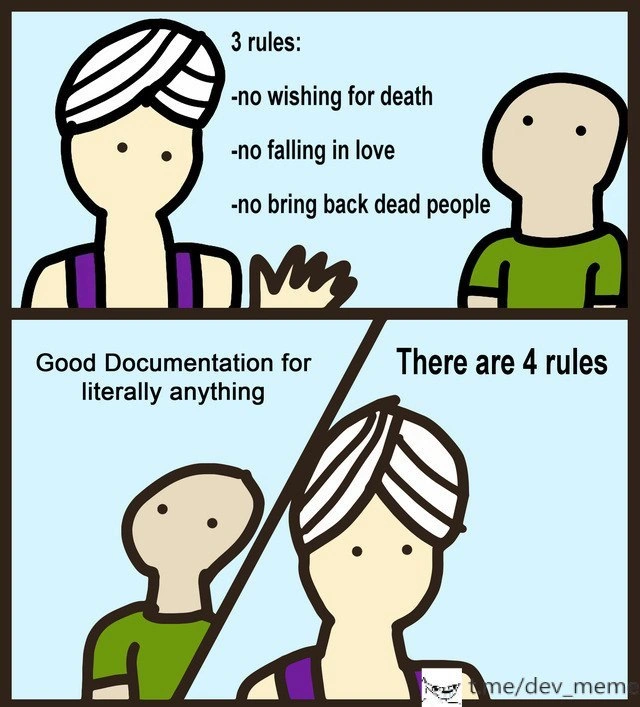
Let’s break down the meme in simpler terms. We have a cartoon genie (like the one from Aladdin) who normally allows three wishes but with certain well-known restrictions: you can’t wish for someone to die, you can’t make someone fall in love with you, and you can’t bring dead people back to life. In the first panel, the genie lists those “3 rules.” In the second panel, a software developer tries to be clever and wishes for something many programmers desperately want: “Good Documentation for literally anything.” This is basically the developer asking, “Please, can I have clear, helpful instructions and explanations for the tools/code I use?” And the genie immediately responds, “There are 4 rules.” In other words, good documentation is now added to the list of forbidden, impossible wishes!
Why would that be funny to a developer? Because it’s poking fun at how rare good documentation is in the software world. Documentation in a software context usually means the written guides, manuals, or comments that explain how code works or how to use an API or software tool. Good documentation might include a README file with setup steps, an API reference detailing each function, example code snippets, inline code comments, or a user guide. It’s basically all the information that developers wish every project came with so they can understand and use it easily. When documentation is missing or poor, developers often struggle. That’s why this is a huge DeveloperHumor and DeveloperPainPoints theme – almost every programmer has a story of feeling lost because some library or code had no good docs. The tags like developer_documentation_struggles and DocumentationWoes are all about these experiences.
The meme suggests that asking for “good documentation for literally anything” is as futile as those other genie-taboo wishes. In real life, developers joke that getting excellent, up-to-date docs is nearly impossible. Missing API docs are so common that it’s basically expected. For example, you might find a cool open-source project and open its GitHub page, only to find a one-line description and no usage instructions. Or you’re working with an internal company system and the only “documentation” is a 3-year-old Confluence page that’s completely outdated. It’s incredibly frustrating and very relatable humor for anyone in tech.
Let’s define a few things to ensure it’s clear:
Documentation: In software, this refers to written text or illustrations that explain how something works. This can be official docs on a website, comments in code, or markdown files in the project. Good documentation typically includes guides (“How to get started”), references (detailed info on functions, classes, endpoints), and examples. It’s meant to make life easier for anyone who didn’t originally write the code.
Good Documentation: This means documentation that is clear, thorough, and accurate. It covers common use cases and edge cases, is kept up-to-date with the latest code changes, and is easy to navigate. For instance, good docs for an API would list each endpoint or function, what parameters they take, what they return, and maybe even example requests and responses. Essentially, it’s the ideal help a developer hopes to find.
Why is it hard to find? Writing good docs takes time and effort. Often, developers are so focused on writing code and delivering features (because that’s what their bosses or the project timelines emphasize) that they neglect writing documentation. Sometimes they assume the code is “self-documenting” (meaning they think the code is written clearly enough to be understood on its own) or they plan to “add the docs later” but never get around to it. Also, software changes quickly – if you write documentation but don’t update it whenever the code changes, it becomes wrong pretty fast. So keeping docs accurate and up-to-date is an ongoing chore many skip. This leads to the situation where developers half-joke that good documentation is almost mythical.
Developer Experience (DX): This category tag DeveloperExperience_DX refers to the overall experience a developer has when using a tool or working in an environment. Good DX means things are easy to set up, code is intuitive, errors are clear, and yes – there are good docs! Bad DX, conversely, might mean that the setup is convoluted, you keep encountering cryptic errors, and documentation is unhelpful or absent. In our meme, the lack of documentation is a major DX fail that developers sadly find all too common.
The second panel’s dialogue captures a relatable developer experience: The dev enthusiastically asks for “Good Documentation for literally anything.” That phrasing “literally anything” is comedic exaggeration – it implies the developer isn’t even picky about what it’s for; they’d take good documentation on any subject, because they’ve found none! It’s a tongue-in-cheek way to say “I’d be happy if anything in this tech world came with decent docs.” The genie’s retort, “There are 4 rules,” delivers the punchline: even omnipotent magic has officially declared good documentation off-limits.
For a junior developer or someone new to coding, it helps to know this is a common issue: you will frequently encounter frameworks, libraries, or codebases where the documentation is insufficient. You might open the docs and find maybe a shallow tutorial that doesn’t cover your case, or nothing but an auto-generated API reference with no examples, or outright find a 404 page where docs should be. Then you’re stuck thinking, “How on earth do I use this?”. You end up searching on Stack Overflow, reading blog posts, or even reading the source code itself to figure things out. It’s almost a rite-of-passage in programming to grumble about poor docs. So this meme humorously bonds developers over that shared struggle. It’s saying, “We all know this pain – if only a genie could help us, but even genies can’t fix documentation!”
In short, the meme highlights the chronic scarcity of clear, complete documentation in software projects. It’s funny because it’s true: asking for well-written docs often feels like asking for the impossible. Both new and experienced developers can relate – whether you tried to learn a new JavaScript framework or set up someone else’s code, you’ve likely sighed and said, “I wish the docs were better.” And here, we joke that even a magical genie would immediately shut down that wish. It’s a playful jab at an ongoing problem in tech.
Level 3: The Unwritten Rule
In this meme’s twisted genie scenario, good documentation is treated as a forbidden wish on par with death, love, or resurrection. It’s referencing the classic Aladdin genie_three_rules_reference: a genie lists three things you absolutely can’t wish for (no killing, no forcing love, no bringing back the dead). The developer eagerly tries to slip in a fourth wish — “Good Documentation for literally anything” — only to have the genie deadpan: “There are 4 rules.” This punchline lands with senior engineers because it satirizes a brutal truth: comprehensive documentation in software is so rare and elusive that it may as well be magically outlawed. It’s a perfect piece of DocumentationHumor highlighting a universal DeveloperPainPoints: the painful absence of clear docs.
For seasoned devs, this joke cuts deep. We’ve all been there — integrating a new library or maintaining a legacy system — only to discover the docs are missing, outdated, or downright useless. It’s practically a rite of passage to mutter “Figures… no docs again,” and then spelunk into 10,000 lines of someone else’s code to reverse-engineer what’s going on. The meme exaggerates this familiar frustration by implying even a literal wish-granting genie would throw up his hands and say “Nope, not even with magic.” It’s a darkly comic nod to DocumentationWoes that plague projects across the industry.
Why is this so funny (or tragic) to us? Because it rings true. Many projects treat documentation as an afterthought or an optional nice-to-have, so finding good documentation sometimes feels as fantastical as discovering a unicorn. The humor comes from hyperbole and relatability: asking for well-written docs is framed as an impossible_documentation_wish. In real life, developers often joke that documentation is the first thing to rot in a codebase (if it even existed). We’ve seen API references that only list function names with no explanations, README files that say “TODO: write docs”, or wiki pages last updated 5 years ago. This widespread negligence turns something seemingly basic — proper docs — into a mythical luxury.
From a senior perspective, the meme also slyly hints at the DeveloperExperience (DX) impact. Poor DX is what you get when libraries, frameworks, or internal tools lack guidance. We measure DX by how pleasant and productive it is for devs to use a technology, and documentation is a cornerstone of DX. When docs are bad or absent, DeveloperExperience_DX suffers: on-boarding slows down, bugs multiply from misuse, and everyone’s frustrated. The genie’s “4th rule” quip underscores that nobody expects good DX via documentation anymore; it’s become a cynical running joke among experienced engineers that no matter how promising a tool is, its docs will likely disappoint.
There’s also an undercurrent of sarcasm here about developer culture. Companies and open-source maintainers often prioritize new features and speedy releases over documentation. Documentation doesn’t get written because “we’ll do it later” — and “later” never comes. Over time this creates massive technical debt: knowledge about how the system works lives only in senior engineers’ heads or in cryptic commit messages. When those people move on, trying to understand or update the code without docs feels like attempting forbidden necromancy (no wonder the genie equated it to bringing back the dead!). In fact, resurrecting lost knowledge from stale code can be as daunting as raising zombies: you’re essentially summoning understanding out of a graveyard of outdated comments and spaghetti logic. RTFM? Sure… if only there was a manual to read. Many veterans have accepted with dark humor that “the code is the documentation” – a phrase often uttered in defeat, meaning you’ll just have to read the source to figure it out because no one wrote it down.
To put it simply, this meme gets a slow, knowing nod (and maybe an eye-roll) from senior devs. It nails the absurd reality that “good documentation” is so chronically absent, we joke it’s officially against the rules of the universe. Even a genie, theoretically omnipotent, adds documentation to his no-can-do list. That blend of fantasy and painfully real developer experience is what makes it hilarious. It’s a coping laugh, born from countless hours lost in poorly documented systems. We laugh so we don’t cry, acknowledging that in our world, wishing for great docs is about as fruitful as wishing for immortality.
# Example: Trying to get help on an undocumented function in Python
import some_library
help(some_library.do_magic)
# Output:
# Help on function do_magic in module some_library:
#
# do_magic(...)
# (no documentation available)
(Above: A familiar sight – even the auto-generated help can’t find any docstring or info for do_magic. “No documentation available.” Story of our lives, right?)
Description
A two-panel comic strip featuring a genie-like character with a white turban and a person in a green shirt. In the first panel, the genie explains the standard three rules for wishes: "-no wishing for death", "-no falling in love", and "-no bring back dead people". In the second panel, the person makes their wish: "Good Documentation for literally anything". The panel is split diagonally, showing the genie interrupting with a stern expression, saying, "There are 4 rules". This meme uses the classic genie format to humorously express a deep-seated frustration in the software development world: the perceived impossibility of obtaining good, comprehensive documentation. The joke is that this desire is so unattainable, it transcends the genie's otherwise immense power, resonating with any developer who has struggled with poorly documented code, APIs, or systems

Comments
7Comment deleted
Genies can't grant good documentation for the same reason we can't write it: by the time you've described the system's current state, it's already a legacy system with three breaking changes
Genie’s fourth rule: documentation can only approach eventual consistency with the codebase - by the time it catches up, the schema’s already sharded itself again
The documentation says "3 simple steps to deploy" but step 2 is "configure the 47 environment variables (see appendix B, which references appendix D, which is TODO)"
The real magic isn't bringing back dead people - it's finding documentation that accurately describes what the code *actually* does after three years of undocumented refactoring, two team turnovers, and a migration to microservices that nobody bothered to update the wiki for
Genies cap restrictions at three; good docs demand four because edge cases always sneak in that extra rule
Good docs are a CAP problem: current, complete, and correct - pick two, until the next hotfix
Good documentation has its own CAP theorem: Current, Accurate, and Complete - pick two; after the next deploy, pick none