Skip to content
DevMeme
5163 of 7435
Every time someone utters “functional programming,” the category-theory confetti cannon fires
FunctionalProgramming Post #5653, on Nov 11, 2023 in TG

Every time someone utters “functional programming,” the category-theory confetti cannon fires

Why is this FunctionalProgramming meme funny?

Level 1: Big Math Party

Imagine you’re at a birthday party, and someone pops one of those big confetti party cannons. 🎉 But instead of normal confetti, a bunch of books, symbols, and super big words burst into the air and start raining down on everyone! All you did was say one simple thing, like “I like this kind of math”, and boom! you set off a chain reaction. Suddenly it’s like a nerd party exploded: colorful numbers and weird squiggly shapes (like λ and ∫) are everywhere, and people are shouting fancy terms you’ve never heard. It’s funny because the reaction is way out of proportion to what you said – it’s as if you asked for a cupcake and got a 10-tier wedding cake dropped on you. In other words, a small innocent comment led to an overwhelming shower of complicated ideas. The humor comes from that surprise overload, kind of like saying a magic word (“functional programming!”) and accidentally summoning a tornado of textbooks and professors explaining things. It’s a silly take on how sometimes asking a tiny question can unleash a huge, chaotic answer that leaves you both impressed and a little cross-eyed!

Level 2: Decoding the Magic

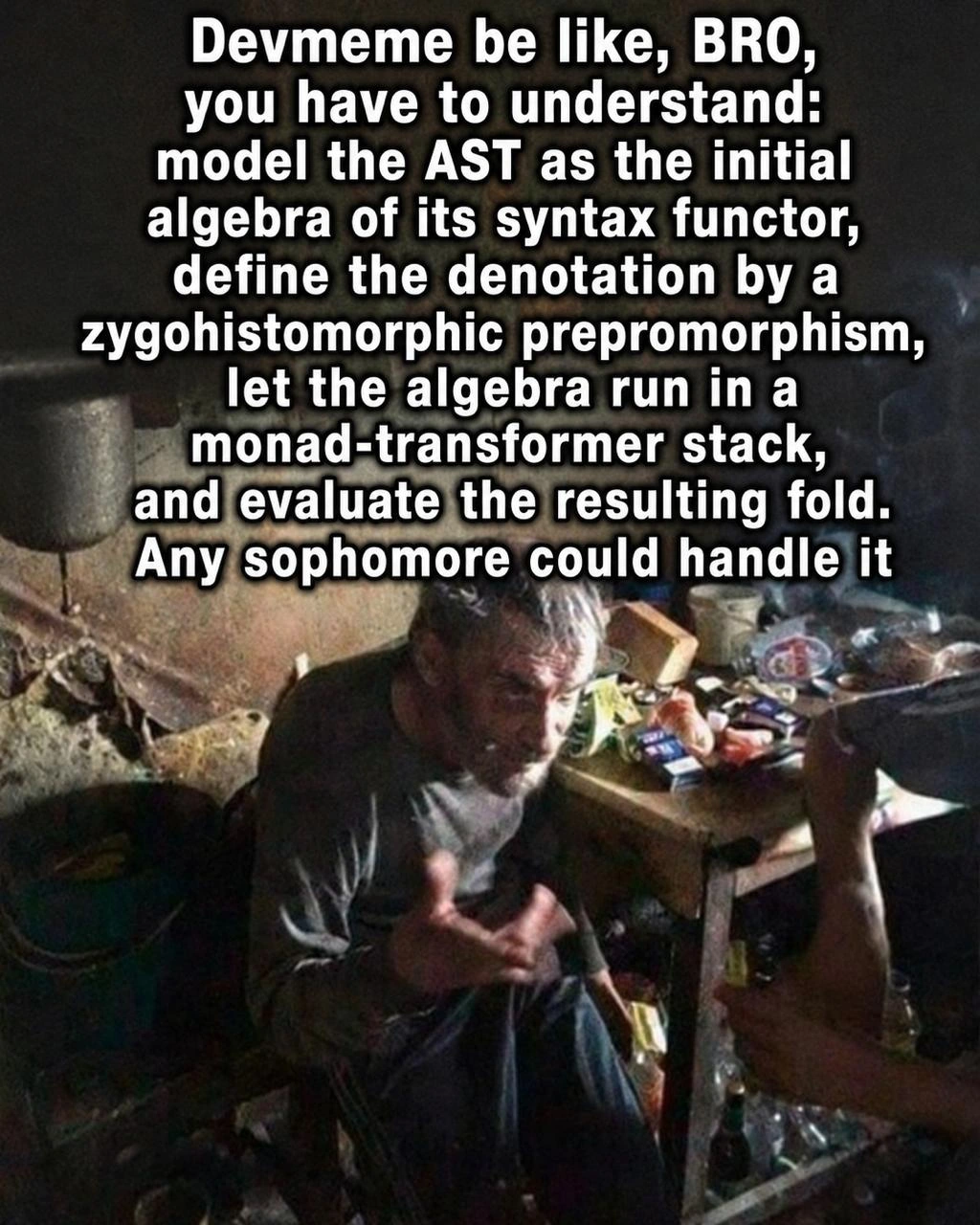
Let’s take a step back and explain what all those wild references mean in simpler terms. The meme shows an anime-style girl wearing a wizard hat with glowing λ symbols, surrounded by a tornado of strange text and images. This represents someone mentioning “functional programming” and immediately being swarmed by super-advanced ideas. To understand the joke, we should decode some of the key terms and images (a bit like explaining each piece of confetti in that cannon blast):

  • Functional Programming (FP): This is a style of coding where you use functions as the main building blocks, and you avoid changing state or mutable data. Think of it like writing math equations: given the same inputs, a function will always give you the same output and not produce side effects (like modifying a global variable or printing to the screen unexpectedly). FP emphasizes pure functions, immutability, and often leads to code that’s easier to test and reason about (since functions don’t have hidden surprises). Examples of functional programming languages include Haskell, Erlang, and Clojure, although you can apply FP ideas in many languages (even in Python or JavaScript, to some degree).

  • Haskell: Haskell is one of the poster-child languages for functional programming. It’s purely functional and has a very strong, static type system (meaning you must declare the types of things, and it checks everything at compile time to prevent type errors). In the meme, Haskell’s influence is everywhere: the Haskell logo (which looks like the letters >=> or a stylized lambda arrow) appears, and many of the code snippets (Control.Monad.Tardis, error messages, etc.) are specific to Haskell. Haskell is known for being powerful but a bit intimidating for newcomers because it uses a lot of concepts from math and category theory to achieve its safety and expressiveness. The meme is basically showing what a conversation can look like if a Haskell guru gets going.

  • Lambda (λ) Symbols: You see the Greek letter lambda glowing on the hat and in the background. In computer science, λ often represents an anonymous function (a function defined without a name). Lambda calculus is a formal system developed by mathematician Alonzo Church, and it’s the theoretical foundation of functional programming. Think of lambda calculus as a very tiny programming language where everything is just functions. It’s super important in CS theory because it shows how functions can be used to compute anything. So when you see lots of λs, it’s basically screaming “Functional programming happening here!” It’s like the mascot of FP. The wizard hat covered in lambdas implies the person has become a “lambda wizard”, i.e., an expert in functional programming magic.

  • Category Theory: This is a branch of mathematics that deals with abstract structures and relations between them. It’s highly theoretical (some call it “math of math”) and was not something most programmers needed to know. However, it turns out a lot of patterns in programming (especially in FP) can be described elegantly using category theory terms. For example, Functor and Monad are terms from category theory that found a second life in programming. In simple terms:

    • A Functor, in programming, is something you can map a function over. Think of a list: if you have a list of apples and you have a function to turn an apple into applesauce, you can map that function over the list to get a list of applesauce. The list is acting like a functor. It’s just an interface that says “you can apply a function to each element inside me.”
    • A Monad is trickier to sum up, but you can think of it as a kind of recipe for chaining operations while keeping context. For instance, imagine you have a context like “possible failure” (this could be represented as something like an Optional type or a Result type in some languages). A monad provides a way to chain computations that might fail without having to constantly check for failure at each step. It’s like, “do this, then if it’s okay, do that, otherwise stop.” Monads are used to handle things like input/output, state, or errors in a clean way in FP. They have a bit of a mythical status because many tutorials made them seem incredibly complex, but conceptually they’re like a design pattern for function chaining.
  • “Monad Tardis” (Control.Monad.Tardis): In Haskell, modules (like libraries or namespaces) often have names like Control.Monad.Something. The Tardis monad is a playful reference to Doctor Who’s time machine, as mentioned. It’s a special case of a state monad (a pattern for handling state changes) that lets you pass state backward in time. To put it plainly, imagine you have a function that not only produces an output but also a “future value” that earlier parts of your computation can somehow see. It’s very unusual – you probably won’t see this outside of Haskell experimentation – but it shows how creative you can get with monads. The meme tosses this in to illustrate just how deep into the rabbit hole the conversation has gone; we’re not just talking about regular monads anymore, we’re talking about time-traveling monads!

  • Type System and Error Message: There’s that strip saying type variable 'b' would escape its scope. This is a technical way of saying “a type we expected to be local is being used in a place it shouldn’t.” In a simpler example, imagine you have a room (scope) and you define a variable x inside that room; if you step outside the room, x doesn’t exist there. The error is like saying “Hey, you’re trying to use b outside the place it was defined, that’s not allowed.” Haskell’s type checker is very strict to keep programs safe – it won’t let you do things that don’t make logical sense type-wise. But the flip side is the errors can be hard to understand for beginners, because they talk about type variables and scopes. The meme including this error is highlighting that in FP discussions, sometimes even the error messages (which are themselves quite academic-sounding) become part of the tale of woe or bragging rights (“Look what weird error I provoked by pushing the type system!”).

  • Curry-Howard Correspondence: This sounds like a mouthful, but for a junior dev, think of it as a deep idea that connects programming with logic. In very straightforward terms: under Curry-Howard, a data type (or a function type) is like a statement in logic, and a program (or function implementation) is like a proof of that statement. So if you have a type that says “if A and B are true, then C is true”, a function with that type would effectively take evidence of A and evidence of B and combine them into evidence of C. It’s a philosophical underpinning of why type systems can ensure correctness. If your program compiles, it’s kind of like you proved something about your algorithm. This is not usually everyday coding stuff – it’s more something you learn in a theoretical CS class or a very deep dive. The meme shows a page labeled “Curry-Howard Correspondence” to indicate that the convo has gone into theory land, connecting code to math logic.

  • Homotopy Type Theory (HoTT): This is extremely advanced. Imagine taking the Curry-Howard idea and pushing it further – not only are programs proofs, but the proofs can have shapes and you can reason about those shapes. HoTT is a new way of doing the foundations of mathematics where a type can be seen like a space, and an equal sign (proof of equality) is like a path between points. It’s pretty wild stuff, usually only discussed by researchers or very enthusiastic mathematician programmers. Seeing Homotopy Type Theory in the meme basically says, “We’ve gone off the deep end now.” It’s like the conversation started at “functional programming is cool” and ended up at “here’s a completely new way to ground all of mathematics that maybe one day will influence programming languages.” Definitely not typical water-cooler chatter at your office job!

  • Optics (Lenses/Prisms): In the context of FP, optics are tools that help you work with complex data structures in a nice way. For instance, if you have a big JSON object and you want to update a tiny nested field without copying everything manually, a Lens can let you focus on that field and update it immutably. A Prism is like the sibling of a lens that focuses on one case of a data type (for example, one variant of a union type). The meme shows an example type_optic p s a b p b -> pst which is reminiscent of the type signatures you might see in an optics library. They tend to be super generalized (so they work for many cases), but that makes the types hard to read. Including this is a way of saying, “Look, even something as practical as updating nested data, when done the FP way, comes with a dose of heavy notation and theory.” For a junior dev: don’t panic, you don’t usually have to write that kind of thing yourself, it’s provided by libraries. But it’s illustrating that FP enthusiasts often don’t shy away from complex type system tricks to get powerful abstractions.

  • Nix build log & GHC: Nix is a package manager and build tool that is popular in some functional programming communities (especially Haskell) because it can precisely manage dependencies and build environments. GHC is the Glasgow Haskell Compiler, basically the program that turns Haskell code into an executable. The log line [1/1/619 built] building ghc-8.6.5 (buildPhase) implies they’re building something with 619 items (possibly dependencies), and one of them is GHC itself version 8.6.5. This shows two things: (1) Haskell projects can be heavy – sometimes you end up compiling the compiler or lots of libraries, which is a running joke (“I wanted to run Hello World, and ended up building half of Hackage [the Haskell package repository]”). And (2) the meme isn’t just about theory; it’s also nodding to practical headaches, like long build times. For a junior dev: it’s like when you npm install something and it pulls in hundreds of packages – here, mentioning FP might drag in hundreds of packages of knowledge and even the need to rebuild tools.

  • Math Symbols (∫, Π, ⊗): These are typical characters you’d see in advanced math or theoretical CS texts. ∫ is an integral sign (from calculus), Π could represent a product or Pi, ⊗ is a tensor product (from linear algebra or category theory). They’re basically there to create a vibe of heavy mathematics floating around. It’s saying “this discussion is now full of Greek letters and formulas.” For someone not used to seeing these in programming, it immediately signals Woah, this got complicated. In reality, most coding doesn’t involve using ∫ or ⊗ symbols – except if you’re literally doing math or using them in comments. So it’s just part of the exaggeration.

  • Algebra-Driven Design: This likely refers to applying algebraic principles to software design. In FP, people often talk about algebraic data types (ADTs) and algebraic structures (like monoids, groups, etc.) as ways to model program behavior. A book or document with that title suggests designing software by first understanding the algebra behind your data and operations. It’s the sort of high-brow concept an FP conference talk might have. The meme tosses that book in probably to say, “Look, they’re even citing fancy books now!”

In summary, each piece of the collage corresponds to a concept or reference that is pretty advanced:

  • FunctionalProgramming → started the whole thing.
  • Haskell → an FP language known for these advanced ideas.
  • LambdaCalculus (λ symbols) → theoretical foundation of FP.
  • TypeSafety/StaticTyping (error messages, type signatures) → Haskell’s type system catching errors, but showing complex messages.
  • LanguageComplexity/LanguageQuirks (weird library names like Monad.Tardis, long compile logs) → quirks of Haskell/FP world that outsiders find unusual.
  • CSFundamentals/Mathematics (Curry-Howard, Category Theory, those math symbols) → the deep computer science and math that underpin the FP concepts.
  • TypeSystemDesign/TypeSystem (optics types, advanced type theory like HoTT) → how designing a type system can get incredibly sophisticated to support these features.

The meme basically says: One little mention of FP, and suddenly you’re dealing with all of the above at once! It captures the feeling a junior dev might have when an experienced FP person goes on a tangent: it’s like techno-babble overload. But important to note, each of these ideas by itself is something one can learn step by step. It’s only when they all drop in together that it feels impossible to follow. In a normal setting, you wouldn’t encounter all of these simultaneously – this is an exaggerated scenario for comedic effect. It’s highlighting the “info-dump” nature of some conversations: the poor listener’s brain experiences a confetti cannon of new terms.

So, decoding the magic: the phrase “category-theory confetti cannon fires” means that as soon as functional programming is the topic, someone starts showering the discussion with a ton of fancy, theoretical concepts (confetti pieces) usually from category theory or related high-level CS math. If you’re new, it feels like you just triggered a trap that dumps a library of mystical tomes on your head! The meme resonates with anyone who has tried to learn Haskell or attend a functional programming meetup and found themselves drowning in unfamiliar terms. The good news is, none of this is actual magic – it’s just a lot of abstraction. And just like you can enjoy a confetti shower without catching every single piece, you can appreciate that FP brings a lot of deep ideas, even if you don’t yet grok all of them. The meme is joking about that overwhelmed feeling, which is very common when starting out in the FP world. It says, “Don’t worry, you’re not alone – even experienced devs feel this way when the theory gets out of hand!”

Level 3: Confetti of Abstractions

For veteran developers, this meme nails a classic inside joke of the programming world: mention functional programming in the wrong crowd, and brace yourself for a blizzard of academic buzzwords and abstract abstractions. The humor comes from that all-too-real escalation. One moment you’re innocently suggesting “Maybe we could use a few pure functions here,” and the next someone has wheeled in a whiteboard covered in Category Theory diagrams, rattling off terms like monads, functors, optics, and the Curry-Howard Correspondence. It’s like you triggered a trap: a Category-Theory Confetti Cannon that blasts everyone with colorful, confounding snippets of math and theory. 🎉

Why is this funny to seasoned devs? Because we’ve seen it happen (or been guilty of it ourselves!). Picture a lunch-and-learn session – the notorious Haskell brown-bag talk. A well-meaning enthusiast starts with “So, functional programming has this concept called a Monad…” and before you know it, half the room looks like the anime girl in the meme: eyes glazed in blissful confusion as symbols and jargon swirl around. The meme’s character wearing a wizard hat adorned with λ is the perfect representation of that moment: someone is effectively doing type system sorcery at the front of the room, and you’re left feeling simultaneously dazzled and dizzy. Senior engineers laugh (perhaps a bit nervously) because it is a rite of passage – surviving a presentation or code review where an FP evangelist excitedly unloads a truckload of theory on unsuspecting bystanders.

The combination of elements in this image captures a specific culture clash in software development. On one hand, you have practical programmers just trying to get things done; on the other hand, you have the FP die-hards who genuinely light up at these abstract concepts. The second functional programming enters the conversation, the FP folks often can’t help themselves – they’ll start talking about how “All bugs are just state mutations, man” and how Category Theory provides the ultimate enlightenment for program design. What makes it comedic (and a bit painful) is how instantly the discussion leaps from something relatable to something deeply esoteric. It’s as if you asked for the time and got a lecture on the theory of relativity. The meme exaggerates it, but not by much! Many of us have been in a meeting where a question like, “Should we try using a functional style for this module?” results in a 30-minute detour through monadic IO, functor laws, and somebody recommending “Algebra-Driven Design” (one of those book covers flying by) as “required reading”.

The shared trauma referenced here is real: terms like Monad, Functor, or Lambda Calculus can be conversation quicksand. Everyone nods along until someone bravely admits, “I have no idea what that means,” at which point the FP proponent’s eyes sparkle – an invitation to explain all the things. Suddenly, you’re discussing how a monoid is just like adding strings together, but oh wait, now it’s monoids in categories of endofunctors… and there goes the afternoon. The meme’s text “Functional programming mentioned” and then boom – an overload of references – rings true to any senior dev who’s dipped a toe into FP forums or conferences. There’s a kind of comedy of over-enthusiasm: the folks who love this stuff REALLY love it, to the point of sometimes overwhelming their audience.

This image is essentially poking fun at FP evangelism. In the industry, functional programming brings a lot of benefits (immutability for fewer bugs, powerful static typing for type safety, etc.), but it also brings along a reputation: the moment you go past the basics, you tumble into a bizarre Wonderland of Greek letters (Π, ∫, ⊗ everywhere!), category diagrams, and Haskell in-jokes. Many senior devs recall the first time they heard someone say with a straight face, “Don’t worry, it’s just a monoid in the category of endofunctors,” as they tried to explain a bug fix. It’s a mix of impressive and ridiculous – impressive that someone understands this stuff, ridiculous how it sounds to the uninitiated. The meme mirrors that dual feeling: the anime character’s expression could be interpreted as overwhelmed joy or intellectual overload (or both!). Seasoned programmers often cope with that overload using humor: “Haha, here we go again – brought up FP and now we’re talking about Homotopy Type Theory and the TARDIS monad… time to buckle up!”

Another layer to why this hits home is the contrast with everyday programming. Most devs spend their days debugging web APIs, tweaking UI code, or writing database queries – fairly concrete tasks. Enter an FP proponent describing your data flow as a “comonadic stream processing pipeline with lenses” and it feels like a different world. The LanguageQuirks of Haskell and friends (like ridiculously long compile times, or error messages that read like academic papers) stand in stark contrast to, say, a quick and dirty Python script. Everyone knows the meme phrase “It’s Always DNS” for network bugs; in the FP realm, an equivalent might be “It’s Always Monads” – any problem, the answer starts sounding like a monad tutorial. So there’s a self-aware laughter from senior folks: We admire the purity and power of these ideas, but we also recognize how insane it looks from the outside.

Historically, this divide came as FP grew from academia into industry. Back in the day, object-oriented programming hogged the spotlight in mainstream dev. Then languages like Haskell, OCaml, and later Scala introduced these academic concepts to real-world projects. Early adopters often had to justify FP by teaching coworkers about pure functions and monads. The result? Many war stories of confused teams and overly ambitious lunch-and-learns. If you talk to a greybeard programmer, they might chuckle about that one time they tried to use Haskell for a production system – “We spent two weeks just wrestling with monads and explaining category theory to the team.” The meme distills that entire experience: the intent was to discuss software Languages and paradigms, and suddenly you’re knee-deep in Mathematics.

In meetings or code reviews, this “FP confetti” effect can lead to eye-rolls or eureka moments, depending on the audience. The meme definitely leans on the eye-roll(but-affectionate) perspective: there they go again with the category theory. It’s a form of nerd humor that acknowledges both the beauty and absurdity of the situation. Yes, category theory can provide incredibly elegant ways to reason about code – Curry-Howard is profound, types-as-proofs is amazing – but dropping Homotopy Type Theory into a conversation about, say, adding a feature toggle to your app is overkill. It’s like using a rocket ship when you needed a bicycle. Senior engineers, having been around the block, appreciate balance – sometimes a simple loop is fine; you don’t need a monadic combinator with an accompanying proof of correctness for everything. The meme exaggerates the imbalance: all theory, zero practicality, launched at the slightest provocation.

Ultimately, the senior perspective finds this meme hilarious because it’s a mirror of real tech culture moments. It captures that blend of awe (wow, these concepts are deep) and exasperation (please, not another monad explanation!). The “category-theory confetti cannon” is an especially sharp metaphor – it implies this was like a party trick: somebody said the magic words (“functional programming”), and boom, an explosion of confetti that’s beautiful but also gets everywhere (and you’ll be picking stray type variables out of your hair for days). In short, it resonates with anyone who’s ever felt overwhelmed by a colleague’s enthusiastic tangent into theoretical computer science. It’s a nod and a wink: we’ve all been that anime girl at some point, caught in a storm of lambdas and logic, thinking… how did we get here?

Level 4: Endofunctor Extravaganza

When someone even mentions functional programming, it’s like they’ve opened a portal to the deep theory dimension. Suddenly, out comes every high-level concept from the halls of computer science and math. In category theory terms, a casual chat about coding can escalate into an endofunctor extravaganza – an onslaught of objects and morphisms that only the initiated recognize. The meme’s chaotic collage is a treasure trove of advanced FP lore:

  • Category Theory – the abstract algebra of structure – is the star of this show. Functional programming (especially in languages like Haskell) borrows heavily from category theory: think functors, monads, and natural transformations. Each of those swirling arrows and diagrams in the image hints at category-theoretic commutative diagrams (triangles, prisms, and arrows everywhere!) that describe how data and functions compose at a very high level of abstraction. It’s so prevalent that mathematicians jokingly call category theory “abstract nonsense”, yet here it is, raining down like confetti.

  • Monads make their inevitable appearance – those infamous structures that, in category theory, can be defined in one intimidating line. In fact, one often-quoted (and humorously unhelpful) definition is:

    “A Monad is just a Monoid in the category of Endofunctors, what’s the problem?”

    This phrase (peppering our confetti here) encapsulates how a simple concept can be masked by layers of abstraction. Decoded: a monoid is an algebraic structure with a binary operation and identity (think adding numbers with 0 as identity), and an endofunctor is essentially a mapping from a category to itself (in programming, imagine a type constructor like List that maps type Int to List Int). Saying “monad = monoid in the category of endofunctors” is mathematically precise – and technically correct – but it’s also a notorious wink to how arcane FP explanations can sound. No wonder the meme blitzes us with symbols like λ^2 and : it’s mimicking that brain-melting moment when an FP discussion dives straight into category theory jargon.

  • Lambda calculus (the blue lambda symbols glowing all around) is the theoretical foundation of functional programming. The lambda (λ) denotes anonymous functions – it’s the core of how we define computations without assigning names. The wizard hat in the image is literally star-studded with lambdas, as if crowning the discussion with the very origin of FP. Lambda calculus is minimal but powerful; it’s what Alonzo Church developed in the 1930s, forming the basis for how Haskell and other FP languages handle functions. The presence of all those λ’s is like a nod that this conversation has regressed (or progressed?) to pure theory – we’re doing math now, folks! – since λ-calculus shows up whenever someone wants to prove things about code logically.

  • We also see a heavy blast of type theory confetti. The phrase “type variable ‘b’ would escape its scope” looks like a snippet from a Haskell compiler error. This is the kind of message you get when you venture into advanced type system features – for example, if you try to use a rank-n type or an existential type incorrectly. It’s the compiler’s way of saying “you’re attempting something beyond the usual rules – this type b can’t be used outside where it’s defined.” In a deep discussion, such an error message might pop up as someone experiments with exotic type hacks. Its inclusion in the meme highlights how strong static typing (a hallmark of Haskell) can lead to hilariously complex error readouts. The humor is that by merely mentioning FP, you’ve apparently summoned even the compiler errors from the abyss of type theory. It underscores how type system design in FP languages, intended to ensure type safety, sometimes produces outputs that read like research papers.

  • Speaking of type-theoretic research, check out those floating book covers: “Homotopy Type Theory” (HoTT) and “Curry-Howard Correspondence.” These aren’t casual reads; they’re cutting-edge and classic academic works, respectively. The Curry-Howard Correspondence is a fundamental principle in theoretical CS that states: Types are like logic propositions, and a program (or proof) is like a proof of that proposition. In other words, if you have a function of type A -> B in Haskell, it’s analogous to a logical implication A ⇒ B. This beautiful idea bridges CS fundamentals and math, showing why FP enthusiasts get so excited: their code isn’t just code, it’s logic. Homotopy Type Theory, on the other hand, is a relatively new frontier unifying type theory with abstract algebraic topology (imagine proving programs correct using principles derived from the shape of donuts and pretzels – yes, really!). It’s a highly theoretical framework imagining types as points in space and equalities as paths – definitely something you’d only encounter if the FP talk veered into PhD territory. By having Homotopy Type Theory literally fly around as confetti, the meme exaggerates that even the most obscure research might get tossed into the conversation. It’s like showing how a simple FP mention can escalate into “Did you read Univalent Foundations in Homotopy Type Theory? It’s mind-blowing!” 😵

  • Now, a real gem for Haskell wizards: Control.Monad.Tardis. This is not made-up – it’s an actual Haskell library (in the Control.Monad module namespace) referencing the TARDIS (the time machine from Doctor Who). The Tardis monad is an exotic state monad that threads state both forward and backward in time. Yes, time-traveling state – you carry two state values: one “past” state that you can read in the future, and one “future” state that you send back to your earlier computations. It’s an advanced example of how far you can push pure functional abstractions; you can implement something akin to prophecy or retroactive change in a purely functional way. Mentioning monads alone often opens Pandora’s box, but bringing up Control.Monad.Tardis is a flex: it screams “we’re deep into Haskell-land now.” The meme tosses this in to show just how hyper-specific and arcane the references get – beyond just theory, into quirky library internals that only well-traveled Haskell devs know. It’s as if the confetti cannon fired and out came a Doctor Who reference embedded in Haskell code, leaving onlookers both amused and perplexed.

  • More Haskell insanity: see that [1/1/619 built] building ghc-8.6.5 (buildPhase) along the bottom? That looks exactly like a snippet from a Nix build log or a continuous integration output, likely indicating that one out of 619 packages was built, specifically the Glasgow Haskell Compiler (GHC) version 8.6.5. This detail is a wink to the fact that Haskell projects often involve building lots of dependencies (or the compiler itself) – sometimes a herculean task. The number 619 suggests an absurdly large dependency graph or a massive Nix environment. It’s another kind of “confetti”: the practical pain of FP – long compilation times and complex build processes – joining the party. So not only do theoretical concepts flood in, but even the tangential headaches like building the Haskell toolchain barge into the conversation. Language complexity in FP doesn’t just mean theory; it can also mean wrestling with tooling and compilers – something senior Haskell users know all too well.

  • Scattered among the neon chaos are diagrams of prisms, functors, and comonad triangles. In functional programming libraries (especially in Haskell), Optics (like Lenses, Prisms, etc.) are composable ways to focus on parts of complex data structures. They come with dense type signatures (the meme even shows a pseudo-signature type_optic p s a b p b -> pst as confetti). These optics let you get or set deep nested values immutably, but behind the scenes they rely on advanced type system features like higher-kinded types and rank-2 polymorphism – hence the funky types. A Prism is a type of optic for one branch of a sum type (think “optional part of a data structure”), often drawn as a little triangular diagram. And if monads are mentioned, comonads often follow for the truly initiated – they’re the dual of monads (if a monad is about building context, a comonad is about tearing context down). The meme’s comonad triangle hints at category-theory presentations where you see shapes commuting to illustrate laws. By peppering these in, the meme underscores how a simple FP chat can veer into extremely specialized tech talk: “Oh, you haven’t used comonads? Let me draw you a diagram!” It’s a confetti cascade of abstractions: functor this, optic that, monad here, comonad there – all swirling at once.

  • And we can’t ignore the academic namedropping: terms like gElgotZygo, DistributiveLaw, Elgot Algebra, Zygomorphism visible on one of the black snippet images. These refer to advanced recursion schemes. For context, recursion schemes are patterns to systematically process recursive data structures (like trees) using categorical concepts. A zygohistomorphic prepromorphism (zygomo-what?! 😅) is a real term in this domain – it’s a fancy way to traverse data in one go. Elgot algebra refers to a way to handle certain recursive definitions, named after mathematician Calvin Elgot. These terms are obscenely niche: even many Haskell devs might never use them, but they do exist in the literature and libraries for those who really dive deep. By tossing gElgotZygo (which looks like a function name combining an Elgot algebra and a zygomorphic fold) into the mix, the meme is firing off the most obscure ammo from the category theory cannon. It’s emphasizing, with tongue in cheek, how ridiculously far from day-to-day coding the conversation has strayed.

At this level, the meme captures an almost inevitable truth: advanced functional programming is intertwined with mathematics and theory. It’s not content with “just enough” abstraction; it leans into the CS fundamentals and academic research. So when the confetti cannon fires, we get all of it thrown at once – from foundational theory like lambda calculus and Curry-Howard, through category theory staples like monads and functors, up to cutting-edge ideas like Homotopy Type Theory and obscure recursion combinators. The humor, of course, lies in the excess: no one can absorb this all at once in a normal conversation! But for those of us who recognize these terms, it’s a delightful overload. It’s as if a casual mention unlocked “Wizard Mode” in a video game: suddenly arcane symbols glow, spell-books of Algebra-Driven Design fly open, and the air fills with the sparkle of lambda calculus. This category-theory confetti is both impressive and absurd – a celebration of just how far down the rabbit hole functional programming can go once the brakes are off.

Description

The meme’s top banner shouts “Functional programming mentioned” in large black text on a white background. Beneath, an anime girl in a blue wizard hat (star-studded, glowing lambda symbols) appears blissfully overwhelmed. Swirling around her are hyper-dense references: Haskell logos, orange lambda glyphs, a blue whale annotated with functor arrows, snippets like “type variable ‘b’ would escape its scope,” “Control.Monad.Tardis,” “type_optic p s a b p b -> pst,” and a nix-style build log “[1/1/619 built] building ghc-8.6.5 (buildPhase).” Book covers for “Homotopy Type Theory,” “Algebra-Driven Design,” and a page labeled “Curry-Howard Correspondence” float alongside diagrams of prisms and comonad triangles. Neon colors, math symbols (∫, Π, ⊗), and layered code fragments create an intentionally chaotic collage, capturing how a simple FP discussion escalates into higher-order type wizardry, category theory, and academic name-dropping - all painfully familiar to senior engineers who’ve survived Haskell brown-bags

Comments

32
Anonymous ★ Top Pick You came for a quick chat about map vs. flatMap and now your build server is compiling 619 derivations of ghc while someone explains why your lunch burrito is a lawful profunctor
  1. Anonymous ★ Top Pick

    You came for a quick chat about map vs. flatMap and now your build server is compiling 619 derivations of ghc while someone explains why your lunch burrito is a lawful profunctor

  2. Anonymous

    When you finally convince the team to try functional programming and now you're explaining why the 619-step GHC build is actually a feature, not a bug, while everyone's wondering why their simple CRUD app now requires a PhD in category theory

  3. Anonymous

    When you casually mention 'functional programming' in a meeting and suddenly find yourself explaining why a burrito is not a monad, defending your use of zygohistomorphic prepromorphisms in production code, and watching your team's eyes glaze over as you compile GHC 8.6.5 for the 619th time. The real functional programming was the category theory PhD we earned along the way - turns out 'just use map' was never going to cut it once someone discovered the Tardis monad and decided time-traveling state was a reasonable solution to form validation

  4. Anonymous

    Say “functional programming” and suddenly you’re proving properties, importing optics, and Nix is rebuilding GHC - just to write a pure filter

  5. Anonymous

    I asked how to dedupe a list; now we’re deriving a gElgotZygo over a Tardis monad with lenses, and Nix has started rebuilding ghc-8.6.5 again

  6. Anonymous

    FP mentioned: your chat's now a GHC build log, 1/619 modules deep in HoTT before anyone mentions 'map'

  7. @domokrch 2y

    the fuck is a monad. only ridiculous answers pls

    1. @purplesyringa 2y

      a monoid in the category of endofunctors

      1. @sylfn 2y

        the fuck is this

    2. @sylfn 2y

      a pancake

      1. @purplesyringa 2y

        🥺

    3. @RiedleroD 2y

      a programming thing I will never learn

      1. @purplesyringa 2y

        that's not ridiculous

    4. @sylfn 2y

      a girlfriend

      1. @hotsadboi 2y

        i don't get it

        1. @sylfn 2y

          maybe touching grass will help

          1. @hotsadboi 2y

            none left. snow everywhere

            1. @sylfn 2y

              under the snow there is some left

              1. @sylfn 2y

                and there's no snow where I am now

                1. @purplesyringa 2y

                  yes indeed there is no snow on the floor

                2. @sylfn 2y

                  OUTSIDE i mean

                  1. @purplesyringa 2y

                    jesus

              2. @hotsadboi 2y

                never was. steppe everywhere

  8. @hotsadboi 2y

    oh camel my camel

    1. @RiedleroD 2y

      1. @hotsadboi 2y

        a dumb ocaml joke that lives rent free in my head for some reason

        1. @RiedleroD 2y

          oh lol

  9. @Algoinde 2y

    terrrible lack of 🍛 in the image

  10. @SamsonovAnton 2y

    What has Half-Life 2 to do with it?

  11. @ZgGPuo8dZef58K6hxxGVj3Z2 2y

    Functional programming is underrated

  12. Deleted Account 2y

    Nah i stick to C++

  13. @zzz_serzh2 2y

    k-on🙈

Use J and K for navigation