Skip to content
DevMeme
5162 of 7435
Kim Possible accidentally predicts the 2020 WFH boom in 2002
RemoteWork Post #5651, on Nov 10, 2023 in TG

Kim Possible accidentally predicts the 2020 WFH boom in 2002

Why is this RemoteWork meme funny?

Level 1: He Guessed the Future

Imagine a friend in 2002 confidently tells you, “Just wait – in about twenty years, nobody will go into a school or office building; we’ll all just stay home and do everything from our computers.” You might laugh and say, “No way, that sounds crazy!” But then, fast forward to around 2020, and suddenly that’s exactly what happened for a while. Everyone was staying home, doing school on a laptop or parents working from the kitchen table, because a big global event made it necessary.

This meme is funny because it’s like that friend who made a wild guess about the future… and got it right. In the cartoon, Wade predicts that everyone will work from home, and Kim doesn’t believe him. It seemed silly at the time he said it. But years later, the world really did change so that people had to work (and kids had to learn) from home. The joke makes us smile because something that sounded impossible ended up becoming real. It’s the surprise of seeing a cartoon prediction come true in the real world, and realizing the one who was laughed at — the kid working from his room — was actually right all along.

Level 2: From Cartoon to Reality

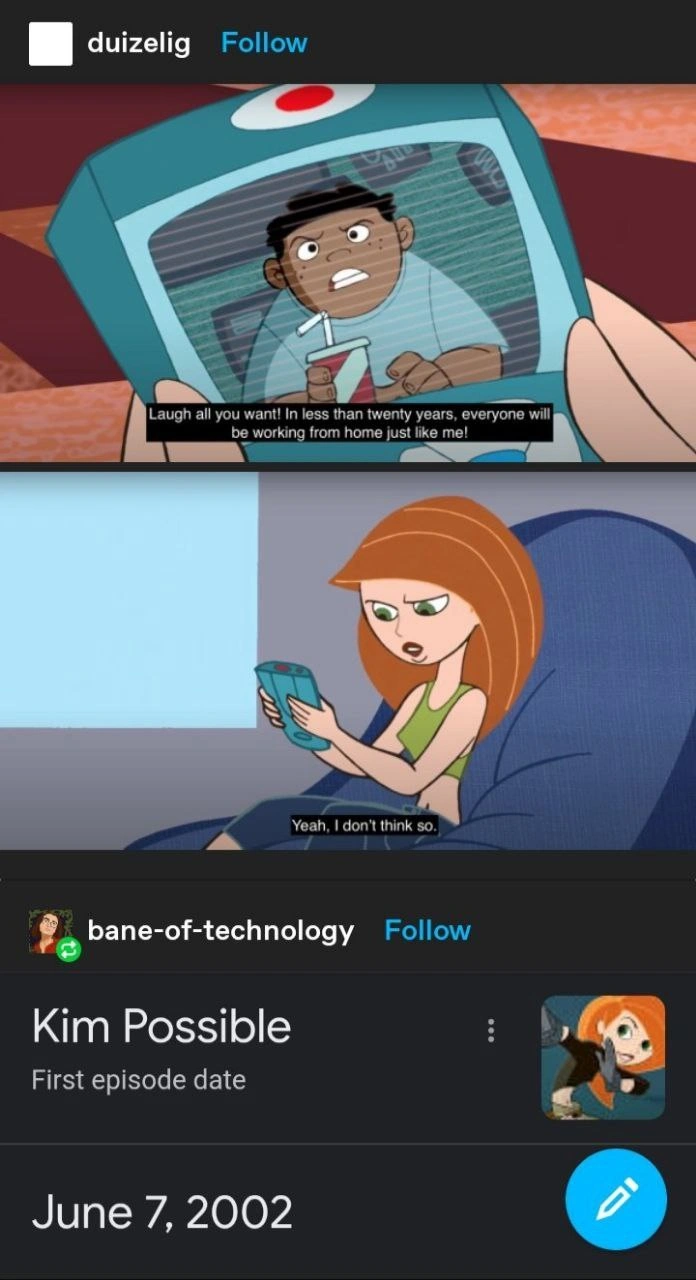
This meme uses scenes from the early 2000s cartoon Kim Possible to make a clever point about remote work. In the first panel, the character Wade (a kid genius who always works from his computer at home) says something like, “In less than twenty years, everyone will be working from home just like me!” Kim, the heroine, responds in the next panel, “Yeah, I don’t think so.” At the bottom, the meme shows a Google info box with Kim Possible’s first episode date (June 7, 2002). The joke lands because if you add about 18 years to 2002, you get to the year 2020 – and that’s exactly when working from home suddenly became mainstream for a lot of people in tech.

In real life 2002, most companies did not have everyone working from home. Going to a physical office was the normal thing, and remote work (sometimes called telecommuting back then) was pretty rare. Kim’s doubtful reaction in the meme (“Yeah, I don’t think so”) shows how unbelievable Wade’s idea sounded at that time. But fast-forward to 2020, and almost every developer was working from home due to the COVID-19 pandemic. Offices closed, and entire tech teams had to do their jobs from home for safety. It turns out Wade’s bold prediction came true: by 2020, remote work became the default situation for many of us.

To make working from home possible on such a large scale, a few key technologies and practices had to be in place:

  • VPN (Virtual Private Network): This is a secure connection method that lets you access a company’s internal network from home. Think of it like a private tunnel through the internet to your office. In 2020, many developers started their day by connecting to the company VPN so they could safely reach servers and internal tools while at home.
  • Video conferencing & “Zoom fatigue”: Without physical meeting rooms, teams used video call apps like Zoom for meetings. You could see your coworkers in little rectangles on your screen and talk in real-time. This was great for staying in touch, but it also led to Zoom fatigue – people felt exhausted from being on camera in meeting after meeting. (Imagine having back-to-back video classes all day; it gets tiring in a different way than in-person meetings.)
  • Distributed teams and online sprints: In software development, a sprint is a short time period (often 1–2 weeks) when a team works to build or fix something specific. A distributed sprint means the whole team is working remotely, in different places, but still collaborating on the same project. By 2020, development teams learned to do their sprints entirely online. They used chat apps like Slack to ask questions, project tools like Jira or Trello to track tasks, and daily video calls to check in. Even though team members weren’t in the same room, they continued to plan, code, and ship new features together from their homes.
  • Security changes (zero-trust): Companies also had to adjust how they handle security once everyone was outside the office. Zero-trust security is a policy that basically says “we trust no one by default.” In simpler terms, even if you’re an employee, your device or login must always be verified because you’re not physically in the office network. This approach became popular in the WFH era. It’s like how a school might check ID for every single person entering, even teachers, because they’re coming in from outside every time.
  • Hybrid work policies: After the initial period where almost everyone was remote, companies started planning for the future. Many adopted hybrid work policies, meaning some days you work from home and some days you go into the office. In 2002, nobody talked about hybrid schedules or remote-first jobs, but by 2021 it became a common idea. It was a way to get the best of both worlds: keep the flexibility of remote work while also having people in the office sometimes for face-to-face time.

The meme is funny to developers and IT folks because it shows a cartoon kid from 2002 perfectly calling a huge shift in how we work. Wade was basically saying “working from home will be totally normal” long before it actually happened, and Kim’s response (“I don’t think so”) is exactly what many people would have said back then. Today, after living through 2020, we know Wade was right. Pretty much everyone on tech teams had a period of working exclusively from their home office, using all those tools like VPNs and Zoom to keep things running. This contrast between what people expected in 2002 versus what actually occurred by 2020 makes the meme both ironic and very relatable. It’s a little reminder that sometimes the “impossible” (no pun intended, Kim!) can become possible after all.

Level 3: Nostradamus in Pajamas

Wade, the teenage tech genius from Kim Possible, inadvertently pulls a Nostradamus on the tech world. In this meme’s top panel, he appears on Kim’s communicator bragging, “Laugh all you want! In less than twenty years, everyone will be working from home just like me!” It’s a bold prophecy delivered in 2002 (the cartoon’s debut year) that seemed absurd at the time. After all, back in the early 2000s, remote work wasn’t a common arrangement in corporate culture – it was mostly a niche perk or a sci-fi novelty. In the next panel, Kim lounges skeptically and replies, “Yeah, I don’t think so.” That was the prevailing attitude back then: sure, a quirky remote life might work for a cartoon whiz-kid, but most real companies expected you in the office. Many tech managers in 2002 (and even much later) believed serious work only happened with everyone under one roof.

Fast-forward to 2020, and Wade’s wild claim comes true almost to the letter. A global catalyst (the COVID-19 pandemic) forced companies worldwide to embrace working from home (WFH) practically overnight. Suddenly everyone was working from home, just like Wade predicted. Senior engineers who lived through that remote-work wave chuckle at this foreshadowing. It’s a shared experience we all relate to now: the daily commute got replaced by logging into a laptop at your kitchen table (the new home-office norm). What seemed impossible in 2002 became mundane reality.

For developers, the reality of 2020’s remote shift meant their VPNs were lit up all day. (A VPN, or Virtual Private Network, is like a secure tunnel back into your office network – by 2020 it became as essential as coffee.) We found ourselves hopping on endless Zoom video meetings – and soon feeling the “you’re on mute” frustration and Zoom fatigue from too many video calls. Agile teams learned to run fully distributed sprints: entire projects planned and completed by team members scattered across time zones, coordinating via Slack messages and video stand-ups. Daily stand-ups still happened at 9 AM, but now everyone was in pajamas dialing in from their living room. It was a far cry from the conference-room huddles of 2002, yet somehow tech teams kept the releases coming.

This shift also spawned a new corporate vocabulary. Zero-trust security went from obscurity to buzzword almost overnight. (Zero-trust means the network assumes every login or device is untrusted until proven otherwise – a practical approach when nobody is “inside” a secure office network anymore.) And then came the talk of hybrid work policies – companies debating how to blend remote and office work as things reopened. Terms like “remote-first,” “asynchronous stand-ups,” and “hybrid schedule” became common, concepts nearly nonexistent when Kim Possible first aired. Even old-school bosses who once swore that “butts in seats” were the only way to be productive had to eat their words.

The humor here is that a kids’ cartoon essentially predicted one of the biggest twists in modern tech history. Kim’s dismissive “I don’t think so” in 2002 mirrors countless real-world executives pre-2020 who insisted remote setups could never replace office culture. Yet by necessity, even the skeptics had to admit it was not only possible – it became the new normal. Developers ended up deploying code from their couches, pair-programming over screen share, and attending all-hands meetings via webcam. Wade’s once-laughable idea became a universally relatable reality. The meme drives the point home with that bottom panel showing Kim Possible’s first episode date in 2002 – a cheeky reminder of just how ahead-of-its-time this cartoon moment was. In hindsight, the kid in the show’s basement had a point: he foretold the remote work revolution long before the world was ready to believe it.

Description

Three-panel Tumblr meme built from the early-2000s cartoon “Kim Possible.” 1) Top panel shows Wade on Kim’s teal handheld communicator saying, “Laugh all you want! In less than twenty years, everyone will be working from home just like me!” (white subtitles overlaid). The Tumblr UI header reads “duizelig Follow.” 2) Middle panel: Kim lounges in a blue armchair, still holding the communicator, replying with the subtitle, “Yeah, I don’t think so.” 3) Bottom panel is a Google-style info card posted by user “bane-of-technology Follow.” It reads: “Kim Possible - First episode date - June 7, 2002.” The joke lands because 2002 + 18 ≈ 2020, the year remote work went mainstream for tech teams. Senior engineers will appreciate the foreshadowing of ubiquitous VPNs, Zoom fatigue, and fully distributed sprints long before zero-trust or hybrid policies were corporate buzzwords
Comments

16
Anonymous ★ Top Pick Wade basically delivered the original zero-latency, fully-remote DevOps setup - everyone else just waited for a global incident to roll out the VPN
  1. Anonymous ★ Top Pick

    Wade basically delivered the original zero-latency, fully-remote DevOps setup - everyone else just waited for a global incident to roll out the VPN

  2. Anonymous

    The real villain move was predicting remote work in 2002 but not buying Zoom stock until the pandemic hit - that's a 18-year missed opportunity for insider trading based on cartoon prophecy

  3. Anonymous

    In 2002, Kim Possible's villain predicted universal remote work and everyone laughed. Fast forward to 2020: suddenly every engineering team is on Zoom, fighting with VPNs, debugging production issues in pajamas, and realizing that 'working from home' actually means 'living at work.' Turns out the real villain was the one who normalized back-to-back video calls without bathroom breaks. At least the cartoon villain had the decency to use async communication on a handheld device instead of scheduling another 'quick sync' at 4:45 PM on Friday

  4. Anonymous

    Prophecy fulfilled: by 2022 we had Git, CI, and Zoom humming across twelve time zones - the only thing that refused to scale was the office lease

  5. Anonymous

    Turns out the villain was right: by 2020 we hot‑fixed society to remote‑first, with Zoom as the message bus, Slack the eventual‑consistency layer, and VPN hairpinning the CFO’s cost center

  6. Anonymous

    Drakken's roadmap: 'Pocket AI sidekick ubiquity by 2022' - vetoed by product, shipped by reality

  7. @APT3M 2y

    She is right. He said EVERYONE.

  8. @dsmagikswsa 2y

    Almost out of 20 years

    1. @TERASKULL 2y

      it already happened in 2020 with covid

      1. @RichStallman 2y

        what's covid?

        1. @TERASKULL 2y

          oh no, the ipad babies are emerging

  9. @ShiningFlames 2y

    Delusions

    1. @mekosko 2y

      of Saviour

  10. @PeGa041 2y

    I almost got fired for working from home back in '06

  11. @PeGa041 2y

    People's so easily scared of what they don't understand

  12. @PeGa041 2y

    they thought I was some sort of hacker or so

Use J and K for navigation