Skip to content
DevMeme
5164 of 7435
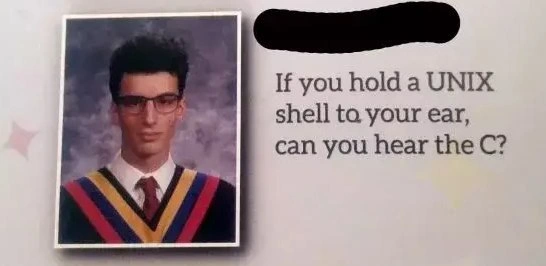
Yearbook quote puns a UNIX shell into hearing the C
CLI Post #5654, on Nov 12, 2023 in TG

Yearbook quote puns a UNIX shell into hearing the C

Why is this CLI meme funny?

Level 1: Hearing the Ocean

Imagine you’re at the beach and you pick up a big seashell. Someone might tell you, “If you hold it up to your ear, you can hear the ocean!” Of course, you’re not literally hearing the real ocean inside the shell – the shell is just echoing the sounds around you – but it’s a neat little trick that feels magical. Now, this joke works by taking that fun idea and swapping in computer stuff. Instead of a real seashell, it talks about a “UNIX shell,” which is not something from the beach at all. A Unix shell is basically a program on the computer (a place where you type and tell the computer what to do, kind of like a fancy calculator screen with just text). And instead of the “sea” (the ocean) that you’d expect to hear, it says “the C.”

Why “the C”? Well, in computers, there’s a very important programming language called C. And the word “C” when you say it out loud sounds exactly like the word “sea” (as in the sea with waves). So the joke is playing a little sound trick on you. It’s as if you replaced “ocean” with “the letter C.” When you read the whole sentence, it’s asking a silly question: if you hold this computer shell to your ear, can you hear the C (sea)? It’s goofy because obviously you can’t hear a programming language by putting a computer to your ear! The fun of it is that “hear the C” sounds just like “hear the sea,” which is what we’d normally say with a seashell.

So, think of it this way: A kid holds up a shell and pretends to hear the ocean – that’s a cute, imaginative moment. Now a computer-loving person holds up a computer shell (terminal) and pretends to hear the C – that’s a nerdy twist on the same idea. It’s funny to people who program because it mixes a warm, familiar childhood idea with something super technical that they love (the Unix command line and the C language). It’s like telling a little inside joke that combines the beach and coding class. Even though it’s a very simple joke, it makes programmers smile because it shows how we can find a dash of humor in our tools and languages. In the end, it’s just a playful pun – a mix-up of words that sound alike – and it’s chuckle-worthy because it’s so delightfully nerdy.

Level 2: The Shell and the Sea

At its core, this meme is playing with two meanings of the word “shell” and two things that sound the same: C and “sea.” Let’s unpack it in a straightforward way. First, a UNIX shell is a program that provides a text-based way to interact with your computer’s operating system. It’s what you see when you open a Terminal or command prompt – you get a $ or > prompt, and you can type commands. This is called the CLI (Command Line Interface). The shell lets you launch programs, list files, write ShellScriptingLanguages commands, and so on. It’s named a shell because it’s like the outer layer of the operating system that users interact with (while the inner core of the OS is called the kernel). Popular Unix shells include bash (Bourne Again Shell), zsh, and even one literally called the C Shell (csh). So when you hear “Unix shell,” think of that black-and-white text window where a developer types magic incantations – for example, the place you might type ls to list files or git pull to fetch code.

Now, the quote says: “If you hold a UNIX shell to your ear, can you hear the C?” This is a twist on a common saying about seashells. In real life, there’s a fun idea that if you hold a seashell (the kind you find on a beach) up to your ear, you can hear the sound of the ocean (the sea). Of course, the seashell isn’t actually holding ocean water or anything; it’s just echoing the ambient noise around you, but it’s a cool little phenomenon often told to kids. The meme takes this familiar concept and swaps in computer terms: instead of a seashell, it’s talking about a Unix shell (the command prompt); and instead of the sound of the sea, it asks about hearing the “C.” The letter “C” here is referring to the C programming language, which is one of the most famous computer languages ever (it’s been around since the 1970s, and it influenced a ton of modern languages – we even call them the C family languages, like C++, C#, Objective-C, etc.). C is pronounced like “see,” which is a homophone (a sound-alike) for the word “sea.” So the joke only works because “C” (the tech thing) sounds exactly the same as “sea” (the ocean). It’s a pun – a classic play on words.

In simpler terms, the quote is asking: if you put a Unix command-line (shell) up to your ear like a seashell, will you hear the C language (which sounds like hearing the sea)? Obviously, in reality you won’t hear anything – computers don’t work that way – but that obvious impossibility is what makes it funny. It’s knowingly absurd. It mixes a peaceful, non-technical image (listening to a seashell at the beach) with a very nerdy reference (Unix and the C language). For someone who has just started learning programming or IT, here’s why it’s amusing:

  • Unix shell = not a literal shell, but a text interface for computers. Think of it as the “language” you use to tell the computer what to do in an old-school way, by typing commands. It’s a key part of OperatingSystems like Linux or macOS.
  • C = not the sea you swim in, but a programming language named “C.” It’s famous for being the language in which Unix itself was written. It’s also just the letter C, which sounds like “sea.”
  • Holding a shell to your ear = a reference to the physical act of putting a seashell to your ear to hear ocean sounds. People do this with conch shells for fun.

The quote merges those elements: it’s as if someone wonders, “hey, if a seashell gives you ocean sounds, would a computer shell give you C sounds?” It’s a silly pun. The humor is pretty much a gentle groan-laugh – the kind you get when someone makes a joke that’s clever with words but totally nonsensical in reality. Many developers love these kinds of puns (we often call them “dad jokes” in the programming world) because they show you understand the jargon. Here the jargon is Unix and C. If you’ve been introduced to the Unix shell in a class or by tinkering with Linux, and you know a bit about the C language, you’ll get the joke and maybe smirk. In case you haven’t: think of it this way – it’s like saying, “If I press my calculator to my ear, can I hear the numbers crunching?” It’s humor by absurd analogy.

It’s also presented as a yearbook_quote, which is part of why it’s funny. In many schools, graduating students get to put a quote under their yearbook photo – something inspirational or a favorite line. Here, the student chose a nerdy inside joke instead. It tells you something about them: they probably spent a lot of time in the computer lab, know their way around the command line, and have a goofy sense of humor. It’s the kind of line that might confuse non-techy folks flipping through the yearbook (“hear the C? Is that a typo?”), but it will make the tech-savvy folks laugh and nod. It’s one of those graduation_memories that double as a wink to fellow geeks. Essentially, the quote combines computer science lingo with a childhood myth to make a light-hearted joke. Once you know all the pieces – Unix shell (command prompt), C language, and the seashell/ocean trick – the pun clicks into place. It’s a small example of how programmers often blend their work and humor, finding witty connections between the digital world and everyday life.

Level 3: C Shells by the C-Shore

“If you hold a UNIX shell to your ear, can you hear the C?”

Seeing this printed as a formal yearbook quote is both nerdy and nostalgic. It’s the kind of cheeky one-liner only a developer would sneak into a graduation photo spread. For those in on the joke, it lands perfectly: blending a bit of beach folklore with classic computing reference. Essentially, this quote is a developer_dad_joke dressed in a cap and gown. It’s a playful pun that combines two pillars of old-school programming lore – the Unix command-line shell and the C language – under the guise of a wholesome saying about seashells. The humor comes from the incongruity: yearbook quotes are usually inspirational or sentimental, but here we have a deadpan technical pun that only makes sense if you know your way around a terminal.

The quote riffs on the well-known childhood myth that if you hold a seashell (like a conch) to your ear, you can hear the ocean. Everybody remembers that little trick from their kid days or graduation_memories. Here, the seashell is swapped out for a UNIX shell (meaning a text-based command prompt), and the “ocean” is replaced with “the C” – a wink at the C programming language (pronounced the same as “sea”). It’s a classic homophone gag. Saying it aloud, “hear the C” sounds exactly like “hear the sea.” The punchline is subtle: only those who recognize that C refers to a programming language (one of the venerable CFamilyLanguages) will get why it’s funny. Everyone else might just be puzzled, or assume it’s a typo. Seasoned engineers chuckle because it evokes an earlier era of computing when working in a CLI (Command Line Interface) and writing in C were daily routine – a bit of retro_computing_reference that feels like an insider secret.

This meme’s charm lies in its layered cultural reference. The Unix shell is emblematic of hacker culture and ShellScriptingLanguages tradition – a simple text interface where countless gurus have spent late nights writing bash one-liners or debugging shell scripts. And the C language is a legend in its own right: the lingua franca of early operating systems, low-level enough to be powerful, yet simple enough to fit in a slim book by K&R. By asking if you can “hear the C” through the shell, the quote humorously implies that the essence of the system (the code in C humming under the hood) might just speak to you if you listen closely. It’s poking fun at how deeply intertwined C and Unix have been in computing history. In fact, many of the tools you invoke in a Unix shell (ls, grep, etc.) are themselves written in C. The joke imagines, tongue firmly in cheek, that the shell might carry the echo of those C programs.

The yearbook setting cranks up the silliness. Picture some straight-A Computer Science student picking this as their grad quote – it’s an ultimate nerd flex. It likely got a mix of eye-rolls and laughs from classmates. The layout mimics a sincere, formal yearbook tribute, which only heightens the contrast when you read the line and realize it’s a pun about operating systems. This contrast — formal presentation versus geeky content — is part of why engineers find it hilarious. It’s self-aware humor: we know this pun is groan-worthy (the kind only a true techie would love), and putting it in a proud, serious yearbook context just amplifies the comedic effect. It’s also a bit of an ode to our roots. Many experienced devs have a fond spot for the shell-and-C days; that was the default toolkit that built so much of today’s software. Dropping a UnixCulture joke into a yearbook is like a secret handshake to fellow developers: “We’ve been around, we remember the classics, and we’re not afraid of a good pun.” In a world of ever-changing frameworks and languages, a nod to Unix and C feels delightfully timeless.

To really appreciate the wordplay, let’s break it down literally. In a Unix shell (say you open a Terminal on a Linux/Mac system), you interact by typing text commands. If you wanted to symbolically “hear” the letter C in a Unix shell, what could you do? Perhaps use the shell’s echo command to output “C” on the screen. It’d look like this:

$ echo "C"
C
# (The shell happily prints "C", but no actual ocean waves are included.)

As you can see, the shell will obediently echo back whatever you tell it – here it prints the letter C to standard output. But of course, there’s no magical sound of the sea; it’s just text on a screen. And that’s precisely why the quote is funny – it deliberately mixes up a physical experience (listening to a seashell) with a computing concept (the Unix shell and the C language) that normally has nothing to do with sound. It’s absurd if you think about it: holding a command-line interface to your ear won’t produce any sound at all, let alone the mystical sound of C. The shell is silent unless commanded to display or beep, and programming languages don’t make noise – but our collective memory of that ocean-in-a-shell trick and our knowledge of tech collide in a perfect pun. The result is a one-liner that’s super corny and yet technically endearing. It acknowledges the deep connection between OperatingSystems and the C language in a whimsical way. So, for any developer who grew up on Unix, hearing this quote is like catching a friendly wink from the past – a reminder that even the tools and languages we use can be the butt of a good joke.

Level 4: Shell Resonance

In operating system design, a shell is aptly named – it's the outer layer interfacing with the core of the system (the kernel). Early Unix architects used this term to differentiate the user-facing command interface from the protected inner workings of the OS. The kernel (think of it as the pearl inside the shell) handles low-level tasks and was famously written in C. So when a seasoned engineer quips about holding a Unix shell to your ear to “hear the C,” there’s a clever subtext: the shell program is our conduit to the kernel’s world, which indeed speaks (or at least is coded in) C. It’s an academic in-joke hiding in a dad joke’s clothing.

This meme’s pun plays on homophonic resonance – the same kind that makes a conch shell seem to whisper the ocean’s roar. In reality, a seashell by your ear isn’t playing stored ocean sounds; it’s resonating ambient noise. Similarly, a Unix shell doesn’t literally emit the hum of C code, but it does echo the processes and output of programs (often written in C) running beneath. The phrase “hear the C” swaps in the letter C (for the C programming language) where one would expect “sea.” It’s a linguistic trick: C and sea sound identical, a happy accident given C’s foundational role in Unix. In essence, this yearbook quote is winking at the way the Unix CommandLineInterface acts as a sounding board for the operating system’s C-powered core. If you could acoustically listen to a running Unix system through its shell, the nerdy fantasy is that you’d catch echoes of that C code churning away in memory.

Historically, this joke carries extra layers. Unix culture in the late 20th century produced an actual C Shell (the csh shell) – a command-line interpreter whose name literally spells “C shell” (and yes, it was partly inspired by C’s syntax). So the pun “hear the C” could be seen as a sly nod to those days when you might choose C Shell as your default CLI. We have a recursion of wordplay: she sells C shells by the C-shore, anyone? The meme packs in a bit of retro computing lore: a reminder that back in the Bell Labs era, the marriage of Unix and C was so fundamental that even our jokes entwine them. If you’re the type to appreciate a touch of computer history, you might even recall that Dennis Ritchie and Ken Thompson created C and Unix together, laying the groundwork for modern OperatingSystems. This quote humorously imagines that foundation as something almost tangible – as if the vibrations of that old C code could literally be heard by a true Unix devotee holding a terminal up like a seashell. It’s a beautiful thought in a geeky way: the UnixPhilosophy and UnixCulture were so rich that even a shell prompt can evoke the sound of the digital ocean.

Description

The image shows a formal graduation-style yearbook portrait on the left: a young person in a black gown with bold V-shaped yellow, red, and blue stripes over a white shirt and tie. Their face is blurred for privacy. On the right, printed in serif type, the quote reads: “If you hold a UNIX shell to your ear, can you hear the C?” against a light gray background. The layout mimics classic yearbook design, but the text delivers an inside joke for seasoned engineers - blending the command-line concept of a UNIX shell with the C programming language while riffing on the seaside ‘conch shell’ analogy. The humor lands for developers who remember when C and the UNIX shell were the default toolkit and appreciate wordplay that hinges on decades-old operating-system lore

Comments

6
Anonymous ★ Top Pick Sure, but only after you pipe it through `grep -i "sea"` and redirect stderr to /dev/conch
  1. Anonymous ★ Top Pick

    Sure, but only after you pipe it through `grep -i "sea"` and redirect stderr to /dev/conch

  2. Anonymous

    After 20 years of piping commands, I finally understand why they call it a shell - it's where all the C creatures live, and if you listen closely, you can hear the faint echo of Dennis Ritchie sighing at your memory leaks

  3. Anonymous

    This joke perfectly encapsulates the symbiotic relationship between UNIX and C that every systems programmer knows intimately - much like how you can't separate the kernel from its syscalls, you can't separate UNIX from C. It's a delightful reminder that while modern developers might reach for Python or Go, the foundation we're all standing on was built by people who thought in pointers and wrote operating systems for fun. The real question is: if you hold a Kubernetes pod to your ear, can you hear the YAML screaming?

  4. Anonymous

    Only if LANG=C; otherwise i18n translates it to ‘sea’ and ruins the bit

  5. Anonymous

    Shh, it's Dennis Ritchie murmuring K&R syntax in an endless echo of fork()

  6. Anonymous

    Hold bash to your ear and you’ll mostly hear fork/exec; the C only leaks through when -Wall is on and UB starts yelling

Use J and K for navigation