The tragedy of adding side-effects to a once pure function
Why is this FunctionalProgramming meme funny?
Level 1: Ruined Toy
Imagine you have a favorite toy that always does one awesome trick every time you press a button. Let’s say it plays a nice song whenever you use it. It’s reliable and makes you happy because it always just plays that song – no surprises. Now, one day your mischievous friend tinkers with the toy. You press the button expecting the usual nice song, and yes, the toy plays the song… but it also starts splattering paint everywhere around your room at the same time! Suddenly your once-perfect toy is making a mess. You’d probably feel upset and yell, “Hey, you ruined my toy!” because it’s not pure and simple anymore.
In this meme, that toy is like a little helper in a program (we call it a function) that used to be clean and predictable. Press the button (give it an input) and you get the song (an output), nothing else. But after someone’s meddling, pressing the button gives you the song and an unwanted paint splash (a side effect). The cartoon character shouting “YOU TOOK MY PURITY! YOU RUINED ME!” is exactly how that poor toy (or function) would feel if it could talk. It’s a funny way to show that doing extra sneaky stuff when you weren’t supposed to can make even a happy, consistent friend (or piece of code) suddenly troublesome. The humor comes from treating the code like a person who is very dramatic about being changed. Even if you’re not a programmer, you can understand that nobody likes it when something that was simple and good starts doing crazy extra things. It’s like the code is crying because someone spoiled its graceful behavior. In short, the meme is joking that making a simple thing complicated is a kind of tiny tragedy – one that even a cartoon hero would scream about!
Level 2: Clean vs Dirty Code
Let’s break down what this meme is talking about in simpler terms. We have a pure function, and we have the idea of adding side effects to it. First, what exactly is a pure function? In programming, a function is considered pure if two things are true:
- It always gives the same output for the same input (no randomness or dependence on hidden data that can change).
- It does nothing else besides computing that output. “Nothing else” means no changing other variables, no printing to the screen, no writing files, no modifying a database, etc. – basically, no side effects.
Now, a side effect in programming is any additional action a function performs that is observable outside the function. This could be:
- Changing the value of a global variable or a variable in the outer scope.
- Modifying one of its input arguments (if it’s an object or reference).
- Printing output to the console or a UI.
- Writing to a file, database, or network (sending an email, making an HTTP request, etc.).
- Even something like calling another function that has its own effects can count.
A pure function is like a vending machine that, whenever you punch in A1, always gives you the same snack, and doesn’t do anything else. No noises, no flashing lights, it just quietly hands you your candy every time, predictably. If we add a side effect to that, it’s like saying: “Now whenever someone presses A1, as well as giving the snack, also ring an alarm bell.” That alarm bell ringing is a side effect – an extra, outward action beyond just delivering the snack. In code, for example, consider this simple function in Python:
# A pure function: no side effects, just returns a value
def square(x):
return x * x
result = square(5) # result is 25, and nothing else happened
Every time we call square(5), we’ll get 25 and that’s it. It doesn’t print anything, doesn’t change any other variable – it’s self-contained. Now let’s add a side effect to illustrate:
counter = 0 # a variable outside the function
def square_with_side_effect(x):
global counter
counter += 1 # side effect: modify external state
print(f"Squaring {x}") # side effect: output to console
return x * x
result1 = square_with_side_effect(5)
# This call printed "Squaring 5" and changed counter to 1, besides returning 25.
result2 = square_with_side_effect(5)
# This call printed "Squaring 5" again and changed counter to 2, besides returning 25.
In square_with_side_effect, we snuck in two side effects: it updates a counter defined outside the function, and it prints a message. Now the function is impure (the opposite of pure) because it has these external interactions. If you call it twice, not only do you get your result (25 both times), but you’ve also incremented counter twice and printed two lines. The output 25 might be the same, but the world around the function changed because of those calls. That’s what it means to lose purity.
So why does the meme show the function freaking out like “You ruined me!”? Because in programming, especially in functional programming concepts, we treat purity as a really good thing. Pure functions are easier to work with. Imagine you’re trying to test or debug code. If a function is pure, you only have to think about “Given this input, did I get the expected output?” You don’t have to reset any external state between tests because nothing external changes. But if a function has a side effect, you might have to reset something or consider the order of calls. For instance, in the above square_with_side_effect example, if you call it and forget that it affects counter, a subsequent part of your program might behave differently because counter is now changed. It introduces a hidden coupling: something else in your program might rely on or be broken by the new value of counter. This kind of hidden effect is often considered a bad practice or code smell when not absolutely necessary, because it makes the code less clear.
In Clean Code principles, we learn that functions should ideally do one thing (and do it well). If a function is meant to calculate a value, it should just calculate that value and not secretly also do logging or modify globals. When you add a side effect, you’re essentially giving the function an extra job without changing its name or how other parts of code call it. That’s why other developers might be caught off guard. It’s like if you had a helper robot that always swept the floor when you pressed the blue button. If someone reprogrammed it so the blue button still sweeps the floor but also knocks over a vase each time, you’d be pretty upset – you weren’t expecting that second action. In programming terms, the robot’s “blue button function” was pure (only did one thing) and now it’s impure (does an additional, disruptive thing). It violates the principle of least surprise: anybody using that function might not expect those side effects.
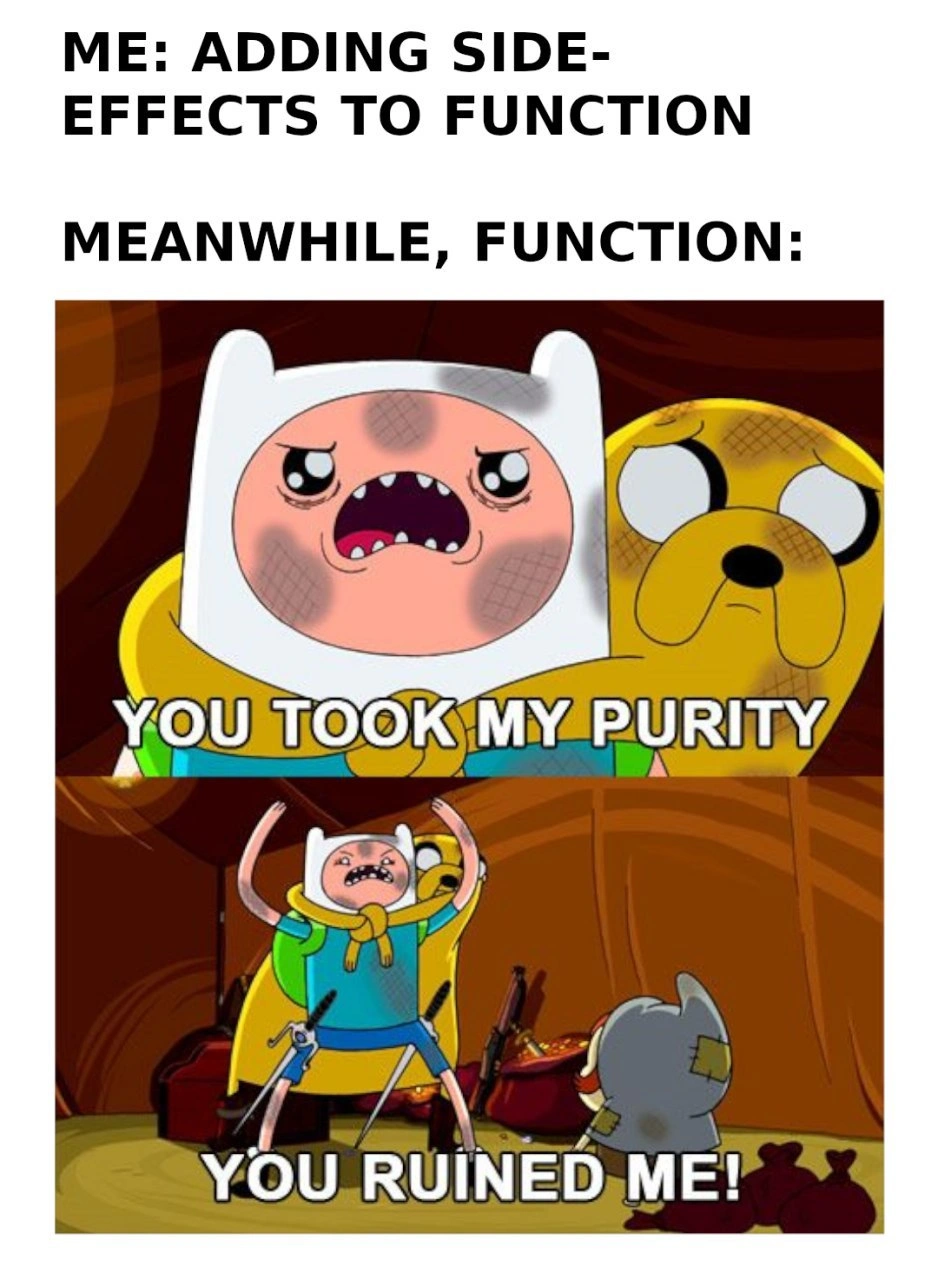
Let’s connect this to the meme’s imagery: The text “ME: adding side-effects to function” implies the developer is doing something that might seem minor – just adding a little extra code inside a function. The “Meanwhile, function:” part with Finn yelling “YOU TOOK MY PURITY” and “YOU RUINED ME!” is a humorous way to personify the function’s reaction. The function “feels” like it was pure and innocent, and now it’s been tainted or messed up by that change. Of course, in reality, a function doesn’t have feelings 😉, but as developers, we often talk about code in human terms (“this code doesn’t like when we do that” or “that function is angry”). It’s part of developer humor – we dramatize the code to highlight a point. Here the point is: adding side effects to a formerly pure function is considered a kind of tragedy or at least a regrettable design choice, especially to those who value functional programming techniques.
If you’re a newer developer, you might wonder “Are side effects always bad?” Not exactly – many things we need to do in programs are inherently side effects (you have to print output to show a user something, you must write to a file or database to save data, etc.). The key is managing side effects carefully. A common practice is to keep most of your code pure and push side effects to the edges. For example, you might have a pure function calculateScore(data) that just computes and returns a score. Then separately, you have another function that takes that score and maybe prints it or saves it to a file. This way, the calculation logic stays pure and easy to test, and the side effect (saving or printing) is done in a contained place. When you mix them haphazardly, you lose those benefits. It’s like mixing clean water with a little bit of dirty water – now all the water is a bit dirty and you can’t get it purely clean again without filtering it somehow.
The meme is categorised under FunctionalProgramming and CodeQuality for these reasons. In functional programming, pure functions are a cornerstone, and avoiding unintended side effects is a big part of writing quality code. It’s also tagged with SideEffectsInProgramming and CleanCodePrinciples – because it’s illustrating a violation of those ideas in a funny way. Essentially, the meme is a light-hearted reminder: if you have a pure function, think twice before you give it a side job. The anguish of the cartoon character is an exaggerated version of the codebase or your fellow programmers reacting, “Nooo, that function was so nice and predictable, and now it’s doing this other thing too!” It’s a joke, but it’s also the kind of thing you’ll hear in code reviews or team discussions about keeping functions clean.
So, for a junior developer learning from this: pure functions good, unexpected side effects bad (unless really necessary). The humor makes it stick in your mind. Next time you consider adding a quick log or modifying some external state inside a utility function, you might remember Finn’s dirty face yelling “You ruined me!” and decide, “Hmm, maybe I’ll handle this side-effect elsewhere instead.” 😅
Level 3: Purity Lost
For seasoned developers, this meme hits on a well-known code quality concern: taking a clean, pure function and sneakily giving it a side job (a side effect). The top text sets the stage: “ME: adding side-effects to function” – we’ve all seen (or been) that developer who says, “I’ll just quickly log something here,” or “I can update that global counter inside this function, no big deal.” Meanwhile, the function – represented by the outraged Finn from Adventure Time – is screaming “YOU TOOK MY PURITY. YOU RUINED ME!” This dramatic reaction embodies how developers who love functional programming and clean design feel when a simple function is corrupted with hidden side effects. It’s the function having an identity crisis: once a straight-laced, predictable piece of code, now turned into a bundle of surprises.
Why is this so humorous (and painful) to experienced devs? Because it’s relatable. Imagine a function computeSalary(employee) that used to just calculate and return a number. It was a nice, referentially transparent helper – you could call it any time and trust it completely. Then someone decides that whenever you compute the salary, we should also print a message, or update some global total, or write to a database for audit. Suddenly computeSalary is doing two things: calculating and causing side effects. It’s no longer predictable in isolation. If you call it twice with the same input, you’ll get the same salary output, but maybe now two log entries or the global total doubles. The poor function’s single responsibility has been muddled. No wonder it’s depicted as yelling “You ruined me!” – that second image of Finn hoisting Jake and bellowing encapsulates the function’s despair at being compromised.
In real-life projects, this is a classic anti-pattern. Pure functions are cherished because they’re:
- Easier to test: You give
f(x)some input, check the output, done. Iff(x)also writes to a file or alters global state, your test now has to consider those effects (cleanup the file, reset the global, etc.) – messy! - Predictable and safe to reuse: A pure function can be called anywhere, anytime, without worrying that it will accidentally change something outside its scope. It’s like a well-behaved child. Add a side effect, and suddenly it’s a wild child — order of calls matters because the first call might alter something needed by the second. For example, if a function increments a global counter each time, calling it in a different order or number of times changes the program’s state in unexpected ways.
- Transparent in purpose: By definition, a pure function’s only outcome is its return value. If you see
result = doThing(x), you knowdoThingdidn’t secretly also modifyxor print logs or trigger an API call. When it does do those things, it violates the principle of least surprise. It’s a code smell – like noticing a whiff of something “off” in what should have been clean code.
This meme exaggerates that violation for comic effect. In the FunctionalProgramming community, purity is almost sacred. So adding a side effect is tantamount to betrayal – hence the full-on Adventure Time melodrama. The developer is oblivious or casual about it (the “ME” in the meme is just doing it, probably whistling innocently), while the function – representing the purist viewpoint – reacts as if its very life force was attacked. Remember, side effects in programming are anything a function does besides computing a return value: modifying a variable outside its scope, altering a data structure it wasn’t supposed to touch, printing to the console, writing to disk, calling another service, etc. These are normal in many contexts, but when they creep into a function that was assumed pure, it “ruins” the properties that developers rely on.
Think of maintainability: you might have built a whole module assuming getConfigs() just returns some config object and nothing else. If someone edits getConfigs() to also write to a log file each time, you could end up with performance issues (writing every call), or even weird bugs if that log writing fails. Or consider concurrency: if a pure function suddenly starts modifying global state, calling it from multiple threads can introduce race conditions where previously everything was thread-safe. Seasoned devs have been bitten by exactly this scenario – a seemingly innocent change causing late-night debugging sessions. It’s always that “tiny logging code” or “quick state increment” that comes back to haunt us at 3 AM!
This is why the meme resonates. It’s developer humor pointing out a real pitfall. It’s poking fun at our tendency to sacrifice purity for a quick fix. We laugh (perhaps nervously) because we remember that time we added a print statement in a function and inadvertently broke someone else’s automation that was parsing the output. Or the time a colleague slipped a database write into a calculation routine “just to track usage,” and half the team cried out, “Nooo, you’ve polluted the function!” It’s a shared understanding that clean code principles encourage minimizing side effects. In an ideal world, side effects are isolated to the edges of your system (for example, one layer that handles all I/O or state changes), and the core logic remains pure. But in real projects, under deadline pressure, someone invariably says, “We can just do it here, it’s faster than refactoring the code to pass this information around properly.” And thus the slippery slope begins… the function’s purity is gone, and with it, some of our confidence in the code’s behavior.
The tragedy (and comedy) here is that once you add one side effect, it’s tempting to add another. A pure function might slowly turn into a dumping ground: today it logs a message, tomorrow it also modifies a global config, and soon it’s doing five different things besides its main job. It starts to resemble a mini-monster hidden behind an innocent name. Developers with experience have seen this pattern enough that the meme’s dramatic cry is both funny and a bit too real. The anthropomorphized function yelling "You ruined me!" is basically the voice in our head when we review such code in a pull request. We know the function won’t literally break down sobbing – but it’s as if the codebase itself is upset because we’ve made it harder to maintain and reason about.
In summary, at the senior level this meme is a tongue-in-cheek warning. It humorously advocates for code purity and single-purpose functions by showing the “feelings” of a function that had impurity forced upon it. It’s exaggeration with a kernel of truth: don’t make your clean functions cry. After all, a screaming Finn in your code comments (“You took my purity!”) is far less desirable than simply keeping that function truly pure from the start.
Level 4: Referential Transparency Trauma
In the pure realm of functional programming, a function is like a mathematical function – given the same input, it always produces the same output and does nothing else. This property is known as referential transparency. In theoretical terms, you can replace a function call with its result (f(x) = y) anywhere in the program without changing the program’s behavior. That holds true only if the function has no side-effects. Classic lambda calculus, the theoretical model underpinning functional languages, doesn’t even have a concept of a “side effect” – evaluating an expression affects nothing but the return value. If you suddenly introduce side effects into that world, you shatter these assumptions. It’s as if our once mathematically-pure function has been yanked out of the Garden of Church (Alonzo Church, lambda calculus founder 😄) and thrown into the chaotic realm of state and I/O.
From a computer science theory perspective, adding a side effect means our function is no longer a well-behaved function in the mathematical sense, but rather an operation that depends on execution context or time. The meme’s anguished cry “YOU TOOK MY PURITY!” isn’t far off – referential transparency has been violated. In formal semantics, this complicates reasoning: you can’t freely rearrange or parallelize calls to that function, because the order of calls might matter now (due to hidden state changes). The Church-Rosser theorem (confluence) from lambda calculus, which guarantees that evaluation order doesn’t change the result, effectively gets tossed out the window once side effects sneak in. Our hitherto pure function has entered the scary world of non-determinism and sequential dependencies.
To manage such chaos, functional programming theory employs some heavy artillery. Enter monads and similar abstractions from category theory – these are like protective containers for side effects. In a purely functional language like Haskell, you can’t just perform I/O or mutate state anywhere; you have to wrap those actions in an IO type or another effect type (like State, Maybe, etc.). The function’s type signature then advertises its impurity (e.g. foo :: Int -> IO String), making it clear “this function does more than pure calculation.” Inside the program’s logic, Haskell treats that IO String as a single abstract value, allowing the core logic to remain pure while the messy effects are cordoned off. In category theory terms, you’ve moved from the nice clean category of pure functions to a Kleisli category for the IO monad – essentially an alternate universe where functions can carry along side effects in a controlled manner. The monad doesn’t eliminate side effects, but it ensures that combining functions is still mathematically composable: the side effects are threaded through explicitly, so you never blindside a pure function with an impurity.
The tragedy in this meme is highlighting what happens when you don’t use such discipline – when a developer in a less restrictive language (or a lazy Haskell dev bypassing the type system via unsafePerformIO 🤭) just injects a side effect directly. The once pure function, which in theory lived in a world of equational reasoning and algebraic bliss, is now corrupted by real-world muck. If there were a Platonic form for “pure function,” it’s now weeping. The function has effectively lost its mathematical innocence. For a theorist or a die-hard FP engineer, that’s a traumatic event! The meme comically personifies this deep principle: a pure function screams in existential dread when forced to carry out an impure action, much like a law-abiding citizen being coerced into crime. In summary, at the theoretical level, adding side effects breaks fundamental assumptions, requiring advanced constructs (like monads and effect systems) to reason about or contain the impurity – otherwise our neat mathematical model of computation is “ruined,” as the meme so dramatically puts it.
Description
The meme is a two-part Adventure Time screen-grab framed by bold black text. At the top, large text reads "ME: ADDING SIDE-EFFECTS TO FUNCTION" followed by another line "MEANWHILE, FUNCTION:". The first image shows Finn the Human, cheeks smudged and mouth open in a furious shout, with Jake the Dog looking worried behind him; overlaid subtitle text says "YOU TOOK MY PURITY". The second image shows Finn lifting Jake overhead in frustration while yelling "YOU RUINED ME!". The joke contrasts a developer casually inserting side-effects with the function’s exaggerated anguish at losing its purity, poking fun at functional-programming ideals about pure functions, referential transparency, and maintainable code
Comments
9Comment deleted
Slid a persistToDB() inside what used to be a pure function - now the memoization cache has trust issues and CI treats referential transparency like a rumor
Twenty years later, you're still maintaining that "pure" utility function that writes to a global logger, updates metrics, and occasionally mutates a config object - but hey, at least the return value is deterministic
The function started as a beautiful pure expression - same inputs, same outputs, every single time. Then someone added a database call, sprinkled in some logging, threw in a cache update, and suddenly it's mutating global state like it's going out of style. Now it's impossible to test without mocking half the universe, and good luck reasoning about what it does when called twice. The function didn't just lose its purity - it became that legacy method everyone's afraid to touch because 'it works in production... somehow.'
The first “just log it” turned our pure function into an IO-bound microservice with retries, backoff, and a pager - referential transparency doesn’t have SLAs
Side-effects in pure functions: FP's original sin, swapping referential transparency for 'works on my machine' roulette
The fastest migration from FP to debug‑driven architecture is a println inside a “pure” function - congrats, you just invented time‑dependent integration tests
Not a haskel dev, didn't care Comment deleted
Nor am I, but I care a lot Comment deleted
fucking aboba Comment deleted