Skip to content
DevMeme
2858 of 7435
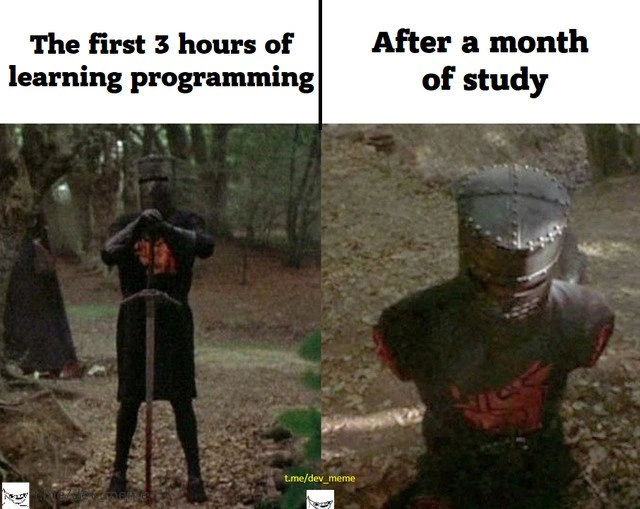
Confidence crash: first 3 hours coding vs one month of learning
Learning Post #3156, on May 24, 2021 in TG

Confidence crash: first 3 hours coding vs one month of learning

Why is this Learning meme funny?

Level 1: Learning is a Battle

Learning to code is kind of like playing a video game. In the tutorial level of the game, you win every fight easily and start feeling like a superhero. That’s the first 3 hours – everything seems simple and you’re on top of the world. But then you enter the next level (after a month of practice) and suddenly the game gets really hard. Big bosses knock you down over and over. You realize, “Whoa, this is tougher than I thought!” In other words, at first you felt as strong as a brave knight with a sword, but pretty soon you felt like that knight got all his arms and legs knocked off in battle. It’s a funny way to show that at the beginning we might feel super confident, and later we understand there’s a lot more to learn. Just like a knight who keeps fighting even when things get hard, a new coder learns to keep trying even after getting knocked down by problems. The meme makes us laugh because we’ve all felt that way: a little victory made us feel invincible, and then a bigger challenge humbled us. Learning anything new can be a battle, but if you don’t give up, you’ll get stronger after each fight.

Level 2: Tis But a Scratch!

Let’s break down the analogy. On the left, we have the Black Knight from Monty Python and the Holy Grail, confidently guarding a bridge in a forest. For a beginning programmer, those “first 3 hours” might mean completing a very easy tutorial or writing a simple program. Imagine a total beginner following a step-by-step guide to make a tiny website or their first Hello World script. Everything works! Our beginner likely thinks, “Wow, I’m really getting this programming thing!” They haven’t yet hit any major errors, just like the Black Knight hasn’t been hit with a sword. This early success boosts their confidence sky-high. In meme terms, they still have all their limbs intact – feeling powerful and invincible. This is a common beginner_overconfidence moment, where a newcomer doesn’t yet see the difficulties ahead. It’s like standing proudly in new armor, not realizing the battle hasn’t truly begun.

Now, the right panel shows the same knight later in the film, who insisted on fighting even after losing both arms and legs. He’s literally just a torso on the ground, but still yelling defiance. The caption “After a month of study” tells us that a month into coding, our beginner’s earlier confidence has taken heavy damage. Why? Because a month of real coding introduces them to the hard stuff that wasn’t in the gentle intro. They’ve now encountered bugs – those mistakes or glitches in the code that stop the program from working. Perhaps they missed a semicolon or mis-typed a variable name, and suddenly nothing works. They run the code and see a giant error message they don’t understand. For example, in Python you might get a Traceback full of information:

Traceback (most recent call last):
  File "app.py", line 1, in <module>
    main()
  File "app.py", line 5, in main
    prnt("Hello, World!")
NameError: name 'prnt' is not defined

The novice’s reaction: “W-what is all this?!” That multi-line dump is a stack trace. It’s basically the computer listing the sequence of function calls that led to the error. In the snippet above, the error at the end – NameError: name 'prnt' is not defined – means the code called prnt() but Python has no idea what prnt is. (Oops, they meant print() with an “i”!). For a beginner, encountering a scary red error for the first time feels like losing an arm in battle. It’s sudden and jarring. They fix one bug like that, but then ten minutes later another error pops up, maybe a TypeError or a SyntaxError. Each new problem slices away at their self-assurance. “Maybe I’m not so good at this after all…”

Beyond just typos, after a month, bigger concepts arrive that weren’t obvious in the first 3 hours. Terms like “object-oriented programming”, “frameworks”, or “algorithms” start appearing. The beginner tutorial probably glossed over these or presented them very simply. But building something slightly more complex (say, a small game or a to-do list app) reveals there’s a whole world of knowledge required. They might struggle with understanding why their code needs to be structured a certain way, or how to debug when the program logic is wrong. This overwhelming feeling is the programming_learning_struggle – our newbie realizing that each topic they explore branches into many more sub-topics and unknown terms. It’s as if every time they think they’ve slain a monster, three more spawn in its place. Losing one leg wasn’t the end of it; next they lose the other leg, then an arm… The knight (our learner) is getting metaphorically dismembered by the sheer complexity of software development.

Yet, the Black Knight in the movie famously refuses to give up, uttering the line “Tis but a scratch!” about a wound that would terrify anyone else. Similarly, many newbie programmers soldier on despite feeling beaten down. They’ll tell themselves, “This bug is just a tiny setback,” even if they’ve been stuck on it for days. There’s a kind of heroic stubbornness in both the knight and the determined student. The meme is funny because it exaggerates this contrast: the initial bravado versus the later struggle, using a losing_limbs_analogy. Each lost limb = one big hit to the learner’s ego. Each error message, each concept that doesn’t click, is another hack of the sword. After a while, the once-confident coder is sitting there like a limbless knight, thinking, “Alright, I’ll call it a draw,” because programming turned out way harder than expected. It highlights the learning curve in a humorous way – initially shallow and easy, then suddenly very steep.

For junior developers (and anyone learning), this meme is a reassurance that it’s normal to feel humbled after a short time, even if you started out feeling smart. In fact, many experienced developers remember going through this confidence crash. It’s almost a rite of passage to go from “I am a natural at this!” to “Oh no, I know nothing!” rather quickly. The key terms here – bugs (errors in code), stack traces (error logs that show what went wrong), and general conceptual complexity – are the culprits that deflate the newbie’s ego. But the Black Knight’s spirit hints at the right attitude: don’t give up! Seasoned programmers have the scars (and missing limbs) from past battles, yet they kept coding and grew back stronger. Over time, that newbie will learn how to interpret those errors, debug the code, and their confidence will start to recover based on real ability, not just beginner’s luck. For now, though, it’s totally okay (and even funny in hindsight) that a month of coding has them feeling like a dismembered knight still trying to put on a brave face. This meme perfectly captures that dramatic early DeveloperFrustration in a lighthearted, iconic way.

Level 3: Peak of Mount Stupid

In the legendary Monty Python scene, the Black Knight boasts invincibility until reality (in the form of King Arthur’s sword) literally cuts him down to size. This meme hilariously likens that knight to a newbie programmer. The left panel’s caption “The first 3 hours of learning programming” shows our novice as a fearless, full-bodied knight. After writing a few lines of code (maybe a victorious print("Hello, World!")), they feel unstoppable. This is the beginner_overconfidence phase of the LearningToCodeJourney – a real-world example of the Dunning-Kruger effect. With only a little knowledge, everything seems conquerable. The newbie stands tall, thinking “None shall pass!” to any bug that dare oppose them. They’ve summited the notorious “Mount Stupid” – that peak of confidence where you don’t yet know what you don’t know.

But then comes the brutal programming_learning_struggle. The right panel – “After a month of study” – is the same knight reduced to a proud torso with no arms or legs. Each missing limb represents a chunk of the newbie’s confidence brutally hacked off by real-world coding challenges. First came the onslaught of bugs that wouldn’t surrender to a quick fix (there goes an arm). Then towering error messages and stack traces attacked (goodbye other arm). Complexity piled on – object-oriented design, pointers, asynchronous calls – concepts far beyond printing “Hello World” (slice, there goes a leg or two). Yet, just like Monty Python’s knight refusing to concede (“Tis but a scratch!”), the determined novice might still be in denial, insisting “I’m fine, it’s just a small error, I can handle this!” even as their confidence lies in pieces around them. It’s both hilarious and painfully relatable to any seasoned developer: we’ve all been that overzealous knight who underestimated the foe.

The humor works because it captures the steep LearningCurve of programming with absurd visual clarity. The newbie’s journey is a knight vs code battle: initially charging in full of bravado, then getting metaphorically dismembered by unforgiving reality. Seasoned devs chuckle (or cringe) because they remember that early hubris – the time they proclaimed victory after a simple script worked, only to be crushed by complexity weeks later. The meme exaggerates this confidence crash in true Monty Python style, but the core joke rings true. It’s a RelatableDeveloperExperience: feeling like a triumphant warrior after a trivial win, then discovering the countless unknown unknowns lurking in the dark forest of software development. And while the Black Knight ends up immobilized, a real programmer eventually learns to reattach those limbs (i.e., rebuild competence). But at that one-month mark, oh boy – it definitely feels like you’re just a flesh wound away from total defeat. This clever mashup of pop-culture satire and coding reality highlights the DeveloperFrustration every programmer faces early on, reminding us with a grin that having your ego chopped down is practically a rite of passage in tech.

Description

Two-panel meme split vertically. Left panel shows the full-limbed Black Knight from "Monty Python and the Holy Grail" standing tall in a dim forest, hands resting on a sword; caption above reads, "The first 3 hours of learning programming." Right panel shows the same knight later in the scene, now reduced to a torso with no arms or legs, still defiantly upright; caption above reads, "After a month of study." The visual joke illustrates how early programming tutorials make newcomers feel invincible, but deeper exposure quickly removes that confidence as bugs, stack traces, and conceptual complexity hack away at them. Seasoned developers recognize the harsh learning curve and the mismatch between initial optimism and the brutal realities of real-world coding

Comments

20
Anonymous ★ Top Pick POC day one: pristine DDD boundaries, feeling like “None shall pass.” Month one: compliance chops the schema, SREs amputate sync calls into queues, finance bolts on a legacy SOAP limb - now I’m torso-coding and still yelling, “’Tis but a minor refactor!”
  1. Anonymous ★ Top Pick

    POC day one: pristine DDD boundaries, feeling like “None shall pass.” Month one: compliance chops the schema, SREs amputate sync calls into queues, finance bolts on a legacy SOAP limb - now I’m torso-coding and still yelling, “’Tis but a minor refactor!”

  2. Anonymous

    The same confidence curve happens at 20 years of experience, except now you're missing limbs from maintaining the authentication microservice that everyone swore would be "simple to extract."

  3. Anonymous

    The Black Knight meme perfectly captures the Dunning-Kruger curve of learning to code: Hour 1 - 'I've mastered Hello World, I'm basically a 10x engineer.' Week 2 - 'Why won't this async function work?' Month 1 - 'I've lost all my limbs to segfaults, null pointer exceptions, and the realization that I don't understand closures, but I'm still here insisting it's just a flesh wound.' The real kicker? Senior engineers know this feeling never truly ends - you just get better at pretending you still have all your limbs while Stack Overflow does the heavy lifting

  4. Anonymous

    Three hours in: “I could architect this microservice,” one month later: timezones, Unicode normalization, idempotency, and distributed transactions have amputated both arms - ’tis but a flesh wound to my confidence

  5. Anonymous

    3 hours: 'I am become Death, destroyer of bugs.' 1 month: Realizing Death was the callback hell you summoned

  6. Anonymous

    Three hours in you’re the Black Knight fresh off ‘Hello, World’; a month later you’ve forfeited limbs to Unicode, time zones, concurrency, and dependency graphs - still insisting ‘tis but a flesh wound’ because CI is green and the SLOs haven’t paged you yet

  7. @armanokka 5y

    Да ну нее

    1. @azizhakberdiev 5y

      English pls, we dont understand

      1. @armanokka 5y

        Eng: Oh, come on.

      2. @VlP_AI_TG 5y

        Ah shit, here we go again!

    2. @VlP_AI_TG 5y

      Pozhaluista, govori po angliiski. U nih bombit)

      1. @RiedleroD 5y

        please use English in this chat warning 1/3 for @ZProger3

        1. Deleted Account 5y

          do you keep a db of warns?

          1. @RiedleroD 5y

            I just search in the chat for mentions every time I warn someone

            1. @gDanix 5y

              ... There are bots that can automate that

              1. @RiedleroD 5y

                setting them up requires time and effort I don't have rn

            2. @armanokka 5y

              Then chat history was cleared👍

  8. @silverstr89 5y

    смешно )) люди со среднеазиатской фамилией не понимают по английски )) в снг наверное совсем не учат русский

    1. @RiedleroD 5y

      please only speak english in this chat. warning 1/3 for @silverstr89

    2. @gotboredanyway 5y

      Why u russians think every one understand ur language ? Its really infuriating

Use J and K for navigation