Fun With Flags: Norway's Flag Remixed as Logic Gates
Why is this CS Fundamentals meme funny?
Level 1: Cousins of the Same Flag
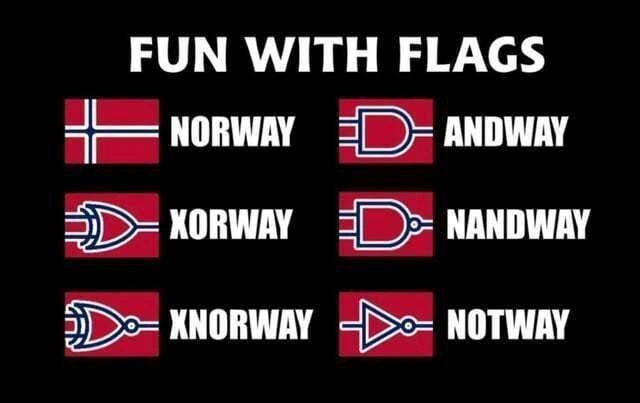
Norway's flag has a sideways cross on it. Someone noticed the cross sits in the same spot where engineers draw their little electronic switch symbols — the doodles that mean "and," "or," and "not" in computer blueprints. So they invented five pretend countries, each flying a flag where the cross is replaced by one of those doodles, with pun names like "NOTWAY." It's funny the same way it's funny when your friend's name almost spells another word: two completely unrelated things — a country's flag and computer-chip drawings — happen to look alike, and once you see it, you can't unsee it.
Level 2: Reading the Symbols
If the shapes are unfamiliar, here's the decoder ring:
- Logic gate: the atomic decision-maker of digital electronics. Takes 1s and 0s in, produces a 1 or 0 out. Billions of them make up your CPU.
- AND (the D-shape on ANDWAY): outputs 1 only if all inputs are 1. "Coffee AND deadline = code."
- NOT / inverter (NOTWAY's triangle with bubble): flips its input. 1 becomes 0, 0 becomes 1.
- NAND (NANDWAY: AND + bubble): AND, then flipped — output is 0 only when all inputs are 1. Cheap to build, weirdly powerful.
- XOR (XORWAY's curved shield): outputs 1 when inputs differ. The "exclusive or" — one or the other, not both.
- XNOR (XNORWAY: XOR + bubble): outputs 1 when inputs match — the equality detector.
These symbols show up in your first computer architecture course, usually right before the lab where you discover that wiring even four of them on a breadboard produces smoke and self-doubt. Recognizing them instantly — that's the membership test this meme runs on its audience.
Level 3: Vexillology Meets Schematic Capture
The graphic works because of a genuinely sharp visual observation. Titled "FUN WITH FLAGS" — Sheldon Cooper's flag-trivia web show from The Big Bang Theory, the canonical framing device for pedantic flag content — it presents the real flag of Norway (red field, white-fimbriated navy Nordic cross, offset toward the hoist) and then notices something only someone who has stared at both flags and datasheets would: the off-center cross occupies roughly the same visual position as the input-stem-plus-body of a logic gate schematic symbol. Swap the cross for IEEE-style distinctive-shape gate symbols in the same white-and-navy livery and you get a plausible national flag family: the D-shaped AND gate ("ANDWAY"), the shield-curved XOR ("XORWAY"), AND with the small inversion bubble ("NANDWAY"), XOR with bubble ("XNORWAY"), and the lone triangle-with-bubble inverter ("NOTWAY").
The details are what sell it to anyone with CS_Fundamentals or digital electronics scars. The inversion bubble — that tiny circle on NANDWAY, XNORWAY, and NOTWAY — is the entire semantic payload of those symbols: one pixel-sized circle is the difference between AND and NAND, between a working circuit and a board respin. Every EE has a story about a missed bubble in a schematic review. The naming is linguistically tight, too: each gate name splices onto "-way" with zero friction, and "NOTWAY" is a gift — the country that simply refuses, the gate whose national anthem is the complement of yours. There's even an accidental vexillological truth here: real Nordic flags are a combinatorial family (Norway, Iceland, Denmark, Sweden, Finland — same template, different colorways), so extending the family by gate type is exactly how flags actually evolve, just with truth tables instead of royal unions. It's the rare meme equally at home in r/vexillology and a digital design midterm.
Level 4: NANDway Is Functionally Complete
Hidden inside this flag pun is one of the loveliest results in Boolean algebra: functional completeness. Of the gates flying these flags, NAND (and its dual, NOR) can each build every other logic function — AND, OR, NOT, XOR, XNOR, all of them — using nothing but copies of itself. Tie a NAND's inputs together and you get NOT; feed that into another NAND and you've made AND; De Morgan's laws get you OR. This was formalized over a century ago (the "Sheffer stroke" showed propositional logic needs only one connective), and Emil Post later gave the complete criteria for which sets of Boolean functions suffice to express all others. The practical consequence shaped the entire semiconductor industry: NAND is exceptionally cheap and fast in CMOS — a 2-input NAND needs just four transistors, and the pull-up/pull-down network topology naturally inverts — so synthesis tools routinely map your elegant RTL into oceans of NAND-equivalent standard cells. Meanwhile, XOR (XORWAY's emblem, the curved gate with the extra input arc) is the algebraic oddball: it's addition modulo 2, the backbone of parity checks, CRCs, RAID reconstruction, and one-time-pad cryptography, yet famously not linearly separable — the reason a single-layer perceptron can't learn it, which helped trigger an entire AI winter. So the meme's quiet punchline for theorists: among these six nations, NANDway could annex all the others without firing a transistor.
Description
A black background graphic titled 'FUN WITH FLAGS' in bold white text (a nod to Sheldon Cooper's segment in The Big Bang Theory). It shows six red flags with white-and-navy emblems in a 3x2 grid. Top left is the real flag of Norway with its Nordic cross, labeled 'NORWAY'. The remaining five replace the cross with digital logic gate schematic symbols rendered in the same flag colors: an AND gate labeled 'ANDWAY', an XOR gate labeled 'XORWAY', a NAND gate (AND with inversion bubble) labeled 'NANDWAY', an XNOR gate (XOR with bubble) labeled 'XNORWAY', and a NOT gate/inverter triangle labeled 'NOTWAY'. The pun maps Boolean logic gate names onto the country name, playing on the visual similarity between the Nordic cross offset and gate schematic symbols, appealing to anyone with digital electronics or CS fundamentals background
Comments
1Comment deleted
NANDway is the only one you actually need - the rest of Scandinavia is functionally complete from it