ZeroHedge Claims Jane Street Engineered the 2022 Terra Crypto Winter
Why is this Blockchain meme funny?
Level 1: The Wobbly Lemonade Stand
Imagine a lemonade stand that promises every cup is always worth one dollar — not because they keep dollars in a box, but because of a clever trading trick. One evening, the stand quietly moves most of its lemonade out of the market square. Nine minutes later, the biggest, smartest trader in town shows up and sells a giant truckload of lemonade cups all at once. The price crashes, everyone panics, and soon a "one dollar" cup is worth 42 cents. Now there's a court case, and the papers explaining what happened have big black marker lines over the juiciest parts. The internet's reaction is the funny part: pointing at the marker lines and shouting, "See! We knew it was that guy all along!"
Level 2: Pegs, Pools, and Why 85 Million Hurt
- Stablecoin: a token meant to always equal $1. Collateralized ones (USDC) hold real dollars; algorithmic ones (UST) promise $1 of LUNA in exchange — fine until LUNA itself is crashing, creating a death spiral.
- Depeg: when the "stable" coin trades below $1. For an algorithmic coin, a small depeg can trigger panic redemption, hyperinflating the sister token — UST went from $1.00 to $0.42 in days.
- Curve 3pool/4pool: automated pools holding several stablecoins so traders can swap between them. Prices move based on pool balance — so a pool low on partner liquidity reacts violently to a large one-sided sale. That's why "withdraw 150M, then someone sells 85M" reads as a setup-and-spike.
- Market maker: a firm (like Jane Street) that trades both sides constantly. Their superpower is speed and information; the lawsuit's whole question is which information.
- Redacted filing: court documents with secrets blacked out — which on social media functions as a Rorschach test where everyone sees their favorite villain.
The junior-dev takeaway: "algorithmic" is not a synonym for "safe." An algorithm is just somebody's assumptions, executing faster than you can react.
Level 3: Nine Minutes and a Redaction Bar
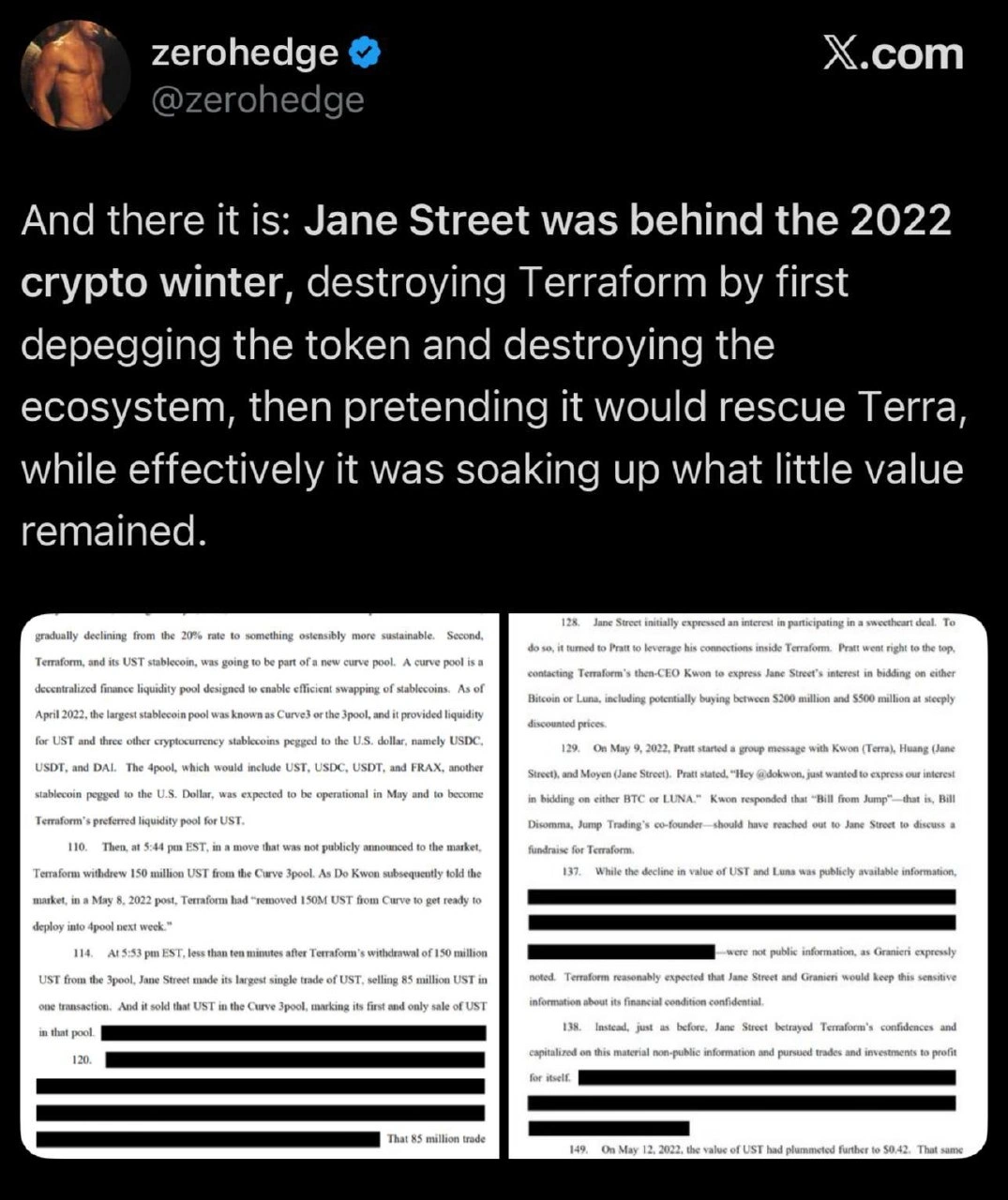
The screenshot is ZeroHedge doing what ZeroHedge does — "And there it is: Jane Street was behind the 2022 crypto winter" — but the interesting part is what sits under the hot take: two pages of an actual legal filing, numbered paragraphs 110 through 149, with black redaction bars doing their best load-bearing work. The unredacted timeline is the kind of thing market-structure people read like a thriller. Paragraph 110: at 5:44 pm EST, Terraform withdraws 150 million UST from the Curve 3pool — a move "not publicly announced to the market," prepping migration to the new 4pool. Paragraph 114: at 5:53 pm EST, nine minutes later, Jane Street sells 85 million UST into that same pool — "its first and only sale of UST in that pool." Then redaction bars. Then paragraph 149: by May 12, 2022, UST at $0.42.
For anyone who lived through it, this is the autopsy of the UST depeg — the event that vaporized roughly $40B across UST/LUNA and detonated the dominoes (Three Arrows, Celsius, Voyager, eventually FTX) that defined the 2022 crypto winter. The technical core: UST was an algorithmic stablecoin, pegged to $1 not by reserves but by a mint-burn arbitrage loop with its sister token LUNA. That design is reflexively stable — it works while confidence holds and amplifies collapse once it breaks. The Curve 3pool was the peg's shallow end: a DeFi liquidity pool where UST traded against USDC/USDT/DAI. Drain the pool's UST liquidity (as Terraform did, mid-migration) and the pool becomes thin; dump 85M UST into that thinness and the price impact is maximal. Whether that sequencing was predation, coincidence, or a market-maker reading public mempool tea leaves is exactly what the redactions — and the filing's claims that the withdrawal info "were not public information" and that Jane Street "betrayed Terraform's confidences" — are fighting about. The filing even quotes the social layer: Pratt's group message, "Hey @dokwon, just wanted to express our interest in bidding on either BTC or LUNA," and Do Kwon name-dropping "Bill from Jump" — Bill Disomma of Jump Trading — because in crypto, the bailout negotiation and the alleged kill shot apparently share a group chat.
The meta-joke for engineers is the collision of two worlds. Jane Street is the industry's cathedral of rigor — OCaml, formal reasoning, famously careful interview puzzles. Terraform's peg was a whitepaper held together by Twitter threads and a 20% yield (Anchor's "gradually declining from the 20% rate," per the filing's own first line) that everyone with a calculator knew was a subsidy burning to zero. When an algorithm meets an algorithmic stablecoin, the one with better math wins, and "decentralized, trustless finance" turns out to have a single point of failure reachable in nine minutes by one trading desk. The accompanying channel post piles on with the folkloric version — a 10am Bitcoin-dumping algorithm that "stopped the second they got sued" — which is unverifiable, but perfectly captures the community's priors: the market isn't random, it's just someone else's cron job.
Description
A dark-mode X (Twitter) post by verified account zerohedge (@zerohedge) with 'X.com' shown top right. The bold-and-plain text reads: 'And there it is: Jane Street was behind the 2022 crypto winter, destroying Terraform by first depegging the token and destroying the ecosystem, then pretending it would rescue Terra, while effectively it was soaking up what little value remained.' Below are two screenshots of heavily redacted legal-filing pages (numbered paragraphs 110-149) describing Terraform's UST stablecoin, the Curve 3pool/4pool liquidity pools (UST, USDC, USDT, DAI, FRAX), Terraform withdrawing 150 million UST at 5:44 pm EST, Jane Street selling 85 million UST minutes later at 5:53 pm EST, a group message from Pratt to Do Kwon ('Hey @dokwon, just wanted to express our interest in bidding on either BTC or LUNA'), references to Bill Disomma of Jump Trading, and UST's value plummeting to $0.42 by May 12, 2022. Large black redaction bars cover portions of the filing. The post alleges market manipulation behind the UST/LUNA collapse that triggered the 2022 crypto crash

Comments
9Comment deleted
Turns out the 'algorithmic' part of the stablecoin was Jane Street's OCaml execution engine all along
Yooooo, English whorebots, that's a new one to me Comment deleted
Oh hey a lot of the math scipop content I've seen has been sponsored by them... I guess that's where the money came from Comment deleted
same… Comment deleted
Who's Jane Street?? Comment deleted
Idk, maybe JP Morgan and Chase know, ask them Comment deleted
Hedge fund thing Comment deleted
Sued for what? How is selling something illegal? Comment deleted
They didn't get sued for dumping BTC. They got sued for insider trading during the Terra collapse. The fact that the 10am BTC dumps stopped might as well be a coincidence. Non of that is proven yet anyways. The allegation that people have is that Jane Street was dumping BTC to crash the market and buy back cheaper afaik Comment deleted