Full Stack Means Every Job
Why is this WebDev meme funny?
Level 1: One Person, Too Many Hats
Imagine asking one person at a school to be the teacher, nurse, security guard, firefighter, and principal all at once. They might be talented, but that is too many jobs for one person. The joke is that "full stack" sometimes sounds like a normal developer title, but it can secretly mean "please do everything."
Level 2: Front, Back, Everything
A frontend developer works on what users see and interact with: pages, buttons, forms, layout, browser behavior, and client-side logic. A backend developer works on servers, APIs, databases, authentication, business rules, and background jobs. A full-stack developer can work on both sides.
That can be reasonable. For example, one feature might need a database table, an API endpoint, and a screen in the browser. A full-stack developer can connect those pieces without waiting for three different handoffs.
The meme exaggerates what often happens next. Instead of "can work across the stack," the role becomes "can do every technical job." The different uniforms represent different responsibilities. In web development, that might include coding the interface, writing server logic, deploying the app, fixing production errors, improving performance, and explaining why the bug is actually caused by stale cache.
For newer developers, the key distinction is breadth versus infinite responsibility. Being full stack means understanding multiple layers of a system. It should not mean being the only person responsible for every layer all the time.
Level 3: The Org Chart Compiler
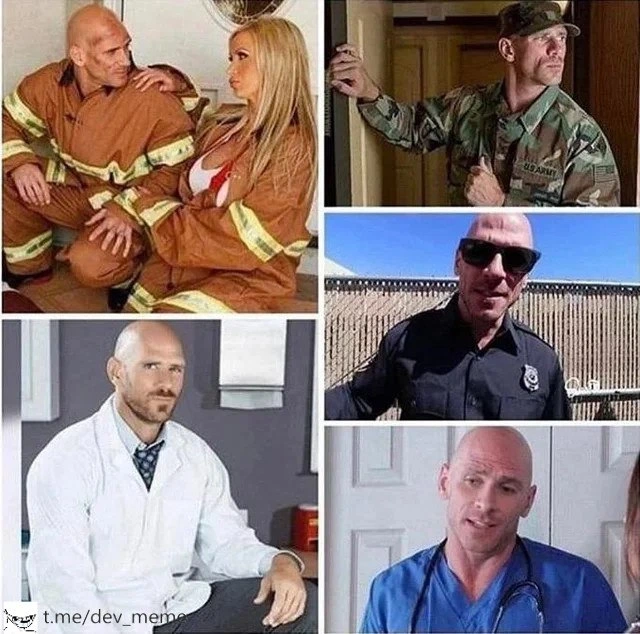
The collage shows the same bald man appearing as several different professions: firefighter, soldier, police officer, doctor, and medical worker. The post message asks:
When you hear "Full Stack" which person do you imagine?
That question is the whole joke. Full stack development originally meant a developer could work across both client-facing and server-facing parts of an application. In practice, many teams quietly stretch it into "please be every missing specialist until hiring catches up, which it will not." The image turns that expectation into a visual job description: one person, five uniforms, all emergencies.
For experienced developers, the humor is not that full-stack work is fake. Good full-stack engineers are real and valuable. The pain is that the phrase often hides wildly different scopes. One company means "React plus a REST API." Another means "design the UI, tune the database, write Kubernetes manifests, fix CI, debug OAuth, answer support tickets, own uptime, and explain DNS to finance." The title stays the same while the surface area expands like a dependency tree with no lockfile.
The professions in the collage matter because they are all high-responsibility public-service roles. That maps cleanly onto the emotional experience of being the single bridge between frontend, backend, deployment, user bugs, and production incidents. Firefighter: urgent outage. Soldier: hostile legacy codebase. Police officer: enforcing review standards. Doctor: diagnosing production symptoms. Medical worker: patching the patient while everyone asks whether the demo will still happen. Subtle? No. Accurate enough to make the coffee taste like incident response.
The industry pattern underneath is role compression. Startups do it because headcount is limited. Enterprises do it because job ladders lag behind actual systems. Product teams do it because "full stack" sounds more flexible than admitting nobody owns observability, accessibility, performance, release engineering, or data modeling. The result is a career expectation where breadth is celebrated, depth is assumed, and burnout is filed under "fast-paced environment."
Description
The image is a collage showing the same bald man posed as several different professions: firefighter, soldier, police officer, doctor in a white coat, and medical worker in blue scrubs. A small watermark at the bottom left reads "t.me/dev_meme." The accompanying caption asks, "When you hear \"Full Stack\" which person do you imagine?" The joke maps the many-role persona onto full-stack development, where one engineer is often expected to cover frontend, backend, deployment, debugging, and whatever else the team has not staffed.
Comments
16Comment deleted
Full stack used to mean UI plus API; now it means the org chart compiles into one employee.
All of the above Comment deleted
none of the above Comment deleted
Half of above Comment deleted
being a full stack developer means being able to repair your grandmas laptop every sunday afternoon. Comment deleted
...that lives in Russia... Using TeamViewer... That is not installed Comment deleted
at least as far as your family is concerned Comment deleted
as as as Comment deleted
That is a real challange Comment deleted
Is it something from Nick Land’s techno-occultism on your avatar? Comment deleted
Yolov4 darknet Comment deleted
Darknet framework* also used for yolov4 Comment deleted
This one Comment deleted
I am a Full Stuck developer Comment deleted
Dumb sack? Comment deleted
Actually, this one is good, ill save it for my midlife crisis, thx Comment deleted