A Programmer's Job: From Systems Architect to Electron Wrangler
Why is this DevCommunities meme funny?
Level 1: Flicking Light Switches
Imagine you have a gigantic wall full of millions of tiny light switches. Each switch can be either ON or OFF. Now, picture that by flipping these switches in just the right pattern, you could solve math problems or show a picture on a screen. Sounds like magic, right? In a very simple way, that’s what a computer does, and a programmer’s job is to figure out which switches to flip and when.
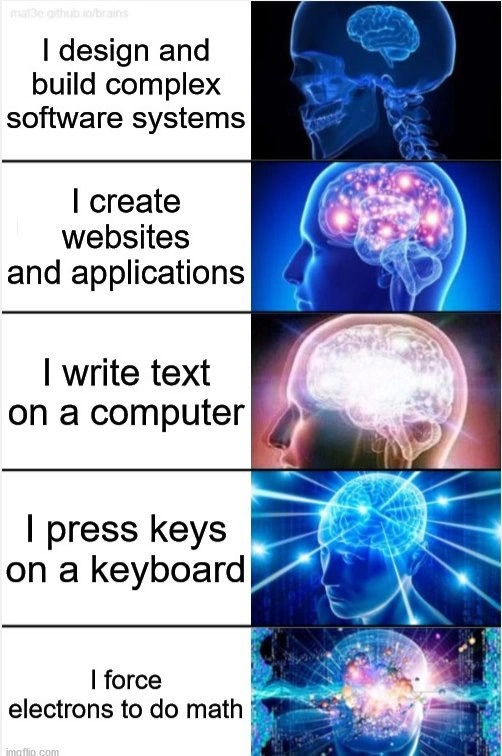
In everyday terms, being a coder can be described in big fancy words or in really simple ones. It’s like if someone asked what an author does. The author could say, “I create immersive worlds and stories,” which sounds grand. Or they could shrug and say, “I just put a bunch of words on paper.” Both descriptions are true — it’s just a matter of perspective. This meme is funny because it plays with those different perspectives for a programmer. At first, the developer sounds like an architect building an entire city (“complex software systems!”). Then, as the descriptions get simpler, we realize, hey, they’re basically just typing on a keyboard. And finally, the silliest yet truthful description: “I make electricity do math problems.” That last one is like saying a chef is just applying heat to ingredients to cause chemical reactions — technically correct, but hilariously basic for describing cooking.
The joke makes us laugh because it reminds us of a simple idea: even the most complicated things we do can be broken down into very simple actions. A painter is ultimately just brushing colors onto a canvas. A pianist is just pressing keys to hit strings that make sounds. And a programmer? They’re pressing keys to light up tiny electric pathways that make the computer do things. We usually don’t think of it that way — we prefer the fancy version, it makes us feel smart. But realizing the down-to-earth truth (and saying it in a funny, exaggerated way) is a good humbling laugh. It’s like being in on a secret: psst, all that high-tech wizardry? It’s really just a bunch of little switches flipping on and off really fast. In the end, the meme is reminding us and anyone listening that what a developer truly does is both amazing and ordinary: we solve problems… by flicking a whole lot of tiny light switches really, really quickly.
Level 2: From Keyboard to Code
So what’s actually going on in each step of this meme? It’s all about describing the same job (programming) at different levels of detail, from fancy to super simple. In computing, we call these levels of abstraction. Each level hides some complexity to make it easier to think about. Let’s break down those meme phrases in plain terms and see what they mean in real life:
“I design and build complex software systems.” This is a high-level description of a programmer’s work. When someone says this, they’re emphasizing tasks like planning the architecture of an application, deciding how different parts of a system talk to each other, and building software that has many interlocking components (for example, a big website with databases, servers, and user interfaces). It sounds impressive — and it is! It means the person isn’t just writing small scripts; they’re creating large, integrated systems. Think of a huge online store or a banking system: there are front-end websites, back-end services, databases, and APIs all working together. Saying you “design and build complex systems” is a bit of a proud, formal way to describe your role in making such a big thing come to life. It highlights software_systems_design skills like choosing frameworks, ensuring everything scales (handles lots of users), and managing complexity.
“I create websites and applications.” Here the language is more down-to-earth. Instead of “software systems,” it says websites and applications, which are things non-technical people recognize. It’s basically the same job as above, just described in a simpler way. If you’re a developer, this might be how you explain your work to your family or someone outside tech. “I build websites” could mean you work on the front-end (the part of the site you see and click) or the back-end (the behind-the-scenes server logic), or both. “I create applications” might include web apps, mobile apps, or desktop programs. This phrasing strips away the buzzwords and focuses on the outcome of the work: actual programs people can use. It’s relatable — most people have used an app or visited a website, so they can imagine what you do. You’re essentially saying, “I make the computer programs that you use in daily life.”
“I write text on a computer.” This is where the meme starts to get cheeky. Writing text on a computer is literally what coding is: developers write source code, which is just text. That text might be in languages like Python, JavaScript, or C++. It might look like English mixed with math-y symbols and keywords (
if,for,{ }, etc.), but it’s ultimately stored as plain text files. When someone says they “write text on a computer,” they’re kind of poking fun at the fact that, although programming feels high-tech, day-to-day it can feel like just typing words in a text editor or IDE. For a new programmer, it’s important to understand that code isn’t some mystical stuff — it’s literally lines of text that you save in files. For example, a simple Python program might be:# This is code (which is text!) name = "Alice" print("Hello, " + name)Those lines you see are just characters you type on your keyboard. But once you run the program, the computer will follow those instructions. So writing code = writing text that the computer interprets as commands. By phrasing it as “I write text on a computer,” the meme humorously downplays the complexity. It’s like a novelist saying “I just put words on a page” — technically true, but it ignores the creativity and skill involved.
“I press keys on a keyboard.” This is an even more literal description of programming. If writing code is writing text, then how do we write text? By pressing keys! This phrase strips the job down to the physical action: typing. It implies, “All I really do is mash keys all day.” For a junior developer or someone just learning, this might sound weird because of course pressing keys is how you code — what else would you do? But the humor here is that it reduces even the act of writing code (which has some dignity) to something any person does when writing an email or a school essay. It removes any sense of “computer expertise.” It’s basically saying a programmer’s day isn’t that different from anyone typing on a computer. This might remind you of those cartoons where someone’s furiously hacking and another character says, “Wow, you’re a hacker!” and the hacker replies, “I’m just typing really fast.” In reality, pressing keys is how all work on a computer starts — writing code, command-line instructions, configuring servers, you name it. Each keystroke sends a signal to the computer that “a key was pressed.” For example, pressing the A key on your keyboard sends a specific code (known as a scan code) to your computer, which the operating system understands and inserts the character "A" into your text editor at the cursor. So when you code, you're really just pressing a lot of keys in a certain order that forms valid instructions. This phrase in the meme is a playful nudge reminding us that, fancy tech job or not, we all use a keyboard like any office worker.
“I force electrons to do math.” Now, this one sounds bizarre at first, especially to a newcomer — what do electrons have to do with making a website or app? This is referencing the fact that inside the computer, everything is ultimately happening via electricity. An electron is a tiny particle that carries electric charge, and a computer chip directs electrons through microscopic pathways to perform operations. When you do math on a computer (say calculate 2+2), the processor doesn’t “think” the way we do — it pushes electrons through logic gates that represent binary numbers and operations. Forcing electrons to do math is a cheeky way to describe computing at the hardware level. It means that by writing code (the high-level instructions), you’re causing the machine’s electronic components to carry out arithmetic or logical decisions (the low-level actions). Each time your program says “add these numbers” or “compare these values,” the CPU sets up a tiny electric circuit to perform that addition or comparison. Electrons move, current flows or stops, and the result is that a new number appears in some register or memory cell. So from a certain point of view, programming is commanding electrons. Of course, we don’t think about it this way in daily coding. We think in terms of variables, loops, and functions, not voltages and currents. But the meme is joking that an enlightened developer realizes that behind all the abstract code, they are indirectly an electron wrangler or an electron_wrangling expert. It’s an exaggeration, phrased to sound almost like a superpower (“behold, I bend electrons to my will!”), which makes it funny and relatable humor for tech folks.
All these descriptions refer to the same job. This meme highlights abstraction_layers by humorously rephrasing a programmer’s tasks from very high-level (complex system design) to very low-level (electrons doing math). As a newcomer to development, it’s useful to understand that what you do spans multiple layers. When you code, you’re thinking in a language like JavaScript or Python. That’s one layer. But that code gets translated down to machine instructions and ultimately to electrical signals. Normally, you don’t need to worry about those deeper layers (thank goodness for modern programming languages and operating systems!). However, knowing they exist can give you a greater appreciation for how computers work. Plus, it armors you with a bit of nerdy humor: the next time someone asks what you do, you can gauge their reaction by answering anywhere from “I build cutting-edge software” to “I just mash keys and electricity happens.” Each answer is true in its own way, which is the playful point of this meme.
Level 3: Ego vs Electrons
Software developers have a notorious habit of describing their work in grandiose terms or, conversely, in comically minimal ones — and this meme skewers that tendency. Each panel presents a developer’s self-identity at a different layer of abstraction, and the humor comes from both the accuracy and the absurdity of these descriptions. At the top, “I design and build complex software systems” is the kind of lofty phrase you might put on a resume or tell a tech recruiter. It screams enterprise architect or senior engineer, someone orchestrating databases, microservices, and distributed pipelines. It’s not untrue — many of us do design intricate systems — but it’s our ego speaking in buzzwords. The next step down, “I create websites and applications,” is a bit more humble and concrete. It’s how you might explain your job to a friend at a party: focusing on tangible outputs like websites or mobile apps that people actually use. It’s still a source of pride, but less jargony.
Then the meme starts deflating the ego further. “I write text on a computer.” This is a senior developer’s self-deprecating chuckle — because in essence, coding is writing text. We type out instructions (source code) in an editor; the fact that those instructions do magical things is abstracted away in that phrase. It’s a deliberately oversimplified job description that pokes fun at the everyday reality: hours spent clacking away at a keyboard. It reminds us of those moments explaining our job to a non-technical relative who asks, “So… you just type all day?” and we reluctantly reply, “Haha, yeah, basically.” This panel of the meme hits a vein of developer humor around imposter syndrome and humility: no matter how advanced our software, at the end of the day we’re just writing text files.
The fourth panel, “I press keys on a keyboard,” zooms out even more on the physical actions. Now the developer is basically equating themselves to a court stenographer or a data entry clerk — just pressing keys. It’s funny because it’s true (that DeveloperExperience_DX in a nutshell — so many keystrokes!), but it’s also ridiculously reductive. A seasoned engineer might joke about this on a frustrating day: after fighting build errors or merge conflicts for hours, you feel less like a genius inventor and more like a monkey at a keyboard trying random combinations. The meme’s escalating brain images here add irony: as the descriptions get dumber or at least more basic, the depicted brain gets more enlightened. This inversion is classic tech satire. It suggests that understanding your job at the most basic level — devoid of any pomp — is actually a kind of higher wisdom (or at least a big laugh).
Finally, the punchline: “I force electrons to do math.” This line is the meme’s crown jewel of developer self-deprecation. It takes the already humbled description and breaks through the bottom of abstraction, into the realm of physical reality and facetious exaggeration. No developer would earnestly describe their day job this way, yet it’s hilariously accurate. In a single terse sentence, it reduces the act of programming to its bare-metal essentials. The phrasing is aggressive (“force electrons”) which gives it a comedic kick — as if the developer is some kind of particle wrangler or electron-whisperer coercing subatomic particles to bend to their will. It’s a nerdy, hyperbolic way to boast and self-mock at the same time. Why is this so relatable? Because it’s an inside joke about abstraction layers. Every programmer knows there are layers upon layers between their high-level code and the electrical signals in the CPU, but we seldom think about it. Highlighting that gap (complex systems vs electrons) in a meme format exposes a kind of absurd truth that tickles the engineer brain. It’s like having an existential crisis about your job in five progressively funnier steps.
This meme resonates across the developer culture because it encapsulates a shared experience: the fluid way we talk about our work depending on context. To other engineers or on LinkedIn, you might emphasize the complexity (“scalable distributed systems”, “cloud-native microservices”, insert fancy jargon here). To everyday folks, you dial it down: “I make websites” or “I write software.” To yourself, on a cynical day, you might mutter something like, “Ugh, I just bang on a keyboard and Google error messages.” The meme plays with exactly that spectrum, ending in a punchline that’s so extreme and specific (electrons doing math!) that it loops back to being hilariously true. The brilliance is that the most fundamental description is depicted as the highest level of enlightenment. It’s a gentle roast of developer egos — suggesting that the truly “galaxy-brain” move is recognizing you ain’t so special; you’re basically an electron wrangler with a keyboard. And honestly, that mix of humility and knowledge of how deep the rabbit hole goes is something seasoned devs appreciate and laugh about.
Level 4: NAND to Tetris Enlightenment
At the deepest level, programming is quite literally applied physics and math. When a developer jokes “I force electrons to do math,” they’re pointing at the fundamental truth of computing. All those elegant algorithms and high-level languages ultimately boil down to controlling electricity through circuits. Inside your computer’s CPU, billions of transistors (tiny electronic switches) flip on and off to represent binary 1s and 0s. Each 1 or 0 is a bit, an electrical state indicating on (high voltage) or off (low voltage). By chaining these transistors into logic gates (like NAND, AND, OR, etc.), we create the hardware that performs everything from addition and subtraction to memory storage. It’s the world of ones, zeros, and electrons moving through doped silicon pathways. This is the realm of low-level programming and CS fundamentals: where code meets the laws of physics.
The meme’s cosmic brain final panel captures a kind of tongue-in-cheek “zen” realization: even the most complex software system is built on electrons dutifully flowing through gates to solve equations. Think of a simple addition like 2 + 3. At a high level, you’d write 2 + 3 in code. But under the hood, that becomes machine instructions telling the processor’s arithmetic logic unit (ALU) to combine the binary representation of 2 (10 in binary) and 3 (11 in binary). The ALU is basically a network of logic gates (built from transistors) that outputs the binary result 101 (which is 5) by manipulating voltages. In other words, the CPU “does math” by routing electrons: an electron current represents a 1, and no current represents a 0, and by controlling where current flows, the hardware executes the addition. Each bit of that operation is an electrical signal either allowed through or stopped—electrons being forced to follow the rules of Boolean algebra we set.
This low-level perspective is something computer science students encounter when they delve into computer architecture or build a CPU from scratch (for instance, courses known as “Nand2Tetris” walk through creating everything from a single NAND gate to a working computer that can run Tetris). It’s mind-bending yet enlightening to realize that your high-level code — whether it’s a Python script or a complex microservices system — is ultimately translated into machine code (strings of binary instructions like 101010...) that orchestrate microscopic electronic events. The humor here comes from taking that theoretical knowledge and framing it as one’s job description. It’s absurd because no engineer actually sits at their desk saying “I will now direct subatomic particles,” yet it’s also spot-on because every software abstraction must bottom out in physical reality. In a way, this panel winks at the almost mystical awe of computing: a coder types some symbols, and at the speed of light, electrons dance around to make it happen. The expanding brain image glowing with the universe emphasizes this as an almost cosmic revelation — the programmer’s ultimate boast or humbling truth, depending on how you see it.
Dig even deeper, and this phrasing isn’t just humor — it’s a reminder of computing’s incredible abstraction stack. Abstraction layers separate our human-friendly code from the messy analog physics of circuits. A high-level program might trigger a JIT compiler or bytecode interpreter, which in turn calls OS system calls, which use CPU instructions, which activate microcode, which then sets gates and flips transistors. Each layer is a translation, from ideas down to electrons. If any layer fails, nothing works. This fundamental reliance on physics means there are limits and weird problems (like electrical interference, clock speeds, heat dissipation) that even the fanciest software architect can’t ignore. It’s all built on the bedrock of electrons and logic. The meme’s punchline winks at those in-the-know: behind our lofty software engineering titles, we’re ultimately hardware hitchhikers, piggybacking on nature’s laws to get results. Recognizing that is a kind of enlightenment, a fusion of computer science theory and physical reality — truly a galaxy-brain moment for those of us who love to peel the onion of computing all the way to the core.
Description
This image uses the 'Expanding Brain' (or 'Galaxy Brain') meme format, which consists of five vertical panels. Each panel has text on the left and a corresponding image of a brain on the right that becomes progressively more illuminated and cosmic. The text describes the job of a software developer with increasing levels of abstraction: 1. 'I design and build complex software systems' (next to a simple brain X-ray). 2. 'I create websites and applications' (brain with some glowing neural activity). 3. 'I write text on a computer' (a brighter, more active brain). 4. 'I press keys on a keyboard' (brain glowing with emanating light beams). 5. 'I force electrons to do math' (brain as a cosmic, universal explosion of light and energy). The meme humorously illustrates the different ways a programmer can describe their job, from the high-level professional summary to the absurdly literal, fundamental physics of computation. It's a form of intellectual humor that appeals to senior engineers who appreciate the vast layers of abstraction they navigate daily, from complex system architecture down to the silicon level
Comments
7Comment deleted
The business thinks I'm an architect designing skyscrapers. I know I'm just a very patient electron choreographer
After 15+ years, I’ve realized my “planet-scale, event-sourced microservice mesh” is really just an absurdly expensive way to beg a few trillion indifferent electrons to toggle the right bits
After 20 years of arguing about microservices vs monoliths, distributed consensus algorithms, and CAP theorem tradeoffs, you realize you've just been very elaborately flipping bits to heat up sand - and somehow that sand occasionally produces a working payment system at 3am on Black Friday
This meme perfectly captures the existential journey every senior engineer takes when explaining their job at family gatherings - starting with 'I architect distributed systems' and inevitably ending at 'I manipulate quantum states to flip bits' when your relatives keep asking 'but what do you ACTUALLY do?' The final panel is what you tell yourself at 3 AM during an on-call incident when you're debugging a race condition and questioning all your life choices that led to professionally herding electrons through silicon
Senior dev enlightenment: I don’t write code - I negotiate SLAs with physics to convince electrons to reach eventual consistency
Senior engineering is deciding where the abstraction will leak so the electrons flip in the least expensive order - and calling it architecture
CTOs pitch 'cloud-native microservices'; we deliver 'electron herding at 3GHz with CAP theorem side effects'