Full Stack Expertise Ends Where Documentation Begins
Why is this Documentation meme funny?
Level 1: The Missing Manual
Imagine your friend proudly says they can build anything with LEGO blocks — a true master builder who doesn’t need any help. They build an awesome castle and call themselves an all-round LEGO expert. But then you ask them to write down the instructions so that you or anyone else can recreate that castle. Suddenly, your friend doesn’t want to do it. Writing the step-by-step instruction book is boring to them, and they avoid it. It’s a bit funny, right? They wanted credit for doing everything, but they won’t do the one less-fun task of explaining how it’s done. This meme is making the same kind of joke: software developers love building the whole product (so they call themselves “full stack,” meaning they do every layer of the work), but when it’s time to write the how-to guide or manual for their code (the documentation), they disappear. It’s humorous because it’s true — many people like doing the fun creative work, but not the boring explaining part, even though it’s important for others.
Level 2: Full Stack Reality Check
Being a full-stack developer means working on all parts of a software application. For example, in a web app, a full-stack dev writes the front-end code (the visuals and interface in the browser) and the back-end code (the server logic, database queries, and APIs). They might switch from tweaking a button’s color with CSS to designing a data model in a SQL database, all in the same day. It’s a versatile role that covers the entire “stack” of technologies, from what the user sees to how data is stored. Claiming the full_stack_label is a bit of a boast that you can do it all in development.
Documentation, on the other hand, is any written text or illustrations that explain the code or project. This can include docs like a user guide, an installation manual, inline code comments, or a README.md file that tells you how to run the project. Good documentation is crucial for teammates and users: it’s the roadmap that helps others understand what you built, how to use it, and how to fix or extend it. Writing documentation often feels different from coding — it’s more like writing a clear essay or tutorial. Not all developers enjoy that part of the job, even though it’s very important for collaboration and DeveloperExperience_DX (developer experience). If you’ve ever started a new coding project, you know how helpful a step-by-step setup guide or clear API examples can be. That’s DX in action: good docs make life easier for developers.
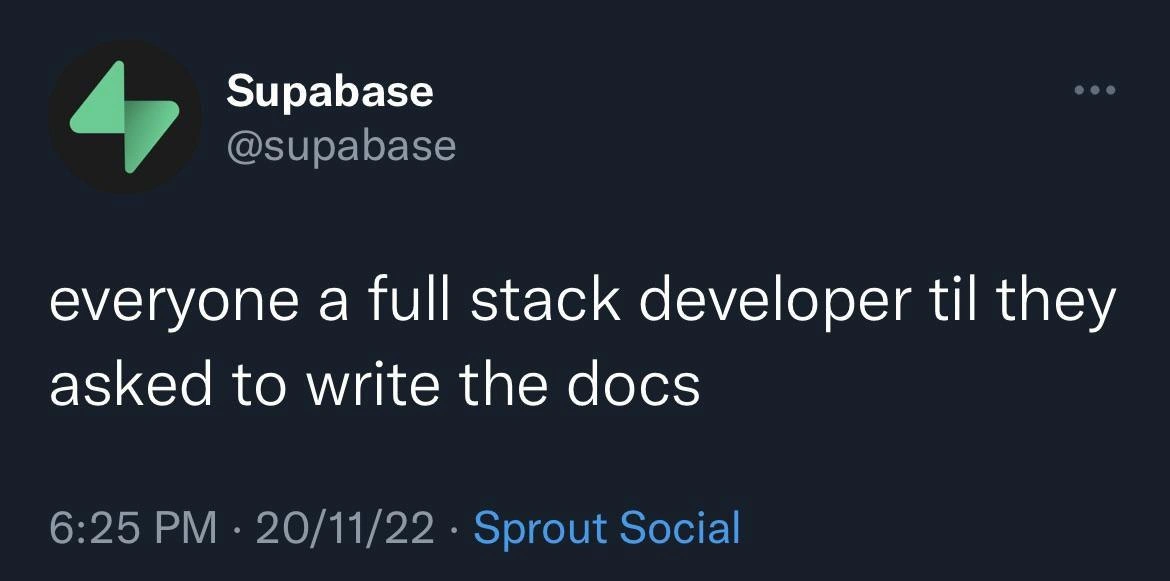
This meme (a screenshot of a tweet by Supabase’s official account) jokes that many developers happily call themselves “full stack” until they are asked to do one specific task: write the documentation. The phrase “everyone a full stack developer ’til they asked to write the docs” is written in a casual, funny tone (notice the lowercase and the shorthand “til”). It highlights a common attitude: developers love coding all parts of a system, but writing things down for others? Not so much. It’s a bit like saying, “Sure, I can do front-end, back-end, anything — but oh no, don’t make me write the instructions!” This is a form of DocumentationHumor because it’s poking fun at how developers often find writing docs unpleasant or avoid it.
Why would a developer avoid writing docs? For a newer developer (junior dev), it might not be obvious at first. But once you work on a team project or an open-source project, you see it: code gets written, features get built, but documentation tends to lag behind. Writing docs requires explaining things simply and clearly, which can be challenging after you’ve been deep in the code. Some developers feel it’s a bit of a chore or they think it’s someone else’s responsibility (like a technical writer or future “me” will do it later). This is often called docs_writing_reluctance or documentation aversion – basically, not wanting to do documentation. There’s even a running joke in programming that “real programmers don’t write documentation.” Of course, that’s not true — real professionals do document — but the joke exists because so many try to skip it.
Supabase’s tweet captures this relatable feeling in tech teams. Supabase is a company that provides tools for developers (like a database and authentication service, kind of an alternative to Firebase). They know their developer audience well. By tweeting this, they’re playfully acknowledging a well-known developer_role_expectations issue: a “full-stack” developer should handle everything, including docs, but in reality, folks often dodge the documentation part. It’s a nod to the community saying, “We get it, writing docs isn’t your favorite, and that’s ironically funny.” The tweet format (a social media screenshot with the Supabase logo and name) is a popular meme style for sharing quick one-liner jokes.
In summary, the meme message is clear even to less experienced developers: being “full stack” ideally means doing all the work (front-end, back-end, and yes, writing the docs), but many developers enthusiastically do the coding parts and shy away from the writing parts. It’s funny because it’s true — plenty of us have been guilty of loving the coding but procrastinating on the documentation. And when someone calls us out on it (like this tweet does), we can laugh because we recognize ourselves in it.
Level 3: Documentation Desertion
In the hierarchy of developer tasks, writing documentation is the often-avoided bottom layer. This meme hits on a painful truth in DeveloperCulture: many proudly claim the FullStackDevelopment mantle until the moment they’re asked to write docs. As the official Supabase tweet jokes:
“everyone a full stack developer til they asked to write the docs”
The humor lands because it satirizes a common scenario. A developer might battle front-end frameworks, wrestle with back-end servers, and even dabble in DevOps — all with full-stack bravado — but will scramble for the exits when it’s time to update the README.md. It’s classic DeveloperHumor and DocumentationHumor rolled into one, highlighting widespread documentation aversion. The full-stack pride evaporates on contact with the thankless chore of writing docs.
Why is this so funny (and painfully relatable)? Because experienced devs know that writing_documentation is the unglamorous hero of a project. In theory, “full stack” means everything: UI, database, APIs, deployment, and documentation. In practice, documentation is treated like kryptonite. It’s the task that always gets deferred, delegated, or forgotten. The tweet’s all-lowercase, blunt phrasing mirrors how casually this dirty little secret is shared — an open secret in programming circles. We’ve all seen that impressive codebase with zero docs, leaving everyone else to play archaeologist in the code.
On a serious note, poor documentation wreaks havoc on DeveloperExperience (DX). Seasoned engineers know that code isn’t truly full stack unless it comes with instructions for others. Documentation is what turns one developer’s work into a team’s asset. Without it, onboarding new team members is a hazing ritual and maintaining the project becomes a scavenger hunt for clues in commit messages. Yet, time and again, even veteran devs skimp on docs because:
- Misaligned Incentives: Organizations applaud shipped features and bug fixes, but rarely celebrate a beautifully written setup guide. If it’s not measured, it gets ignored.
- The Tedious Factor: Let’s face it, writing docs feels like doing homework. After a caffeine-fueled coding sprint solving a complex problem, describing it in plain English feels mundane.
- Code Illusion: Some devs convince themselves the code is self-documenting. “The function names are clear enough — who needs a guide?” they say, underestimating how cryptic their “clear” code is to others.
- Ever-Changing Reality: In a fast-paced project, code changes often. Keeping docs up to date is a moving target, so some give up entirely (or leave a
// TODO: update docs laterin the code that never gets addressed).
This Supabase tweet playfully calls out those patterns. Supabase (a backend platform company known for developer-friendly tools) is implicitly saying: “We know you all love coding every part of your app, but the moment someone mentions documentation, you vanish. We see you.” The fact that it’s an official account tweeting this adds irony — even a company built on good docs knows the struggle of getting devs to write them. It’s a wink and nod: writing docs is essential for great Developer Experience, yet it’s the documentation_chore nobody volunteers for.
The meme resonates deeply because it’s RelatableDeveloperExperience. Every developer who’s been in a team project or an open-source repo has encountered the missing docs problem. The tweet’s humor is a gentle roast of that developer_role_expectations gap: you can conquer the tech stack, but do you have the discipline to document it? A truly full stack developer would treat documentation as first-class as code, but in reality, many treat it like an optional add-on. It’s a perfect punchline in the ongoing saga of devs vs. docs: everyone’s full-stack… until documentation duty calls.
Description
A screenshot of a tweet from the official Supabase account (@supabase), which has a green and black logo. The tweet is on a dark blue background with white text. The text reads: "everyone a full stack developer til they asked to write the docs". Below the main text, a timestamp is visible: "6:25 PM · 20/11/22 · Sprout Social". This meme humorously points out a common blind spot in the "full stack" developer identity. While full stack implies proficiency across the entire software development process, from frontend to backend, the often-neglected skill of writing clear and comprehensive documentation is where many developers fall short. It's a relatable joke for senior engineers who understand that building a feature is only half the job; making it understandable and maintainable for others is equally critical, yet frequently avoided
Comments
10Comment deleted
The definition of a 'full stack' developer seems to be 'can do everything except write a coherent README.md'
We’ll argue gRPC vs REST for three stand-ups straight, but ask “who writes the integration guide?” and suddenly it’s a distributed consensus problem without a quorum
The same developers who can architect microservices, optimize database queries, and debug race conditions in production suddenly develop selective amnesia when asked to explain how their code works in plain English - because writing 'it just works' in the README doesn't count as documentation, apparently
Ah yes, the classic full-stack developer: fluent in React, Node, PostgreSQL, Redis, Kubernetes, and every cloud provider... but mysteriously unavailable when it's time to document the authentication flow they built three sprints ago. Turns out 'full stack' doesn't include the documentation layer - that's apparently part of the 'mythical stack' only senior architects are supposed to maintain
Full-stack mastery spans UIs to databases, but docs? That's the layer where even battle-hardened architects invoke 'self-documenting code' as a shield
Everyone’s full‑stack until you ask for docs - then README becomes a write‑only datastore with eventual consistency to the code
Every “full‑stack” hero stays full‑stack until the Definition of Done includes documentation - then it’s magically out of scope, the bus factor stays at 1, and README TBD becomes the busiest service
When you're already running on 5 hours of sleep due to having to manage the entire infra, who's got time for docs lol Comment deleted
First, they are developers, not writers. Second, their stack is already full, so any additional task causes overflow and undefined behavior. Comment deleted
I would rather write 100 docs then 1 css layout Comment deleted