Skip to content
DevMeme
4593 of 7435
When Reverse Image Search Confuses Art with Appetizers
AI ML Post #5040, on Nov 26, 2022 in TG

When Reverse Image Search Confuses Art with Appetizers

Why is this AI ML meme funny?

Level 1: Everything Looks Like Food

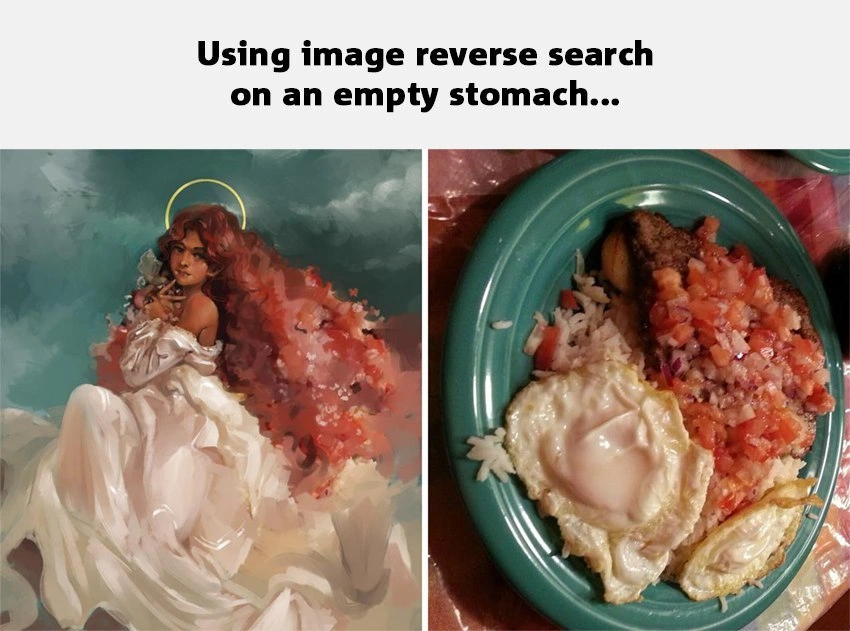
Imagine you missed lunch and your tummy is rumbling. Suddenly, you look at a cloud in the sky and think, “Hey, that cloud looks kind of like a fluffy scoop of ice cream!” 🍦 When we’re really hungry, our brains can play tricks on us and make us see food in the strangest places. That’s exactly the funny feeling this meme is giving us. On the left, there’s a pretty painting of a lady in a fancy white dress with a nice teal background. On the right, there’s a photo of a yummy plate with rice, salsa, and a fried egg on a teal dish. A computer program was asked to find pictures similar to the pretty painting, and guess what it found? The dinner plate photo! To the computer, these two images looked the same because of the colors and shapes – basically, the computer thought the lady in the flowing white dress was as interesting as the white rice, and her big red hair was as shiny as the red salsa. It’s like the computer had hungry eyes and said, “Mmm, that painting reminds me of food.”

This is funny because we can clearly see one is art and one is food. It’s a silly mix-up, kind of like a cartoon where a hungry character looks at their friend and suddenly imagines them as a roast turkey! 🍗 Here, the developer (the person using the computer) was really hungry, so the joke is that even the computer got confused and served up a picture of food. In simple terms: if you’re starving, everything starts to look tasty – and in this joke, even the super-smart image search tool is not immune to a little craving-induced confusion. It’s a cute reminder that sometimes computers can be a bit clueless, and maybe that we shouldn’t skip lunch or we’ll start seeing food everywhere!

Level 2: Painting or Plate?

Let’s break down what’s happening in simpler terms. Reverse image search is a tool many developers (and regular folks) use to find images that look like a given image. For example, you can feed a photo into Google’s image search to find out where else it appears or to discover visually similar images. It’s like asking a computer “Hey, have you seen something that looks like this before?” The computer then uses image processing algorithms to analyze the picture’s features – things like colors, shapes, and textures – and tries to find other images with similar patterns.

Now, in our meme, the developer used reverse image search on a digital painting of a woman in a white dress. Normally, you’d expect results like the artist’s website or similar artwork. Instead, the top result was a photo of a plate of food (rice, salsa, fried egg) that just so happened to share the same overall colors and layout as the painting. Imagine the developer's surprise (and amusement) when the search engine basically said, “I found an image that looks like your lady-in-a-dress picture: it’s this yummy lunch!” The text “Using image reverse search on an empty stomach...” suggests that the developer was really hungry at the time. It’s a witty way to frame the joke: as if the machine learning algorithm got confused because of the developer’s hunger-induced vibes, or as if the hungry developer is now only capable of seeing food in everything.

Let’s clarify some terms from the meme:

  • Computer vision: This is the field of computer science that trains computers to interpret and understand images, almost like giving them a pair of eyes. Here, computer vision techniques allowed the reverse search to analyze the painting and the photo.
  • Image feature: This means a characteristic of the image – for instance, “lots of teal color” or “big round shape in the center” could be features. The algorithm doesn’t know “woman” or “egg”; it knows “color blobs and shapes”. In our case, the painting had features like a teal background, flowing white shape, and red-orange accents. Coincidentally, the food photo had a very similar composition of colors and shapes. So the algorithm saw a strong image_feature_similarity between them.
  • Hunger bias: This isn’t a real technical term, but a playful concept. It implies that if you’re hungry, you might unintentionally bias the process – kind of like how when you’re starving, every object might remind you of food. Here it’s as if the search engine’s “mind” was influenced by hunger (really it’s the developer projecting their own hunger into the situation). In truth, the algorithm itself doesn’t get hungry; it’s just a joke to make the situation more relatable and funny.
  • AI hype vs reality: People often get excited about AI, thinking it’s super smart and almost human. The hype is that AI can do magical things, like perfectly recognize images. The reality is that AI can also be pretty naive. This meme shows that gap: we have a high-tech tool doing something a bit dumb (like confusing art with food) that a human would unlikely do. It’s a lighthearted reminder that AI isn’t infallible.

For a junior developer or someone new to this, think of it this way: the reverse image search is like a detective that looks for visual clues. But this detective is colorblind to meaning – it only matches patterns. It saw the painting and plate both had similar “clues” (teal, white, red, round shapes) and declared them a match. It didn’t realize one clue was a woman’s dress and the other was rice, because it doesn’t actually understand the scene like you or I would.

Why is this funny in a dev context? Well, developers deal with these kinds of unexpected outcomes all the time. You write a program or use a tool expecting a sensible result, and occasionally you get a nonsense result that makes you go “Huh? That’s not what I meant!” It’s both slightly frustrating and oddly amusing. In this case, the developer probably just laughed and thought, “Okay, clearly it’s time for lunch if even the AI is showing me fried eggs in place of my search.” It’s a perfect little nugget of developer humor: mixing tech mishaps with everyday life (in this case, hunger).

So, bottom line: The painting looked enough like the plate of food to fool the image search algorithm. The developer was hungry, went looking for image info, and ended up essentially being shown a lunch photo. The meme is pointing out that funny mismatch. Even if you’re not deeply technical, you get the gist — the computer mixed things up in a ridiculous way, and the poor hungry coder got food on the brain (and on the screen). It’s a scenario that’s both educational (showing a limitation of AI image searches) and just plain silly.

Level 3: Algorithmic Appetite Accident

"Using image reverse search on an empty stomach..."

This caption sets the stage: a developer attempts a reverse image lookup while famished, and the outcome is comically off-target. The humor here plays on a shared experience among developers and AI enthusiasts: AI hype vs. reality. We’re told AI can recognize images like a pro, yet here we see it make a goofy mistake that a human never would – unless that human is so hungry that they start seeing food everywhere! The meme merges two scenarios:

  1. The machine’s perspective – the reverse image algorithm that thinks these two pictures look the same.
  2. The hungry developer’s perspective – the jokey idea that the developer’s own hunger somehow influenced the search, as if the computer picked up on their “I need food” vibes or the dev is interpreting results through a hunger-tinted lens.

From a seasoned developer’s standpoint, this is prime MachineLearningHumor. We’ve all seen how algorithms can produce bizarre outputs. Perhaps you’ve uploaded a photo to a search engine expecting similar art, and instead got something absurdly unrelated. It’s the same energy as those notorious “Chihuahua or muffin?” AI fails – where an algorithm confuses a Chihuahua dog with a blueberry muffin because, well, they both have small brown spots and white-ish backgrounds. Here, our algorithm can’t tell painting vs. plate for similar reasons. The computer_vision_mismatch is glaring to us (a lady isn’t lunch!), but the system has zero understanding of context. It just knows the two images share visual patterns. This evokes a knowing smile (or eye-roll) from experienced devs: it’s a classic case of “the tool is technically doing what we asked, but not what we meant.”

There’s also an implicit wink at the developer experience (DX) of working with AI tools. Using an API or feature like reverse image lookup often feels like magic – until it coughs up something totally left-field. That moment when you realize the AI isn’t actually “smart” in a human way is both humbling and hilarious. The AIHumor here lies in anthropomorphizing the algorithm: we joke that it’s got a “hunger bias,” as if the software itself is hangry. Of course, the real culprit is the algorithm’s design, but it’s funnier to imagine the computer going, “Hey, that painting looks like rice and eggs, must be dinner time!” In reality, the developer’s empty stomach is just a relatable backdrop for the joke — who hasn’t been so hungry during a coding session that your mind wanders to food? It’s a playful suggestion that maybe the dev is seeing what they subconsciously want to see in the results.

Technically, what’s being satirized is the AI_hype_vs_reality gap: non-developers might think reverse image search is like a magic mirror that always knows what it sees (“find me the source of this painting!”). But insiders know it’s often more brute-force and dumb than that. The algorithm likely uses an index of images and some similarity metric; it doesn’t truly “know” a woman from a fried cutlet. It just found a funny match by pattern coincidence. We laugh because the AI is both impressively sophisticated (it can search billions of images in seconds) and endearingly stupid (it pairs a lady with a lunch plate because of color matching).

For a senior dev, there’s an underlying truth here: these systems are only as good as their image_feature_similarity metrics and training data. If you’ve worked on or used such systems, you’ve encountered false positives like this in testing. Perhaps you even had to explain to a product manager why your image recognition beta thought a customer’s profile pic was “95% similar to a tomato omelette” – cue the awkward meeting. Fixing this isn’t trivial: it means making the algorithm more context-aware, maybe integrating object detectors or category filters (so artworks don’t match with food photos). But that adds complexity and cost. Many companies ship the simpler approach and accept that once in a while, a reverse search might serve up something surreal. After all, 9 times out of 10 it works, and the 10th time gives everyone a good laugh and a reminder not to take AI results at face value.

In day-to-day developer life, this meme also pokes fun at our tendency to work through lunch. The “stomach growls” line hints that the dev might be skipping meals while coding, and the universe (or algorithm) is cheekily intervening. It’s like the computer is telling the developer, “Buddy, go grab a bite. Here, I’ve even given you a recipe suggestion!” 😅 In a modern DevOps or AI dev workflow, such lighthearted moments are a coping mechanism. Deploys fail, servers crash, and yes, image processing algorithms misfire. We joke about them to stay sane. This meme is a gentle reminder: even in high-tech AI land, you might get outcomes that are more Looney Tunes than Skynet. And when that happens, the best thing to do is chuckle, share it in the team chat, and maybe go eat a real meal before debugging further.

# Pseudo-code dramatizing the scenario:
query_image = "beautiful_painting.jpg"  
results = reverse_image_search(query_image)  
print("Top match:", results[0].title)  
# Expected: "Woman in White Dress with Red Hair (Digital Painting)"  
# Actual:   "Fried Egg with Salsa on Rice (Photograph)" 🍳

(It’s not a bug, it’s a feature… literally a image feature similarity!) The senior folks reading this will nod knowingly: we’ve seen algorithms serve up head-scratching results that make us wonder if the AI is pulling our leg. In the end, this level of the joke reassures developers that it’s not just them – even state-of-the-art AI can faceplant in fabulously silly ways, especially when our own human quirks (like hunger) get entangled in the process.

Level 4: Convolutional Cravings

At the most granular level, this meme highlights a quirk in computer vision algorithms: they often match images based on low-level image features rather than true understanding. A reverse image search engine typically transforms an image into a mathematical fingerprint (a high-dimensional feature vector). This fingerprint might encode color distributions, textures, and shapes from the image. In a perfect world, similar images yield similar vectors — but here’s the catch: similarity in feature space doesn’t always equal similarity in meaning. The painting of the red-haired woman in a white dress with a teal backdrop and the photo of a rice-and-egg dish on a teal plate accidentally ended up near each other in feature space. Why? Both images share an uncanny alignment of colors and forms:

  • A large swath of teal in the background (the painted backdrop vs. the teal plate)
  • Prominent white blobs (the flowing ivory dress vs. the rice and egg whites)
  • Vibrant red-orange patches (the woman’s voluminous curls vs. the tomato salsa)
  • Even a circular yellow element (a glowing halo behind her head vs. the fried egg yolk)

A content-based image retrieval algorithm (whether using old-school color histograms or modern deep CNN embeddings) can easily latch onto these coincidences. It computes something like a cosine similarity between feature vectors of the two images. If we denote the feature extraction function as $F(I)$ for image $I$, the similarity might be evaluated as:

\text{sim}(I_{\text{painting}}, I_{\text{food}}) = \frac{F(I_{\text{painting}}) \cdot F(I_{\text{food}})}{\|F(I_{\text{painting}})\| \, \|F(I_{\text{food}})\|}

If this score is high enough, the search concludes “match found!” even though one image is fine art and the other is fine dining. This is a classic demonstration of the semantic gap in image processing: the algorithm sees matching pixels where a human sees completely unrelated concepts.

Under the hood, the convolutional neural network that might power such a search isn’t actually thinking “woman or food?” It’s more like comparing a flattened matrix of abstract visual patterns. Early convolutional layers detect edges and color blobs; later layers detect more complex textures. But if two images share these abstract patterns (teal smooth areas, white flowing shapes, red details), their feature representations can cluster together. The network doesn’t know that one set of patterns comes from hair and fabric while the other comes from lunch ingredients — it just knows they look statistically similar. In essence, the algorithm had a bit of a perceptual mix-up: it treats the painting as if it were just another arrangement of colorful blobs, accidentally analogous to a tasty meal. This technical situation could be humorously dubbed “Convolutional Cravings” – the model isn’t truly hungry, but its math mistakenly links a piece of art to a plate of food as if it had the munchies.

It’s worth noting that no amount of additional brute-force computing can entirely fix this kind of problem without introducing higher-level context. Researchers in AI/ML have long worked on ways to inject semantic understanding into image retrieval (like combining object recognition or introducing textual metadata), precisely to avoid these surreal matches. But as long as a search algorithm is driven purely by pixel-level similarity, quirky mismatches are bound to pop up. The meme captures this beautifully: a fundamental limitation of image processing algorithms wrapped in a joke about being hangry. It’s a playful reminder that even cutting-edge machine learning has a primitive side — one that sometimes can’t tell a heavenly figure from a hearty meal.

Description

A two-panel meme with a white banner at the top containing black text that reads, "Using image reverse search on an empty stomach...". The left panel displays a beautiful digital painting of a woman with a golden halo, long flowing red hair that fragments into particles, and a white, cloud-like dress, set against a teal and cloudy sky. The right panel shows a close-up photograph of a meal on a green plate: a piece of meat covered in red pico de gallo, served with white rice and a fried egg. The humor comes from the striking visual similarity between the two images. The flowing red hair mimics the salsa, and the white dress resembles the rice and egg. The joke plays on the concept of pareidolia (seeing familiar patterns in random objects) and suggests that either a person's hunger or a flawed image recognition algorithm is hilariously misinterpreting the artwork as food, highlighting the occasional absurdity of pattern recognition
Comments

7
Anonymous ★ Top Pick This is a perfect example of a catastrophic false positive in a computer vision model. The feature vectors for 'divine being with flowing auburn hair' and 'carne asada with pico de gallo' must be uncomfortably close in the latent space
  1. Anonymous ★ Top Pick

    This is a perfect example of a catastrophic false positive in a computer vision model. The feature vectors for 'divine being with flowing auburn hair' and 'carne asada with pico de gallo' must be uncomfortably close in the latent space

  2. Anonymous

    Eight hours into an incident with no lunch break and my CLIP embeddings start clustering ‘Pre-Raphaelite angel’ and ‘arroz con huevo’ - apparently hunger is a latent variable

  3. Anonymous

    After 20 years in tech, I've learned that computer vision models are just like junior developers during code review - they see what they want to see, especially right before lunch. The real question is whether this is a feature extraction problem or just proof that even neural networks get hangry

  4. Anonymous

    This perfectly captures the eternal struggle between low-level feature extraction and high-level semantic understanding in computer vision. Your reverse image search is essentially doing a glorified color histogram match and edge detection - it sees 'white blob, pink-orange gradient, teal background' and calls it a day. Meanwhile, you're sitting there at 2 AM debugging why your production image classifier thinks every breakfast plate is a Renaissance masterpiece. The model's not wrong about the pixel distributions; it's just catastrophically missing the 'is this art or is this food' layer that humans get for free. Classic case of optimizing for the wrong loss function - turns out SSIM and perceptual similarity don't capture 'will this make me look ridiculous on Stack Overflow.'

  5. Anonymous

    Feature leakage is real: skip lunch and cosine similarity maps “romantic portrait” to “fried eggs on rice” - hair ≈ pico de gallo, halo ≈ egg yolk

  6. Anonymous

    Like querying image embeddings in a vector DB when starving - the top-k nearest neighbors are always takeout

  7. Anonymous

    Cosine similarity? More like cuisine similarity - CLIP+FAISS mistook a halo for a sunny-side-up

Use J and K for navigation