Chrome OS Inventor's Mic Drop on 'Elite Developer' Status
Why is this OperatingSystems meme funny?
Level 1: Big Work, Still Unknown
Imagine a kid who spends all summer building a super elaborate treehouse – we’re talking a multi-story, fully furnished, amazing treehouse. Now, the kid thinks, “Once everyone sees this, I’ll be the most famous, top-tier kid in school!” But when it’s done, people say “Cool treehouse,” and then carry on with their day. The kid who actually built an entire house up in a tree doesn’t suddenly become a celebrity – he’s proud of what he did, but most classmates just think, “Neat,” and that’s it. This meme is making the same point for programmers. One person asks, “If I do something really huge and hard – like create my own operating system – will all the other programmers treat me like I’m super special?” And a guy who actually did something like that (he helped make Chrome OS, which is like a big treehouse in the tech world) basically answers, “I did that, and nope, I’m not a famous superstar.” It’s funny and a little bit like a fairy tale with a reality check: even if you pull off a giant feat, it doesn’t mean you automatically get a badge of honor or a spot in a hero club. You might end up just like our treehouse builder – accomplished, yes, but still just you, without a spotlight or trophy.
Level 2: The Elite Dev Myth
Let’s break down the context and tech terms to see why this scenario tickles developers. Operating Systems (OS) are the fundamental software that manage computer hardware and provide services for other programs. Think of an OS as the master program that runs the show: examples include Windows, macOS, Linux, and yes, Chrome OS. Now, Chrome OS is an operating system created by Google, mainly used in Chromebooks (lightweight laptops). It’s designed to be fast and secure by focusing on running the Chrome browser and web apps. Building an OS like Chrome OS is a huge effort – typically a team of engineers works on it for years. Chrome OS itself is actually built on top of Linux (an existing OS kernel), which made the task a bit more manageable than writing everything from zero, but it’s still an enormous project involving integrating hardware support, user interface, security features, and so on. So “writing my own OS” means coding an operating system from scratch – a very advanced project. Ambitious programmers sometimes attempt it as the ultimate learning exercise, because it requires knowledge of how computers boot, how to control memory, how to schedule tasks, and how to interface with devices like disks and networks. It’s akin to building your own car by hand rather than buying one – doable with enough skill and time, but exceedingly complex.
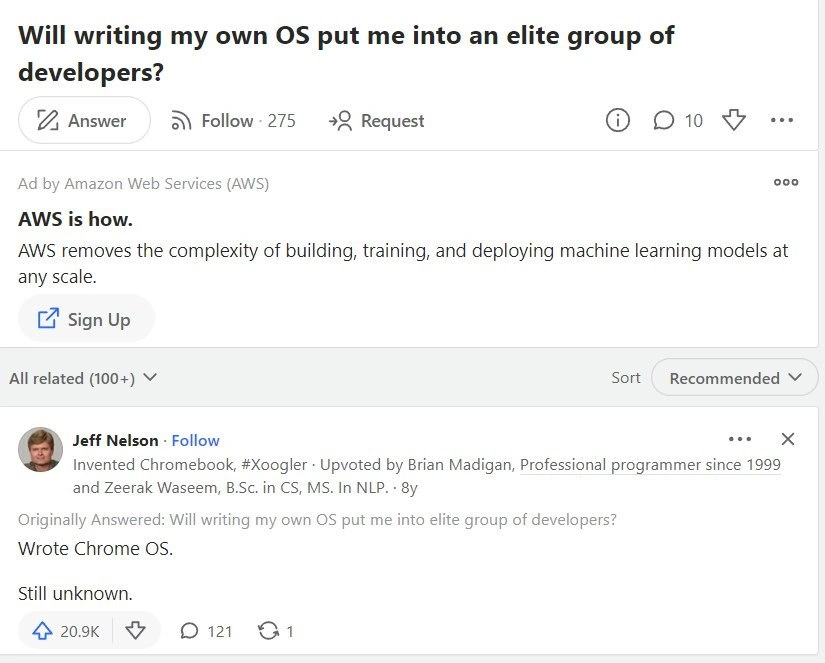
Now, the person on Quora is basically asking, “If I pull off this crazy difficult project, will I join an elite group of developers?” This taps into a stereotype or myth in developer communities that there’s a special club of “elite” programmers – the ones who build operating systems, write compilers, or do other hard, low-level work – and that membership is earned by accomplishing some grand feat. It’s true that folks who do those things are highly skilled, but the meme points out an awkward reality: even if you do something as grand as making an OS, you might not get the recognition you expect. Jeff Nelson, the guy who answered, lists his credentials as “Invented Chromebook, #Xoogler”. “Xoogler” is a slang tag meaning an Ex-Googler (a former Google employee). He uses that to show he’s been in the big leagues. Jeff’s answer is literally: “Wrote Chrome OS. Still unknown.” This is a very short, almost deadpan way to say, “I did the thing you’re talking about — I created a real operating system that millions use — and I’m not treated like some celebrity developer or part of an exclusive club.” His answer is the punchline to the question. It underscores that there isn’t some automatic fame or badge of honor that comes with a big achievement in tech.
The Quora screenshot also shows an Amazon Web Services (AWS) ad right under the question. AWS is a popular cloud computing platform. The ad says, “AWS is how. AWS removes the complexity of building, training, and deploying machine learning models at any scale.” This is likely just a coincidental ad placement, but it’s funny in context. Why? Because the ad is basically saying “Don’t reinvent complicated stuff, use our ready-made services to handle the complexity for you.” It’s almost answering the question in a sideways manner: someone asks if they should do something very low-level and complex to become elite, and here’s an ad saying here’s a high-level service that hides complexity. It’s a contrast between two mindsets in tech: one is “build everything yourself from the ground up” (like writing an OS), and the other is “stand on the shoulders of giants” (use cloud services, existing tools, etc., to be productive). The juxtaposition is amusing because it highlights how modern developers often actually rely on pre-built infrastructure (like AWS or open-source libraries) instead of doing everything from scratch. In other words, the industry doesn’t usually demand you write a new OS – it might prefer you know how to deploy on AWS or use existing operating systems effectively. So the advertisement unintentionally pokes fun at the original question’s premise.
In developer communities (DevCommunities), especially online Q&A forums like Quora, it’s common to see questions from less experienced folks who have big aspirations or misconceptions about what will earn respect. There’s an ongoing inside joke about “10x engineers” or “rockstar developers” – terms that some HR departments throw around hoping to hire mythical ultra-productive coders. Many seasoned developers roll their eyes at those labels. The idea of an “elite group of developers” is a bit of a unicorn; there are certainly highly respected developers (like the creators of famous programming languages or tools), but there’s no formal elite club that one project will unlock. Respect in tech communities usually comes from consistent contributions, sharing knowledge, or building something that others find useful, rather than chasing status symbols.
The meme’s punchline is essentially about career expectations vs. reality. The person asking the question imagines a direct cause-and-effect (big impressive project => recognition and status). Jeff Nelson’s experience shows a more real-world outcome: you can do a huge impressive thing and still be just another name to most people. It’s a bit of a cautionary tale against misaligned career expectations. Jeff’s “Still unknown” is also a tiny window into how recognition works at big companies: if you create something under a large company’s umbrella (like Google), often the product’s name becomes known, but the individual engineers behind it remain anonymous to the public. Unless you’re the founder or a front-facing figure, tech fame usually doesn’t trickle down. So in a nutshell, this meme uses a Quora Q&A scenario to humorously debunk the “elite developer” myth – pointing out with real evidence that even writing an OS (a hallmark of advanced programming skill) won’t automatically make you a superstar. The dev community finds it funny because it’s true, and it’s a lesson many learn eventually: great engineering feats don’t always come with glory. Sometimes the satisfaction has to be internal – you know you did it, even if the world doesn’t applaud.
Level 3: No Syscall for Fame
This meme strikes a chord with seasoned developers because it hilariously confronts the “elite developer” myth. The question on Quora reads “Will writing my own OS put me into an elite group of developers?” – and you can almost hear a chorus of senior engineers chuckling. The humor comes from the stark reality check delivered by Jeff Nelson’s answer: “Wrote Chrome OS. Still unknown.” It’s a mic-drop moment. Here’s a guy who actually did create a full-fledged, commercially shipped operating system – the very accomplishment the questioner thinks will grant them rockstar status – and he’s saying nope, it doesn’t come with a golden ticket to fame or a secret clubhouse of coding deities. It’s the ultimate humble-brag double whammy: he gets to subtly flash his creds (inventing Chromebook, i.e. leading Chrome OS development at Google) while simultaneously deflating the ego balloon of anyone who thinks such an achievement puts you on tech’s Mount Olympus. The reaction count (20.9k upvotes!) shows thousands of developers found this truth bomb both funny and painfully relatable.
Why is it so relatable? Because the industry is full of misaligned expectations like this. Many junior devs fantasize that doing something extraordinarily difficult or impressive – like writing an entire OS from scratch – will instantly earn them admittance to some “elite” tier of respect and recognition. It’s the same naïveté that labels people “10x developers” or “rockstar programmers” as if one heroic feat overnight changes your peer reputation. The veteran crowd knows better: there’s no system call for instant fame (int fame = syscall(SYS_get_fame); // returns -1 ENOSYS). In the real world, recognition in developer communities is fickle and often disconnected from raw technical accomplishment. Jeff’s answer highlights that even shipping a major product used by millions (Chrome OS powers Chromebooks everywhere) doesn’t mean the community will herald you as a legend. Most people had no clue Jeff Nelson was behind Chrome OS until he himself pointed it out. Meanwhile, plenty of developers who haven’t built an OS might be well-known for other reasons – maybe they maintain a popular open-source library, have a viral Twitter presence, or wrote a beloved blog. Tech fame, such as it is, often comes from communication and community visibility as much as from pure coding prowess.
The juxtaposition with the AWS ad adds a delicious layer of irony. The ad cheerfully proclaims, “AWS removes the complexity of building, training, and deploying machine learning models at any scale” with a big “Sign Up” button, right under a question about undertaking one of the most complex programming projects imaginable (an OS). It’s as if the internet itself is saying: “Why build an OS from scratch, buddy? Just use cloud services, we got fancy pre-built stuff for you!” For senior developers, this contrast is comedic gold. On one hand, you have someone considering reinventing the lowest-level wheel to gain status; on the other, modern industry trendiness is all about using high-level platforms that abstract away low-level toil. It highlights a truth: companies today often value developers who can deliver business value quickly (leveraging cloud, existing tools) more than lone wolves toiling on esoteric projects. The AWS ad inadvertently answers the question with a big corporate “No, don’t do that, use our services instead”. It’s a bit like someone asking, “Should I handcraft a sports car to become a famous driver?” and a billboard next to them shouts, “Lease a Tesla today! No assembly required.”
Additionally, consider the #Xoogler (ex-Googler) flair in Jeff’s profile. In communities like Quora, flexing a Google background and a high-profile project like Chromebook is meant to establish credibility. Jeff effectively says, “I’ve been to the mountain top of engineering at Google. I did the thing you think is so special. And guess what? I’m not in any secret VIP club, I’m just another dude in the industry.” That’s both funny and a little cathartic. It’s a reminder of the often thankless nature of engineering work: you can pour your soul into a product, and in the end, the product’s name outshines yours. Software engineers don’t get rockstar name recognition unless they cultivate it; even the ones who truly are geniuses often blend into the crowd. For example, countless developers use Linux every day and revere it, but outside tech circles how many could name Linus Torvalds? Even Linus, who created something far more influential than Chrome OS and is somewhat legendary among programmers, isn’t a household name in the wider world. For every Linus or Guido van Rossum (creator of Python) who gains a bit of fame, there are thousands of brilliant developers who built crucial systems (maybe your phone’s OS scheduler, or the database engine your bank uses) that remain unsung heroes. As a grizzled engineer might say with a smirk: “Kid, you can spend years on a monumental project and still end up as just a line in someone else’s résumé.” The meme resonates as an insider joke: it skewers that youthful hubris head-on. We’ve all encountered ambitious folks (including our younger selves) who equated mastering arcane technology with instant peer admiration. Reality is far more sobering – and apparently 20,000 people found comfort or comedy in Jeff Nelson’s six-word reality check.
Level 4: Ring 0 Dreams
At the deepest technical level, writing your own operating system means diving headfirst into the heart of the machine – running code at Ring 0 (the CPU’s most privileged level). It’s a tour-de-force through kernel architecture: you’d craft everything from a bootloader that kicks the CPU out of firmware into your code, to a scheduler deciding which process runs next on the CPU (juggling time slices like a robotic circus master). You’d implement virtual memory by setting up page tables and managing RAM with algorithms like a buddy allocator or slab allocator – yep, you become the boss of bytes, deciding which memory stays and which gets swapped out. Then there’s I/O and device drivers, where you negotiate with hardware using interrupts and memory-mapped I/O, essentially teaching your OS to talk to disks, keyboards, networks – all in their native tongue of voltages and registers. This is serious wizardry: you confront concurrency issues (hello, race conditions and deadlocks!) and enforce isolation between programs so a misbehaving app doesn’t clobber the whole system. Writing an OS is like solving dozens of complex puzzles at once – process scheduling akin to tackling a multi-dimensional optimization problem, file system design requiring data-structure finesse (B-trees, journaling for crash recovery), and managing syscalls (system calls) which form the API between user programs and your kernel. Each of these domains has entire textbooks devoted to it. In fact, a lot of fundamental computer science theory lives here: from synchronization primitives (e.g., semaphores, mutexes) to paging algorithms and cache eviction policies, an OS developer wrestles with the same kind of math and logic that made the likes of Dijkstra and Knuth famous in academic circles.
It’s no surprise that historically, only a handful of operating systems gain widespread use – Unix, Windows, Linux, etc. Each was built by teams of brilliant engineers or decades-long efforts. Even Chrome OS, which Jeff Nelson claims to have “wrote,” wasn’t created in a vacuum; it’s actually built on the Linux kernel with Google’s added layers on top. In other words, even Google didn’t start entirely from scratch – they stood on the shoulders of OS giants. There’s an entire universe of complexity under the hood of any real-world OS, often invisible to users. And here’s a cruel twist of geek fate: mastering these low-level intricacies doesn’t automatically shower you with glory. The technical elite might appreciate the elegance of your page-fault handler or the ingenuity of your inter-process messaging, but the broader developer world often takes the OS for granted. It’s the stage on which software dances – mostly noticed only when something goes horribly wrong (blue screen, kernel panic, anyone?). Writing an OS is arguably as hardcore as it gets in software engineering, a rite of passage in extreme system design. Yet, as Jeff’s wry answer implies, operating systems are the ultimate unsung hero: pull off this near-herculean engineering feat, and your reward might just be that everything works quietly in the background – no fanfare, no “elite developer” badge unlocked. In the theoretical realm, there’s beauty in how an OS orchestrates the symphony of hardware and software. But in reality, those Ring 0 dreams often meet a harsh truth: even the most elegant kernel won’t automatically elevate your status in the eyes of others.
Description
This image is a screenshot of a question-and-answer from the website Quora. The question at the top asks, 'Will writing my own OS put me into an elite group of developers?' Below an advertisement for Amazon Web Services (AWS), the highest-voted answer is displayed. The answer is from Jeff Nelson, whose bio identifies him as the 'Invented Chromebook, #Xoogler'. His response to the question is a brilliantly concise and witty two-line takedown of the premise. He writes: 'Wrote Chrome OS. Still unknown.' The humor is derived from the profound humility and dry wit of the answer. The question comes from a place of ambition and status-seeking, common among less experienced developers. The answer, from someone who has actually achieved this monumental task, humorously suggests that even creating a globally recognized operating system doesn't guarantee a feeling of 'eliteness.' It's a perfect encapsulation of the expert's mindset: the more you accomplish, the more you realize how much there is to know, making the very concept of an 'elite group' seem absurd
Comments
13Comment deleted
The only thing more complex than writing your own kernel is figuring out if doing so makes you 'elite' enough to finally get PRs approved without 15 nitpicks about variable naming
Built a kernel, a compositor, and a full update pipeline - still less “elite” on LinkedIn than someone who clicked “Enable Auto-Scale” in the AWS console; apparently recognition is serverless now
The guy who literally created an OS used by millions in education and enterprise is 'still unknown' - meanwhile, every bootcamp grad who deploys a todo app on Vercel updates their LinkedIn to 'Full Stack Architect | Thought Leader | 10x Engineer'
Ah yes, the classic developer career arc: spend years mastering low-level systems programming, write an OS that ships on millions of devices worldwide, and still get ghosted by recruiters because your LinkedIn says 'Chrome OS' instead of 'React Developer.' The real elite group isn't those who write operating systems - it's those who can explain to their parents what they actually do for a living. At least kernel developers can console themselves knowing their code runs closer to the metal than their career recognition runs to their actual impact
Implement a kernel, scheduler, and ship Chrome OS; recognition is eventually consistent with unbounded latency - unlike the AWS ad pipeline’s five nines
Elite OS club: where 'it boots consistently' merits a release party, unlike your average SaaS sprint
Writing an OS doesn’t make you elite; getting suspend/resume to work across 500 OEM ACPI permutations while an AWS ad claims it “removes complexity” does
Ads in Memes: Brought to you by capitalism Comment deleted
Not so bad tho Somehow still better than posting only gov approved memes 👀 Comment deleted
Two memes in one Comment deleted
>they're using the internet without an adblocker Comment deleted
tr: "listen here you little bastard" Comment deleted
https://www.merriam-webster.com/dictionary/double%20standards Comment deleted