Skip to content
DevMeme
2638 of 7435
Frontend Complexity vs. Backend's Primal Simplicity
Frontend Post #2917, on Apr 9, 2021 in TG

Frontend Complexity vs. Backend's Primal Simplicity

Why is this Frontend meme funny?

Level 1: Monkey See, Monkey Do

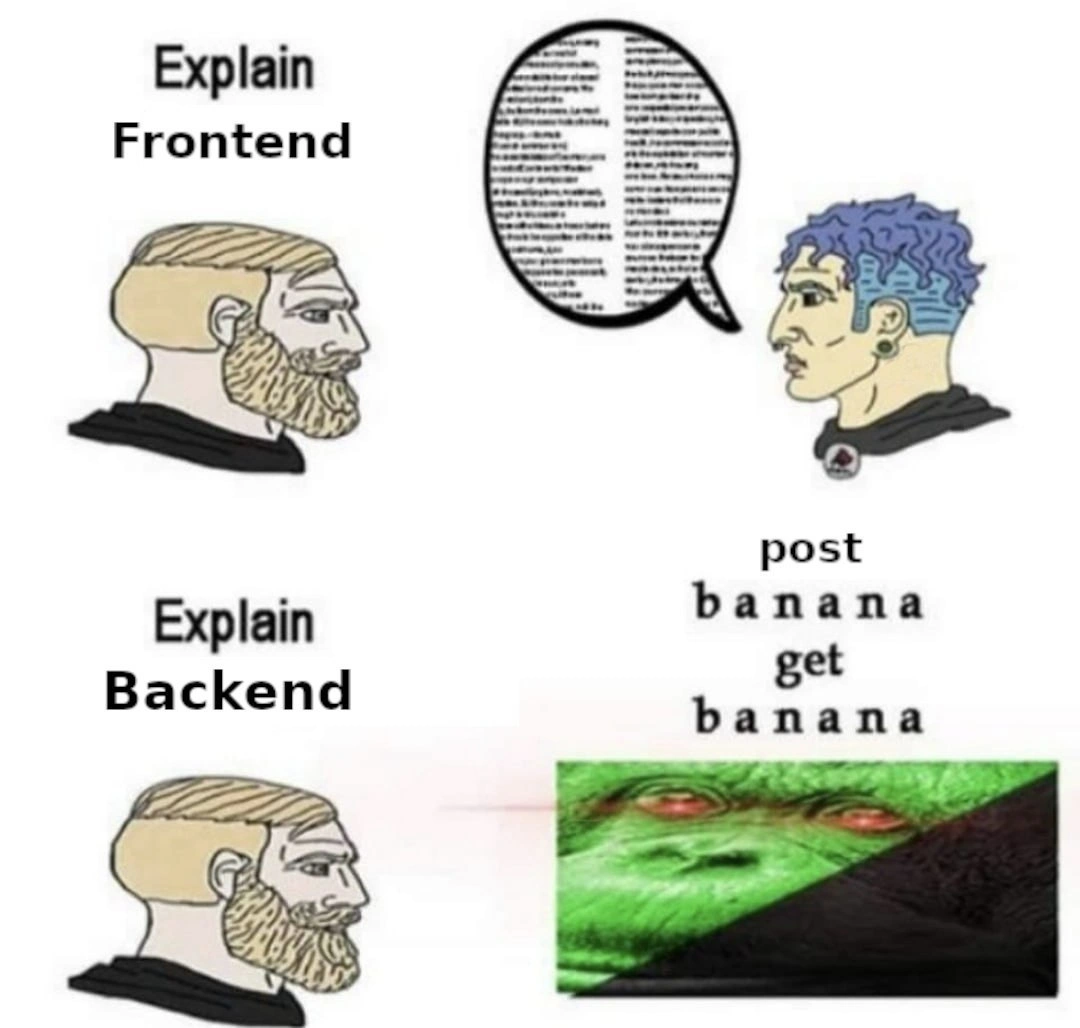
Imagine you ask two friends to explain their jobs. The first friend’s job is really complicated, and when you ask them to explain what they do, they start talking a lot. They’re using big words and going on and on – so much that it’s like a giant block of text coming out of their mouth! You might feel a bit lost because there are so many details. Now you turn to the second friend, who has a different job, and you ask the same question. This friend just thinks for a second and says, “I take a banana, and I give back a banana.” That’s it – a one-sentence answer. It’s so simple and literal that it’s funny, especially compared to the first friend’s super long explanation.

This meme is using that idea to make us laugh. The first part (the frontend) is like someone giving a really long explanation – picture a huge speech bubble full of words, almost like an overstuffed book. The second part (the backend) is like someone who just repeats what you give them – you hand them a banana and they hand the same banana back to you, like a copycat. And they even show a silly monkey face, because monkeys and bananas go together and it makes the whole thing even more playful. It’s basically saying: one side of making a website can sound crazy complicated, and the other side (at least in this joke) is made to look laughably simple. We find it funny because the difference is so extreme – it’s like expecting a huge story but then only getting a single goofy line. Even if you’re not a tech guru, you can chuckle at the idea of “lots of talking versus just giving a banana back.” In simple terms: one person is over-explaining, and the other is just doing a basic monkey see, monkey do with a banana. That huge contrast is the punchline, and it’s what makes the joke work!

Level 2: Banana In, Banana Out

Let’s break down the meme in plain tech terms. In web development, the frontend is the part of an application that runs in your browser – basically everything you see and interact with on a webpage. That includes the layout of the page (HTML structure), the styling and colors (CSS – Cascading Style Sheets), and the interactive behavior (usually driven by JavaScript code). Modern frontend development often uses frameworks or libraries (like React, Angular, or Vue.js) to help manage all these pieces by building the UI in components and handling dynamic updates. There’s also a build process (with tools like Webpack, Babel, etc.) to bundle and optimize the code. So, explaining how a frontend works can get complicated fast: you might talk about how user clicks trigger events, how state changes cause re-renders of components, how you have to deal with different browser quirks, and so on. That’s why the meme shows a speech bubble crammed with text for “Explain Frontend” – it represents that huge amount of explanation. It’s poking fun at the fact that a simple question about a UI can lead to a very long answer covering lots of moving parts.

Now, the backend is the behind-the-scenes part of a web application that runs on a server. It handles things like storing data in a database, enforcing rules or business logic, and responding to requests from the frontend. When you use a website and click a button, often the frontend will call an API (Application Programming Interface) provided by the backend to either get or save some data. One common style for these APIs is REST. In a RESTful API, the client and server communicate using HTTP methods like GET (to retrieve data) and POST (to send data). For example, if we have a “banana” resource, an HTTP POST /banana might create a new banana entry on the server, and an HTTP GET /banana could retrieve it.

So what does the meme’s phrase “post banana get banana” mean? It’s basically an ultra-simplified description of a REST API interaction:

  • post banana” suggests making a POST request to the server with “banana” as the data (perhaps as simple as sending the word banana or a banana object in JSON format).
  • get banana” suggests that if you then make a GET request, the server returns the banana back to you.

In other words, you give the server a banana, and the server gives you the same banana back. This is like a minimal example of how a backend might store something and then let you retrieve it. It’s almost a comedic shorthand for a create-and-read operation. There’s even a blurry green monkey face image shown under the text in the meme, which adds silliness (bananas and monkeys, naturally). The monkey image hints that this backend task is so simple that even a monkey could do it, or it’s just there to be random and funny.

To put it in perspective, imagine a real web app: the frontend might be a page with a form where you type “banana” and hit submit. The JavaScript on that page makes a POST request to https://example.com/banana with the text "banana". The backend (on the server) receives that request, perhaps saves “banana” somewhere (or just remembers it temporarily), and then when the frontend immediately asks via a GET request, “Hey, do you have a banana for me?”, the server responds with “banana”. That’s it – the data goes in and comes back out unchanged.

The meme exaggerates the difference in complexity:

  • Frontend explanation: a lot to talk about (many technologies and details) — hence a huge wall-of-text in the speech bubble.
  • Backend explanation: very little to say for this simple case — just “banana in, banana out,” as if the server is a simple vending machine or echo.

This is a form of BackendHumor paired with FrontendHumor. It reflects a common light-hearted sentiment among developers that frontend work can sometimes be very intricate (even for something that looks simple to users), whereas a basic backend endpoint might be straightforward to describe. Of course, in real projects, backend systems can be extremely complex too, involving authentication, scaling, caching, and more. But the joke here chooses an example of a trivial backend process to contrast against the seemingly endless layers of frontend explanation. It’s a playful jab at the Frontend vs Backend divide. A junior developer who’s started learning both might recognize this pattern: the first time you try to center a div with CSS or debug a weird JavaScript issue, you realize frontend has depth. And the first time you write a basic API route on the backend, you might think, “huh, that’s all it takes to send data from A to B?” (Of course, later you find out there’s more to it, but at first blush it can seem that simple.)

Here’s a quick comparison to summarize the meme’s point:

Explain Frontend 🙇‍♂️ Explain Backend 🐒
Lots of detail! A long, verbose explanation covering multiple files, frameworks, and browser details. (The speech bubble full of text represents this.) Keep it simple. “Post banana, get banana” – a one-liner summary of an ultra-basic API call, with a monkey image to hammer home the simplicity.

The contrast in the table above is exactly what makes the meme funny. It resonates with anyone who has seen a frontend developer passionately go on about component lifecycles or CSS hacks, versus a backend developer casually saying, “Yeah, I just set up a quick POST endpoint.” It’s a simplification, but an instantly relatable one for folks in web development.

Level 3: Wall of Text vs One-Liner

This meme humorously pits frontend complexity against backend simplicity in a way that makes seasoned devs smirk. In the top panel ("Explain Frontend"), the bearded Wojak Giga-Chad character asks about the frontend, and the reply is a gigantic speech bubble crammed with text. It’s a visual nod to how explaining a modern frontend often feels: you end up rattling off a cascade of details about UI components, CSS quirks, state management, and build tools. The frontend side of a web app can entail a labyrinth of concerns – from ensuring responsive layouts with CSS (and battling its cascading effects) to managing asynchronous data flows with something like React state or Vue’s reactivity. The meme deliberately shows an overwhelming wall-of-text to poke fun at that verbosity. Seasoned frontend developers know this scenario too well: try explaining why a button is misaligned, and suddenly you're talking about box models, flexbox vs. grid, browser devtools, and a bug that only appears on IE11 old browsers. It’s FrontendHumor taken to the extreme, reflecting how a simple question can lead to an impromptu seminar on the intricacies of the client-side.

Now contrast that with the bottom panel (“Explain Backend”). The same Chad-like figure asks about the backend, and this time the response is absurdly simple: the text “post banana get banana” floats above a low-res green monkey face. This phrase reads like pseudo-code for the world's simplest REST API. It implies that if the client POSTs a banana to the server, a GET request will fetch that banana back – basically an echo service. It’s a tongue-in-cheek way to claim “See? Backend is easy, you just send data and get the same data back!” The inclusion of the glowing-eyed monkey image adds to the joke: as if to say, even a monkey could handle this backend task. The backend’s role is reduced to a primitive CRUD action (Create banana, Read banana), or more accurately just CR (since nothing changed with the banana!). Every backend developer knows there’s a lot more going on behind the scenes – databases, authentication, error handling, scalability – but the meme gleefully ignores all that. By boiling down “explaining the backend” to four words and a banana, it satirizes the way non-backend folks sometimes underestimate what happens on the server side.

This contrast is funny to experienced devs because it flips the usual script of full-stack discussions. We’ve all been in those meetings where the frontend engineer needs 10 minutes to justify a complex React refactor or a tricky CSS fix, while the backend engineer’s update is like, “Added one API endpoint, all good.” Here’s a snippet that captures the meme’s banana API in code form for the techies:

// Express.js pseudo-code for the "banana" endpoint:
app.post('/banana', (req, res) => {
  // The server just sends back whatever was posted (banana in, banana out)
  res.send(req.body);
});

Reading this, a senior dev might chuckle because it’s BackendHumor at its finest – a trivial endpoint that does literally nothing but return the input. It feels like an example straight out of an introductory web programming tutorial or a mocking take on “enterprise” APIs that don’t do much. The meme format (with the Chad Wojak and the e-boy character) drives home the shared understanding: the perceived complexity gap between frontend and backend can be hilariously wide. In reality, both have their challenges, but the joke lands because it contains a grain of truth exaggerated to cartoonish proportions. The frontend can involve an ocean of complexity even for small things, while a basic backend API might sometimes be summed up as “receive banana, return banana.” It’s an inside joke about the Frontend vs Backend dynamic that most developers, especially those who have dabbled in both, can appreciate with a grin.

Description

This is a two-panel meme that humorously contrasts the perceived complexity of frontend and backend development using Wojak characters. In the top panel, a traditional blonde 'Chad' Wojak asks, 'Explain Frontend.' He is answered by a more modern-looking character with blue hair, whose speech bubble is filled with an unreadably dense wall of text, symbolizing the overwhelming complexity often associated with frontend technologies, frameworks, and build tools. In the bottom panel, the same Chad character asks, 'Explain Backend.' The response is a starkly different image: a close-up of a green-tinted gorilla's intense, red eyes, with a black anarcho-primitivist flag overlay. Below it, the explanation for backend is simply 'post banana get banana'. The joke hinges on this extreme dichotomy: frontend development is portrayed as a verbose, convoluted discipline, while backend is reduced to its most primitive, fundamental function - handling simple data transactions, akin to basic cause and effect. It's a relatable caricature for senior developers who have witnessed the explosion of frontend complexity while the core principles of many backend services have remained relatively simple

Comments

13
Anonymous ★ Top Pick The frontend dev is still explaining their state management solution for the banana display, while the backend dev has already shipped the v1, v2, and a GraphQL endpoint for 'get_banana'
  1. Anonymous ★ Top Pick

    The frontend dev is still explaining their state management solution for the banana display, while the backend dev has already shipped the v1, v2, and a GraphQL endpoint for 'get_banana'

  2. Anonymous

    “POST banana, GET banana” is adorable - right up until PM asks for versioned bananas, GDPR-compliant peels, and a three-region active-active orchard with exactly-once picking semantics

  3. Anonymous

    After 15 years of explaining microservices architecture, event sourcing, and CQRS patterns to stakeholders, you realize the junior dev who said 'it's just CRUD with extra steps' wasn't entirely wrong - they just hadn't discovered the joy of debugging distributed transactions across 47 services yet

  4. Anonymous

    Ah yes, the classic dichotomy: Frontend engineers need a PhD thesis to explain why they chose React over Vue and how their state management strategy handles async boundary cases with Suspense, while backend engineers just grunt 'POST banana, GET banana' and somehow that's supposed to encompass distributed transactions, eventual consistency, database sharding, caching strategies, and the entire CAP theorem. Both are equally reductive explanations, but only one gets you weird looks at the architecture review

  5. Anonymous

    Frontend: 10 minutes on hydration; Backend: “POST banana, GET banana” - until someone asks about idempotency keys, OAuth, retries, and CAP, and suddenly the banana is an eventually consistent distributed fruit with strong opinions about 200 vs 201

  6. Anonymous

    Frontend: Flexbox thesis in 10k LOC. Backend: One GET /banana scales to petabytes

  7. Anonymous

    Every time someone says “backend is just POST banana, GET banana,” an architect writes a 12‑page doc on idempotency keys, auth scopes, retries, pagination, and GDPR deletes

  8. @nepalymiynik 5y

    Чот мне кажется, что про бэк спросили у фронтендера

  9. @Iliya_malecki 5y

    Так наоборот же

  10. @karumsenjoyer 5y

    Вот это бэкендерам НЕПРИЯТНО

    1. @dugeru42 5y

      я бэкендер и мне норм KISS - лучший принцип i am backender and i am okay with meme KISS is the best

  11. @a_desant 5y

    Post banana 500 internal server error

    1. @dugeru42 5y

      best company i ever worked with was called Team 502

Use J and K for navigation