The Perilous Art of Refactoring a Stable Application
Why is this Refactoring meme funny?
Level 1: Don’t Poke the Tiger
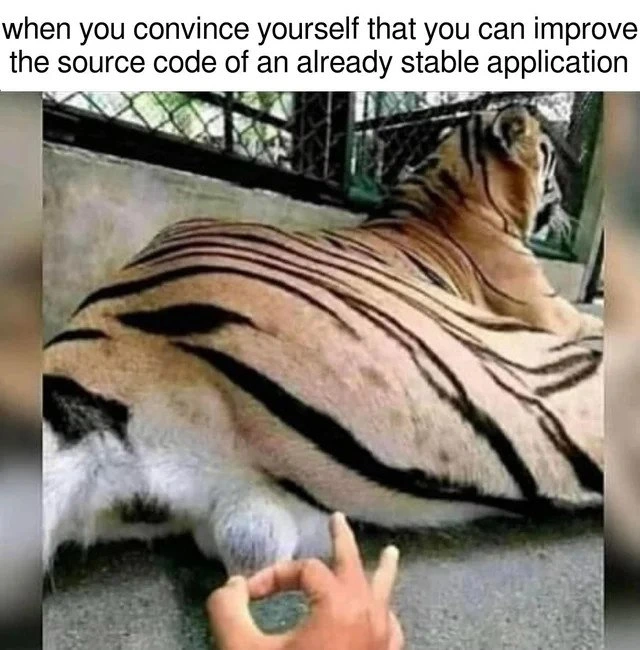
Imagine you have a big, sleeping tiger 🐯 taking a nap. It’s peaceful and not bothering anyone right now. Would you walk up and poke it for no good reason? Probably not, because you know the tiger could wake up angry and cause chaos. This meme is a funny way of saying the same thing about computer programs.
The tiger represents a program that’s working just fine – it’s sleeping happily. The person’s hand about to poke it means a developer is about to mess with something in that program. They think, “Maybe I can make it a little better.” But that’s like poking the tiger: it might wake up a bunch of problems (bugs) that were quietly hidden. In simple words: if everything is running smoothly (the tiger is sleeping), changing things for no reason can cause trouble (waking up the tiger 😡).
It’s funny because we all kinda know it’s a bad idea to poke a tiger or to mess with something that’s working. The picture and caption together make a joke: the developer is being silly and a bit too confident – and everyone is nervously laughing because we expect the tiger (the bugs) to jump up any second now! It teaches a little lesson: sometimes it's safest to just let things be.
Level 2: If It Ain’t Broke...
Now let's break down the joke in simpler, concrete terms. The meme text says: "when you convince yourself that you can improve the source code of an already stable application". This is referring to the act of refactoring – which means changing the code to improve its structure or readability without changing what it actually does (in theory). The key part is “already stable application.” A stable application is a program or system that’s been running reliably; it doesn’t crash, and users aren’t complaining about bugs. It’s like a machine that’s humming along nicely.
In software development, there’s always an urge to clean up or improve existing code. Code can always be a little cleaner, faster, or more modular, right? We call things that might need fixing code smells – signs that code isn’t as good as it could be (for example, duplicate code or functions that are too long). Fixing these via refactoring can improve CodeQuality – making the code easier to understand or extend in the future. So, it sounds good in principle.
However, this meme highlights a big risk of refactoring: even if you don’t intend to change behavior, you might accidentally introduce bugs. A bug is an error or flaw in the software that causes it to produce a wrong or unexpected result, or to behave in unintended ways (like crashing or miscalculating). A stable system might have no known bugs right now, but that doesn’t mean bugs don’t exist – they might just be dormant or very rare. For instance, there could be a hidden bug that only happens on February 29th of a leap year during a full moon – but since that scenario hasn’t happened recently, the program appears stable.
When the meme shows a hand about to poke a tiger, it’s using a metaphor: the tiger represents those hidden dangers or potential bugs in the stable code. The hand with the "👌" OK gesture is the developer who is confident and maybe a bit naive, thinking “It’ll be fine, I know what I’m doing.” Poking the tiger (making a code change) could wake up those sleeping bugs. In real terms, a change might cause an issue to surface that was previously not happening. This is why senior devs sometimes joke that making any change to old, stable code will cause something to break.
Let’s illustrate with a simple example in code. Imagine we have a function in a stable system:
def compute_value(x):
if x == 42:
return 0 # legacy hack: handle x=42 as a special case
return x * 2
This function has a weird special-case: if x is 42, it returns 0 instead of 84 (because normally it doubles the number). Maybe this was done long ago to handle some quirky requirement or bug – we might not even know why (this is technical debt: old decisions that remain in the code). Now a developer comes along, sees this “odd” code and decides to refactor it to make it cleaner:
def compute_value(x):
return x * 2 # It's cleaner now - what could possibly go wrong?
They remove the “magic number 42” case, thinking it’s unnecessary. The function looks simpler and more logical. All good, right? But suddenly, somewhere else in the application, something starts failing whenever x is 42. 😨 It turns out that special case was there for a reason – perhaps 42 was an input that would cause an overflow or was a marker for “no value”. By removing it, the developer inadvertently introduced a bug. The stable app (the tiger) was quiet because that odd code was keeping it happy. Removing it woke up the bug (the tiger roars).
This is a contrived example, but it happens a lot. Maybe the code you refactor had hidden dependencies: e.g., two pieces of code rely on each other in an odd way (a form of coupling). When you “clean up” one part, you break the connection in a way you didn’t realize. Without comprehensive tests or understanding, it’s easy to miss this. That’s why refactoring an old, stable codebase can be so tricky.
Some important concepts and principles play into this meme’s meaning:
YAGNI (You Aren’t Gonna Need It): This principle tells developers not to add functionality or code until it’s actually needed. It’s a reminder not to over-engineer. In context, the stable application doesn’t need changes right now if it’s working fine. The developer “convinced themselves” they should improve it, but honestly, maybe it wasn’t necessary. YAGNI would caution: don’t write extra code or do extra work just because you think it might be useful later. Similarly, don’t refactor just because the code isn’t perfect; do it because there’s a real benefit or need.
Premature Optimization: This is a famous concept meaning you shouldn’t try to optimize your code for performance too early, especially not before you know what part of the code is actually slow. A classic quote is “premature optimization is the root of all evil” in programming. In the meme scenario, maybe the developer thinks they can make the code run faster or use less memory by changing something. But if the app is stable and fast enough, then that optimization is “premature” – not needed – and might introduce bugs or complexity. It’s like tuning up a car that’s running perfectly fine and accidentally misaligning the engine.
Over-engineering: This is when someone designs a solution or code that's far more complex or fancy than necessary for the task at hand. If a developer decides to rewrite a stable module into a high-tech, brand new architecture without a real need, that’s over-engineering. It’s risky because the new, complex solution hasn’t been battle-tested like the old one. The meme implies the person is overconfident in their improvement idea – which might be over-engineered relative to the simple, working code that’s already there.
Technical Debt: Think of this like shortcuts or messy code from the past that we owe cleanup on. A stable application often has some technical debt (old code that could be improved). Paying off technical debt (by refactoring) is usually good in the long run because it makes future changes easier. But there’s interest on that debt – the risk and effort when you finally address it. The meme jokes that the interest might be very high: you “pay” by spending hours fixing the new bugs you introduced 🤕. In other words, while the code was stable, the debt wasn’t hurting you; once you try to fix it, you feel the pain if you’re not careful.
Refactoring vs Rewriting: It’s worth noting, refactoring ideally shouldn’t change the code’s outward behavior. It’s like reorganizing a closet without throwing out any clothes – when you’re done, everything fits the same, it’s just neater. However, big refactors border on rewriting, which is replacing code with new code. The bigger the change, the higher the chance of mistakes. The meme suggests even a small change can be dangerous. Seasoned devs handle this by doing refactors in small steps, writing tests to confirm nothing breaks, and by not poking the tiger unless necessary.
Why do junior devs find themselves in this situation? Often, if you’re newer to a codebase or coding in general, you want to prove yourself. Cleaning up code seems like a good way – it demonstrates understanding and improvement. Juniors also might underestimate the complexity hidden in a seemingly straightforward code block. It’s a learning experience (sometimes a hard one) to realize that “simple” code changes can have far-reaching effects in a large system. That function or module might be used in 25 different places, or have to handle weird inputs, or integrate with an external system. If you change it without knowing all that, you get surprises.
Another element: The OK hand gesture right near the tiger’s backside is comically implying the person is about to do something very bold and silly. The "OK" sign usually means "This is fine" – which is exactly what that overconfident developer thinks: “It’s fine, I can improve this, no problem.” Meanwhile anyone watching (like an experienced teammate) would be holding their breath, thinking “Oh no, this is NOT fine…”. It’s a visual punchline because you expect in the next moment the tiger will wake up snarling. Just as in code, the minute after you deploy that “improvement,” all those sleeping bugs might attack with errors and crashes.
To sum up this level: The meme is a funny warning. It defines a situation every programmer eventually encounters: risky code changes to a stable application. We’ve covered how refactoring works and why it’s done, but also why it can be dangerous if done without caution. We explained terms like YAGNI, premature optimization, and technical debt, which all basically advise: be careful and make sure that change is worth it. The humor of the meme sticks because it captures a universal developer experience in one image and caption. Even if you’re a newer developer, you likely know the nervous feeling of changing something and hoping nothing breaks – that’s exactly “hoping the tiger stays asleep.”
Level 3: Refactoring Roulette
In this meme, a developer is essentially playing refactoring roulette with a stable codebase. The top caption reads, "when you convince yourself that you can improve the source code of an already stable application". Seasoned engineers immediately cringe because they've all seen how a "little improvement" can spiral into a colossal bug chase. The photo of a relaxed tiger being approached with an "OK" 👌 hand gesture perfectly visualizes the situation: the stable application (tiger) is calm and working perfectly. The developer’s overconfident attempt to "optimize" or clean it up (the risky poke) could awaken the tiger of bugs.
Why is this so funny (and painfully true)? In real-life software projects, there's a saying: "If it ain't broke, don't fix it." This meme riffs on that wisdom. The humor comes from overconfidence meeting Murphy’s Law: that anything that can go wrong, will go wrong—especially right after you boast that it won’t. Developers often convince themselves their small refactor or code cleanup is harmless, only to unleash a cascade of unexpected bugs. The tiger here represents all those dormant issues and hidden couplings lurking in a mature system. While the code sleeps, it’s stable. But disturb it even slightly, and you might get bitten by a bug you never knew existed (just like an annoyed tiger waking up 😾).
From a senior developer’s perspective, this image evokes the collective PTSD of late-night deploys gone wrong. We’ve seen that tiny “innocent” change – maybe renaming a variable or tweaking an algorithm – unexpectedly bring production down. A stable application might contain years of technical debt and weird fixes that aren’t obvious. For example, a snippet like if (year == 2021 && stableFlag) { /* do nothing, it just works */ } might look like a no-op code smell begging to be removed. A junior dev might say, "Surely we can clean this up, it's unnecessary!" Remove that line, and suddenly the app crashes for certain customers, because that odd check was actually preventing a rare edge-case failure. In other words, that code smell might be the only thing keeping the beast tamed.
Industry Patterns & Pain: This meme speaks to the RefactoringPain many teams feel. Over time, projects accumulate CodeSmells and hacky solutions (technical debt). It’s tempting to polish that code – to satisfy our engineering pride or bump a CodeQuality metric. But the pain comes when touching that dusty corner breaks something unrelated. Often such legacy code lacks unit tests (or any tests at all), so you don’t discover the breakage until it’s live. There’s a dark joke among veterans: “The oldest, ugliest code is the most dangerous to change, because all its bugs have decided to take a nap.” 💤 This meme captures that idea – the bugs are sleeping like the big cat, and poking them with a refactor is how you get clawed.
Let’s talk anti-patterns: The scenario here parodies premature optimization and needless refactoring. A developer might be thinking, “I can make this faster or cleaner,” without a real need – classic example of the adage “PrematureOptimization is the root of all evil.” It’s not that refactoring or optimizing is bad – in fact, controlled refactoring is necessary to manage technical debt – but doing it just because you can or right before a deadline, or without fully understanding the consequences, is like juggling torches in a room full of dynamite. YAGNIPrinciple (“You Aren’t Gonna Need It”) is another concept this touches: maybe that fancy redesign or extra feature in the stable codebase isn’t needed at all. YAGNI encourages devs to not add functionality (or complexity) until it’s necessary; similarly, don’t refactor for hypothetical gains.
Shared Traumas & Real Stories: Pretty much every senior dev has a war story of an “innocent refactor” unleashing chaos. For example: a team once decided to “clean up” an authentication module that had worked fine for years. They removed duplicate code and streamlined some logic (it all made sense logically). Next deployment, nobody could log in. Why? That duplicate code they removed had a subtle difference for a legacy client integration – by merging it, they inadvertently dropped a critical check. It was like poking a tiger’s sensitive spot – production roared in protest. It took a 12-hour scramble to debug and restore service. The moral? That messy code was stable for a reason.
Another scenario: imagine a massive monolithic application running smoothly. A new dev thinks, “I’ll refactor this 1000-line function into smaller pieces, that’ll improve maintainability.” They do it, tests pass (if there are tests), and they deploy. Suddenly, an unrelated feature breaks – say, file uploads start timing out. 😱 It turns out that giant function included some critical side-effect or sequence that wasn’t obvious, and the refactor changed execution order. Untangling that took days. The DeveloperHumor here is dark: we laugh because we’ve all accidentally been that person or been on the team with that person. It’s the laugh of “Oh no, please don’t do that again.”
This meme also pokes fun at over-engineering tendencies. Developers love to optimize and improve things—it’s in our nature. But a senior knows to balance risk vs. reward. Sure, the code might not be pretty, but if it’s performing well and the business/users are happy, a big cleanup has diminishing returns. One wrong move and you might spend a week chasing a bug introduced by a refactor that nobody asked for. That time could’ve been spent building a new feature or fixing a known issue. So the humor has an underlying truth: messing with stable code without a clear reason is a risky gamble.
Organizational Dynamics: This also reflects workplace reality. Often, a new team member wants to prove themselves by boldly refactoring something to show off their skills. Meanwhile, the senior engineers are like “Please, no – we know that code is ugly, but it’s working and our customers depend on it.” Or maybe there’s pressure from management to “improve code quality” because some static analysis rated the code a 'C'. The dev thinks they’re being a hero by refactoring to get an 'A' grade. But if that effort introduces a bug that causes downtime, suddenly no one cares about the code quality grade – they care that production is on fire. 🔥 This contrast between idealism (always keep code clean!) and pragmatism (ensure the app runs reliably, even if the code isn’t perfect) is at the heart of the joke.
In summary, at this senior level of analysis: the meme humorously encapsulates a fundamental tension in software engineering – the desire to clean up code and eliminate technical debt, versus the very real danger of breaking something that works. It’s a cautionary tale told through a tiger photo. The combination of the OK hand sign (as if saying “It’s fine, I got this”) and the obliviousness to the huge tiger (the potential consequences) nails the ironic humor. Every experienced dev chuckles (and maybe shudders) because they remember that one time they poked the tiger… and the tiger definitely woke up. 🐅💥
Description
This meme humorously illustrates the risks of modifying a system that is already working reliably. The image is split into two parts: a caption at the top and a photograph below. The caption reads, 'when you convince yourself that you can improve the source code of an already stable application'. The photo depicts a person's hand making a playful 'OK' gesture inches away from the rear of a massive, sleeping tiger that is lying in an enclosure. The visual gag is potent: the developer's confidence and desire to 'improve' the code is analogous to this incredibly risky and foolish act of taunting a dangerous predator. For experienced engineers, this is a deeply relatable scenario. It represents the hubris of thinking a 'quick improvement' or a 'simple refactor' on a critical, legacy, or complex but stable system won't have disastrous, unforeseen consequences. The sleeping tiger is the fragile stability of the application, and the poke is the seemingly innocuous code change that could awaken a beast of production incidents, cascading failures, and late-night debugging sessions
Comments
9Comment deleted
That 'stable' application is just a tiger that has memorized the exact shape of all its bugs. Your 'improvement' is just teaching it new, more exciting ways to maul you in production
“It’s just a tiny refactor,” I whisper, pressing merge - basically the software equivalent of flashing an OK sign at a sleeping tiger and wagering my on-call shift on tail latency
After 15 years in this industry, I've learned that the urge to refactor stable production code is like petting a tiger's belly - it looks soft and inviting, but you're one swipe away from explaining to the CTO why the payment gateway that processed $10M yesterday is now returning null pointer exceptions
Ah yes, the classic 'I can refactor this legacy monolith in a weekend' delusion. That codebase has been in production for 15 years, survived three acquisitions, and somehow processes $10M in transactions daily despite violating every SOLID principle known to humanity. But sure, your fresh eyes and that Martin Fowler book you skimmed will definitely improve upon the battle-tested spaghetti that's been keeping the lights on since the Bush administration. Spoiler: You'll spend Monday morning reverting commits and Tuesday explaining to the CTO why the payment gateway is down
Refactoring stable code: the OK gesture of 'it'll be fine,' until the tiger's 'side effects' claw your on-call rotation
Stable code is a tiger held together by undocumented invariants; that “little cleanup” gesture optimizes MTTA while expanding the blast radius
Refactoring a cash‑cow service for a hypothetical 2% speedup is the engineering equivalent of tweaking a tiger’s whiskers - if the tests don’t catch it, the pager will
Dragon BallZ. Comment deleted
fdupes is stable but jdupes improved on it Comment deleted