The Beautiful Lie of the Frontend vs. The Horrifying Truth of the Backend
Why is this Backend meme funny?
Level 1: Fancy Cake, Messy Kitchen
Imagine walking into a birthday party and seeing a big, beautiful cake on the table. It’s decorated with bright colors, maybe with cute Mario and Luigi figures on top, and it looks absolutely perfect and delicious. That cake is like the frontend of a project – it’s what everyone sees and gets excited about. Now think about the kitchen where that cake was baked. If you open the kitchen door, you’ll probably find a huge mess: bowls and pans everywhere, flour and eggs spilled on the counter, and a tired baker with smudges on their face. The kitchen is totally not as pretty as the cake; it’s chaotic and full of hard work in progress. That hidden kitchen is like the backend – it’s all the behind-the-scenes effort that people don’t see. It’s funny to compare the two, right? The fancy cake and the messy kitchen are very different in appearance, even though one can’t exist without the other. Without the messy kitchen work, there would be no cake to enjoy! But when we’re busy eating the yummy cake, we don’t think about the mess in the kitchen at all. This meme is making the same kind of comparison: the colorful characters we love to look at (Mario & Luigi all bright and cheerful) are like the part of a program that users interact with, while the shadowy, black-and-white version of them is a reminder of the hidden work and complexity that’s needed to make the fun stuff happen. It’s amusing because it shows just how different those two sides look, even though they are part of one single creation – just like a beautiful cake needs a messy kitchen to come to life!
Level 2: Front-of-Screen vs Behind-Scenes
In software development, frontend and backend are like two halves of the same whole, each with different responsibilities. The frontend is the part of an application that you directly see and interact with – for example, everything that shows up in your web browser or mobile app screen. Think of it as the face of the application: the buttons, text, images, and menus that users click on and read. In the meme, Mario and Luigi in full color represent this front-facing side – bright, friendly, and fully detailed, just like a well-crafted user interface that welcomes you. A frontend developer’s job is to make sure the app looks good, feels intuitive, and responds nicely when you use it. They use languages and tools like HTML (which structures the content on the page), CSS (which styles that content with colors, fonts, and layouts), and JavaScript (which adds interactivity, making things respond when you click or type) to build everything the user sees. So if Mario were a part of a website, a frontend developer ensures he appears on the screen in the right place with the right colors (red hat, blue overalls), and maybe even animates Mario with a jump when you hover the mouse – all those visual, interactive elements are frontend work.
The backend, on the other hand, is everything behind the scenes that powers that front experience. It includes the server application, the database, and the logic that actually does the heavy lifting for the app. If we continue the Mario analogy, the backend would be the unseen engine that decides what happens when Mario jumps or how many coins Luigi has collected — essentially the part that handles data and rules, which players (users) don’t directly see. Backend developers work with languages like Python (often using frameworks like Django or Flask), Java (with frameworks like Spring), JavaScript on the server side (with Node.js), or many others, to write the code that manages how the application runs under the hood. They also design and interact with databases (like MySQL, PostgreSQL, or MongoDB) where information is stored. For example, when you log in to a website and see your profile info, the frontend is displaying those details nicely on the screen, but it’s the backend that checked your password, looked up your account details in the database, and sent that info to the frontend. The user just sees a “Welcome, Mario!” message (perhaps with fun graphics), but behind that message, the backend quickly did all the work to make sure Mario’s data was correct and up-to-date.
Now, why does the meme show the backend as a black-and-white silhouette of Mario and Luigi? It’s a playful way to say: the backend isn’t about looks at all – it’s about raw functionality. The image was put through a threshold filter, which is an image effect that turns a picture into pure black and pure white areas, removing all the intermediate colors and shading. Essentially, it reduces the picture to just a rough outline and a few key features (in the meme you can just make out Mario’s “M” emblem and Luigi’s “L”, and their general shapes). This is analogous to how the backend deals with information. When a backend system sends data, it’s usually in a very plain format with no frills – for example, a backend might return something like:
{"character": "Luigi", "score": 120, "online": true}
This JSON response is just raw data. There’s no styling, no color, no font; it’s basically just the facts. In the same way, the black-and-white filtered Luigi has no color or texture – just the essential shape (the fact that it’s Luigi is barely conveyed by an outline and the “L”). To a user or someone who’s not technical, looking directly at the backend’s output or inner workings feels as confusing or unappealing as trying to identify a character from a blurry silhouette. But to a developer, that silhouette (or that JSON data) contains exactly the info needed; we’re used to reading the raw form without the polish.
For someone new to development, this meme is a fun illustration of how different the two sides of making software can appear. You might recall the first time you made a simple webpage in HTML/CSS: you picked colors for the background, chose a cool image (maybe a Mario picture) to display, and made a neat layout. That was the front-of-screen stuff — you saw the results immediately in your web browser, and it looked like something. Later, perhaps you learned to add a backend, like a small server to handle a form or to store high scores for a game. When you tested that part, often you didn’t have any pretty visuals – you were sending test messages to your server and getting back plain responses (maybe just text saying “Success” or some raw data printout). It might have been a surprise how unimpressive-looking that behind-scenes work was, even though it was very important. It’s kind of like running a game in debug mode with all the graphics turned off: you know the logic is running, but all you see are basic outputs.
That’s exactly why developers smirk at this meme: it exaggerates the contrast beginners eventually discover. The front-of-screen side is all about presentation – making things user-friendly and visually appealing. The behind-scenes side is all about operation – making things actually work and handle real data. Neither side is “better” – they complement each other, but they sure have different vibes. The meme uses a super recognizable example (Mario & Luigi) to drive the point home. The colorful Mario & Luigi are like a finished app’s UI, polished and familiar. The shadowy Mario & Luigi are like peeking into the source code or server console of that app – a world of black text on white (or green on black) and no indication of the fun graphics. For a junior dev, understanding this difference is a rite of passage. It’s the moment you realize that cool apps aren’t magic; they’re the result of a lot of behind-the-curtain code. And often, that behind-the-curtain part (the backend) cares only that things work, not how they look. So the meme humorously reminds us: when you see an application that’s as cheerful and crisp as a Nintendo game on the surface, just remember there’s a lot of binary-looking, unglamorous stuff running in the background making it possible! It’s a relatable comparison that helps newcomers appreciate both sides of development — the stage front and the backstage — in a very visual way.
Level 3: UI Glam vs Data Grit
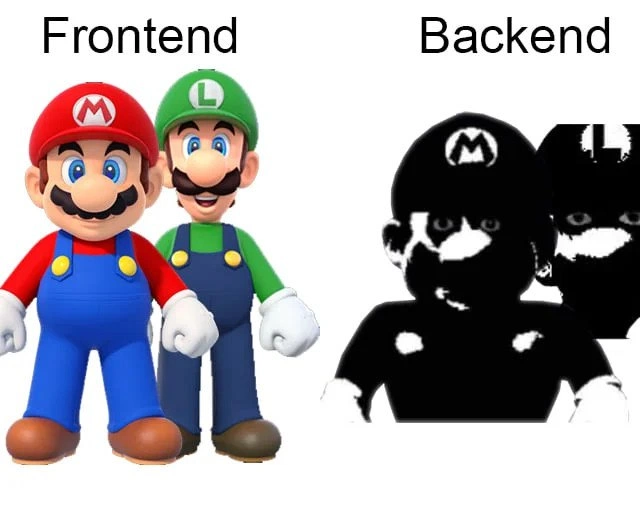
At first glance, this meme captures a classic developer truth: the Frontend of an application is all bright colors and friendly characters (like Mario & Luigi in full color glory), while the Backend is lurking in the shadows, a stark black-and-white silhouette of the same characters. The left side labeled “Frontend” shows Mario and Luigi with every detail intact — vibrant red and green outfits, cheerful expressions — just the way a polished user interface appears to users. On the right side labeled “Backend”, the identical image has been run through a high-contrast threshold filter, stripping away all nuance and color until only crude black shapes and a few white highlights remain. It looks like Mario and Luigi’s ghosts in a debugging console. This extreme contrast is immediately recognizable to developers because it’s exactly how a beautiful UI can mask the raw simplicity (and occasional ugliness) behind the scenes.
In tech terms, the front end is built with tools like HTML, CSS, and modern JavaScript frameworks (think React or Angular) to create pixel-perfect visuals and responsive experiences. It’s all about fine details: aligning Luigi’s mustache just right, picking vibrant color palettes, smoothing out the animation when Mario leaps. The back end, by contrast, is implemented in languages like Python or Java (or even JavaScript on Node.js servers) focusing on data processing, business logic, and server performance – none of which produce any pretty graphics. If you peek into a backend developer’s world, you'll often see plain text configuration files, terminal windows with white log text on a black background, and data in formats like JSON or SQL. In other words, the backend cares about function over form, much like that threshold-filtered Mario & Luigi are recognizable by shape but devoid of colorful detail. The meme cleverly visualizes this dichotomy: the UI layer adds polish and personality (full color image), whereas the server side strips everything down to raw black-and-white essentials (silhouette).
This juxtaposition is funny to anyone who’s built a full-stack app, because we know the glamorous UI is often just the tip of the iceberg. Happily clicking a button on a website (Mario’s big friendly face) might trigger a cascade of server operations (the dark silhouette doing heavy lifting). Users only see the colorful front-end result, not the spaghetti code or gnarly database queries churning in the backend. It’s like building a cheerful castle facade for customers, while behind it there's a bare-bones scaffold held together with duct tape and printf debug statements. Any experienced developer has stories of a gorgeous interface that wowed clients, powered by a back-end hack they’d rather keep in the dark. The meme perfectly captures that front-of-house vs back-of-house divide in software projects — one side is all smiles for the audience, the other is toiling in obscurity to make sure the show goes on.
In many organizations, Frontend Development and Backend Development involve different mindsets and priorities that this image humorously exaggerates. Frontend teams obsess over user experience details — ensuring the UI is accessible, the layout is responsive, every icon pixel-aligned and on-brand. Backend teams, meanwhile, prioritize data integrity, scalability, and reliability — making sure requests get processed correctly, databases stay consistent, and the server doesn’t crash under load. Because of these differing priorities, front-end code tends to be more visual and iterative, going through design tweaks and aesthetic polish, while back-end code can be more utilitarian and permanent, as long as it produces the correct output and performance. The meme’s depiction of Mario & Luigi as featureless shadows on the “Backend” side also implies how the internal workings are invisible to outsiders; only developers recognize those shapes (just like only developers see and understand the backend processes through logs and monitoring tools). Meanwhile, the front-facing part gets all the color, attention, and sometimes even the credit when things go right.
There’s also a wink here about developer culture. The blurred face of Luigi on the front-end half might hint that even in a shiny UI, a lot of identity is hidden (perhaps Luigi represents the unsung backend hero staying anonymous while Mario, the front-facing mascot, gets the spotlight). Or it could just be for comedic effect — like saying “we’ve obscured Luigi to protect the guilty”! Either way, every developer chuckles at this because they’ve lived it. We’ve seen managers or clients gush over how amazing the app looks and feels (Mario’s brightly colored charm winning applause), blissfully unaware that backstage Luigi has been frantically fixing memory leaks and patching server crashes at 2 AM, figuratively working in the dark where his face becomes a blur. The humor hits home: the pretty front-end is propped up by a gritty back-end, and unless you’re a developer, you’d never guess how rough things look behind that curtain. This meme resonates with devs precisely because it exaggerates that hidden reality with a perfect visual metaphor — the two Italian plumbers of game fame, one in full color and one in monochrome, reminding us that for every polished interface out there, there’s a bunch of raw code and hard work in the shadows making it all possible.
This image takes that classic “iceberg analogy” of software (the user-facing part is just the visible tip) and gives it a Mario twist, making the point hilariously clear at a glance. It’s a shared wink among developers, acknowledging that the seemingly magical experiences we create for users are powered by a lot of utilitarian logic under the hood. The front end may be all sunshine and mushrooms 🍄, but the back end is often a dark cavern with only the occasional glowing debug eyes — and that contrast is what makes this meme so instantly relatable and funny.
Description
This is a two-panel meme that humorously contrasts the frontend and backend of a software application using characters from the Mario franchise. The left panel, labeled 'Frontend', shows a crisp, colorful, and friendly image of Mario and Luigi, representing a polished, well-designed user interface. The right panel, labeled 'Backend', shows a distorted, terrifying, high-contrast black and white version of the same characters, with glowing, demonic eyes and shrouded in shadow. The meme visualizes the common reality in software development where the user-facing part of an application (frontend) is clean and presentable, while the server-side logic and infrastructure (backend) that powers it can be a complex, messy, and sometimes frightening tangle of legacy code, quick fixes, and arcane business logic that is hidden from the user
Comments
9Comment deleted
The frontend has a beautiful GraphQL API. The backend is a Perl script that connects to an Oracle database from 1998 via a library that hasn't been updated since the first dot-com bubble burst
Frontend: Mario in full RGB; Backend: same Mario rendered by a 2007 cron chain, three JNI calls, and a legacy charset conversion - no wonder all the color’s been garbage-collected
Frontend devs get praised for adding a loading spinner while backend devs are three incidents deep explaining why the spinner has been spinning for 47 minutes
Frontend developers get all the glory with their pixel-perfect UIs and smooth animations, while backend engineers are down in the trenches wrestling with race conditions, database deadlocks, and legacy code that looks like it was written by a corrupted Mario sprite. The frontend is the Instagram filter; the backend is the 3 AM production incident that filter is hiding
Product wants pixel‑perfect parity; my API returns a 1‑bit mask and trusts the BFF, CDN, and CSS to conjure Mario from JSON
Frontend: pixel-perfect plumbers users applaud. Backend: shadowy pipes where leaks flood prod at 3AM
OpenAPI says mario: boolean; backend returns a binary mask and calls it done - frontend can add the gradients
Uga booga Comment deleted
Uga booga brooga Comment deleted