The Developer's Dilemma: Content vs. Complete Overhaul
Why is this DeveloperProductivity meme funny?
Level 1: Cleaning Instead of Homework
Imagine you have a homework assignment due, something like writing a small essay for class. You sit down to start working on it, but then you think, “Hmm, my desk is a bit messy. I should tidy up first.” So you begin cleaning your desk. Then you decide to rearrange your whole room. Maybe you even convince yourself the walls need repainting! By the end of the day, your room looks great, but you haven’t written a single word of your essay. This meme is funny in the same way: the developer had a simple job (write a new blog post) but found a big distraction that feels productive (rebuilding the whole website). Just like cleaning your room instead of doing homework, rebuilding the site is doing something elaborate to avoid the real task. It makes us laugh because we recognize this behavior in ourselves — doing anything except the one thing we’re actually supposed to do. The developer’s “homework” was the blog post, and their “room cleaning” was completely overhauling the website. It’s silly and relatable: a lot of effort went into the wrong thing, so the original task still isn’t done.
Level 2: Rewriting Instead of Writing
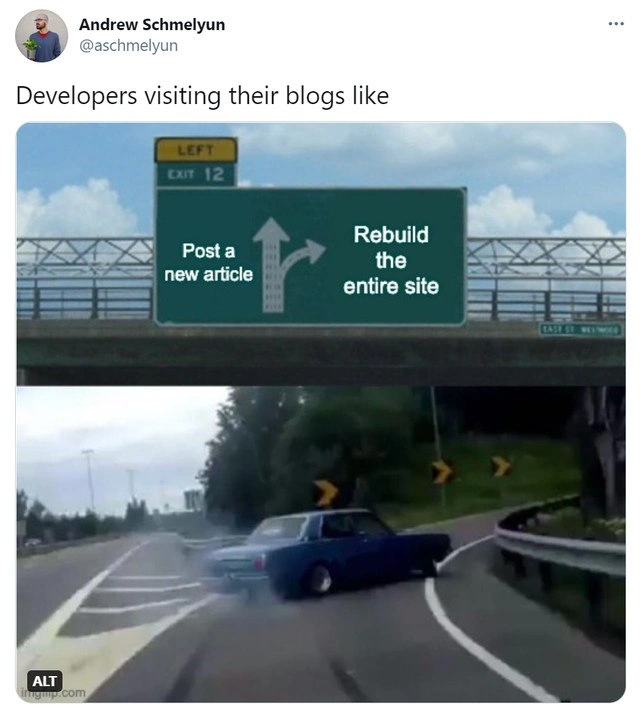
This meme shows a common scenario in the tech community, especially among developers with personal blogs. On the highway sign in the image, the straightforward option is “Post a new article” (keep driving forward), and the tempting exit ramp is “Rebuild the entire site.” The car image below is shown forcefully swerving to take that exit. In simpler terms, the developer should be writing a new blog post, but instead they choose to completely revamp their blog’s website. It’s a humorous exaggeration of how developers sometimes behave when faced with writing content. Rather than doing the relatively small task of writing a post, they get distracted by a much larger task — changing the code, structure, or platform of the whole blog. This is basically a form of procrastination: they avoid the thing they find hard (writing) by doing something else that feels productive (coding).
Let’s break down some key terms and ideas here. CMS stands for Content Management System. A CMS is any software that helps you create and manage content on a website (for example, WordPress is a popular CMS for blogs). In recent years, many developers use static site generators (like Jekyll, Hugo, or Gatsby) as their personal blog engines. These are tools that generate a set of static HTML files from source files (often Markdown and templates). They still count as CMS tools, just more developer-oriented ones. The meme’s text “Rebuild the entire site” suggests the developer is not just tweaking a post, but possibly switching to a new CMS or framework. Maybe they are migrating from one static site generator to another, or doing a full redesign of the site’s theme and layout. This is what we mean by a site rewrite or refactor: changing the underlying system or code of the website without necessarily adding new content. Refactoring generally means improving or reorganizing code while keeping the functionality the same. In this context, “rebuild the entire site” is a kind of extreme refactor (possibly throwing out the old system and starting from scratch on a new one). It’s like deciding to reorganize all your files and folders when you meant to just edit one document.
Why would a developer do this? One reason is the lure of new technology. Developers frequently suffer from “shiny new tool” syndrome. Whenever a new framework or tool becomes popular, it’s tempting to try it out. For instance, if the blog was originally made with Jekyll (a Ruby-based static site generator), the developer might hear about Next.js (a React-based framework) or a cool headless CMS service and suddenly want to rebuild the blog using that. A headless CMS is a back-end content system that doesn’t dictate how the front-end site looks. It just provides content through an API, and developers can use whatever front-end framework they want to display it. Moving to a headless CMS plus a custom front-end is a big undertaking, but developers might justify it as giving them more flexibility or a more modern stack. This ties into developer experience (DX): using a new framework or a different workflow might be more enjoyable or interesting for the developer. They might think, “If I rebuild my site with this new tool, it will be easier or more fun to write posts in the future.” While sometimes that’s true, often it’s just an excuse to code instead of writing text.
The humor of the meme comes from the relatability of this procrastination habit. In the developer community, it’s almost a rite of passage to start a blog and then spend more time messing with the blog’s code than writing actual blog posts. It’s a form of over-engineering: doing a lot of extra technical work for something that doesn’t really need it. A simple blog with a few posts does not need a cutting-edge JavaScript framework or a complex microservices setup. But it’s very tempting for a developer to say, “I’ll add all these fancy features or switch to a cooler framework, then I’ll write more.” In reality, they often get bogged down in the site rebuild and the RefactoringPain of migrating content, fixing broken features, and learning the new system. By the time the site is up and running again, the original motivation to write a post might have faded.
So “developers visiting their blogs like…” (as the tweet says) means that whenever developers go to their own blog with the intention to write, they end up doing something else. The highway_exit_sign_meme format perfectly illustrates it: the normal path is to just use the blog for its intended purpose (posting an article), but the developer can’t resist the detour to tinker with the site itself. It’s funny to anyone who’s tried to maintain a personal site or blog, because this scenario happens a lot. Instead of creating new content, the developer updates the design, switches from one JavaScript framework to another, or restructures the whole project. It’s a mix of procrastination and love for coding. Essentially, the developer is rebuilding the entire site instead of doing the one thing they set out to do (writing the article). The meme captures this irony in one quick visual joke, and it’s labeled DeveloperMemes and DeveloperHumor because you’d probably need to have experienced this or worked with developers to immediately get why it’s so true and funny.
Level 3: The Overengineering Off-Ramp
In this meme, a developer approaches the simple task of updating their blog with a new post, yet violently swerves off-course into a full site rebuild. The image is the highway exit ramp meme, a classic format in online humor: the straight path is labeled “Post a new article,” but the car drifts through smoke onto the exit labeled “Rebuild the entire site.” It’s an absurdly over-the-top depiction of a choice every seasoned engineer recognizes. Instead of taking the straightforward route (just write the content), the developer’s brain impulsively yanks the wheel toward a massive refactoring project. This resonates as Developer Humor because it satirizes a real temptation in our field — procrastinating on actual output by indulging in shiny technical work.
Behind the laughter is a truth about developer psychology and Developer Experience (DX) priorities. Writing a blog post (the intended task) exercises communication and creative effort, which can feel daunting or “slow.” In contrast, rebuilding the blog’s infrastructure scratches that engineering itch: it’s tangible, technical, and gives an immediate sense of progress (even if it’s a form of productive procrastination). Many developers genuinely enjoy tweaking their tools and frameworks. Updating a codebase or switching to a new framework provides instant gratification — new libraries to play with, new build scripts to tune, perhaps a chance to finally implement that perfect dark mode or a fancy CI/CD pipeline for the blog. In the meme, the “Rebuild the entire site” option represents that seductive allure of over-engineering a personal project under the guise of improvement. The humor comes from the overengineering off-ramp being so extreme: the car is practically burning rubber to take that exit, implying the decision wasn’t even slow or reluctant. It’s a knee-jerk impulse for many of us in tech.
This pattern is procrastination via rewrite. Instead of writing one new article, the developer might say, “Well, the site’s tech is outdated… maybe I should upgrade from Jekyll to Gatsby or from Gatsby to Next.js first. Oh, and perhaps move to a headless CMS for flexibility!” Hours or weeks later, they’ve built a brand new site architecture (again), but produced zero new content. It’s a running joke in blogging circles: a dev’s blog often has one “Hello World” post and a dozen posts about migrating the blog to different technologies. The framework fatigue is real — ironically self-inflicted by chasing each “latest and greatest” tool for a blog that might have only a handful of readers. We laugh (and wince) because we’ve been that developer in the blue sedan, convinced that a new static site generator or an overhaul of the CSS will magically inspire us to write more. Spoiler: it usually doesn’t.
From an experienced engineer’s perspective, the meme nails a common anti-pattern: over-engineering a CMS for trivial gains while important work languishes. The categories of CMS and Refactoring are front and center here. Personal blogs are often built with static site generators or lightweight CMS platforms that are already perfectly capable of letting you “just write.” Yet the developer veers into a complex rebuild, perhaps switching to a completely different tech stack (e.g., moving from a WordPress CMS to a headless CMS plus a custom frontend). It’s like killing a fly with a bazooka – technically impressive, but overkill for the problem at hand. The Refactoring Pain comes later: big rewrites have consequences. What started as “I’ll modernize my blog’s backend” can spiral into days of porting content, fixing build errors, adjusting themes, and broken plugins – all of which delay the actual goal of publishing an article. The meme’s humor acknowledges this painful irony: we developers often create our own Yak Shaving traps (performing a chain of related tasks that were not originally needed) and then jokingly complain that we never have time to write!
Ultimately, this meme lands so well because it’s a Developer Meme reflecting a shared experience. The DeveloperExperience_DX angle is that we optimize for our own enjoyment (retooling the blog) at the expense of the end result (new content for readers). We can’t resist the exit ramp to Overengineering-ville. And it’s not just personal blogs – the impulse strikes in professional projects too (“Before adding this feature, how about we rewrite the entire codebase in a new language?”). The difference is, on a personal blog, no project manager is there to stop you from chasing that rabbit. So the next time you see a dev’s blog with an announcement of a “Site relaunch” but no actual new posts, you’ll know exactly why – they took the rebuild exit at full speed, just as this meme hilariously illustrates.
def write_new_article(content):
# Intended functionality: add new blog post
raise NotImplementedError("Decided to rebuild the site instead.") # 😂
Description
This image is a popular meme format known as the 'Freeway Exit' or 'Drifting Car', presented as a screenshot of a tweet by Andrew Schmelyun with the caption 'Developers visiting their blogs like'. The top panel shows a green highway sign with two options: going straight is labeled 'Post a new article', while the sharp, swerving exit is labeled 'Rebuild the entire site'. The bottom panel shows a blue car dramatically drifting and smoking its tires to take that exit. The meme perfectly encapsulates a common form of developer procrastination or 'yak shaving'. Instead of performing the simple, content-focused task, developers are often tempted by the more complex and technically engaging challenge of re-engineering their entire personal site with a new framework, language, or architecture. This highlights the tendency for developers to treat personal projects as playgrounds for new tech rather than focusing on their original purpose

Comments
8Comment deleted
My blog has had five different static site generators, a perfect 100 on Lighthouse, and two draft posts from 2019
“Wanted to publish a 500-word post - so naturally I migrated Jekyll → Gatsby → Next → Astro, containerized the build, and left the actual article as the closing comment in the Helm chart.”
After 15 years in the industry, I've rebuilt my blog seven times across five different static site generators, implemented three custom CMS solutions, and written exactly two posts - one about choosing a blogging platform and another about why I'm switching platforms again
Every senior engineer knows the real reason their blog hasn't been updated in 18 months isn't writer's block - it's because they're still deciding between Next.js, Astro, or writing their own static site generator in Rust. After all, why spend 2 hours writing an article when you can spend 200 hours achieving the perfect Lighthouse score on a site with three posts?
Static sites: where incremental builds are a myth and every post commit triggers a full-spectrum rebuild ritual for that pure dev masochism
Went to write a post; took the exit into a full migration - Jekyll→Astro, SSG vs SSR vs ISR, new CI/CD - and shipped one page: “Why I rebuilt the site (again)”
My publishing cadence is 0 posts/year, but I’ve migrated Jekyll→Hugo→Gatsby→Next→Astro with 100 Lighthouse scores - nothing renders faster than no content
😂😂😂 Comment deleted