Skip to content
DevMeme
1538 of 7435
Choosing Your Frontend Weapon: The Allure of the Old Guard
Frameworks Post #1719, on Jun 17, 2020 in TG

Choosing Your Frontend Weapon: The Allure of the Old Guard

Why is this Frameworks meme funny?

Level 1: The Old Teddy Bear

Imagine you walk into a big toy chest filled with all the newest, coolest toys that light up and make sounds. Your friend picks up a shiny electronic sword with flashing lights and goes, “Wow, look at this! There are so many awesome toys here. Which one are you going to play with?” Now, instead of grabbing one of the fancy new toys, you quietly reach for your old teddy bear that you’ve had forever. You hold your teddy bear tight and say, “I’ll play with this.” Your friend looks at you, looks at all the crazy new toys, and then nods with a smile and says, “Nice.”

It’s funny because everyone expects you to choose something big and flashy from the pile of new toys, but you chose the comfy old toy you love. The joke is that sometimes the thing that makes you feel safe and happy (like your favorite teddy bear) is better than all the sparkly new gadgets around. In other words, trying every new fancy toy can be exciting, but in the end, there’s nothing wrong with sticking to the simple, familiar one that you know always works for you.

Level 2: Old Reliable vs New Hotness

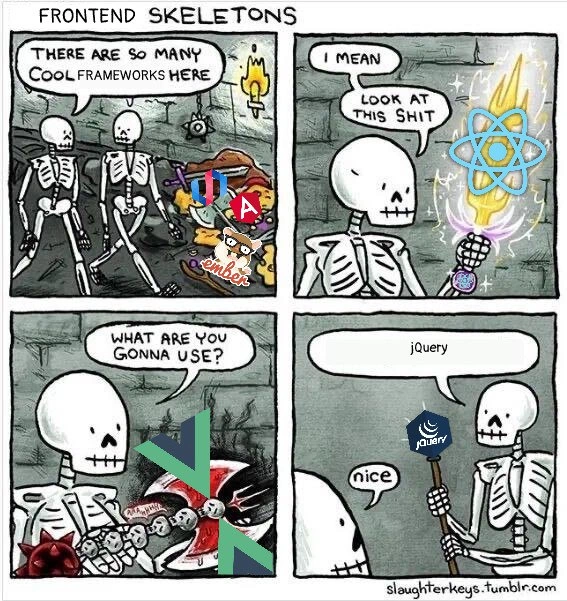
On the surface, this comic is showing a classic scenario of framework overload in frontend development, but in a funny, medieval dungeon style. The two skeleton characters represent developers exploring a trove of Frontend weapons (tools) at their disposal. The dialogue "There are so many cool frameworks here" sets the scene: the skeletons have stumbled on a cache of modern JavaScript frameworks, each represented by a different weapon with a logo. These logos correspond to actual front-end technologies:

  • Angular – Represented by the red shield logo in the pile. Angular is a comprehensive front-end framework maintained by Google. It lets you build large web applications using TypeScript and a powerful MVC-like structure. Think of Angular as a heavy sword or armor: it’s robust and comes with everything (routing, forms, HTTP client) built-in, but it can be heavy to carry (i.e., it has a steep learning curve and lots of setup).
  • Svelte – Shown as an orange spiral logo among the loot. Svelte is a newer JavaScript framework (or technically, a compiler) that compiles your UI components into efficient vanilla JS. It’s like a magically light blade that promises high performance because most of the work is done ahead of time. Svelte was gaining popularity around 2020 for producing very small and fast web apps with less runtime overhead.
  • Ember – Marked by the Ember.js mascot goggles in the pile. Ember is an older framework that was very popular around 2015. It uses the convention-over-configuration approach, meaning it has a lot of built-in decisions made for you. You can imagine Ember as a well-crafted mace that has specific techniques to swing it effectively; once you learn the Ember way, you can be very productive. Ember’s logo (often a cute mascot with goggles) being tossed in the pile suggests it’s one of those once-cool frameworks that fewer people choose today, but it’s still respected for certain uses.
  • React – The skeleton in the second panel is holding a flaming sword with React’s blue atom logo on the hilt. React (by Facebook) is a hugely popular JavaScript library for building user interfaces. It’s depicted as a flaming sword because it’s hot and powerful. React introduced the idea of building UIs with components and efficiently updating the DOM using a virtual DOM. In real life, many developers learn React as a first framework now because it’s so widely used. It’s not a full framework (it doesn’t dictate all aspects of your app), but it’s often the core around which other libraries are added (routing, state management, etc.).
  • Vue.js – In the third panel, one skeleton is readying a spiked mace with Vue’s green-blue "V" logo on it. Vue.js is another very popular front-end framework that is often praised for being approachable and flexible. Vue’s mace imagery in the comic suggests it’s a strong tool, perhaps a bit easier to wield than some others (many find Vue easier to pick up than Angular, for instance). Vue allows you to build components and reactive interfaces in a progressive way – you can start by adding a little to an existing page or go all-in for a full single-page app.

And then there’s the star of the joke: jQuery – symbolized by the small club with jQuery’s swirl logo, held by the skeleton in the final panel. jQuery is not a framework but a fast, lightweight library that was introduced back in 2006 to make JavaScript easier to use on websites. It became incredibly popular because it simplified many common tasks:

  • Selecting elements on a webpage (e.g., $('.my-button') finds all elements with class "my-button"),
  • Handling events (like clicks or form submissions),
  • Making AJAX requests (fetching data in the background),
  • Animating elements (fading, sliding, etc.),
  • And solving browser compatibility issues (in the 2000s, different browsers behaved inconsistently; jQuery smooths those quirks out).

In the late 2000s and early 2010s, jQuery was essentially everywhere – almost every website included jquery.min.js because it was the de-facto standard tool. It earned a reputation as a trusted, battle-tested helper. That’s why in the comic it’s portrayed as a modest club: unassuming and old-school, but reliable. By 2020, however, the rise of modern frameworks (like the ones above) meant that jQuery was no longer the shiny new tool. Many developers moved on to using frameworks for building complex apps, and jQuery became a symbol of an older approach to web development (simpler, but less structured).

Now, in the comic’s story, one skeleton excitedly shows off React (flaming sword) and Vue (mace), and asks his friend which weapon they’ll choose from this arsenal of modern frameworks. This mirrors real life, where a developer might ask, “What are we going to build this project with? React? Angular? Maybe try that new Svelte thing?” The expectation is usually that you’ll pick one of those shiny new frameworks. But the other skeleton just says, “jQuery,” holding up that tiny club. It’s an unexpected answer, almost retro. However, it gets an immediate “nice” from his friend. This implies that, despite all the hype around the cutting-edge tools, there’s an understanding that sometimes the old, simple solution is actually a smart choice.

To understand the humor, let’s compare modern frameworks vs. jQuery in practical terms:

Modern Frameworks (React, Vue, Angular, etc.) jQuery (Old Reliable Library)
Designed for building full single-page applications or complex interactive UIs from the ground up. They often handle everything: rendering, state management, routing, etc. Designed for sprinkling interactivity onto existing pages. It mostly focuses on one thing: making DOM scripting easier (finding elements, events, AJAX).
Typically involves a structured approach with components or modules. For example, you don’t directly manipulate the page; you write component classes or templates and let the framework update the DOM. Involves direct DOM manipulation. You select an element and do something with it (e.g., $("#menu").hide() to hide an element with id "menu"). You are directly scripting what happens on the page.
Often requires a build process and tooling. For instance, using React or Angular usually means setting up a project with Node.js, bundlers like webpack or Vite, and transpilers (for JSX or TypeScript). There’s an initial time investment before you see “Hello World”. No build tools needed. You can just include a <script> tag linking to the jQuery library (from a CDN or your own file) and write a small script in a <script> tag. You can add it to an existing page in minutes.
Steeper learning curve. Each framework has its own concepts/syntax (like React’s JSX and hooks, Angular’s decorators and modules, Vue’s directives). You have to learn the framework’s way of thinking about apps. Very shallow learning curve to start. If you know basic JavaScript and a little bit of CSS selectors, you can do a lot with jQuery quickly. For example, knowing that $(".button") selects elements with class "button" is enough to then do $(".button").click(() => {/*...*/}) and attach a click handler.
Great for large, complex projects where maintainability and scalability are concerns. The framework gives structure and helps organize code for big teams/apps. (E.g., building a dynamic dashboard or a multi-view app is easier to manage in React/Angular/Vue than with just jQuery.) Great for small-to-medium functionality needs, or augmenting a server-rendered site. If you just need a pop-up here, a carousel there, or to submit a form via AJAX, jQuery is often the simplest solution. It’s also handy in legacy projects that aren’t using modern frameworks.

From the table, you can see it’s not that jQuery is “better” than frameworks in general — it’s that jQuery is simpler and requires less setup, which can be an advantage for certain cases. The meme zeroes in on that idea: when you’re overwhelmed by fancy options, the quick and simple fix can be very appealing.

For a junior developer (or anyone new to the frontend world), this joke carries a couple of lessons and experiences:

  • So many choices! The first skeleton’s reaction, “so many cool frameworks,” might mirror how you felt the first time you peeked into modern frontend development. It’s exciting and a bit intimidating — there’s React, which everyone talks about, then Angular, then Vue, and oh wait there’s also Svelte, and Ember, and others like Next.js, Nuxt, Redux (not a framework but another tool), etc. It’s like being a kid in a candy store but also feeling like you can’t possibly taste all the candies. This can lead to something people call JavaScript fatigue (or FrameworkFatigue): the feeling of being tired or overwhelmed by the rapid pace of new tools in the JavaScript ecosystem. Don’t worry, every new developer goes through this; it’s a known FrontendPainPoint trying to decide what to focus on.
  • Old vs New. The second skeleton’s choice of jQuery might surprise someone just learning web development today. You might have heard, “jQuery is old, nobody uses it anymore,” especially with so many newer frameworks around. But in reality, a ton of websites still use jQuery, and it’s a very practical tool for certain jobs. If you’ve ever used a bit of jQuery in a small project or to tweak a webpage, you know it gives immediate results. Many of us who started with jQuery remember how satisfying it was to make something slide or fade on the screen with just a couple of lines of code. It feels straightforward. In contrast, if you jump straight into a big framework like React, your first day might be spent just setting up the project structure or figuring out where to write the code to make something happen. So there’s a certain instant gratification with a simple approach like jQuery that new developers can appreciate once they try it.
  • When simple is enough. A key takeaway from this scenario is that you should use the right tool for the job. A common early-career experience is to learn a shiny framework and then want to use it for everything (because it’s cool and you’ve invested effort learning it). But as you gain experience, you encounter cases where a heavyweight solution is not necessary. For example, imagine you just need to add a little interactive behavior to an otherwise static HTML page – you could spin up an entire React app for it, or you might just write a few lines of jQuery inside a <script> tag. Often, the latter is much faster and perfectly fine. Seasoned developers have seen projects where over-engineering caused more problems than it solved. So the joke is highlighting that wisdom: don’t use a flamethrower to light a candle. In other words, not every problem requires the most powerful, complex solution; sometimes a simple script (or a tiny club 😄) is best.
  • Respect for the classics. The friend saying “nice” in response to jQuery shows a sort of respect. Even though jQuery is old-school, it’s being treated as a valid choice. This reflects a real-world sentiment: while we love innovating with new frameworks, experienced devs won’t ridicule using jQuery in the right context. In fact, knowing when to use a small library versus a big framework is seen as good judgment. As a newcomer, you might observe seniors occasionally opting for an older, well-known technology because they know it will work without fuss. It’s a bit counter-intuitive (why not use the newer thing?), but it teaches you that “new” doesn’t automatically mean “better for every case.” There’s value in reliability and familiarity.

In summary, this meme is an inside joke about framework churn in the web development world. It uses the fun imagery of skeleton warriors and glowing weapons to make it memorable. But underneath, it’s communicating: “We have a ton of tools to choose from in frontend development — sometimes it’s too many — and ironically, once you’ve been through the hype cycles, you occasionally just stick to the basics that you know work.” If you’re just starting out, know that it’s okay to feel overwhelmed by the options, and it’s okay to use something simple if it gets the job done. Even the pros do it, as the skeletons illustrate. And that “nice” at the end? That’s everyone collectively acknowledging that a pragmatic choice often deserves a thumbs-up. 👍

Level 3: Framework Fatigue Fallout

In the top panels of this skeleton_comic, two bony adventurers (representing seasoned frontend developers who have been around the block) stumble upon a dungeon room littered with the remnants of shiny JavaScript frameworks. One skeleton marvels, "There are so many cool frameworks here," as they gaze at a glowing pile of discarded weapons adorned with familiar tech logos. In that heap lie the symbols of front-end hype: the red shield of Angular, Svelte’s orange swirl, Ember’s goofy goggles, and more — basically a framework_overload treasure pile. The other skeleton holds up a flaming sword with the React atom logo on its hilt, exclaiming in awe, "I mean, look at this sh!t!" (Pardon our French, but that’s the direct quote from the meme.) This scene sets the stage by parodying the IndustryTrends_Hype cycle in web development: an endless parade of new, cool tools, each one promised to be more awesome than the last. The flaming sword of React, glowing bright, epitomizes the hottest framework-of-the-moment that every developer is tempted to grab because, well, everyone says it’s amazing.

But here’s where the meme gets delightfully cynical. In the third panel, a skeleton hefts a spiked mace emblazoned with the green Vue.js logo and asks his comrade, "What are you gonna use?" — expecting to hear the name of some equally flashy weapon/framework from the pile. It’s the classic peer pressure many devs feel: Which shiny new framework are you picking for this quest/project? The punchline lands in the final panel. The second skeleton, utterly unfazed by all that glitter, calmly answers: "jQuery." He’s holding the tiniest weapon of all: a little wooden club stamped with jQuery’s blue swirl logo. The first skeleton pauses, then simply responds, "nice." – as casual and sincere as one skeleton can be. No arguments, no “Wait, what? Not React?” — just an immediate nod of respect.

Why is this so humorous to a programmer audience? It’s poking fun at framework churn and our collective FrameworkFatigue. In real-world terms, front-end devs constantly face an overload of choices. Today it’s React, Angular, VueJS; yesterday it was Ember or Backbone; tomorrow it might be Svelte or some new hotness that’s “just a compile step and a proxy away from magic.” We’ve all seen the cycle: shiny new tools get picked up enthusiastically (like grabbing that flaming sword), tech blogs sing their praises, teams start migrating to them — only to discard some of these tools later (AngularJS to Angular, anyone?) when an even cooler approach comes along. This meme compresses that whole saga into a simple dungeon gag. The pile of abandoned weapons is the graveyard of past JavaScript frameworks and libraries that were once frontpage news on Hacker News but eventually ended up as yesterday’s news (or your project’s legacy code). The skeletons, being undead and all, have literally outlived these tools. It’s a darkly funny metaphor for how senior engineers have survived countless fads and “revolutions” in web development.

Now, why jQuery of all things? For context, jQuery is a much older JavaScript library (released in 2006) that once dominated the web. It’s ancient in internet years, practically a relic from the jolly days of IE6 hacks and CSS float clears. These days, jQuery isn’t shiny – in fact, many consider it outdated in the era of component frameworks – but it is trusty. It’s the battle-worn club that just won’t break. The veteran dev (our skeleton hero) chooses the familiar weapon he’s wielded since back when AJAX was mind-blowing and $() was the coolest thing in town. There’s a jquery_loyalty aspect here: despite the buzz around modern frameworks, some experienced developers remain loyal to jQuery for certain tasks because they know it inside-out. It might not be glamorous, but it’s reliable. As the saying goes, “if it ain’t broke, don’t fix it.” By answering “jQuery,” the skeleton is basically saying, “I’ll stick with the simple tool that I know will get the job done” — and his fellow skeleton acknowledges this with that approving “nice.” It’s the kind of quiet, knowing respect you only get after you’ve fought through a dozen framework migrations together.

This FrontendHumor hits home because it reflects a common scenario in development teams. Imagine a sprint planning meeting: the team is excited about rewriting a feature with the latest fancy framework du jour. One enthusiastic dev is waving around the React sword, another is brandishing the Vue mace, raving about performance or two-way binding or whatever the NewThing™ offers. Then the senior engineer, who has seen one too many framework rewrites go south, just clears his throat and says, “How about we just use jQuery for this?” A moment of silence — then a collective sigh of relief or a chuckle, and everyone gets back to work using the straightforward approach. This comic distills that moment. It’s too real: the unspoken developer trauma of chasing new tech and the guilty pleasure of sometimes reverting to a simpler solution. The term FrameworkFatigue exists because constantly relearning how to do basic things (like forms or modals) every year is exhausting. The skeletons, basically developers who died of exhaustion, symbolize that exhaustion in an exaggerated way. (Heck, maybe they turned into skeletons waiting for npm install to finish or for a massive webpack build to compile — we joke, but only kinda.)

Technically speaking, there’s a contrast in development philosophy being joked about. Modern frameworks (React, Angular, Vue, etc.) encourage building rich, single-page applications with structured, maintainable code. They come with lots of abstraction: virtual DOMs, component hierarchies, state management, CLI tools. They are the flashy swords and maces – powerful, but heavy. They require skill and practice to wield properly (try swinging a flaming sword without training and you’ll burn your hand, figuratively). On the other hand, jQuery is a lightweight DOM manipulation library – the wooden club – extremely straightforward to use for quick tasks: you just include it and whack away at the DOM with a few $() calls. It doesn’t demand a build step or a deep architectural plan for small uses. There’s an old-school charm in that simplicity. Sure, you wouldn’t build a massive modern app solely with jQuery anymore (just like you wouldn’t fight a dragon with a tiny club if you had a sword), but for smaller foes (like a simple slideshow, a form validation, or a one-page widget), jQuery is often good enough and far faster to implement. The meme exaggerates this choice to comic effect: in a room of overkill options, the simplest tool wins by practicality.

Finally, that single word “nice” in the last panel is the cherry on top. It’s delivered deadpan, but it carries a ton of context. It implies that the first skeleton, despite drooling over React’s flaming sword moments ago, completely understands and respects the jQuery choice. It’s almost an admission: “Touché, you’re keeping it simple. I can’t argue with that.” There’s a camaraderie in that moment — a shared wisdom among elders of the craft. It’s funny because it’s true: all the hype in the world can’t beat the satisfaction of using a tool that simply works, especially if you’ve been burned by a flashy new one before. The meme resonates with developers who’ve been through the framework wars. After you’ve spent nights chasing weird bug regressions in an overly-engineered stack, the idea of just sprinkling a little jQuery on a page (like we did in the “old days”) sounds almost liberating. The comic winks at us: sometimes the bare bones solution (pun intended) is the smartest move of all.

Description

A four-panel comic titled 'FRONTEND SKELETONS' based on an original by slaughterkeys.tumblr.com. In the first panel, two skeletons are in a dungeon-like room filled with discarded developer tools. One skeleton says, 'THERE ARE SO MANY COOL FRAMEWORKS HERE', pointing to a pile of logos including Vue.js, Angular, and Ember.js. In the second panel, a skeleton holds up a glowing magical staff topped with the React logo, saying, 'I MEAN LOOK AT THIS SHIT'. The third panel shows the other skeleton, who is examining a brutal-looking axe adorned with the Vue.js logo, asking, 'WHAT ARE YOU GONNA USE?'. In the final panel, the first skeleton has discarded the flashy frameworks and is now holding a simple wooden staff with the jQuery logo, simply stating 'jQuery'. The other skeleton replies, 'nice'. The meme humorously portrays the overwhelming number of modern JavaScript frameworks and the occasional developer's choice to stick with an older, simpler, but still effective tool like jQuery, despite it being considered outdated by many
Comments

7
Anonymous ★ Top Pick Modern frameworks are like magical swords, powerful but complex. jQuery is the trusty club you grab when you just need to bonk a div on the head and don't feel like reading a 200-page grimoire on state management first
  1. Anonymous ★ Top Pick

    Modern frameworks are like magical swords, powerful but complex. jQuery is the trusty club you grab when you just need to bonk a div on the head and don't feel like reading a 200-page grimoire on state management first

  2. Anonymous

    We keep React for conference slides, Vue for hack‐day demos, Angular for HR’s keyword scanner - then quietly ship the release with that 30 kB jQuery club we’ve been tanking with since 2006

  3. Anonymous

    After 15 years of watching frameworks rise and fall like empires, you realize jQuery is the COBOL of frontend - everyone jokes about it being dead, yet half the internet still runs on `$(document).ready()` and nobody wants to touch those legacy migrations

  4. Anonymous

    After surviving the Great Framework Wars of 2015-2024, watching React hooks replace class components, Angular rewrite itself three times, and Vue become the 'progressive' compromise, some senior engineers have achieved enlightenment: sometimes the real modern framework was the jQuery we kept in production all along. Sure, it doesn't have virtual DOM diffing or reactive state management, but it also doesn't require 47 webpack plugins and a PhD in functional programming to center a div

  5. Anonymous

    Frontend skeletons approve: jQuery - no build step, just ship it and watch it outlive the next ten meta-frameworks

  6. Anonymous

    React’s torch is shiny, but the dungeon is a 2013 SharePoint with IE mode and “no npm deps” - so the architecture decision is jQuery, a.k.a. actually shipping

  7. Anonymous

    Twenty pages of ADRs on concurrent mode, signals, and islands later, the production fix was a 12-line jQuery snippet

Use J and K for navigation