The Great 'nodemon' Pronunciation Debate
Why is this DevCommunities meme funny?
Level 1: Tomato, Tomahto
Imagine you and your friends discover a new funny word in your favorite game or cartoon, and none of you have heard anyone say it out loud before. The word is “Nodemon.” One friend thinks it’s pronounced like “Node-mon,” another is absolutely sure it’s “No-demon,” and a third friend giggles and says it in a silly way, kind of like how you’d say “Pokémon” (with a dramatic flair: “No-day-mon!”). Now you all start laughing because you’re arguing over a make-believe word! In the end, you realize you’re all talking about the exact same thing – you just say it a bit differently. That’s the whole joke here: a bunch of grown-up programmers are having the same kind of playful argument about how to say the name of a tool they use. It’s funny to them for the same reason it’s funny when friends disagree on how to say a character’s name – it’s a silly, light-hearted debate where no one is really wrong, and everyone gets to laugh about it.
Level 2: What's in a Name?
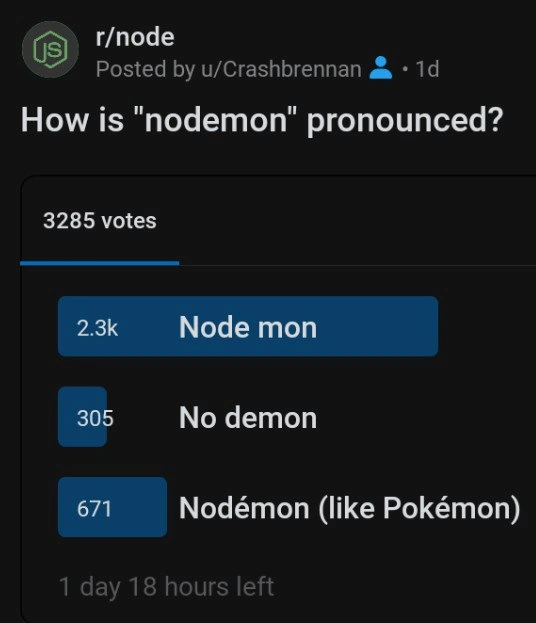
The image is a dark-mode screenshot of a Reddit poll in the r/node community (a forum for Node.js developers). The poll asks a seemingly simple question: “How is nodemon pronounced?” This caught a lot of attention – over 3,285 developers voted on it! The meme highlights how even a small thing like a name can spark curiosity and humor among programmers. Let’s break down what’s going on and why it’s funny to devs:
What is Node.js and nodemon?
- NodeJS is a popular runtime environment that allows developers to run JavaScript outside of a web browser (for example, on a server). It’s the backbone of many web servers and developer tools in the JavaScript world.
- CLI Tools: Node.js has many command-line interface (CLI) tools – these are programs you run in a text terminal (like typing commands into your console). CLI tools help developers automate tasks or run servers. For instance, you might open your terminal and run a command like
node server.jsto start a Node server. nodemonis one of those CLI tools, widely used to improve the development workflow. When you usenodemonto start your Node.js app (for example:$ nodemon app.js), it will automatically watch your project files. If you edit and save a file, nodemon will detect the change and restart your Node app for you. This is super convenient – it means developers don’t have to constantly stop and restart the server manually every time they make a change. Because of this usefulness,nodemonis considered a “beloved” dev tool in the Node/JavaScript community. It makes coding and testing easier, which is a big part of good Developer Experience (DX). (Good DX means the tools we use are easy, smooth, and maybe even enjoyable.nodemondefinitely scores points there by saving time and effort.)
Why the pronunciation debate?
The name “nodemon” is a bit quirky. It’s all lowercase and smashed together, as many CLI tool names are. Developers often encounter names like this in text – in documentation or installation commands – without anyone saying them out loud. Over time, people came up with their own ways to pronounce it. The poll shows three popular interpretations:
“Node mon” – pronounced as node-mon (like two separate words run together). This treats the name as Node + mon, possibly short for Node Monitor. It makes sense because nodemon is essentially monitoring your Node app. Most voters chose this option, suggesting that a lot of developers naturally read it this way. For example, a dev might say, “Run
nodemon(node-mon) to keep an eye on your server while you edit the code.”“No demon” – pronounced as no-demon (as if you’re saying “no” and then the word “demon”). This one is interesting because it reads the name as no + demon. Why would a tool be called “no demon”? This could be a play on the word daemon. In computing, a daemon (pronounced the same as “demon”) is a background process that runs without direct user interaction (for instance, a server service that’s always running could be called a daemon). Some people might have thought nodemon’s name was referencing a “Node daemon” or something like that. Without the letter “a”, you get “no demon.” It’s a bit of a stretch, but some developers did interpret it this way. So, a person in this camp might say, “I always read
nodemonas ‘no-demon’ – like no demons in my code!” It’s a more playful or literal reading of the letters.“Nodémon (like Pokémon)” – pronounced somewhat like no-DAY-mon, mimicking the way we say Pokémon. This option adds a fictional accent on the “e” (spelling it Nodémon to emphasize the similarity). It’s not an official or serious pronunciation; it’s more of a fun, community-driven idea. The fact that 671 people voted for it shows that developers enjoy a good joke. They’re basically saying, “Hey, wouldn’t it be fun if we pronounced it fancy, like a Pokémon name?” If you’ve heard how people say “Pokémon” (poh-kay-mon), you can imagine them calling this tool “noh-DAY-mon” just for giggles. No one expects you to actually use this in a formal setting – it’s an inside joke for those who saw the poll.
Where did this poll come from?
It was posted on Reddit’s Node.js forum (r/node). Reddit recently introduced a poll feature, and user u/Crashbrennan decided to poll fellow developers about this pronunciation. The fact it accumulated thousands of votes in ~1 day means nodemon is widely used – and that many people never realized others might say it differently! The poll still had “1 day 18 hours left” when the screenshot was taken, so even more votes could have rolled in. This indicates how engaging (and amusing) the topic is to the community. It’s not a critical problem, but it’s something almost everyone in Node land has an opinion on once it’s brought up.
Developer Experience (DX) and NamingThings:
So why does this trivial question matter at all? It comes down to communication and the humor in shared experiences. In software development, there’s a saying that naming things is one of the hardest parts of the job. That’s tagged as NamingThings in the meme description because it’s a well-known pain point and joke. Good names need to be short, meaningful, and not easily confused with something else. With open-source tools (like nodemon), developers often pick clever or catchy names, and sometimes those names aren’t perfectly clear to new users. This can lead to situations where two developers are talking about the same tool but pronounce it differently without realizing it at first. It’s a minor hiccup in DX – imagine a junior dev reading online about nodemon and then asking a question in person: “I installed no-demon but it’s not working,” and the senior dev pauses, “No-demon?... oh! You mean node-mon (nodemon). Got it!” They share a laugh and carry on.
Thankfully, debates like these are all in good fun. It’s a form of DeveloperHumor. Nobody’s productivity is truly harmed by the pronunciation of “nodemon,” but embracing these little debates is part of developer culture. It’s similar to how people joke about whether it’s “GIF” or “JIF” for the image format, or whether to pronounce SQL as “sequel.” These discussions can be surprisingly passionate, yet they create a sense of community – we’re all nerding out about the same quirky stuff. In the end, polls like this Reddit one serve as a light-hearted way for developers to bond over a shared experience: the moment of “Huh, I’ve been saying it this way. How about you?” And who knows – if enough people see the poll, we might actually converge on a common way to say nodemon (it looks like node-mon is winning!). But if not, that’s okay too. As long as our code runs, we can call our tools whatever rolls off the tongue. 😃
Level 3: Pronunciation Pandemonium
"There are only two hard things in Computer Science: cache invalidation and naming things."
In the NodeJS ecosystem, we’ve apparently added a third hard thing: pronouncing those names! The meme shows a Reddit poll where thousands of developers are debating how to say nodemon – the beloved Node.js CLI tool that auto-restarts your app on file changes. It’s a tongue-in-cheek snapshot of developer experience (DX) quirks: a simple naming question spirals into a community-wide discussion.
At first glance, nodemon looks straightforward, but the poll reveals three distinct camps:
"Node mon" – The runaway favorite with ~2.3k votes. Most seasoned devs read it as Node-mon, essentially treating the name as two words. This interpretation hints at Node Monitor, describing exactly what the tool does. It feels logical: Node + mon(itor) = a monitor for Node. When spoken aloud, it’s like saying “node” and “mon” separately. For many, this pronunciation just clicks – it’s simple and it matches the tool’s purpose.
"No demon" – A smaller group (~305 votes) insists on No-demon (yes, like “no demon here!”). Why on earth would anyone call a Node tool a demon? Here’s the nerdy context: in Unix lore, a background process is called a daemon (pronounced dee-mon, basically “demon”). If you squint, nodemon contains the word demon (
nodeMON👉no DEMON). Some developers likely thought the name was a playful nod to a “Node daemon” running in the background. So they pronounce it like the phrase “no demon.” It’s a bit of a stretch, but it shows how we reverse-engineer meaning from odd names. (Ironically, calling a tool No Demon makes it sound like it banishes evil spirits from your app – not the intent, but tech folks love a good pun.)"Nodémon" (like Pokémon) – The funniest camp (~671 votes) adds a faux-French twist: No-day-mon. The poll literally says “like Pokémon,” accent on the ‘é’ and all. This doesn’t come from any official meaning – it’s pure community humor. JavaScript devs often have a goofy streak, and here they’re basically saying, “Why not make
nodemonsound like a Poké-creature?” It’s a tongue-in-cheek option that caught on. You can picture a developer half-jokingly exclaiming, “Nodémon, I choose you!” when their app auto-restarts. While few would earnestly use this pronunciation in a meeting, it shows how developer humor turns a dull debate into a fun reference.
So why is this poll so hilariously relatable? For one, it highlights that much of our communication in tech happens via text (chat, docs, code reviews). We see tool names written out long before we ever say them. By the time you have to mention nodemon in a conversation, you’ve silently read it a hundred times and probably formed your own idea of how it sounds. Discovering a teammate says it differently can be a record-scratch moment: “Wait, have I been saying it wrong?” or “Is that what you’ve been talking about all this time?” It’s the same collective realization that led to this poll. Each option in the poll is basically a different subgroup of the community going, “Well I thought it was pronounced this way…”
This scenario is a great example of how NamingThings can trip us up. In software, picking a name is tough – and as we see, even once a name is picked, the battle might not be over! The DeveloperExperience angle comes in when you think about teamwork: if half your team says “node-mon” and the other half says “no-demon,” you’re guaranteed some confused looks in stand-ups. It’s not a serious production issue, of course (your app doesn’t care what you call the tool), but it’s a tiny friction in developer communication. And DX is all about smoothing out friction. A well-chosen name is part of a good DX: ideally, it’s easy to say, easy to remember, and conveys meaning. nodemon scores 2 out of 3 – it’s memorable and meaningful to those who get the “Node monitor” idea, but easy to say… well, that’s where we’re laughing now.
From a senior developer perspective, this meme also pokes fun at how tribal we can get over trivial things. It’s reminiscent of classic tech pronunciation holy wars: think GIF (hard “g” in “gift” vs. “jif” like the peanut butter) or SQL (“sequel” to some, “S-Q-L” to others). We spend countless hours standardizing code style and frameworks, yet something as simple as a name’s pronunciation slips through the cracks and causes a stir. The fact that 3,285 people (and counting) bothered to vote on a Reddit poll about this is both absurd and endearing. It shows the Node.js community’s scale – so many devs use nodemon regularly – and their passion for even the minutiae of their tools. This little poll became a communal moment of “LOL, we never agreed on this, did we?”
And of course, there’s an undercurrent of pride and inside-joke culture. If you’ve been saying node-mon for years and someone comes along saying no-demon, you might chuckle and think, “Ah, a newcomer, perhaps?” Conversely, hearing node-mon might prompt a grin from someone who’s been privately saying no-demon all along, realizing they’re outnumbered. In true Reddit fashion, even the minority opinions get some love (hence the Pokémon-style option not coming in last!). It’s a low-stakes debate where everyone gets to champion their version without any real conflict. In the comments, you can imagine folks typing things like, “I can’t believe ‘no-demon’ is even a thing,” followed by playful jabs, emoji, and someone inevitably bringing up that famous Phil Karlton quote about naming.
In summary, this meme resonates because it exposes a harmless yet universal developer quirk: we often have no idea how to pronounce the tools we use every day. It’s a funny reflection on communication in software teams. The next time these Node developers meet up (maybe over Zoom, given 2020 vibes), they’ll at least know whether it’s “node-mon” or “no-demon” when they recommend nodemon to each other. And if someone cheekily says “noh-DAY-mon” with a Pikachu accent? Well, now we’re all in on the joke. 😄
Description
A screenshot of a Reddit poll from the r/node subreddit, posted by user u/Crashbrennan. The poll, which has 3285 votes, asks the question: 'How is "nodemon" pronounced?'. It presents three options in a dark-themed interface. The first option, 'Node mon', is the overwhelming winner with 2.3k votes. The second option, 'No demon', has 305 votes. The third option, 'Nodémon (like Pokémon)', has 671 votes. This image captures a classic developer in-joke: the trivial but passionate debates over the pronunciation of tools and technologies. Nodemon is a widely used utility in the Node.js ecosystem that automatically restarts the application when file changes are detected. The humor lies in the seriousness of the poll and the nerdy reference to Pokémon, highlighting a lighthearted aspect of developer culture
Comments
7Comment deleted
The real senior dev answer is 'I don't care how you pronounce it, just tell me why it's consuming 90% of my CPU in watch mode.'
We finally nailed the CAP trade-off for the new microservice - then someone said “nodemon” out loud and we realised even pronunciation can’t be made strongly consistent
After 15 years in the industry, I've debugged race conditions in distributed systems and optimized database queries to sub-millisecond response times, but I still pause every standup when someone mentions nodemon because I'm terrified of revealing which pronunciation camp I'm in
After years of nodemon automatically restarting our servers, we've finally discovered the real daemon it's been fighting: consensus on how to pronounce its own name. At least it's more decisive about detecting file changes than developers are about syllable emphasis
Nodémon wins hearts but 'Node mon' takes votes - classic JS: type coercion even in pronunciation polls
Call it node‑mon or no‑demon; in production I pronounce it “systemd/PM2/k8s,” because the only daemon that matters there is the pager
It’s “node-mon” - the “in prod” is silent; say “daemon” and an SRE appears to ask why your Docker image is chewing through inotify watchers