Turning undefined into a function: one tweet’s solution to frontend woes
Why is this Frontend meme funny?
Level 1: Pretend It’s Fixed
Imagine you have a toy that keeps showing a red error light because something inside it isn’t working right. Instead of actually fixing the toy, you just cover the error light with a piece of tape and draw a happy face on it. Now the toy never shows the red error – but of course, underneath, the toy is still broken. You just don’t see the warning anymore. This meme is joking about a programmer doing something like that: they had a big recurring error (“undefined is not a function” – which is like a red error light in coding) and they “fixed” it by essentially covering it up.
It’s funny because the programmer is pretending to solve the problem without really solving it. In real life, if something’s not working (like undefined being used incorrectly in code), you should repair it properly. But here, the developer jokingly changes a basic rule in the programming world so the error message won’t appear. It’s like saying, “I keep tripping on this rug, so I removed gravity in the house to solve the tripping problem.” It’s an obviously silly solution played for laughs. Everyone can see that the mistake is still there, but the error message is hidden by this little trick. The reason people find it funny is the contrast: front-end programming can be very hard and complicated, and yet this person jokingly claims they solved all of it with one outrageous cheat. It’s a bit like a student proudly announcing they aced a test, but really they just peeked at the answers – we all know that’s not truly solving anything, and that’s why we smirk.
In simple terms, the meme’s joke is about cheating the rules to make a problem look like it’s gone. It makes us laugh because we know it’s not a real fix – it’s just a cheeky way to hide the problem and declare victory. It captures the feeling of being frustrated by a stubborn issue and daydreaming, “What if I could just magically make this error go away?” It’s the humor of a quick fake fix, something everyone can understand: sometimes, when we’re fed up with a problem, it’s tempting to just cover it up and pretend everything is fine.
Level 2: Undefined No More
If you’re newer to front-end programming or JavaScript, let’s unpack what’s going on in this meme. First, JavaScript has a special value called undefined. A variable is undefined when it has been declared but not assigned a value, or when something is just not present. For example:
let foo;
console.log(foo); // prints undefined, because we haven't set foo to anything
foo(); // TypeError: foo is not a function
In the example above, foo starts out as undefined. When we try to use foo() like a function call, JavaScript throws an error saying “foo is not a function” – essentially “undefined is not a function” – because you’re attempting to call something that isn’t actually a function. This kind of error is very common when developing in JavaScript, especially in the Frontend (like in web pages). Maybe you expected foo to hold a function (like a callback or some object’s method), but something went wrong and it’s undefined instead. The meme refers to this common frustration: seeing “undefined is not a function” in the browser’s developer console means something in your code is broken or missing.
Now, what does the code in the meme do? It’s doing something with Object.prototype. In JavaScript, Object.prototype is like the master template for all plain objects. Think of it as a base toolbox that every object gets by default. For instance, methods like toString() or valueOf() are defined on Object.prototype, which is why almost every object you create can use those methods – they inherit them. If you add a new property to Object.prototype, then all objects will inherit that new property (unless they have their own property with the same name hiding it). This is extremely powerful, but it can also be dangerous if used carelessly, because you might unintentionally affect code everywhere. Changing Object.prototype is often compared to changing a fundamental rule of the language while it’s running. It’s typically something you don’t do in normal practice, except maybe to polyfill (add) missing features in old environments, and even then very carefully.
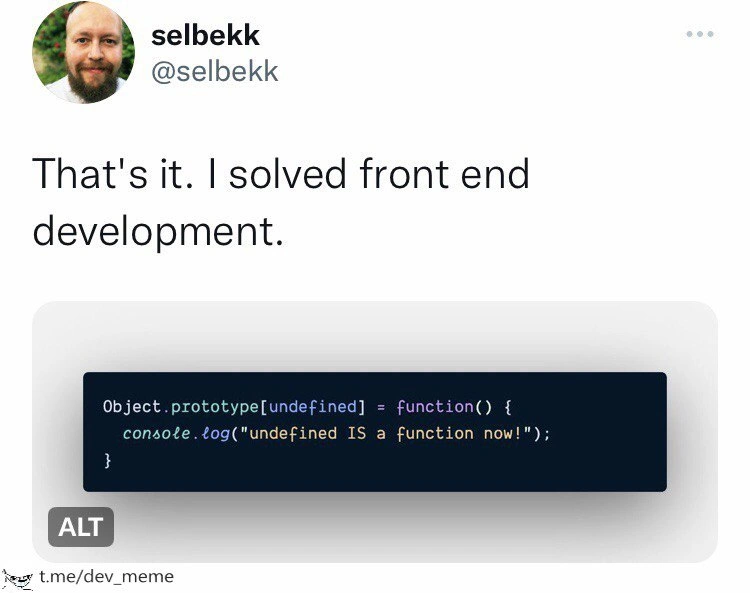
The code snippet in the meme is:
Object.prototype[undefined] = function() {
console.log("undefined IS a function now!");
};
When you see object[something] in JavaScript, it’s accessing a property using the value in the brackets as the key. If that something isn’t a string or symbol, JavaScript will convert it to a string. So undefined becomes the string "undefined" internally. That means the code is adding a new function property named "undefined" to the global base object. In simpler terms, it teaches every object in JavaScript a new trick: if you ask an object for a property called "undefined", it will now give you this function. By doing this, the author is jokingly ensuring that if any code tries to call something that is undefined (in a very specific way, like obj[undefined]()), instead of throwing an error, it will find this function and be able to call it. When called, that function will log the message "undefined IS a function now!" to the console. Essentially, they turned “undefined” into a function in the context of object property lookups.
Let’s clarify with an example after that code runs:
Object.prototype[undefined] = function() {
console.log("undefined IS a function now!");
};
const myObject = {};
// Initially, myObject has no properties of its own.
console.log(myObject.undefined); // prints: function() { console.log("undefined IS a function now!"); }
myObject.undefined(); // logs: undefined IS a function now!
Here, myObject didn’t have an "undefined" property, so normally myObject.undefined would be undefined. But because we added an "undefined" function on Object.prototype, JavaScript finds that property on the prototype chain. So myObject.undefined evaluates to the function we set, and thus myObject.undefined() actually calls that function, printing the message. We’ve effectively caught the scenario where someone does obj[undefined]() and prevented it from erroring out.
Now, why is this FrontendHumor? Because in real development, if you see “undefined is not a function”, the solution is definitely not to do this! The proper solution is to debug and figure out why that value is undefined in the first place. The tweet’s author is being cheeky, pretending that by adding this one line of code, they have “solved front-end development” – as if the biggest problem in front-end (which is a joke in itself, since front-end is vast and complex) was just that error message, and now it’s gone. It’s CodingHumor because it’s taking a shortcut that no one should realistically take and presenting it as the ultimate fix.
This relates to a concept called monkey patching. Monkey patching means changing or extending existing code at runtime, especially modifying objects or prototypes that you really shouldn’t. Here, adding a property to Object.prototype is a form of monkey patching – we’re modifying the fundamental Object that all others inherit from. It’s like sneaking an extra tool into everyone’s toolbox behind the scenes. Usually, monkey patching is done sparingly, and when it is, it’s done on specific objects or prototypes (like adding a new function to Array.prototype so all arrays get it). Doing it with something as general as Object.prototype is considered prototype pollution. That term, object_prototype_pollution, describes messing with the base object’s properties such that it “pollutes” all objects. This can have unintended consequences. For example, if someone later writes a loop to go through all properties of an object using a for...in loop, they might unexpectedly see this "undefined" property we added even if it wasn’t originally there. That could confuse the logic or cause bugs. For security, if an untrusted script did this, it could maliciously alter behavior of applications. So, in real life, we avoid doing this unless absolutely necessary (and it rarely is necessary).
Because this meme is in the format of a twitter_screenshot_meme, it’s basically showing a tweet where a developer is joking around. The tweet says, “That’s it. I solved front end development.” with an air of finality and self-congratulation, followed by the code snippet. The image of code with an ALT badge indicates it’s likely a code snippet embedded in the tweet (Twitter shows an “ALT” badge when accessible image descriptions are available, but here it’s just part of the screenshot joke context). The watermark t.me/dev_meme suggests it’s reposted via a developer meme channel. All these context clues tell us it’s meant to be humorous, not an actual coding tip. The comedic effect comes from how outrageous the code is. It’s the kind of thing a mentor would beg a junior developer never to do for real. So if you’re new: please don’t actually do this in your projects! It’s all sarcasm and exaggeration, reflecting a shared understanding among programmers that sometimes our fixes can be hacks, but this would be taking it way too far.
In essence, the meme is making fun of the idea of a “quick fix.” Front-end development often involves debugging lots of issues, and beginners quickly learn that a quick fix can sometimes do more harm than good. The tweet’s author jokingly presents the ultimate quick fix for one of those pesky issues. It’s funny because it’s so wrong yet presented in a triumphant way. Everyone who’s written JavaScript can chuckle because they know the struggle of that error, and they also know this “fix” is just for laughs. The tags like Frontend, JavaScript, LanguageQuirks, and UndefinedBehavior all point to this being a lighthearted take on how quirky and sometimes frustrating JavaScript can be, and how creative you could get (if you throw caution out the window) to avoid a problem. It’s a great example of developers bonding over a common experience: the battle against undefined errors, and the absurd ideas that cross our minds in that battle.
Level 3: Monkey-Patching the Universe
When a seasoned developer sees the tweet “That's it. I solved front end development.” paired with this code snippet, they immediately sense the tongue-in-cheek sarcasm. The tweet is presented as a twitter_screenshot_meme, a popular format in DeveloperHumor where someone shows an outrageous solution as if it’s the final word on a frustrating problem. In this case, the problem is the notorious JavaScript error “undefined is not a function” (a classic runtime error that has plagued front-end engineers for ages). The supposed “solution” offered is to literally make undefined into a function by monkey-patching Object.prototype. It’s a facepalm-inducing joke that riffs on the extreme lengths frustrated developers wish they could go to silence those relentless errors.
Why is this funny to an experienced coder? Because it’s absurd on multiple levels. In real front-end development, getting a runtime error like TypeError: undefined is not a function means something in your code went wrong – maybe you called a function that wasn’t defined, or got an unexpected undefined where an object or method was expected. The correct solution would be to trace the bug, understand why that value is undefined, and fix the logic. But here, the developer humorously claims to have “solved” the entire field of front-end by hacking the language itself to prevent that error message. It’s like swatting a fly with a bazooka – overkill and aimed in the wrong direction (but undeniably dramatic!). The meme exaggerates a common newbie mistake (trying wacky fixes) and a shared veteran joke: “if undefined is not a function, well, let’s just make it one!” It’s a perfect example of CodingHumor where the punchline comes from a deep familiarity with a Frontend pain point and the boldness of the “fix”.
This snippet is a prime example of monkey_patching run amok. Monkey patching refers to changing or extending code at runtime, often by replacing or adding to existing objects or prototypes. In moderation, monkey patching can be used for polyfills or quick fixes, but doing it to core objects is widely regarded as a bad practice. Why? Because it’s effectively changing the rules of the entire game for all code running in that environment. Here the “game” is JavaScript’s object model. By adding an undefined property to Object.prototype, the code is effectively polluting the global prototype. Every object (unless it has an undefined property of its own) now inherits this new function. Seasoned devs see this and chuckle because it’s the kind of “solution” you’d joke about after a long day of chasing a bug – “Ugh, I keep getting undefined is not a function... I wish I could just make undefined a function and be done with it.” Someone actually went and demonstrated that idea, satirically.
The humor also stems from the confident tone: "That's it. I solved front end development." Front-end development is a huge, complex field with countless frameworks, LanguageQuirks, and daily challenges. The tweet’s author facetiously claims that a single clever hack could resolve all those woes. It’s dripping with irony – everyone knows this one-liner does not truly solve anything. In fact, it would likely cause more problems than it fixes. By “solving” the error message, you’re not solving the underlying bug. It’s similar to slapping duct tape on a leaky pipe and proclaiming the plumbing fixed. Fellow developers find it funny because it’s a shared absurdity: “if only it were that easy to fix our bugs!” It also pokes fun at the chaotic creativity of some JavaScript developers, who sometimes come up with outrageous hacks or one-liners that exploit the language’s quirks (like type coercion and prototypes) in unintended ways. This is FrontendHumor at its finest – referencing both the daily grind of debugging and the wild flexibility of the language that lets you try such stunts.
Let’s consider a real scenario that this meme is riffing on. Imagine you have a piece of front-end code that’s breaking: somewhere, someObject.someMethod() is being called, but someObject.someMethod is actually undefined – hence the runtime throws "TypeError: undefined is not a function". A junior developer, in desperation, might think, “What if I just make that undefined into a function somehow?” Of course, no sane developer would patch the global Object prototype with an undefined key in a production codebase, but as a joke, it’s relatable. It reminds experienced devs of those late-night debugging sessions where wild thoughts like this do occur, even if only as a fleeting “what if I hack it?” fantasy. The tweet’s code is like a parody of those half-crazy remedies one imagines at 3 AM when a bug just won’t go away. It’s DeveloperHumor that resonates because we’ve all been there – tempted by an easy out that we know is horribly wrong.
Moreover, this meme subtly satirizes JavaScript’s reputation for having many footguns (ways to shoot yourself in the foot). JavaScript gives you enough rope to hang yourself; here, the rope is the ability to alter Object.prototype, and hanging yourself would be the unintended consequences of doing so. In the past, libraries like MooTools or Prototype.js famously extended base prototypes (for example, adding methods to Array.prototype or Object.prototype) which led to LanguageQuirks conflicts when combined with other code. Seasoned devs remember the days of multiple libraries clobbering each other’s additions, or newer ECMAScript standards introducing a method that someone’s monkey patch had already defined differently. Those were headaches we learned from. Now it’s almost universally agreed: don’t modify Object.prototype unless you absolutely have to (and you almost never have to). Seeing someone do Object.prototype[undefined] = function(){ ... } thus triggers a mix of amusement and horror. It’s an obviously wrong approach, which is exactly what makes it a great joke. It flagrantly breaks the rules we try to follow, purely for the comedic payoff of “undefined is a function now!”
One can also sense a Frontend inside-joke here: front-end development (mostly JavaScript in browsers) is infamous for error messages like “Cannot read property ‘x’ of undefined” or “undefined is not a function,” often stemming from things like asynchronous code not yet having data, or a typo in a variable name. It’s practically a rite of passage to debug these as you learn. The tweet mocks this common struggle. By “solving” the error in such a brute-force way, it laughs at the impatience we sometimes feel. It’s saying, “Wouldn’t it be nice if we could just fix JavaScript’s universe to avoid our mistakes?” It’s funny because every experienced dev knows that’s not how programming works, but deep down, we all have moments we wish it did.
In summary, from a senior developer’s perspective, this meme combines a well-known undefined_is_not_a_function headache with an outrageous fix that violates all best practices (object_prototype_pollution through javascript_prototype_abuse). It elicits laughter through irony and shared experience. We laugh with the author, acknowledging the cleverness of the hack, and laugh at the notion that this “solves” anything for real. The tweet’s solution is intentionally over-the-top. It highlights how FrontendHumor often involves poking fun at the language’s oddities and the sometimes absurd coping mechanisms developers dream up. It’s a little cathartic, too: after wrestling with a tough bug or the umpteenth “undefined” error, seeing someone facetiously “defeat” the error with one line gives us a moment of comedic relief. We all know real life isn’t that simple, but for a second, it’s entertaining to imagine that it could be.
Level 4: Prototype Chain Reaction
Under the hood of JavaScript lies a fascinating metaprogramming ability: you can modify the very blueprint that all objects use. In JavaScript’s prototypal inheritance model, every ordinary object links to Object.prototype (except those explicitly created with no prototype via Object.create(null)). When you do Object.prototype[undefined] = function() { ... }, the engine performs a type coercion: it converts the key undefined into the string "undefined" using the language’s to-property-key conversion. Essentially, this one-liner is doing Object.prototype["undefined"] = function() { ... }. Now, since almost every object in JavaScript inherits from Object.prototype, this means every object magically gains a new ancestral property keyed as "undefined" – and that property is a function.
Let’s break down the prototype chain mechanics in technical terms: when you access a property on an object (for example, doing obj[someKey]), the JavaScript runtime will look for that property directly on obj. If it doesn’t find it there and obj has a prototype, it climbs up to obj.__proto__ (which is usually Object.prototype for plain objects) and looks there. It keeps climbing up the prototype chain until it either finds the property or reaches an object with no prototype. By adding a property named "undefined" to Object.prototype, the code in the meme ensures that any property lookup using the key undefined will eventually resolve to this new function. In code, that means:
Object.prototype[undefined] = function() {
console.log("undefined IS a function now!");
};
// Example:
const emptyObj = {}; // a simple object with no own properties
emptyObj[undefined](); // logs: undefined IS a function now!
Here, emptyObj doesn’t have an "undefined" property on itself, so the JavaScript engine checks emptyObj.__proto__ which is Object.prototype and finds our injected function, then calls it. This effectively monkey-patches the global base object, altering fundamental behavior at runtime. It’s a dramatic illustration of javascript_prototype_abuse: the snippet abuses the dynamic nature of the language by patching the universal object template.
From a language design perspective, this is like reaching into the Metaobject Protocol of JavaScript and scribbling in a new rule. It’s a power unique to dynamic languages (like JavaScript, Ruby, etc.) where objects are open for extension at runtime. Statically typed languages such as Java or C++ would never let you just graft a method onto the built-in Object or change the meaning of null/undefined on the fly – but JavaScript’s flexibility makes this possible (for better or worse). This flexibility is what gives JavaScript its notorious LanguageQuirks: you can bend the rules of the system in unexpected ways. The meme’s code leverages one such quirk (the implicit string conversion of property keys, and the shared prototype of objects) to achieve a darkly humorous “fix” for a common error.
However, this kind of prototypal tampering has serious side effects. In terms of performance, adding a new property to Object.prototype can force JavaScript engines to adjust their internal optimizations. Modern JS engines (like V8 in Chrome) create hidden classes and shape-based optimizations; a global change to Object.prototype can deoptimize property access across the board, since now every single object has to consider this extra property. It’s like adding a new constant overhead to every property lookup – a pandemonic chain reaction through the runtime. The situation also ventures into undefined behavior territory (not in the C/C++ sense of undefined memory, but in the sense of uncharted, unwise modification): you might not break the JavaScript spec per se, but you’re certainly wading into behavior that normal code would never rely on. For example, many code patterns or libraries might not expect an "undefined" property to exist on objects, potentially causing logic errors or security issues.
Speaking of security, this snippet is a textbook illustration of object_prototype_pollution. In security research, prototype pollution refers to an attack where an adversary injects properties into high-level prototypes (like Object.prototype) to manipulate how software behaves. By doing something akin to Object.prototype.evil = true, an attacker could make every object have an evil property, possibly bypassing certain logic checks (if(!obj.evil) {...} might now be always false because obj.evil exists). In our humorous case, the developer is “polluting” the prototype with an undefined property. It’s done in jest, but it echoes real-world pitfalls where such pollution leads to bugs or vulnerabilities. Historically, vulnerabilities in Node.js libraries have been found where merging user-provided objects without guard could let someone set __proto__ or special keys, thereby modifying Object.prototype. This is why modern coding practices and frameworks defend against broad object mergers or discourage modifying global prototypes.
In summary, at this deepest level, the meme exposes how JavaScript’s prototypal inheritance and type coercion work in a fundamentally weird way. It’s highlighting a corner of the language’s design where incredible power (and risk) resides. We see how a simple line of code exploits the core object model to achieve a cheeky result: turning “undefined” from a primitive that normally signals absence into an actual callable method on every object. It’s both a brilliant and horrifying demonstration of dynamic language flexibility. UndefinedBehavior in JavaScript usually refers to unpredictable outcomes, but here we’ve quite literally defined undefined (as a function) for the entire runtime environment. The humor at this level comes from recognizing just how insane and far-reaching this change is – it’s like editing the laws of physics in your program’s universe just to suppress one pesky error message.
Description
Screenshot of a tweet in the standard Twitter UI. The tweet text reads: "That's it. I solved front end development." Beneath it is a dark-themed code block displaying: "Object.prototype[undefined] = function() { console.log(\"undefined IS a function now!\"); }". A small grey "ALT" badge appears at the lower-left of the snippet, and a watermark "t.me/dev_meme" sits underneath. The meme humorously "fixes" the classic JavaScript error "undefined is not a function" by adding an undefined key to Object.prototype, highlighting prototype pollution, type coercion quirks, and the sometimes reckless creativity of frontend engineers
Comments
13Comment deleted
Achieved 100% green tests by making undefined a function on Object.prototype - sure, it’s also a planet-scale prototype-pollution CVE, but the dashboard is green and that’s what the OKR tracks
After 20 years in the industry, I've finally accepted that JavaScript's 'undefined is not a function' isn't a bug report - it's a philosophical statement about the nature of existence in a weakly-typed universe where even nothing can be something if you prototype it hard enough
Ah yes, the classic 'fix the symptom, not the cause' approach - because nothing says 'senior engineer' quite like polluting Object.prototype to paper over type errors. This is the architectural equivalent of fixing a memory leak by downloading more RAM. Sure, 'undefined is not a function' won't throw anymore, but congratulations: you've just created a Heisenbug that will haunt code reviews for years and make every library maintainer weep. It's the kind of 'solution' that gets you promoted to a different team... very quickly
Bold strategy: convert “TypeError: undefined is not a function” into a company‑wide for…in incident - congrats, you just launched Prototype‑Pollution‑as‑a‑Service
Bold move - patch Object.prototype[undefined] so the TypeError vanishes and every for…in across the fleet starts iterating 'undefined'; a one-line fix that upgrades a bug into a distributed outage
Prototype pollution since ES1: the frontend dev's shortcut to 'solved' today, legacy regret tomorrow
JS be like: Comment deleted
null is a value, why not just point it to a null ? Comment deleted
pointers in javascript… are you mad? Comment deleted
Wait, you have pointers in js? Wha.... Comment deleted
you don't, that's the point(er, haha) Comment deleted
Haha Comment deleted
whhoooops Comment deleted