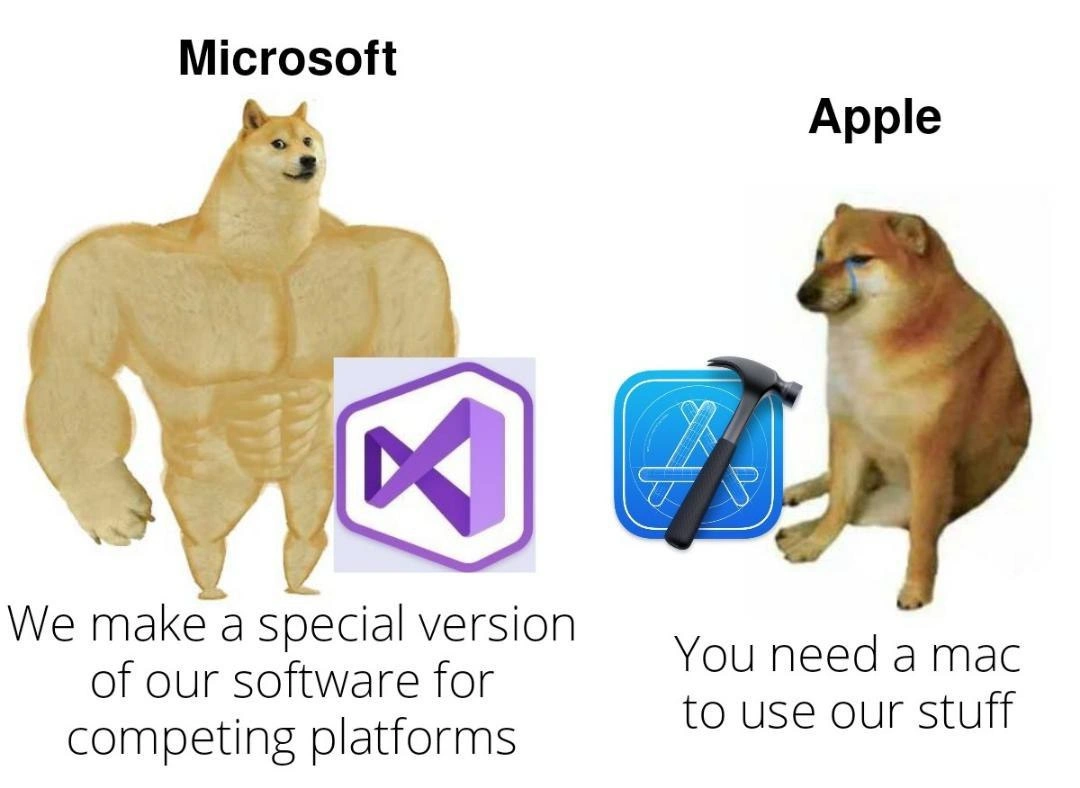
Buff Doge showdown: Visual Studio cross-platform love vs Xcode Mac lock-in
Why is this Microsoft meme funny?
Level 1: Open Playground vs Exclusive Club
Imagine two kids on a playground, each with their own super-cool toy set. The first kid (let’s call him Mike for Microsoft) has a big awesome toy toolbox. Mike is strong and friendly – he’s like a big buff dog who’s happy to share. He says, “Hey everyone, I brought toys that anyone can play with! I even made sure my toys work on different playgrounds. Sandbox, grass, or woodchips – it doesn’t matter, we can still have fun together.” In other words, Mike is willing to go play at other kids’ houses and bring his toys along so everyone can enjoy.
Now the second kid (let’s call him Adam for Apple) also has a cool toy set, but he’s a bit fussy and exclusive – kind of like a sad dog who won’t share. Adam says, “If you want to play with my toys, you have to come to my house and use my playroom. No exceptions.” This means if you’re not already at Adam’s place (or you don’t have the same fancy setup he has), you simply can’t join in the fun with his toys. Adam’s not budging – his rules, his turf.
In the picture (meme), Mike is drawn as a super muscular, confident dog because he’s open and strong by sharing his toys everywhere – this makes him look cool and powerful. Adam is drawn as a smaller, crying dog because his “only at my house” rule makes others (and eventually even him) a bit sad – he’s left out from playing with friends on other playgrounds because of his own strict rules.
The joke is basically showing how one company is like the generous kid who includes everyone (that’s Microsoft with its Visual Studio toy available for all kinds of computers), and the other company is like the kid who says “friends can only play if they do it my way” (that’s Apple with Xcode only on Macs). It’s funny and relatable because even though Adam’s toys are great, his attitude ends up looking stubborn and kind of silly when you compare it to Mike’s super welcoming approach. The emotional core here is about sharing vs. not sharing: one approach makes everyone happy and flexes how strong and kind you are (hence the buff smiling dog), and the other approach might protect your own turf but makes you and others a bit miserable (hence the sad crying dog). Even if you’re not a programmer, you can understand it like this: Would you rather play with a friend who brings toys to everyone’s yard, or a friend who says “Nope, you can only play if you buy the same expensive toy house I have”? The meme uses the dogs and simple captions to make this point in a silly, memorable way.
Level 2: Cross-Platform vs Locked-In Tools
Stepping down to a more introductory view, let’s explain what’s going on with these two companies and their developer tools. Microsoft and Apple each have a major IDE (Integrated Development Environment) for building software:
Visual Studio (logo in purple, by Microsoft): This is a powerful coding environment originally made for Windows. There’s also Visual Studio for Mac, a special version that runs on Apple’s macOS, and Visual Studio Code, a lightweight code editor that runs on Windows, Mac, and Linux. When we say a program is cross-platform, we mean it can run on different operating systems (like an app that works on Windows and Mac and Linux in the same way). Microsoft has embraced this idea: they want developers on any OS to be able to use their tools. It’s a very developer-friendly move because it doesn’t force you to change your primary computer or OS – you can stick with what you love and still use Microsoft’s developer software.
Xcode (blue icon with a hammer, by Apple): This is Apple’s official IDE for making iPhone apps, iPad apps, and Mac applications. It’s the main tool to write code in Swift or Objective-C and design interfaces for Apple’s platforms. However, Apple has a big catch: Xcode only runs on macOS. In simpler terms, Apple says “if you want to build apps for our iPhones or Macs, you must be using one of our Mac computers.” This is an example of platform lock-in or vendor lock-in – a situation where a company’s product only works within their own ecosystem and doesn’t play nice elsewhere. Apple’s developer tools are basically locked to Apple’s own operating system.
Now the meme compares these two approaches. On the left side, we have the famous buff Doge (a popular meme image of a Doge dog looking extremely muscular and confident) labeled “Microsoft”. The text under Buff Microsoft Doge says: “We make a special version of our software for competing platforms.” This refers to Microsoft’s willingness to adapt their software (like Visual Studio) to run on platforms that compete with Windows – namely macOS (Apple’s OS) and even Linux. It’s like Microsoft is proudly saying, “Hey, if you use a Mac or Linux, no problem – we got you a version of our tool!” This resonates with developers because it shows MicrosoftProducts being inclusive. For example, VisualStudioIDE which was once Windows-only now has editions for Mac, and developers using Linux can use VS Code to benefit from Microsoft’s developer ecosystem too. Microsoft even makes the core of .NET (their programming framework) work on Linux and Mac through .NET Core/.NET 5+, illustrating true CrossPlatformDevelopment. This cross-platform support is a huge improvement in developer experience, as it removes a barrier to entry: you don’t need a Windows PC to benefit from Microsoft’s developer tools.
On the right side, the meme shows a small, sad-looking Doge (often nicknamed Cheems in meme culture, usually portrayed as whimpering or sad) labeled “Apple”. Next to it is the Xcode icon (a blue square with an image of a hammer and some drafting tools – the hammer subtly implying it’s a development tool for building things). The text says: “You need a Mac to use our stuff.” This is essentially Apple’s policy for Xcode, phrased bluntly. It means if a developer is on Windows or Linux and they want to develop for iOS (iPhone/iPad), they’re out of luck unless they get a Mac. Many new developers discover this when they excitedly decide to make their first iPhone app: you go to download Xcode and find out you literally can’t install it on Windows. Apple’s developer website will say something like “Xcode requires macOS. Please download from the Mac App Store.” If you don’t have a Mac, that’s a dead end. This feels very restrictive, and that’s why in the meme Apple-Doge has a tear – it’s a bit of dramatization of developers’ frustration with Apple’s one-platform rule. It’s platform_gatekeeping by Apple: only those inside the Mac club can play.
To a junior developer or someone new to this, here’s why it’s funny and noteworthy:
- Microsoft appears unusually generous and even a bit sly: they’re making friends with everyone, even with users of competing operating systems. That’s like a big company saying “We love everyone! Windows, Mac, Linux – come use Visual Studio!” Historically, you might expect big tech companies to keep their stuff to themselves, but Microsoft realized that supporting everyone actually gets more developers on board. This strategy helps them remain relevant. The meme exaggerates Microsoft as a super-strong Doge to show how “powerful” and cool this cross-platform support makes them look to developers.
- Apple, a company known for high-quality products but also a tightly controlled ecosystem (often called the AppleEcosystem), insists on a closed approach. Want to use Apple’s fancy tools? Then you must use Apple’s hardware/OS. For a newcomer, it might feel like Apple is being a strict gatekeeper – “No entry unless you buy our Mac.” This policy can feel like a frustrating limitation or a bit arrogant, hence the sad, weak Doge depiction. In reality, Apple does this to ensure that developers are using the environment that Apple can fully control and optimize (macOS on real Mac hardware). They argue it ensures better apps and compatibility. But to developers (especially hobbyists or those not already on Mac), it feels like an unnecessary hurdle. It’s a classic case of VendorLockIn, where a vendor (Apple) is making you stay in their product family to use their stuff.
Some key terms and concepts in this meme:
- IDE (Integrated Development Environment): a software application that provides comprehensive facilities to computer programmers for software development. Both Visual Studio and Xcode are IDEs. They typically include a code editor, debugger, and build tools in one package.
- Cross-Platform Development: creating software in a way that it can run on multiple operating systems. Visual Studio Code is a great example because Microsoft built it to run on Windows, Mac, and Linux alike. Cross-platform tools use technologies (like Electron for VS Code, or Java and .NET Core which are cross-platform runtimes) to be OS-agnostic.
- Walled Garden: a closed platform environment where the platform owner (Apple in this case) tightly controls what software can do and how tools can be used. Apple’s ecosystem is often described as a walled garden – beautiful, curated, but you can’t stray outside the walls. Requiring a Mac for Xcode is one of those walls.
- Platform Gatekeeping: restricting access to software based on platform. Here, Apple is gatekeeping Xcode behind macOS. It’s like a bouncer at the club saying “Mac users only, sorry” to a Windows user who shows up with a PC.
- Developer Experience (DX): similar to user experience (UX) but for developers – it’s how easy and pleasant it is for devs to use certain tools or platforms. Microsoft boosting cross-platform support improved the DX for non-Windows developers who want to use Microsoft tools. Apple enforcing Mac-only for Xcode is often seen as hurting DX for those who don’t have Macs.
In summary at this level: The meme is comparing two big tech approaches to developer tools. Microsoft’s approach: “we’ll meet you where you are” (very flexible, cross-platform, inclusive). Apple’s approach: “you have to come to us” (exclusive, controlled, requires you to be on Apple’s platform). Developers, especially those who have experienced both, find this comparison funny and true. The buff Doge vs sad Doge images exaggerate the situation: it’s a bit like saying “Microsoft’s Visual Studio is the friendly giant that supports everyone, Apple’s Xcode is the stingy little guy that only supports its own.” It’s humor born from real tech ecosystem differences that many in the programming community know well.
Level 3: Cross-Platform Flex vs Walled Garden Woes
At the highest technical vantage, this meme highlights a developer tooling philosophy showdown. On the left, Microsoft’s buff Doge (a super-jacked Shiba Inu) stands in for Visual Studio’s cross-platform muscle. Microsoft is effectively saying, “We’ll pump iron to support developers on any OS – even our competitors’!” This references how Microsoft offers Visual Studio (and its little brother Visual Studio Code) on Windows, macOS, and even Linux. They literally built special versions (like Visual Studio for Mac) so devs can use their tools anywhere. On the right, we have Apple’s weepy Doge (Cheems with a tear) representing Xcode locked inside the macOS walled garden. Apple’s caption, “You need a Mac to use our stuff,” lampoons the platform gatekeeping of the Apple ecosystem. In plainer terms, if you want to develop iPhone or iPad apps with Xcode (Apple’s official IDE), you must be on a Mac. No Windows or Linux allowed – an undeniable example of vendor lock-in.
This contrast is rich with industry irony. Historically, Microsoft was once notorious for Windows-only MicrosoftProducts and a proprietary mindset (the old “embrace, extend, extinguish” playbook). But in modern times, Microsoft flipped the script to champion CrossPlatformDevelopment. They open-sourced .NET, released Visual Studio Code (built on Electron for portability), and even brought the Bash shell to Windows via WSL. The buff Doge flexing Visual Studio’s purple logo humorously signifies Microsoft’s new DeveloperExperience_DX gains – a swole commitment to developer_tool_accessibility across platforms. Meanwhile, Apple – who once ran “1984” ads about breaking tyrannical IBM/Windows control – has ironically become the strict gatekeeper of its domain. The sad Doge with the Xcode icon and a hammer (the Xcode logo literally has a hammer in it) represents Apple hammering shut the gates: you want in to iOS development? Then you must buy into macOS hardware and tools. No cross-platform love from Cupertino, just an exclusive club.
Technically, this situation frustrates devs who don’t primarily use Macs. ToolingFrustration sets in when, say, a .NET back-end developer on Windows is asked to build an iPhone app. Microsoft’s path would be: “No worries, here’s Visual Studio for Mac – go ahead and code in C# for iOS on that Mac or even use Xamarin/.NET MAUI. We’ve got extensions to connect Visual Studio on Windows to a Mac build agent, too.” Basically, Microsoft bends over backwards so you can use their tools anywhere, even blending ecosystems (as weird as VisualStudioIDE on a Mac once sounded!). Apple’s path, by contrast, is: “Oh, you only have Windows or Linux? Too bad. You can’t even run Xcode there. Consider getting a Mac (with our M1 chips, please).” The meme nails this absurdity by personifying Microsoft as the Buff Doge who cross-trains on all platforms, versus Apple as the Sad Doge that isolates itself, crying because it won’t play with others. It’s classic developer humor: exaggerating real tech ecosystem behaviors using the popular doge_meme_format.
From a senior developer perspective, we also recognize the trade-offs and history behind this. Apple’s tight control (the walled garden) ensures Xcode is finely tuned for macOS. They can guarantee that iOS apps are built in a consistent environment – which arguably reduces certain variables and bugs. It’s a bit like how back in the day Apple insisted on their own hardware/software integration (PowerPC chips, then Intel, now Apple Silicon) to optimize performance. They’ve carried that philosophy: if you want to build for our platform, you also use our platform. It’s a closed loop that platform_gatekeeping enforces for quality, security, and yes, probably profit (selling Macs to all iOS devs is a nice side effect). Microsoft, on the other hand, realized that embracing developers on competing platforms grows their influence. A coder using VS Code on a Mac might later deploy to Azure or use GitHub – a strategic win for Microsoft. So the buff Microsoft Doge isn’t just altruism – it’s a calculated flex to win hearts and mindshare across the entire developer world. But from our viewpoint, it’s still a win-win because we get more freedom.
The humor also lies in role reversal. Seasoned devs remember the 90s and 2000s when Visual Studio only ran on Windows. If you were on a Mac or Linux and needed .NET or VS, you were out of luck or stuck with clunky workarounds. Meanwhile, Apple’s tools were always Mac-only, but Apple had a smaller market share so it wasn’t as in-your-face. Fast forward to today: Microsoft makes VS Code which runs everywhere (and is wildly popular even on Macs for JavaScript/Python, etc.), and a full Visual Studio IDE for Mac so C# developers on macOS feel first-class. Microsoft’s even contributing to open-source, crossPlatformDevelopment projects and appearing at Linux conferences – who are these buff guys and what did they do with old Microsoft? 😂. Apple, conversely, doubled down on VendorLockIn: want to write an iPhone app in Swift? Use Xcode on Mac. Period. There’s no Xcode for Windows, no official support for other OS. Devs find this ToolingFrustration painfully real. Many have resorted to hacky solutions: maintaining a Mac mini as a build server, using cloud Mac services, or running macOS in a virtual machine (violating Apple’s EULA, shh). The meme’s emotional kick comes from every dev who’s groaned, “Seriously, Apple? I have to buy a Mac just to compile this?” versus the pleasant surprise that “Wow, Microsoft actually made this easy for non-Windows folks.”
To senior folks, it’s also a commentary on developer experience (DX) as a competitive field. Good DX means lowering barriers – Microsoft handing out Visual Studio to anyone interested, even on rival OS, is great DX. Poor DX is a barrier – Apple effectively saying “No entry if you don’t use our platform” is a literal barrier. We’ve all been on teams where one policy or tool creates a bottleneck. Apple’s stance here is that bottleneck. If an organization predominantly uses Windows machines, spinning up an iOS project triggers procurement of MacBooks or setting up CI pipelines with Mac build nodes. There’s legendary internal discussions like:
Manager: “We need an iPhone app.”
Dev: “Okay, we need Mac hardware for all iOS devs.”
Manager: “Can’t we do it on our Windows machines?”
Dev: “Nope, Apple doesn’t allow that.It’s always DNSIt’s always Apple’s walled garden.”
It’s funny because it’s true. The buff vs sad Doge format exaggerates it perfectly: one company looks strong and magnanimous by comparison, the other looks weak and stingy. Technically, we might express Apple’s stance in pseudo-code vs Microsoft’s like so:
// Apple Xcode pseudo-launcher:
if (Environment.OS != OS.MacOS) {
Console.Error.WriteLine("Xcode can only run on macOS 💻🚫.");
Environment.Exit(1);
}
// ... proceed to launch Xcode on Mac
// Microsoft Visual Studio pseudo-launcher:
if (Environment.OS == OS.MacOS) {
Launch("Visual Studio for Mac"); // Special version for macOS
} else if (Environment.OS == OS.Linux) {
Launch("Visual Studio Code"); // Use VS Code on Linux (cross-platform editor)
} else if (Environment.OS == OS.Windows) {
Launch("Visual Studio for Windows"); // Standard VS on Windows
} else {
Console.WriteLine("We even support unexpected platforms! 💪");
}
In the snippet above, Apple’s logic unceremoniously rejects you if you’re not on macOS – classic platform_gatekeeping. Microsoft’s logic has a branch for every major OS (and even a joking catch-all), reflecting that “let’s make something work for everyone” attitude. This is essentially the cross_platform_vs_walled_garden contrast encoded as code.
Seasoned developers chuckle at this meme because it distills a long-running ecosystem war into one image. It’s a mix of schadenfreude and relief – schadenfreude seeing Apple called out for its closed ecosystem (with the sad Doge crying), and relief that Microsoft, of all companies, emerged as the unexpected hero (buff Doge) of developer_tool_accessibility. In a world where we constantly fight tool chain issues and environment setup headaches, the idea of an IDE provider going the extra mile for cross-platform support feels like a triumphant flex. Conversely, an IDE that stubbornly demands a single OS feels archaic in 2022. By using the Doge meme format, the post delivers this critique in a light, humorous way that any programmer who’s dealt with IDEsAndTextEditors can appreciate. It’s a modern David vs Goliath twist – except here Goliath (Microsoft) is helping David (developers on other OS), while Apple sits in the corner with its toys, unwilling to share. The absurdity and role-reversal, combined with our shared pain of wrestling with proprietary toolchains, make it chef’s kiss perfect for a laugh.
Description
The meme uses the classic buff-versus-sad Doge split. Left panel: a heavily muscled Doge labeled "Microsoft" stands proudly beside the purple Visual Studio logo; caption reads "We make a special version of our software for competing platforms." Right panel: a teary, slumped Doge labeled "Apple" sits next to the blue Xcode icon with hammer; caption reads "You need a mac to use our stuff." The contrasting dog images emphasize Microsoft’s cross-platform support (Visual Studio for Windows, Mac, and Linux) against Apple’s walled-garden requirement of macOS for Xcode and iOS builds. Visually the background is plain white, black sans-serif text tops each panel, and the tool icons are centered below the dogs, making the platform-lock-in joke clear to developers familiar with IDE ecosystems
Comments
69Comment deleted
Microsoft lets us docker-compose an entire toolchain; Apple’s scaling strategy is just “add another Mac mini to the rack and pray the next Xcode update doesn’t brick SSH.”
The real power move is when you're running Visual Studio Code on your MacBook Pro to develop a .NET Core app that you'll deploy to Linux containers on Azure, while your iOS app CI/CD pipeline requires a Mac mini farm that costs more than your entire Kubernetes cluster
The irony here cuts deep: Microsoft, once the poster child for proprietary lock-in, now ships VS Code to every platform including their competitors', while Apple - champion of 'think different' - insists you think exactly like them by buying a $2000+ Mac just to compile Swift. It's the ultimate role reversal where the former monopolist embraced open tooling and the design-forward innovator gatekeeps their entire development ecosystem behind hardware purchases. Senior engineers remember when this was flipped, making the meme's 'buff vs weak' comparison a delicious commentary on how corporate strategies evolve - or devolve - over decades
Microsoft ships their IDE to every OS; Apple turns your CI into a Mac mini shrine because Xcode won’t containerize and codesigning needs the blessing of Cupertino
Microsoft ports the IDE; Apple ports your budget to a Mac‑mini farm that only runs xcodebuild, codesign, and notarize
.NET Core: Write once, debug everywhere. Xcode: Buy Mac, pray it compiles
right, what bullshit is this then? Comment deleted
ever heard of office for linux? I sure haven't Comment deleted
Ever heard about youtube for windows phone? Comment deleted
some version have youtube, the others have offbrand clients Comment deleted
you need WP8.0 for official yt iirc Comment deleted
Lol no there was bever an official google youtube. There was one that was made by Microsoft but the google sued for not serving ads and video downloads loool. If you manage to download the youtube app now it just closes itself and launches www.youtube.com Comment deleted
what? bruhhh Comment deleted
Yes Comment deleted
They discontinued Monodevelop, the IDE close enough to Visual Studio for Linux Comment deleted
You can use LibreOffice, it's really good office package. Don't forget to enlarge pics cache in LIbrerOfficd options before using or you will encounter extreme lags when scrolling a document with one or more pictures inside. Comment deleted
Excel, word etc still better Comment deleted
It depends on the hardness of your task and the way of following productivity ideology of your boss. Comment deleted
let's just say that my classmates swear much more when using MSOffice than I do when I'm using libreoffice Comment deleted
both are utter trash, but this is true across all text processors Comment deleted
yes. Comment deleted
the only slightly not sad processor is latex, but you will be cursed if you touch it Comment deleted
and i am cursed Comment deleted
same Comment deleted
latex is really neat and hell at the same time Comment deleted
latex is actually cursed ancient alien technology, which no one could replicate since the 70s, the beginning of time Comment deleted
LibreOffice is a Word processor. What I'm referring here with Monodevelop is an IDE used for software development, in this case using Microsoft software. Now that Microsoft discontinued this IDE, it's now more cumbersome to develop on Microsoft's platform from Linux. Comment deleted
Cloud version exists at least. They don't stop you from using WINE either Comment deleted
Not everyone has good enough internet or funds for an annual cloud subscription, while the hardware is already capable to run it and wine doesn't work good for modern Windows programs Comment deleted
Yeah I know, I actually dislike cloud most of the time. That's why in the message after I said I don't recommend it Comment deleted
LibreOffice Comment deleted
I meant ms office specifically Comment deleted
There is a Mac version, and it's kind of OK. Why should they bother about Linux? It's a dead thing, used only by servers and embedded stuff. You don't need office there. Chrome OS? Not popular enough. For Android, there is an app from MS to open and edit text in .docx files. Adobe also don't care about Linux, btw. Comment deleted
oh my how wrong you are omg Comment deleted
this is a certified funni Comment deleted
Well Linux is what, 3% of desktop, why'd you make and maintain linux version of your software Comment deleted
i'm thinking, are there lots of people that are staying on windows because there are no adobe software on linux? Comment deleted
i know several people who only have windows because adobe Comment deleted
At the end of the day: what is Linux? Comment deleted
I mean any linux-based desktop os Comment deleted
well, it was 1% 1yr ago, go figure Comment deleted
There’s a lot of installations in gov/bus envs. This is pretty hard to calculate properly Comment deleted
😂😂😂😂😂😂😂😂 Comment deleted
JetBrains IDEs fully operational on all platforms be like: Comment deleted
Jetbrains don't sell OS and hardware Comment deleted
I wish one of them (CLion) was not so slow at medium sized projects. I faced unprecedented memory consumption and low responsiveness when added two files with ~1k lines of code to my project Comment deleted
Did you wait for indexing to be finished? Comment deleted
Sure Comment deleted
Yes, but IDEs are not compilers, much different thing Comment deleted
Microsoft doing less powerful version for competing systems Comment deleted
I wish visual studio (not vs code) was released for Linux Comment deleted
Yes that will be cool, but what's the problem just use Virtual Machine or Dualboot? Comment deleted
Install Win11 and use it with WSL, lmao Comment deleted
Ever heard about Picture in Picture for Premium YouTube on iPhone ? Comment deleted
same on android, but we can easily sideload youtube vanced, for example. Comment deleted
except Vanced is dead and so am I inside Comment deleted
vanced is dead when it stops working. For now, development on vanced is dead. But I'll use newpipe before using the official crapp Comment deleted
Nope. https://github.com/revanced Comment deleted
ooooh, now that is exciting Comment deleted
Apple is the worst. Can't even develop for this shitty plataform without expending way too much money that it isn't worth it anymore. That and the constant breaking changes just for fun Comment deleted
also let's not forget that apple has literally THE worst documentation Comment deleted
But not in GNU/Linux. 🙄 Comment deleted
At this rate, Apple might catch up with Swift support on Linux Comment deleted
AFAIK, VS for macOS supports only .NET development Comment deleted
Lol what? Its an IDE you can link any compiler to it if you know how it works Comment deleted
Have you ever used it? I have no idea how to install stuff manually to VS. It's all packed into .vsix magic box or provided by VS Installer. Also, I don't think that Microsoft will ever port Windows-native tools to Mac. Furthermore, VS for Mac is not actually a "VS". It is a modified and rebranded Xamarin Studio for Mac. Btw, you can always check the info on its webpage: https://visualstudio.microsoft.com/vs/mac/ Comment deleted
Loool so its more like a phone app? 😂😂😂💀 Comment deleted
Well, I haven't used it. According to MS, people can do all (or almost all) .NET stuff there. Personally, I use CMake, so it all means nothing to me. I write code in my Visual Studio on Windows, and then just test stuff on Mac. If I need to do some debugging or Metal magic, then XCode is enough. Comment deleted
I see Comment deleted