Skip to content
DevMeme
2983 of 7435
Python to C++: A Study in Pointer-Induced Terror
Languages Post #3293, on Jun 19, 2021 in TG

Python to C++: A Study in Pointer-Induced Terror

Why is this Languages meme funny?

Level 1: Training Wheels Off

Imagine you’ve been riding a bike with training wheels all your life, and you’re really good at it. Riding is fun and easy and you feel confident. Now one day, a big kid comes along on a fancy mountain bike (with no training wheels) and sees you. He laughs a bit and says, “Ha, you’re not biking for real! Take those training wheels off and try a real bike like mine.” You’d probably feel confused – why fix what isn’t broken? Riding with training wheels works just fine for you! In this story, Python is like the bike with training wheels – it’s easier to ride and you don’t worry about falling over. C++ is like the big kid’s bike with no training wheels – harder to balance but once you master it, you can go faster and do tricks. The meme is basically one biker telling the other to “stop using the easy bike” in a joking way. It’s funny because each bike gets you where you want to go, but the big kid acts like his way is the only “real” way. In the end, it’s a playful tease about doing things the easy way versus the hard way, and why some people take pride in doing things the hard way just to show they can.

Level 2: From Pseudocode to Pointers

Let’s break down why this cover is amusing, especially if you’re new to these terms. First, Python and C++ are two programming languages that differ a lot in how you write code and manage computer memory. Python is often praised for its simple, readable syntax – so clear that it can look like pseudocode, which is a way to write down programming logic in plain English-like steps without worrying about exact syntax. Calling Python “pseudocode” is an insult in the meme (meant to tease Python developers) because pseudocode isn’t real executable code – it’s like instructions you’d jot down on a whiteboard. In reality, Python is real code – it runs on a virtual machine and does serious work – but it’s true that Python’s syntax is very high-level. For example, adding two numbers in Python is as straightforward as:

# Python code (high-level and simple)
result = 2 + 2

In C++, doing the same arithmetic might look similar at a glance, but C++ gives you a lot more low-level control (and responsibility). One of C++’s fundamental features is the pointer. A pointer is essentially a variable that holds a memory address – basically a number that tells you where another piece of data lives in your computer’s memory. This concept doesn’t really appear in Python coding. In Python, if you do:

a = 42  
b = a  

you might think b is a “pointer” to a, but actually b is just a name referring to the same object as a. You can’t grab a’s memory address directly or mess with it in pure Python – the Python runtime handles all that behind the scenes (it’s garbage-collected, meaning it automatically cleans up unused objects so you never manually free memory).

In C++, you can do things like this:

int a = 42;
int *p = &a;  // p is a pointer to an int, storing the memory address of a
std::cout << *p;  // The * here dereferences p, accessing the value at that address (prints 42)

Here, &a means “address of a”, and we store that in p. Now p “points” to a’s location in memory. By writing *p, we access the value at that location (which is 42). This is powerful because you can manipulate values in memory directly, but it’s also dangerous. If you point to the wrong place, or forget to point to any place at all (a null pointer), your program can crash (this is what's behind those infamous segmentation faults or memory access errors). Python saves you from ever having to worry about that; you can’t accidentally overwrite random memory in Python – if you try something invalid, Python will raise an exception instead of silently corrupting memory.

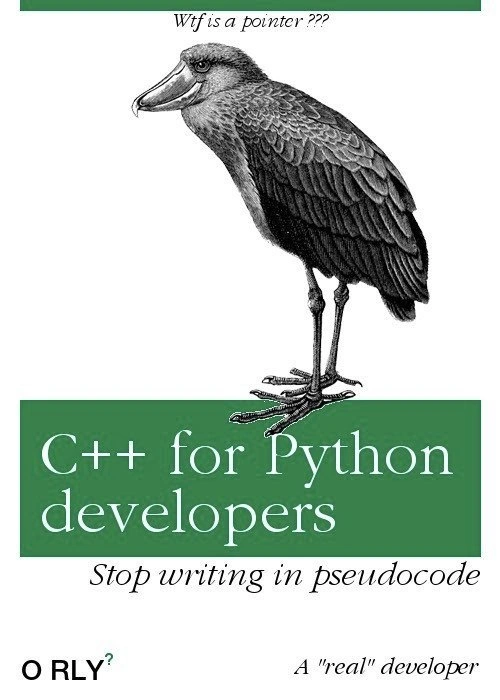
Now, the meme jokes that Python code is just “pseudocode” and implies Python devs don’t know what a pointer is. This plays on a stereotype: Python developers (or other high-level language users) may not have had to work with pointers and manual memory management, so when they first see C++ code with pointers, it’s confusing. The italic question at the top, “Wtf is a pointer ???”, is written as if a baffled Python developer is speaking. It humorously exaggerates the confusion and slight panic a newcomer might feel. Pointers are indeed a common pain point when learning C or C++ – they’re often introduced in CS fundamentals courses and many students struggle initially because it’s a more abstract concept than just using variables normally.

The phrase “Stop writing in pseudocode” in the meme’s context is basically one camp of developers teasing the other. Imagine a grumpy C++ programmer telling a Python programmer: “Hey, enough of that easy stuff, write real code like me!” It’s a form of developer humor where people playfully insult each other’s favorite tools or languages. In tech culture, this is pretty common and usually lighthearted, though it can sometimes reflect genuine elitism. The meme is calling that out by citing a “real” developer as the author – implying only a self-proclaimed “real programmer” would say something so gatekeep-y.

And what about that book cover design? The reason it looks official is because it’s parodying O’Reilly Media’s famous programming books. Real O’Reilly books have covers with an animal illustration and a colored block with the title. For example, there’s a well-known Python book from O’Reilly with a snake on the cover, and classic C++ books with animals too. Here, the meme uses a big, somewhat intimidating bird (perhaps to symbolize a serious, no-nonsense “teacher” or just because O’Reilly covers always have a random animal). The fake publisher “O RLY?” with a question mark is a wink at an old internet meme: people used to post an image of an owl and the caption “O RLY?” (slang for “Oh, really?”) in forums to mock obviously false or silly statements. So using “O RLY?” instead of “O’Reilly” is double-layered humor – it mocks the authoritative style of an O’Reilly tech book while also referencing that sassy owl meme. Essentially, every piece of text on this faux-cover is either referencing a tech concept (like pointers or pseudocode) or nerd culture (the O’Reilly book format), which is why it hits multiple funny bones for programmers.

In summary, the meme pokes fun at the challenge a Python dev faces when confronted with C++’s complexity. It’s highlighting the contrast between a language that’s beginner-friendly and one that demands you understand low-level details. It’s the kind of joke you’d find on programming forums or Reddit: one side says “your language is just a toy,” and the other side might respond “well, your language is needlessly complicated.” Both sides laugh, because in practice good developers know each tool has its place. The meme just cranks that contrast up to 11 for comedic effect.

Level 3: Manual Memory Machismo

In this parody O’Reilly-style cover, a smug tone oozes from every element to lampoon the classic LanguageWars between low-level and high-level programming. The bold green title "C++ for Python developers" immediately sets the stage for a LanguageComparison showdown: on one side, C++ with its raw pointers and manual memory management; on the other, Python with its garbage-collected simplicity often dismissed by hardcore systems devs as “pseudocode.” The meme’s top question, “Wtf is a pointer ???”, captures the bewilderment of a Python engineer diving into C++ for the first time. It’s a tongue-in-cheek reference to pointer_confusion – that universal moment of shock when a dev accustomed to Python’s easy references encounters C++’s int *ptr syntax and direct memory addresses.

At its core, the humor riffs on CS_Fundamentals: a pointer in C or C++ is a variable holding a memory address (an actual location in your RAM), allowing direct manipulation of memory. Seasoned C++ devs wield pointers for efficiency and control, but they also bear the scars of segmentation faults and wild pointers. Meanwhile, Python devs live in a safer world of abstractions: variables in Python are references to objects managed by the runtime (no explicit addresses or * operators in sight). From the C++ veteran perspective, Python’s ease can look like “programming with training wheels.” Hence the italic zinger “Stop writing in pseudocode” under the title – a jab implying that Python’s high-level syntax is so simple and readable that it’s not real code at all, just pretend instructions. This line drips with DeveloperHumor and gatekeeping snark: the fictitious author billed as “A ‘real’ developer” suggests that real_developer_quote mindset where only low-level, complex languages count as “real” programming. It’s mocking that elitism.

The O’Reilly cover motif itself is a smart layer of the joke. O’Reilly Media’s programming books are famous for their covers featuring illustratively drawn animals and serious titles like “Learning Python” or “C++ Pocket Reference.” Here the meme mimics that perfectly – down to the grayscale bird illustration and the mock publisher logo “O RLY?” (a playful twist on O’Reilly, and a nod to the classic “Oh, really?” owl meme). This inside joke adds historical tech flavor: many senior devs fondly recall learning from O’Reilly books (with animals like camels, snakes, or elephants on the cover). By choosing a somewhat goofy tall bird and the irreverent text, the meme parodies those authoritative manuals. It's as if someone published a brutally honest guide for Python devs stepping into C++ world, complete with an exasperated teacher voice saying, “Ugh, pointers aren’t that hard – stop writing in that baby pseudocode!” The result is funny because it merges a formal, respected format (a book cover from a real publisher) with low-brow dev trash-talk. It resonates with experienced engineers because it exaggerates a real tension: C/C++ old-timers sometimes scoff at newer language folks, while Python enthusiasts might roll their eyes at archaic C++ quirks. The shared trauma of debugging null pointers at 3 AM versus the bliss of Python’s simple None checks is an underlying contrast.

In real-world terms, this meme hits home whenever a project written in Python hits performance limits and someone suggests rewriting critical parts in C++ for speed. The Python devs groan because that means wrestling with compile errors, header files, and the dreaded pointers. A senior C++ dev might jokingly say, “Time to do it the real way,” echoing the “A 'real' developer” taunt. The phrase “Stop writing in pseudocode” satirizes that exact attitude: it’s what the weary C++ veteran might mutter under their breath when handed yet another Python script to optimize. It’s an absurd overstatement – Python is obviously real code running billions of dollars worth of infrastructure – but that’s what makes it funny. Every engineer who’s sat through language flame wars on forums or endured a condescending code review can appreciate the absurdity here. The meme blends CodingHumor with a grain of truth: each language has its trade-offs, and bravado often masks frustration. Underneath the machismo of manual memory management (and it is a kind of machismo, wearing segfaults as battle scars) lies the reality that pointers are powerful but perilous. And ironically, Python itself is written in C, so behind Python’s pseudocode facade lurks a whole lot of pointer arithmetic in the interpreter’s C code – a fact that senior devs smirk about. In summary, this orly_parody_cover lands so well because it packages a multi-layered inside joke (technical, cultural, historical) in one image: it’s the perfect bait to troll Python devs while also poking fun at C++ gatekeepers, all wrapped in nostalgic O’Reilly imagery.

Description

The image is a parody of a classic O'Reilly programming book cover. It features a detailed, black-and-white illustration of a shoebill stork, which has a distinctly perplexed and intimidating stare. The book's title, set in a green banner, is 'C++ for Python developers', with a provocative tagline underneath: 'Stop writing in pseudocode'. Above the bird, a small line of text reads 'Wtf is a pointer ???', capturing the internal monologue of the target reader. The bottom of the cover completes the satire with the logo 'O RLY?' - a spoof of 'O'REILLY' and a nod to a classic internet meme - and the phrase 'A "real" developer', dripping with sarcasm. This meme brilliantly encapsulates the steep learning curve and culture shock a Python developer faces when delving into C++. It humorously highlights the transition from a high-level, readable language often jokingly called 'executable pseudocode' to the world of manual memory management, where pointers are a foundational and often terrifying concept for newcomers. The joke resonates deeply with experienced developers who understand this technical and cultural gap


Comments

30
Anonymous ★ Top Pick The hardest part of a Python dev learning C++ isn't the syntax; it's realizing 'garbage collection' is now a manual task on their calendar, right after 'crying over segmentation faults'
  1. Anonymous ★ Top Pick

    The hardest part of a Python dev learning C++ isn't the syntax; it's realizing 'garbage collection' is now a manual task on their calendar, right after 'crying over segmentation faults'

  2. Anonymous

    C++ for Python devs: the course where you discover gc.collect() is now spelled “valgrind” and every forgotten delete ships as a memory-leak feature flag

  3. Anonymous

    After 15 years of Python's garbage collector cleaning up after you, discovering C++ pointers is like being handed a mop in a memory leak flood while someone yells 'but think of the performance gains!' - and yes, that segfault is definitely your fault, not the compiler's

  4. Anonymous

    Ah yes, the classic Python-to-C++ journey: where 'import antigravity' becomes 'delete[] this;' and suddenly you're debugging why your program crashed three function calls after you freed that memory. The marabou stork is perfect here - a scavenger picking through the bones of your assumptions about memory management, just like you'll be picking through core dumps at 2 AM wondering why your smart pointer wasn't so smart after all

  5. Anonymous

    Call Python “pseudocode” all you want - then watch your C++ hello‑world grow a 600‑line CMake, three allocators, and a debate over who owns the buffer

  6. Anonymous

    C++ for Python devs: pointers are just Python references without the nanny - miss a lifetime and ASan becomes your therapist

  7. Anonymous

    Python devs discovering pointers: like swapping garbage collection for a 'malloc' that bites back in prod

  8. @D03238 5y

    What's funny?

  9. @sylfn 5y

    Text on sticker: The other way is impossible because this is shitty python

  10. @RiedleroD 5y

    translation please?

    1. @sylfn 5y

      one message up

      1. @RiedleroD 5y

        oh bruhhh nvm

  11. @affirvega 5y

    After C++ I can't help to notice that python variables are somewhat similar to shared_ptr. You've got nullptr as None, you pass variables by reference, it's all allocated on the heap...

  12. ẞonny 5y

    So c++>>phyton?!

    1. @sylfn 5y

      Accept the truth.

      1. ẞonny 5y

        I didnt knew that's why I asked :D

  13. ẞonny 5y

    I tried to learn phyton but now I wont bec i could learn to Code better c++ Code lol

  14. @sylfn 5y

    You can talk Russian (or any other language) if you add a translation of your message to English. В этом чате есть правило -- можно разговаривать на любом языке, но чтобы чат мог прочитать каждый, необходимо добавить перевод к каждому иноязычному сообщению на английский язык.

  15. @sylfn 5y

    I have added the translation to Russian. Добавил перевод на русский

  16. @RiedleroD 5y

    while @developerxyz is not a moderator, he's absolutely correct. Don't be a dick, and talk english in here. This is an english chat, not a russian one.

    1. @p4vook 5y

      Who said it's English chat?

      1. Deleted Account 5y

        i said

      2. @p4vook 5y

        Have you collected statistics about native languages of members?

        1. Deleted Account 5y

          100% austrian

        2. @RiedleroD 5y

          we don't need to, if admin says we speak english, then we speak english.

          1. @p4vook 5y

            You know that this is not exactly how freedom works?

            1. @RiedleroD 5y

              You know that the right to freedom of speech doesn't protect you from private people shutting you up, right?

      3. @RiedleroD 5y

        admin & me

      4. @VlP_AI_TG 5y

        I said😢

      5. dev_meme 5y

        Like, channel owner?

Use J and K for navigation