Skip to content
DevMeme
684 of 7435
The 'Quick Twenty-Minute' Friday Bug Fix Adventure
Bugs Post #776, on Nov 3, 2019 in TG

The 'Quick Twenty-Minute' Friday Bug Fix Adventure

Why is this Bugs meme funny?

Level 1: Never Deploy on Friday

Imagine you have a big tower made of wooden blocks. It’s standing tall, but one little block near the bottom is sticking out a bit and looks funny. Late in the day, your friend (let’s call him Rick) says, “Hey, just fix that one block really quick. It’ll only take a few seconds.” You feel a bit unsure (you’re like Morty in this situation), but you decide to give it a try because it sounds easy enough – just push the block back in, right?

You gently press on the block to fix it… and suddenly the whole tower starts to wobble. Uh oh! Within seconds, the entire tower of blocks comes tumbling down, blocks scattering everywhere on the floor. So much for a “few seconds” fix! Now what was a tiny task has turned into a huge task: you’re on your hands and knees all evening picking up pieces and rebuilding the tower from scratch. Your quick and easy job just became a long, difficult adventure.

This is the same kind of feeling the meme is joking about. The manager thought the software bug would be a quick fix – like that one block – but fixing it caused a bunch of other things to break, and the poor developer ended up spending the whole weekend fixing the mess. It’s funny in a relatable way: we’ve all had moments where someone said “Oh, this will be super quick!” and then it ended up taking way more time and effort. It’s that mix of surprise and exasperation that makes us laugh.

So, just like you learned not to mess with a wobbly block tower right before bedtime, developers learn to be very careful about “little” fixes late on a Friday. What seems easy can unexpectedly become a big problem. The humor comes from that all-too-familiar situation: being promised a “twenty minute” task and then finding yourself in a much bigger adventure than you bargained for. It’s a lesson in disguise – things are not always as simple as they seem, especially when someone confidently says, “Oh, it’ll be quick!”

Level 2: Little Bug, Big Mess

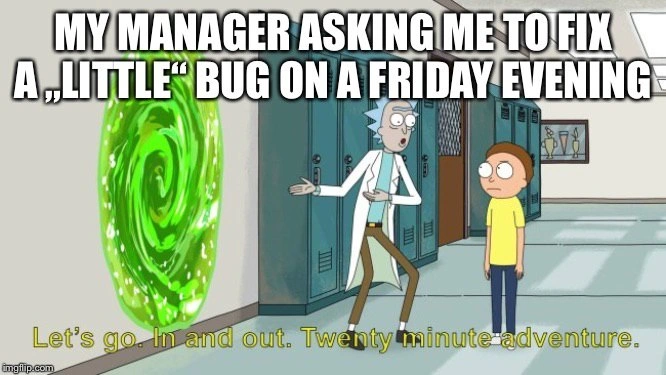
Let’s unpack the meme in simpler terms. In the picture, we have characters from the animated show Rick and Morty. Rick is the tall guy with blue hair – a genius scientist in the show – and Morty is his anxious teenage grandson. They’re standing in a school hallway next to a glowing green portal (a doorway to another world). In this meme, Rick is labeled as “My manager asking me to fix a ‘little’ bug on a Friday evening.” Morty is like the software developer being told to come along for this quick task. Rick famously says, “Let’s go. In and out. Twenty minute adventure.” He thinks it will be really fast and easy. The humor is that fans of the show know Rick’s “20-minute adventures” always go wildly out of control. And in real-life software development, a manager saying a task will be quick often means they underestimate it.

Now, what’s a bug? In software, a bug is a mistake or error in the code that makes a program act in ways it shouldn’t. It could be a button that doesn’t work, a calculation that’s wrong, or an app crashing when you try a certain action. Bugs range from very minor (text on a page is misaligned) to very serious (the app keeps crashing for all users). When a bug is discovered, especially in an app or website that’s already live for users (we call that production), the development team has to fix it by changing the code. A small bug fix might involve altering a few lines of code to correct the logic.

So why is fixing a “little” bug on Friday evening a big deal? Think of Friday evening as the end of the work week. People are wrapping up, and many team members (QA testers, other developers, managers) are about to go offline for the weekend. If you release new code or changes right at that time (we call this a deployment to production), you’re doing it when almost no one is around to monitor or help if things go wrong. There’s even a common saying among developers: “Never deploy on Friday.” The reason is simple: if a change causes problems, it could take hours to fix, and you might end up working late into Friday night or through the weekend.

In this meme, the manager is asking for a quick fix of a bug late on Friday. Managers or project leads sometimes call an issue “small” or “just a quick fix” to encourage it to be done immediately – they likely mean no harm, they’re just eager to have the problem solved. They might not realize that even a one-line code change can have unexpected consequences. The developer (like Morty, who looks worried in the image) is the one who actually has to do the fix and deal with any fallout. Developer frustration comes from experience: often what seems like a “small” change isn’t small at all.

Let’s say the bug is something simple on the surface, like a typo causing a button on a website to appear in the wrong color. The manager thinks, “Oh, that’s just a tiny cosmetic fix, let’s do it right now so we can close the ticket.” If it truly is just a typo in a CSS file, maybe it really is quick. But in many cases, bugs are deceptive. For example, that “little” bug might be that a user’s data isn’t saving correctly. A manager might think, “Just save the data properly, how hard can that be?” But a developer knows this could involve multiple layers: the front-end form, the back-end server logic, the database – and the bug might be in any one of those layers (or how they talk to each other). It could be a simple fix like adding a missing condition, or it could reveal that a whole part of the system isn’t working as expected.

Crucially, after fixing a bug in code, the changes need to be deployed to production (meaning, you release the updated code to the servers/users). With any deployment, there is a risk: the change that fixes the bug could accidentally break something else. Why would that happen? Because software systems have many interconnected parts. Changing one part can affect another, especially if there aren’t comprehensive tests. Maybe the “little bug fix” wasn’t tested in all scenarios because it was rushed on Friday. For instance, you fix the user data saving issue, but now users with older accounts can’t log in – because your change unintentionally didn’t account for some older data format. These kind of side effects are common if changes are made hastily or without full testing.

The Rick and Morty quote “In and out. Twenty minute adventure.” is the manager insisting it will be fast – implying, we’ll be done in 20 minutes, no big deal. As developers, we chuckle because we’ve had managers say things like “it’s just a small tweak” or “should be done in no time” and it almost always turns into a much longer task. It might start small, but then you hit a snag: maybe the code is more complicated than expected, or fixing the bug exposes another bug. It’s like when you try to quickly straighten a framed picture on the wall, and suddenly the frame falls and the glass breaks – now it’s a bigger mess than before.

On-call duty is another aspect hinted at by “weekend overtime.” Many development teams have an on-call rotation, meaning one team member must be available to respond if something goes wrong with the production system outside of normal working hours. If you happen to be the developer who deployed a fix on Friday, guess who might get the call at 11 PM if the app starts having issues? You. On-call humor in the developer community often includes scenarios where someone’s relaxing Friday night is interrupted by a pager or phone notification about a system crash. That’s why deploying late on Friday is dreaded – it increases the chance you’ll be called to fix things on your own time.

The management underestimation in the meme is the boss thinking it’s a minor issue that can be solved immediately (“little bug”) and not foreseeing any problems. The senior dev cynicism (the knowing skepticism that experienced developers have) is embodied by Morty’s uneasy face. A senior dev might respond to “fix this little bug now” with, “If it’s really little, why not wait until Monday when we’re fresh and have the whole team?” They know that haste makes waste in software. But managers sometimes have deadline pressure or just want to impress a client by saying “we fixed it, no waiting!” It’s a clash of perspectives: move fast and please stakeholders versus move carefully to avoid disasters.

To a newer developer or someone just starting out, this meme is a friendly warning. You might not have experienced it yet, but nearly every programmer eventually has a story of “I thought it would be an easy fix, but…”. Maybe during a school project or an internship, you’ll relate: you change one thing to solve a bug and suddenly five other things break. It teaches you to be cautious. The meme exaggerates it with a sci-fi portal and a weekend lost to work, but the core lesson is real. If someone says “it’s a quick fix, do it right now (on a Friday)”, be careful. It could indeed open a portal to a lot more trouble than expected.

In summary, the meme is funny to developers because Rick’s absurd confidence (“20 minute adventure!”) mirrors the optimistic timelines we sometimes hear from non-engineers, and Morty’s hesitant stance is exactly how we feel inside. We laugh because we know that a “20-minute fix” on a Friday can turn into hours of debugging. It’s a shared joke about developer frustration: the phrase “quick bug fix” often ends up being anything but quick. And if you ever find yourself in that position, just remember this meme and know you’re not alone – it’s a rite of passage in software development to have at least one “Friday night bug” story to tell!

Level 3: Portal to Prod Purgatory

The meme perfectly skewers a classic late-week horror story in software development: the Friday evening “quick bug fix” that spirals into an all-night or weekend ordeal. In the image, Rick (the wild scientist from Rick and Morty) represents the overly optimistic manager. He’s flinging open a glowing green portal – enticing Morty (the developer, looking worried) to jump in. The top caption shouts: “MY MANAGER ASKING ME TO FIX A ‘LITTLE’ BUG ON A FRIDAY EVENING.” If you’ve been around the industry, you can practically feel the dread in those quotes around “little.” That’s manager-speak for “I think it’s trivial, so it shouldn’t take you long, right?” Meanwhile, every seasoned dev’s internal alarm bells are ringing.

Rick’s famous line from the show, “Let’s go. In and out. Twenty minute adventure,” appears at the bottom in bright yellow text. In context, Rick always says this expecting a quick jaunt, but it inevitably escalates into a chaotic saga. Here it’s the manager’s reckless optimism on full display. Famous last words. The experienced developer (Morty in this scenario) knows that a “20-minute” hotfix on a complex production system is a fantasy. It’s never just 20 minutes. In reality, that glowing portal leads straight to production debug hell – a dimension of endless log spelunking, urgent rollbacks, frantic Slack messages, and cold leftovers for dinner.

Why is this so funny to devs with battle scars? Because we’ve all lived it. It’s Friday 5:00 PM, you’re packing up to finally relax, and then the boss pipes up: “Hey, just a minor bug in the login form. Should be a quick fix, can you handle it before you go?” The bug itself might be small – say, a null pointer exception when a user has a blank profile field. Sure, probably a one-liner change. But here’s the catch: even a one-line change can unleash a cascade of unintended consequences in a complex application. The codebase is like a precarious Jenga tower (or perhaps a house-of-cards architecture no one admits is a house-of-cards). One wrong move and the whole thing topples. That “little” bug might be sitting on top of a shaky stack of other assumptions and quick patches. Change the wrong thing at the wrong time, and you’ve opened a portal to every hidden flaw that’s been lurking. Suddenly that simple fix snowballs: the login fix triggers an error in the user profile service, which overloads the notification service, which… you get the picture. The entire emergency patch cycle kicks off like a Rube Goldberg machine of failure.

Let’s break down the anatomy of this Friday deploy disaster step by step, because it’s practically an IT legend:

  • Manager’s request: “It’s a tiny bug, just fix it real quick.” – The manager sees a quick win before the weekend. They often underestimate the technical complexity (maybe they’re non-technical or under deadline pressure). The quotes around “little” in the meme hint that the dev knows this request is suspect.
  • Developer’s hesitation: Seasoned devs have that Spidey-sense tingling: deployments late on a Friday are how you summon Murphy’s Law. The code might build and pass tests (if you even have time to run them), but decades of collective experience say something will go wrong in production. As an old saying goes, “One does not simply deploy on a Friday.”
  • Rushed fix implementation: You quickly hack the code to address the bug. Maybe it truly is a one-line change in validateUserInput() or a small config tweak. You run the app locally, it seems fine. Due to time, you skip some regression tests or code review. After all, Rick’s voice in your head is saying it’s a “20 minute adventure.” You just want to push it out and go home.
  • The initial deployment: You deploy the fix to production (the live system). For a brief moment, it feels like Rick’s promise might hold – the fix is out, and everything is quiet…
  • Unforeseen side-effect: Then reality hits. The new code causes an unintended side-effect. Perhaps that “small bug” was masking a deeper architectural flaw. For example, your change to the login form now exposes a memory leak in the session manager that only kicks in under real user traffic. Or maybe the “little bug” was in a shared library, and your fix wasn’t backwards-compatible, causing another module to misbehave. In a microservices setup, that tiny tweak in Service A might break the API contract with Service B. In a monolithic app, that one-line change might throw off an entire flow elsewhere (the classic butterfly effect in software).
  • Production meltdown: Errors start spamming the logs. Alerts fire. PagerDuty starts pinging whoever is on-call. Users begin noticing the app is slow or parts of it aren’t working. The “quick fix” has now triggered a production issue far worse than the original bug. You find yourself rolling back the change (assuming there’s a quick rollback path – sometimes there isn’t if the fix involved a database migration or config change). The system might even go down or enter a degraded state. Now it’s a full-on firefight to restore normalcy.
  • Overtime and on-call pain: Instead of heading out for the weekend, the developer (and often a couple of unlucky teammates rousted out of their Friday night) are now knee-deep in emergency debugging. Out come the sweat and tears: tailing log files, frantically writing another patch or script to patch the patch, maybe even SSH-ing into servers to apply manual fixes (the stuff of Deployment Horror Stories™). Pizza gets ordered, spouses get texted “I’ll be late.” That “twenty minute adventure” has become an all-hands overnight marathon. Many of us have been that developer in the data center at 1 AM, or that groggy engineer fielding a 3 AM on-call phone alert because of a so-called “little bug fix” gone sideways.
  • Aftermath: By Sunday (if you’re lucky) or Monday morning, things are finally back to stable. The team is exhausted. What was supposed to be a trivial patch ended up requiring a full incident post-mortem. In Monday’s meeting, the manager might sheepishly ask, “So... you still worked on it, didn’t you?” Everyone knows the answer. The incident gets a Jira ticket and a blame-free analysis write-up titled something like “Root cause: over-hasty Friday deployment of untested fix.” And the dev team gently reminds management why change policies exist (and maybe adds a new rule: no changes on Friday after 2 PM unless absolutely necessary).

To summarize the comedic contrast, here’s how the manager’s expectations stack up against the developer’s reality:

What the Manager Says What the Dev Hears What Actually Happens
“It’s just a small bug, easy fix.” No bug is truly small in this codebase… The bug is a symptom of a deeper issue.
“This should take 20 minutes.” Famous last words — probably all night. It takes all evening (or all weekend).
“Just do a quick patch now.” We’re skipping normal tests & process. The rushed patch breaks something else.
“We need it fixed today.” Pressure to deploy on a Friday, yikes. Change goes live at 6 PM Friday – risky!
“Great, see you Monday!” If it blows up, I’m on my own. On-call phone buzzes at 11 PM Friday.

Everything in that table is painfully familiar to anyone who’s dealt with management expectations vs. technical reality. The humor (and horror) comes from the huge gap between the manager’s carefree assumption (“in-and-out, 20 minutes”) and the developer’s lived experience (“this will be a long night”). It’s a form of collective developer catharsis – we laugh to keep from crying at how accurate it is. This meme is effectively a battle-scarred in-joke: even though it references a wacky sci-fi cartoon, it’s poking fun at a very real IT workplace dynamic. It highlights how non-technical folks often underestimate the complexity of software bugs, and how overconfident promises (“quick adventure!”) often lead to unintended journeys through Weekend Overtime Land.

Underneath the humor, there’s a reason so many dev teams have policies or unwritten rules like “No Friday Deployments”. Systems tend to fail in the most diabolical unpredictable ways when changes are rushed. Part of it is Murphy’s Law, part of it is just the inherent complexity of modern software. By Friday evening, people are tired, the A-team of reviewers might be offline, and if something goes wrong, it’s harder to muster help. In distributed systems or large legacy codebases, even a “tiny” change can have a disproportionate impact – think of it like tapping one domino in a line and inadvertently knocking down dozens. Seasoned developers have seen how a minor-looking bugfix can interact with a dozen other modules or microservices. Maybe that “little bug” was actually preventing a bigger bug from surfacing (a sort of weird Heisenbug situation), so when you “fix” it, a bunch of latent issues come bursting forth. This is why senior devs tend to be a bit cynical (or realistic, as we like to say) when management asks for a last-minute change. We’ve learned, sometimes the hard way, that software is complex and nothing is truly trivial, especially not at 5 PM on a Friday.

In summary, this meme hits home because it’s grounded in truth. It exaggerates with a portal to another dimension, but any dev who’s been on-call will tell you it feels that way when a “20-minute” Friday fix turns into a 48-hour debugging saga. It’s equal parts comedy and PTSD flashback. So when we see Rick (the manager) beckoning Morty (the unwilling developer) toward that glowing portal, we laugh – and maybe cringe – because we all know Morty isn’t going home anytime soon. He’s about to discover that “little bug” was actually a gateway to production purgatory, and the twenty-minute adventure is just getting started.

Description

This is a meme using the 'In and Out, Twenty Minute Adventure' format from the animated TV show Rick and Morty. The image shows the character Rick Sanchez, a chaotic scientist, gesturing confidently towards a swirling green portal, while his anxious grandson Morty Smith looks on with apprehension. An overlay of white text at the top reads: 'MY MANAGER ASKING ME TO FIX A 'LITTLE' BUG ON A FRIDAY EVENING'. The original dialogue from the show is at the bottom, acting as a punchline: 'Let's go. In and out. Twenty minute adventure.' The humor lies in the dramatic irony familiar to all software developers. A seemingly 'little' bug, especially one reported on a Friday evening, is notorious for turning into a complex, multi-hour ordeal that ruins the weekend. Rick's casual, dismissive confidence perfectly mirrors a manager's underestimation of the task, while Morty's worried expression embodies the developer's realistic dread, knowing the 'adventure' will be anything but short
Comments

7
Anonymous ★ Top Pick The probability of a bug fix actually taking 20 minutes on a Friday is inversely proportional to how confidently your manager states it will
  1. Anonymous ★ Top Pick

    The probability of a bug fix actually taking 20 minutes on a Friday is inversely proportional to how confidently your manager states it will

  2. Anonymous

    Sure boss - I'll slip a "quick" hot-fix through the monolith, three microservices, the CDN, Terraform, and two change-control firewalls; we’ll be out faster than entropy reaches equilibrium

  3. Anonymous

    The 'little bug' was a race condition that only happens when Mercury is in retrograde and someone in Tasmania clicks submit exactly 47 milliseconds after a cache invalidation

  4. Anonymous

    Ah yes, the classic Friday 5 PM 'twenty minute adventure' - where a manager's optimistic time estimate meets the reality of a production bug that inevitably involves: undocumented legacy code, a race condition that only manifests under load, missing observability in that exact code path, and a deployment pipeline that takes 45 minutes per attempt. Spoiler alert: you're not getting out in twenty minutes, and that portal leads straight to a weekend of SSH sessions, rollback strategies, and explaining to your family why you're debugging instead of attending dinner. The real adventure is explaining on Monday why the 'little bug' required a full architectural review and three emergency patches

  5. Anonymous

    Every “twenty‑minute” Friday fix is just the prologue to a three‑hour rollback, five‑region cache warm‑up, and a postmortem titled “CAP theorem meets manager estimates.”

  6. Anonymous

    Every Friday 'quick bug' is Schrodinger's outage: trivial until you open the portal and discover a cross-service contract break, and the only thing that takes 20 minutes is PagerDuty's escalation timer

  7. Anonymous

    Manager's 'twenty-minute adventure': the portal where one null pointer births a multiverse of regressions and forces a monolith refactor

Use J and K for navigation