The 'Code is Art' Debate, Visualized as Code Goulash
Why is this DevCommunities meme funny?
Level 1: Painting with Blocks
Imagine someone said, “Building things with your blocks isn’t creative at all! It’s not real art!” 🧐 Then picture a kid responding by taking those very same plain LEGO blocks and arranging them to perfectly copy a famous painting like the Mona Lisa. 🖼️ That’s exactly what’s happening here, except with programming. One person complained that writing computer code is nothing like making art. It’s like they yelled, “Your little projects are nowhere near as special as a real painting!” In reply, another person used pieces of code (the words and symbols you’d normally use to tell a computer what to do) and drew a picture with them – a picture of the Mona Lisa, one of the most famous works of art ever. They basically said, “See, I can be creative with code!” It’s a funny and satisfying comeback because it shows that even with simple building blocks (here, coding words instead of LEGO or crayons), you can create something cool and artistic. The first person tried to put the coder down, but the coder proved them wrong by turning their code into a little masterpiece. 💻✨
Level 2: Code as Canvas
Let’s break down the scene. A programmer on Twitter (Dorian Develops) loudly claims that programming isn’t creative and code is not art. In his words, your “shitty CRUD app isn’t the Mona Lisa.” CRUD stands for Create, Read, Update, Delete – the basic operations in many simple apps (think of an online contact list where you can add, view, edit, or remove contacts). Calling something “just a CRUD app” is a way some developers belittle straightforward, boilerplate projects as uninteresting or uninspired. It’s like saying, “Eh, you’re just doing paint-by-numbers, not real art.” The Mona Lisa, of course, is the famous painting by Leonardo da Vinci, often held up as one of the greatest works of art. So the tweet is basically yelling: “Stop thinking your code is some masterpiece – it’s not art!” This kind of stance can make folks in dev communities bristle, especially those who pour creativity into coding.
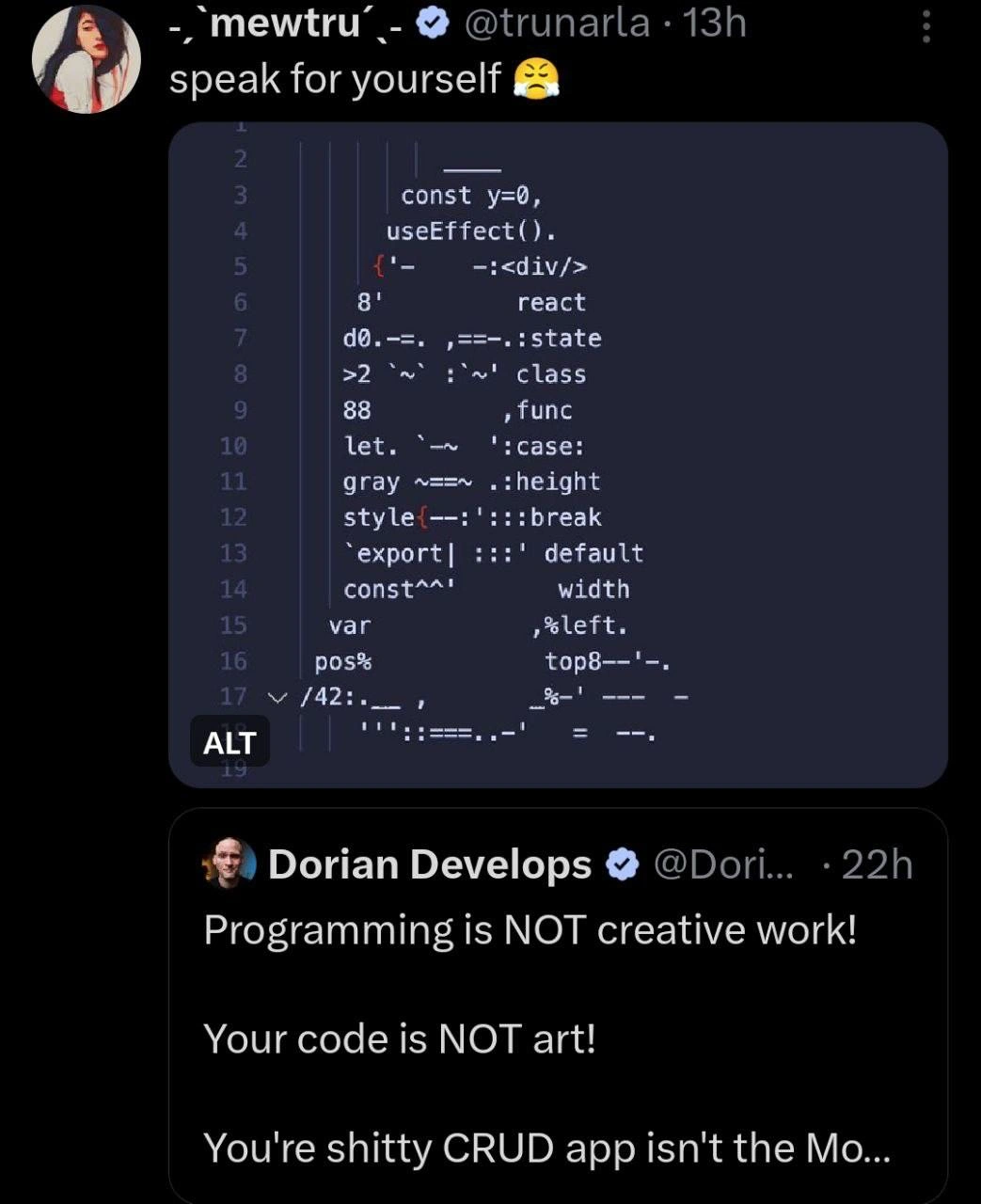
Now, the response from user mewtru is both technical and cheeky. They say “speak for yourself 🖕,” meaning “maybe you feel that way, but I sure don’t!” The middle-finger emoji underscores how strongly they disagree. And then comes the brilliant part: they attach a screenshot of a code editor where the code itself forms a picture. This is an example of ASCII art – making images out of the characters on your keyboard. ASCII art has a long history in computing (think of pictures made of text you might have seen in old forum signatures or code comments). Usually it uses symbols like /, \, _, |, O arranged in a grid so that, when viewed together in a monospaced font (where each character takes equal width), they resemble a sketch. Here, the “sketch” is a silhouette of what looks like the Mona Lisa’s bust. And the twist? The pieces of the sketch are actual programming keywords and symbols from React and JavaScript – the exact stuff one would use in a front-end web app (potentially even in that “shitty CRUD app” being insulted!). We see fragments like useEffect() (which is a React Hook function for running side effects in a component), state (every React dev knows state holds dynamic data in an app), class (a JS/React class component or CSS class reference), style, export default (common in JavaScript modules), and so on. They’re arranged almost like puzzle pieces with stray punctuation ({ '- -:, %-'__, etc.) filling in shading or outline. The code snippet probably wouldn’t compile or run properly – that’s not the point – it’s written to look like a picture rather than to execute logic.
This visual gag turns the code into a canvas. The very tools of a front-end developer become the art materials. It’s as if someone painted a portrait using only the words and symbols from a programming textbook. For context, React is a popular JavaScript library for building user interfaces on the web, and it uses functions like useEffect to handle things after a component renders. Seeing those terms in the “drawing” immediately tells developers, “Hey, this is our front-end world being used creatively!” It’s a perfect bit of FrontendHumor. Also noticeable is the small “ALT” in the corner of the screenshot, indicating there’s alternative text describing the image (which likely explains the ASCII Mona Lisa for screen readers or anyone who can’t see the picture). Even that detail shows the poster’s thoroughness – providing an alt text caption for an ASCII art made of code is a meta kind of accessibility humor.
Why is this funny and satisfying? Well, it directly rebuts the claim. The first tweet essentially said, “Your code will never be art like the Mona Lisa.” The second tweet says, “Oh really? Here’s my React code literally turned into a Mona Lisa. Checkmate.” 😂 It’s a playful twitter_argument_creativity outcome: rather than just arguing with words, the developer uses their coding skills to make a point. This resonates with a lot of developers who do feel creative when they code. It also highlights how even something as rigid as programming text can be bent into an expressive medium. For a junior dev or anyone new to this, it’s a cool revelation: those boring snippets of code can double as art pixels if you’re clever! And importantly, it captures the vibe of dev communities online – a mix of serious tech discussion and tongue-in-cheek CodingHumor. One tweet ignites a debate, and another turns that debate into a creative showcase. In sum, this meme is showing that code isn’t just about correctness and functionality; sometimes, code is culture, expression, and yes, even art.
Level 3: Monospace Mona Lisa
On TechTwitter, flames ignite over whether programming is truly creative work or just keyboard drudgery. In this meme, a bold tweet declares: “Programming is NOT creative work! Your code is NOT art! Your shitty CRUD app isn’t the Mo…” (clearly implying Mona Lisa). This kind of rant is a familiar sight in developer communities – someone basically sneering that cranking out yet another web form or database app is about as artistic as assembling IKEA furniture. Seasoned engineers have seen this debate cycle through the years. Is coding an art, a science, or just a 9-to-5 job? This tweet’s take is blunt: that our everyday apps (especially the basic CRUD kind) will never hang in the Louvre.
Enter the sarcastic clap back from user mewtru. They fire back with “speak for yourself 🖕” and – here’s the punchline – a screenshot of actual React code arranged as ASCII art of the Mona Lisa. Yes, those lines of code form a monospace portrait! The image shows a code editor with line numbers 3–18 shaping a silhouette. If you squint (or have a developer’s eye), you recognize familiar JavaScript/React tokens scattered like pixels: const y=0,, useEffect(),, <div/>, react, .state, class, func, height, export default, width, var, left, top… seemingly gibberish in terms of running code, but very deliberate in visual arrangement. It’s the Mona Lisa, drawn with code keywords as brush strokes. This is an inside joke on multiple levels. First, it’s literally ASCII art – an old-school tech art form – using actual front-end code terms as the “ink.” Second, it directly addresses the bold claim: Oh, my code isn’t the Mona Lisa? Watch me literally turn my code into the Mona Lisa! It’s a clever bit of DeveloperHumor that leaves any experienced dev grinning. The use of real frontend jargon (React’s useEffect hook, component <div/> tag, state management words) as the art supplies makes it extra satisfying. It’s taking the tools of a “shitty CRUD app” and making something whimsical out of them – a modern coding humor renaissance moment, if you will.
From a senior developer perspective, this meme nails a RelatableDeveloperExperience. Who hasn’t sat through architecture meetings or tedious CRUD feature tickets and wondered if there’s room for creativity in our day-to-day code? One side of the industry (often management or cynical veterans) might chime “This is engineering, not art – ship the feature and save the poetry for weekends.” But many of us know the truth: there is creativity in how you solve problems, write elegant functions, refactor nasty legacy code, or even sprinkle Easter eggs in an app. In fact, legendary computer scientist Donald Knuth unapologetically called his famous book series “The Art of Computer Programming.” That’s right – art. The Twitter user’s ASCII Mona Lisa is a fun, defiant reminder of this spirit. It also pokes at how devs often hide playful things in code (like ASCII logos in terminal output or witty comments). Even the “ALT” label on the screenshot hints that the image has alt text describing the art for accessibility – a thoughtful, and ironically artistic, touch for a Twitter rebuttal. All in all, this level of humor resonates with seasoned devs because it transforms a flame-war argument into a tangible example of code_as_ascii_art. It’s a nerdy mic-drop: the code’s not just a CRUD app anymore; it’s literally art on the screen.
Description
A screenshot of a Twitter conversation debating the creativity of programming. The bottom tweet is from 'Dorian Develops' (@Dori...), who provocatively states, 'Programming is NOT creative work! Your code is NOT art! You're shitty CRUD app isn't the Mo...'. The top tweet is a reply from user '@trunarla', who retorts 'speak for yourself 😠' and includes a screenshot of a code editor with a dark theme. The code snippet is a chaotic and visually dense block of what appears to be JavaScript, containing keywords like 'useEffect', 'react', 'const', 'style', and 'export', but arranged in a nonsensical, almost artistic, jumble. This meme captures the perennial philosophical debate within the developer community. The chaotic code serves as a visual rebuttal, implying that wrangling such complexity requires immense creativity, contrasting with the dismissive view that all programming is just building simple CRUD applications. For senior developers, it's a humorous nod to the fact that while some code is straightforward engineering, other code is a messy, abstract, and deeply creative struggle

Comments
21Comment deleted
Of course code is art. Some code is elegant minimalism, and some code is a Jackson Pollock painting created by a webpack plugin during a dependency conflict
“Code isn’t art,” says the engineer whose 15-year-old CRUD monolith is so caked in one-line hotfixes it’s basically impressionist diff-pointillism - at least my React Mona Lisa of useEffects is intentional
After 20 years of arguing whether code is art or engineering, we've finally achieved peak developer discourse: using useEffect() as a brushstroke in abstract expressionist JavaScript that would make Jackson Pollock's CI/CD pipeline throw a NullPointerException
When someone claims 'programming isn't creative work,' the most devastating rebuttal isn't an argument - it's a perfectly crafted ASCII art masterpiece using nothing but React hooks, CSS properties, and JavaScript keywords. This is the senior engineer equivalent of responding to 'your framework choice doesn't matter' by live-coding a compiler in the comments. The real artistry here isn't just the visual ASCII - it's the meta-commentary of using the very tools dismissed as 'not creative' to create something undeniably artistic, all while maintaining syntactically valid-looking code structure. It's like proving Turing completeness by implementing Conway's Game of Life in CSS selectors: technically unnecessary, absolutely beautiful, and guaranteed to make the 'CRUD app' critics reconsider their life choices
Code isn’t art? A React file mixing var, class, and hooks is a full retrospective - ESLint’s the curator, PagerDuty’s the critic at 3 a.m
Your 'artistic' useEffect isn't the Mona Lisa - it's the tech debt masterpiece that survives three refactors and still leaks memory
If programming isn’t art, why did my React diff ship a portrait drawn with useEffect and export default - the only commit where Prettier doubled as a brush?
While the definition of art may be contested, programming does require some sort of creativity or at least my weird scripts sometimes end up in weird overthought places Comment deleted
*is confused on how this keeps getting hearts and is probably her most popular post in this group* Comment deleted
https://youtu.be/DEqXNfs_HhY?si=ild0gaus4GpGtK08 Comment deleted
SHAME TO U FOR TRACKING LINK Comment deleted
Can't take seriously someone who doesn't know how to use you're Comment deleted
Get tracked Comment deleted
tracking link? Comment deleted
shit which goes after = Comment deleted
and why is that used? Comment deleted
Google using it to undertsant connection betwen acconts/users Exemple: you send tracking link from youtube to your twitter account Now Google index system will know that your youtube acc and twitter acc are owned probably by you and connected Comment deleted
oh my Comment deleted
welcome to the internet Comment deleted
Your* Comment deleted
Please avoid using slurs here Comment deleted