The Inevitable Friday Afternoon Bug
Why is this Bugs meme funny?
Level 1: Shattered Plans
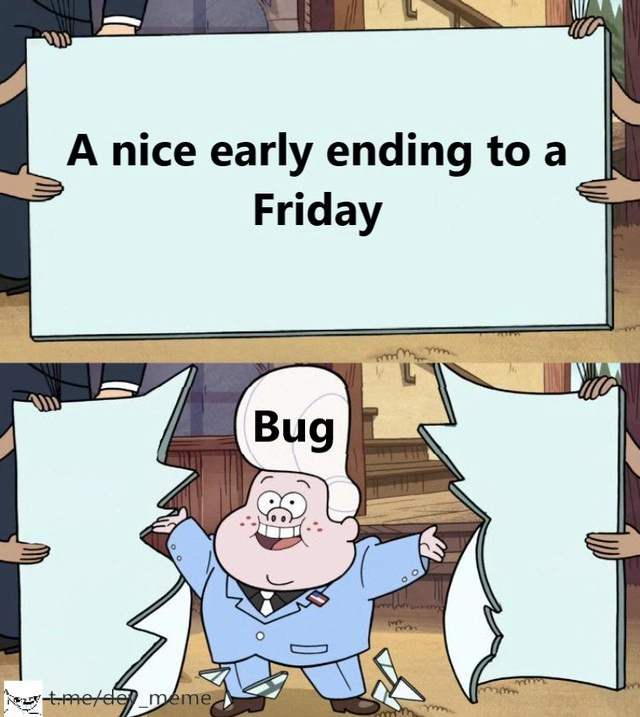
Imagine you’re all set to do something fun, and then right at the last second, something goes wrong that stops you. It’s like you cleaned your room and finished your homework early so you could play video games or go outside, but just as you’re about to start having fun, you spill a big glass of juice all over the floor. Now, instead of playing, you have to spend time cleaning up the sticky mess. Feeling pretty upset, right? In this meme’s story, the developer thought they were done with work early on Friday (that’s the fun plan), but then a bug (which is like a sudden problem) appeared and wrecked that plan – just like the spilled juice ruined playtime. The picture shows a sign that said “A nice early ending to a Friday” being torn in half, which is just a funny way to say “no early Friday for you.” In simple terms, it’s about that oh no! moment when you realize you can’t do the relaxing thing you wanted because you have to fix an unexpected problem first. It’s both frustrating and a little funny, kind of like how you might laugh later about the juice spill (after it’s cleaned up). The meme makes us smile because we’ve all had plans go wrong at the last minute, and we know exactly how that feels.
Level 2: On-Call Chaos
Imagine it’s Friday afternoon at a software company. You’ve finished your work and you’re looking forward to logging off early to start the weekend. Now picture the exact opposite happening: right at the last moment, someone discovers a bug in the software that’s running on the live site. This is not just any bug – it’s a production bug, meaning it’s in the version of the application that real users are interacting with (often called production or prod). When a serious bug appears in production, it’s a big deal because it can affect many customers or critical business operations. Suddenly, that relaxing early evening turns into an emergency debugging session.
In developer lingo, an on-call engineer is the person (or team) designated to respond if something breaks outside normal hours. Many companies have an on-call rotation – essentially, if you’re “on-call,” you must be reachable to handle urgent productionIncidents. There’s even a popular alert system called PagerDuty that will literally page or push notifications to the on-call person’s phone when an incident occurs. In this scenario, as you’re about to leave, your phone starts buzzing with a PagerDuty alert or a message from a teammate: something is wrong in production and needs immediate attention. Your nice plan for an early Friday exit is ruined in a flash (cue the collective sigh and eye-roll). This is what we mean by OnCall_ProductionIssues – you’ve got to jump into action because it’s your duty to fix the issue, even if it’s inconvenient.
Let’s break down what typically happens when a last_minute_bug pops up at the end of the week:
- 4:00 PM – Feeling good: You’ve wrapped up development tasks for the week. All tests passed, deploys were done, and things seem stable. You’re thinking, “Great, I might actually get to leave a bit early today!”
- 4:30 PM – Uh oh: A teammate or automated monitor notices something off. Say users are complaining they can’t log in, or an error counter on your dashboard suddenly spikes. There’s a problem in the live system (end_of_week_incident starting to brew).
- 4:45 PM – Alert! The issue is confirmed as a serious bug in software that’s affecting customers. The on-call engineer gets a notification (e.g., via PagerDuty or a big red alert in Slack). Perhaps a message like “Service X is down – urgent investigation needed.” Everyone’s attention snaps back to work mode.
- 5:00 PM – All hands on deck: Instead of heading out, the development team is now huddled around their computers (or on a video call) trying to debug the issue. There’s some deployment anxiety because if a fix is needed, they’ll have to deploy new code on Friday evening – something many avoid due to the risk.
- 5:30 PM – Debugging frustration: The team is digging through logs and error messages. Maybe they find a recent code change that could be the culprit. It’s a tense atmosphere. People are a bit stressed – this bug is a blocker for going home.
- 6:30 PM – Hotfix in progress: After identifying the cause, someone writes a quick fix (often called a hotfix) to patch the bug. They carefully test it (as much as time allows) and deploy it to production. This is done nervously because deploying under pressure can be scary; if the fix doesn’t work or breaks something else, that’s even more trouble.
- 7:00 PM – Issue resolved: Thankfully, the hotfix works. The bug is squashed, and the system is back to normal. Only now do you realize it’s well past the time you hoped to leave. So much for that “early Friday” – it turned into weekend_overtime pretty quickly.
As you can see, what started as a hopeful early sign-off became an overtime firefight. In the meme, the giant sign “A nice early ending to a Friday” is basically that 4:00 PM optimistic feeling. The grinning character labeled “Bug” ripping the sign represents the bug wrecking those plans, just like in our timeline where the bug forces everyone to stay late. It’s a tongue-in-cheek way to show how a software bug can shatter plans in an instant. The reason this scenario is so recognizable (and meme-worthy) is because many developers have been through it. It’s almost a running joke in IT: if you want a quiet Friday, expect the unexpected.
Let’s clarify a few terms from the scenario: bugs are errors or flaws in software that cause it to behave unexpectedly or incorrectly. Every developer, even juniors, deals with bugs – it’s part of writing code. A production bug means that flaw is in the version of the software that is currently running for users or customers (as opposed to a bug in a development version that only developers see). Production bugs are urgent because they can impact real transactions or user experience. Being on-call means you are responsible for responding to these urgent issues during a certain period. If you’re on-call on a Friday evening and a critical bug appears, you’re the one who gets that phone alert and has to start the fix. Companies often use tools like PagerDuty (which is practically synonymous with getting an emergency IT alert) to manage this – it will keep messaging/calling the on-call person until the issue is acknowledged.
We also mentioned hotfix: this is a quick fix deployed to address a serious bug in production. Think of it like an emergency repair. If a bug is causing login failures for all users, you might need to bypass the usual longer release process and push a targeted patch ASAP – that’s a hotfix. Of course, hotfixes are done carefully, because doing anything in a hurry on live servers is risky. Some teams might instead opt to roll back the software to an earlier version that didn’t have the bug (when possible). That can sometimes be the safer move late on a Friday. However, rolling back might not always be easy if the system or data has changed.
Why do these bugs often pop up on Fridays? It’s not that the code knows what day it is, but there’s a bit of truth in joking about it. All week, developers might be shipping new code and features. Friday is often a deadline for getting changes out before the weekend or before a code freeze. That increased activity can introduce last-minute issues. Also, by end of week, people are a bit tired and might miss something, or they’re rushing to meet that deadline. Sometimes teams avoid deploying on Friday for this exact reason – no one wants to risk breaking things right before the weekend. But despite precautions, surprises happen. It’s almost a superstition in tech: if something can go wrong late in the week, it eventually will. Hence the meme’s comedic exaggeration of a “bug” figuratively ripping up your early Friday finish.
This meme uses a scene from a cartoon (Gravity Falls) – the character with the big white hair is normally a kid villain in the show. Here, the community has repurposed him to symbolize a devious software bug. Even if you don’t know the show, the visual gets the point across: a smug troublemaker destroying something valuable (your free time). For a junior developer (or anyone new to on-call duty), this meme is a humorous introduction to a hard truth: production issues don’t follow your schedule. You have to be ready for that occasional late-night or weekend emergency. It’s a bit of gallows humor shared among developers to cope with the stress. When you see this image captioned “That last-minute bug that shreds your early Friday exit plans,” you immediately understand the feeling, even if you haven’t experienced it yet. It’s funny because it’s relatable – you laugh, but you also make a mental note: next time, be cautious around Friday, and maybe don’t brag about leaving early until you’re actually out the door!
Level 3: The 4:59 PM Surprise
There's an unwritten rule in software teams: never deploy on a Friday. Why? Because if something can break, it will break at the worst possible moment – usually 4:59 PM on Friday when everyone’s packing up. This meme nails that scenario. The top panel’s sign reading “A nice early ending to a Friday” represents every developer’s weekend dream, and in the bottom panel that dream gets literally torn apart by a grinning, pompadoured Bug. It’s a personification of that last-minute production issue gleefully shredding your early logoff plans. Seasoned engineers laugh and cringe at this because they’ve lived it: a critical bug surfacing right before the weekend, blowing up what should have been a calm Friday evening. In the on-call world of ProductionIncidents, this pattern is so common it’s basically tradition – hence the dark DeveloperHumor in this meme.
In real life, a last_minute_bug like this can trigger full-on OnCall_ProductionIssues mode. Picture it: your team’s phone or laptop suddenly lights up with an alert. Maybe an automated monitoring system flags a spike in errors, or a frantic Slack message appears from QA:
PagerDuty Alert: Critical outage in production.
Error rate exceeded threshold in the payment service.
Severity-1 – immediate attention required.
Your heart sinks. That pagerduty_page at 5 PM on a Friday is the developer equivalent of a fire alarm at the end of the day. This means an urgent ProductionBug is affecting users. Perhaps customers can’t check out in your e-commerce app, or a critical microservice just started throwing HTTP 500 errors. Whatever it is, it’s all hands on deck. The whole team’s evening is about to be spent debuggingFrustration instead of unwinding. The meme’s torn sign perfectly captures that vibe of plans obliterated. Four hands hold up the plan (the team excited for an early weekend), and Bug (the villain of our story) rips it to shreds with a big grin. It’s funny because it’s true – bugs have a knack for arriving at the worst times, almost as if deploys have a built-in Murphy’s Law.
From a senior dev perspective, there’s a mix of deploymentAnxiety and grim expectation here. Software systems are complex, and even with good practices, an end_of_week_incident feels inevitable occasionally. It could be that deadline-driven development led to a rushed change that wasn’t thoroughly tested. Maybe someone merged a last-minute PR at 3 PM Friday to meet a deadline, thinking “It’s a minor tweak, what could go wrong?” (Rookie mistake, cackles the cynical veteran inside us). Or perhaps an existing bug had been dormant and only now, due to some rare condition, decided to rear its head in production. Experienced engineers have seen both scenarios. They know that even with rigorous CI/CD pipelines and tons of tests, there’s always that one edge case. Like a subtle timezone glitch that only triggers when the server’s clock hits midnight UTC – which happens to be Friday evening local time, naturally. Or a memory leak that only becomes obvious after a week of uptime. These gremlins lie in wait until the worst possible moment to manifest. BugsInSoftware don’t follow our schedules.
The result? Instant on-call chaos. PagerDuty or a similar system blasts out alerts. The on-call engineer (or whoever discovered the problem) scrambles to assemble an incident response: hop on a Zoom/Teams war room call, notify stakeholders, and start scouring logs. The debuggingFrustration sets in as you sift through stack traces and metrics under pressure. Is it the database acting up? Did a new deployment introduce a regression? Maybe it’s an infrastructure glitch (hey, “It’s always DNS” isn’t just a joke – maybe the bug is literally some DNS misconfiguration that decided to misbehave late Friday!). Meanwhile, managers and product folks are pinging: “Is it fixed yet? How serious is it?” No one is going home until this ProductionIncident is resolved or at least mitigated. If the meme’s Bug character had a voice, he’d be saying, “Not so fast, you aren’t done yet!” with that mischievous grin.
To fix a production bug at the eleventh hour, teams often perform a hotfix – a quick patch deployed directly to the live environment to address the issue. Hotfixing on a Friday evening is high-stress: you’re making changes in a hurry, possibly bypassing the usual code review or full test cycle because the situation is urgent. This carries risk – a rushed fix can introduce new bugs if you’re not careful. But when users are impacted, you do what you must. Sometimes the safer move is a rollback (revert to an earlier stable version) if the bug came from a recent release. Of course, rolling back on Friday is its own adventure, especially if the system has had other changes or if data migrations are involved. It’s a damned-if-you-do, damned-if-you-don’t scenario. The team might be weighing, “Do we deploy a fix right now or temporarily take the feature offline until Monday?” Either way, early drinks at Happy Hour are off the table.
All of this happens while the rest of the company might already be enjoying the weekend. It’s a lonely feeling patching code in a quiet office (or from home) on a Friday night. The irony is thick: all week you follow best practices, and then one stray bug dictates your Friday evening. No wonder veteran devs are a bit cynical. They joke that the code can sense when you have weekend plans. Announce “I might log off early today” in the team chat, and you’re virtually jinxing yourself – cue a critical alert within the hour. It’s like the software gods demand a sacrifice of weekend_overtime now and then.
To cope, many teams implement a code freeze on Fridays: no new releases unless it’s an emergency. This practice arose precisely to avoid the “Friday fire drill” this meme highlights. Yet, emergencies still happen. Hardware can fail, third-party APIs can go down, or an undiscovered bug can surface from past changes. So even with a freeze, you might get that panicked call: “Prod is down!” Developers who have been on-call for production issues carry a bit of PTSD – they’ve been the ones getting a PagerDuty alert during dinner, racing back to a laptop. The meme resonates strongly because it encapsulates that shared trauma in a lighthearted way. We laugh so we don’t cry. The cartoon style (a repurposed scene from Gravity Falls, with the character’s hair labeled “Bug”) makes it comical, but every dev knows the underlying truth isn’t far-fetched.
In summary, the humor works on multiple levels: it’s an exaggeration of the deploymentAnxiety every engineer feels before the weekend, and it’s a nod to a very real phenomenon in tech culture. The “nice early Friday” is the optimistic scenario we all hope for; the grinning Bug tearing it apart is reality snapping back. It’s the perfect depiction of how a friday_bug can ruin your day. Senior engineers smirk at this meme because they’ve lived through that exact moment – many times. They know that feeling when a single unexpected issue shreds not just paper, but your whole evening’s plans. As a result, a meme like this is equal parts catharsis and cautionary tale: Never celebrate too early, especially not on a Friday. The battle with Bugs isn’t over until you’re actually out the door (and even then, keep your phone on loud just in case).
# Murphy's Law encoded in code form:
import datetime
now = datetime.datetime.now()
if now.strftime("%A") == "Friday" and now.hour == 16 and now.minute == 59:
raise ProductionBug("Your weekend is ruined by a last-minute bug!")
Description
This is a two-panel meme format from the animated series 'Gravity Falls'. In the first panel, a large sign is held up that reads, "A nice early ending to a Friday," representing a developer's hope for a peaceful start to the weekend. In the second panel, the character Gideon Gleeful, with the word "Bug" superimposed over his head, bursts triumphantly through the sign, shattering it. This meme humorously and painfully captures the all-too-common experience of a critical, unexpected bug appearing late on a Friday, completely derailing any plans for an early departure and often leading to late-night or weekend work to fix it before it impacts users
Comments
7Comment deleted
Bugs are like quantum particles; they don't exist until observed. And they are most easily observed at 4:59 PM on a Friday
Friday 2:58 PM: laptop goes into the bag. 2:59 PM: a cron job last touched in Subversion ’07 fires, torches prod, and I’m suddenly the on-call archaeologist
The bug that shows up at 4:47 PM on Friday is always in that one service nobody's touched in six months, written by someone who left the company, with a comment that just says "// temporary fix - TODO: refactor this properly"
The universal law of software engineering: the severity of a production bug is directly proportional to how close it appears to the weekend, and inversely proportional to how many people are still around to help fix it. Every senior engineer knows the cardinal rule - never deploy on Friday unless you're prepared to spend Saturday explaining to your family why 'just one more rollback' is taking three hours
Nothing stretches a Friday longer than a “minor bug” that bypasses the feature flag, forces a rollback through three migrations, and promotes the canary to incident commander
My calendar’s “leave early” event is basically a webhook that summons a sev1 Heisenbug in prod
The one prod bug that achieves perfect availability: zero uptime for engineers' Friday shifts