ChatGPT's Unfortunate Phonetic Problem in French
Why is this AI ML meme funny?
Level 1: Serious People, Silly Words
Imagine you’re watching a very serious news show, and the news anchor keeps saying something that sounds like “my cat farted” over and over with a completely straight face. You’d probably burst out laughing, right? That’s basically what’s happening here! A super-smart computer program got a name that, by pure accident, sounds like a goofy fart joke in French. It’s like if someone named a new robot “BeePeeTee”, and in another language those sounds meant “I burped”. Whenever adults on TV talk about this amazing robot, kids who speak that language hear “I burped” and have to try not to giggle. The funny part is the adults have no idea – they’re being very serious about technology, while the words coming out sound really silly. This contrast — serious people saying silly words — is why everyone finds it so hilarious. It reminds us that languages can be tricky, and even important things can accidentally sound like a joke to someone else!
Level 2: Lost in Pronunciation
Let’s break down why French speakers are hearing “cat, I farted” everywhere, and why that’s AIHumor gold. It comes down to how acronyms are pronounced differently in different languages and a bit of simple French vocab. In English, we say “ChatGPT” just as chat-G-P-T (spelling out the letters G, P, T). French news presenters also spell it out — but here’s the catch: the French pronunciation of G, P, T forms a full phrase! To a French ear, “Chat G P T” sounds exactly like “chat, j’ai pété.” Let’s parse that:
- In French, the word
chat(pronounced “sha”) means cat (🐈). - The letters
G P T, when spoken in French, come out as “jay pay tay.” This is almost indistinguishable from the phrase “j’ai pété”, which translates to “I farted” (💨).
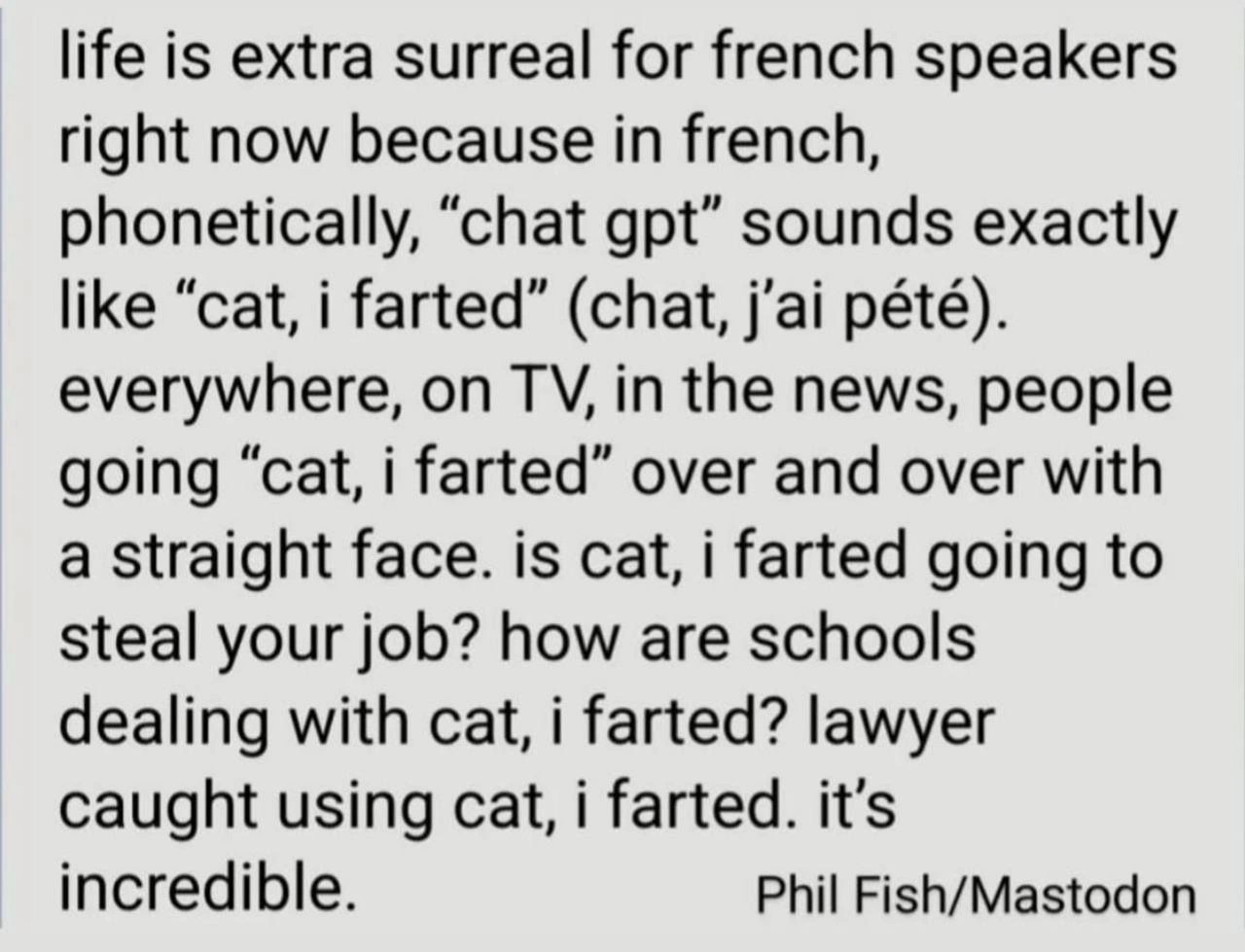
So, ChatGPT pronounced in French = “chat, j’ai pété” = “cat, I farted.” Voilà! It’s a perfect french_phonetics_pun. Now imagine you’re watching TV and the serious host keeps saying that phrase without laughing. It sounds silly (like something a kid would blurt out), but on the news they’re actually talking about a sophisticated AI chatbot. The meme lists a few headline examples:
- “Is ChatGPT going to steal your job?” → To French ears, this sounds like “Is cat, I farted going to steal your job?”
- “How are schools dealing with ChatGPT?” → becomes “How are schools dealing with cat, I farted?”
- “Lawyer caught using ChatGPT in court.” → suddenly “Lawyer caught using cat, I farted.” 🤣
Those scenarios are referencing real discussions in the tech world: the fear of LLMs (Large Language Models) replacing human jobs (llm_takes_jobs_clickbait is everywhere in tech news), concerns about students using tools like ChatGPT to do homework or cheat on exams, and even true stories of professionals misusing AI (like a lawyer who did get in trouble for submitting a brief full of AI-generated errors – prompting headlines about “lawyer uses ChatGPT”). The meme brilliantly parodies these headlines by swapping in the goofy homophone.
For a junior developer (or anyone new to this), it’s a funny reminder that internationalization (often shortened to i18n in developer-speak) isn’t only about translating text in your app – it’s also about making sure your cool product name or tech term doesn’t turn into something bizarre or embarrassing across languages. Internationalization means designing software (or any product) so it can be easily adapted to different languages and cultures. We usually think about things like translating words, handling different date formats, currency, or ensuring encoding (like UTF-8 for Unicode) so characters from French, Chinese, Arabic, etc., display correctly. But here we have a more unexpected aspect: pronunciation. The AIIndustryTrends might get everyone saying an acronym like “GPT” out loud globally, so you’ve inadvertently stepped into linguistic territory. 🤷♂️ Who would’ve thought sound could be an issue? Well, any developer who’s worked on localization (l10n) for global software knows you sometimes have to check that your brand or feature names don’t mean something weird in other languages. There are legendary examples of brands that had to change names because of this kind of thing. This meme’s scenario is basically the tech version of that: a cutting-edge AI tool’s name sounds like a fart confession in French. It’s both a chuckle-worthy AI humor moment and a neat little case study in cross-language quirks.
In short, ChatGPT is the superstar AI chatbot of the moment, and its name, when spoken in French, accidentally creates a homophone (same sound, different meaning) for a phrase that’s more suited to kindergarten humor than evening news. The result? French developers and viewers get a giggle, and we all get a reminder to double-check our naming conventions when we go global. Because sometimes the hardest problem in Computer Science isn’t caching or concurrency – it’s what happens when language itself throws a whoopee cushion under your big product launch. 😅
Level 3: Phonetic Facepalm
In the whirlwind of AI hype, this meme highlights a classic internationalization (i18n) snafu that even seasoned engineers find equal parts hilarious and cringe-worthy. Everywhere you look, mainstream media and industry panels are obsessing over ChatGPT – a cutting-edge Large Language Model at the heart of current AI_ML trends. Serious discussions abound about how this AI might reshape industries (the typical “will it steal your job?” AIIndustryTrends panic), how schools should respond to students using it, and even real court cases where lawyers foolishly let an AI draft legal briefs. But here’s the kicker: in French, “ChatGPT” spoken aloud phonetically comes out as “chat, j’ai pété” – which literally means “cat, I farted.” So French speakers are watching prime-time news segments with completely straight-faced anchors repeating “cat, I farted” over and over. It’s a media_headline_parody come to life: Is cat, I farted going to steal your job? Schools dealing with cat, I farted! You can’t make this stuff up. The ultra-serious discourse around AI and LLMs gets deflated (pun intended) by a simple cross-language homophone. It’s the kind of absurd intersection of tech and language that makes any senior engineer smirk and think, “We can land rovers on Mars, but we still trip over a fart joke on live TV.”
From a veteran developer perspective, this is a textbook language_collision in global branding. It’s a reminder that internationalization isn’t just about UTF-8 encodings, translating UI strings, or supporting right-to-left text—sometimes it’s about how your product’s name resonates (or misfires) in another tongue. Engineers and product managers who have taken software global have war stories of accidentally offensive or absurd translations. This “cat_i_farted_meme” is basically one giant facepalm for anyone who’s dealt with product naming internationally. It’s incredibly on the nose (again, pun intended): a state-of-the-art AI branded with an acronym that turns into potty humor in a major world language. Historically, we’ve seen similar gaffes: for example, car makers learned the hard way when the Toyota MR2 sports car’s name, spoken in French (M-R-2 or “emm-err-deux”), sounded just like merde (French for “excrement”). 😬 Oops. The lesson? Always check your naming against other languages and cultures. You might avoid a facepalm moment where your revolutionary tech’s name becomes playground comedy abroad. In the case of ChatGPT, the creators surely didn’t anticipate French newscasters unwittingly saying “j’ai pété” on air. It’s a benign slip, of course—nobody’s getting hurt—but it perfectly satirizes the IndustryTrends_Hype cycle around AI. After all, nothing punctures overblown techno-optimism like the mental image of a gassy cat sneaking into every conversation. This meme lands so well with senior devs because it merges high-tech chatter with lowbrow linguistics: a LLMHumor gem and a cautionary tale. The next time we launch a globally available app or API, we’ll remember that internationalization includes sanity-checking how our chosen names might sound around the world. Sometimes the difference between cutting-edge and utterly comical is just a phonetic coincidence.
Description
This image is a screenshot of a text post, likely from a social media platform like Mastodon, as it is attributed to 'Phil Fish/Mastodon' in the bottom right corner. The text, in a clear black font on a light gray background, explains a humorous linguistic coincidence: 'life is extra surreal for french speakers right now because in french, phonetically, “chat gpt” sounds exactly like “cat, i farted” (chat, j’ai pété).'. The post then hilariously illustrates this by replacing 'ChatGPT' in common, serious news headlines, such as 'is cat, i farted going to steal your job?' and 'lawyer caught using cat, i farted.' The technical humor lies in the absurd juxtaposition of the world-changing, much-hyped AI technology with a silly, juvenile phrase. For developers and tech professionals saturated with constant discourse about AI's impact, this pun provides a moment of pure bathos, grounding the hype in a simple, funny, cross-lingual misunderstanding
Comments
11Comment deleted
The AI alignment problem is tough, but imagine trying to debug a model in France where every error log just says 'cat, I farted'
Yet another proof that the hardest problems in computer science are cache invalidation, naming things, and apparently - pronouncing them across locales
After 20 years of dealing with null pointer exceptions and race conditions, the real bug in production is explaining to French stakeholders why your AI strategy document keeps making them giggle during board meetings
When your billion-dollar AI product's international rollout reveals that proper i18n testing should have included phonetic collision analysis across Romance languages - because now every French tech conference sounds like a veterinary gastroenterology symposium, and your SEO team is having an existential crisis trying to explain why 'flatulent feline' is trending in Francophone markets
ChatGPT accidentally namespaced as “chat, j’ai pété” in fr-FR - proof that internationalization isn’t a CSS issue; it’s a P0 in the phoneme registry with a blast radius across PR, Legal, and SRE on-call
ChatGPT in French: overfitting to feline flatulence, the ultimate hallucination benchmark for phonetic embeddings
Rare P0: the only fix is either rebrand the model or fork the French language - both are breaking changes
le frônc Comment deleted
ChatGPT4 (four) sounds like, chat, j'ai pete fort , which translates to cat, I farted strong😂 Comment deleted
It's like talking about cookies in hungarian. "Just accept the cookies" (Csak fogadd el a cookie-kat [kuki-kat]). It kind of sounds like "Just accept small penises" Comment deleted
https://chat-jai-pete.fr/ Comment deleted