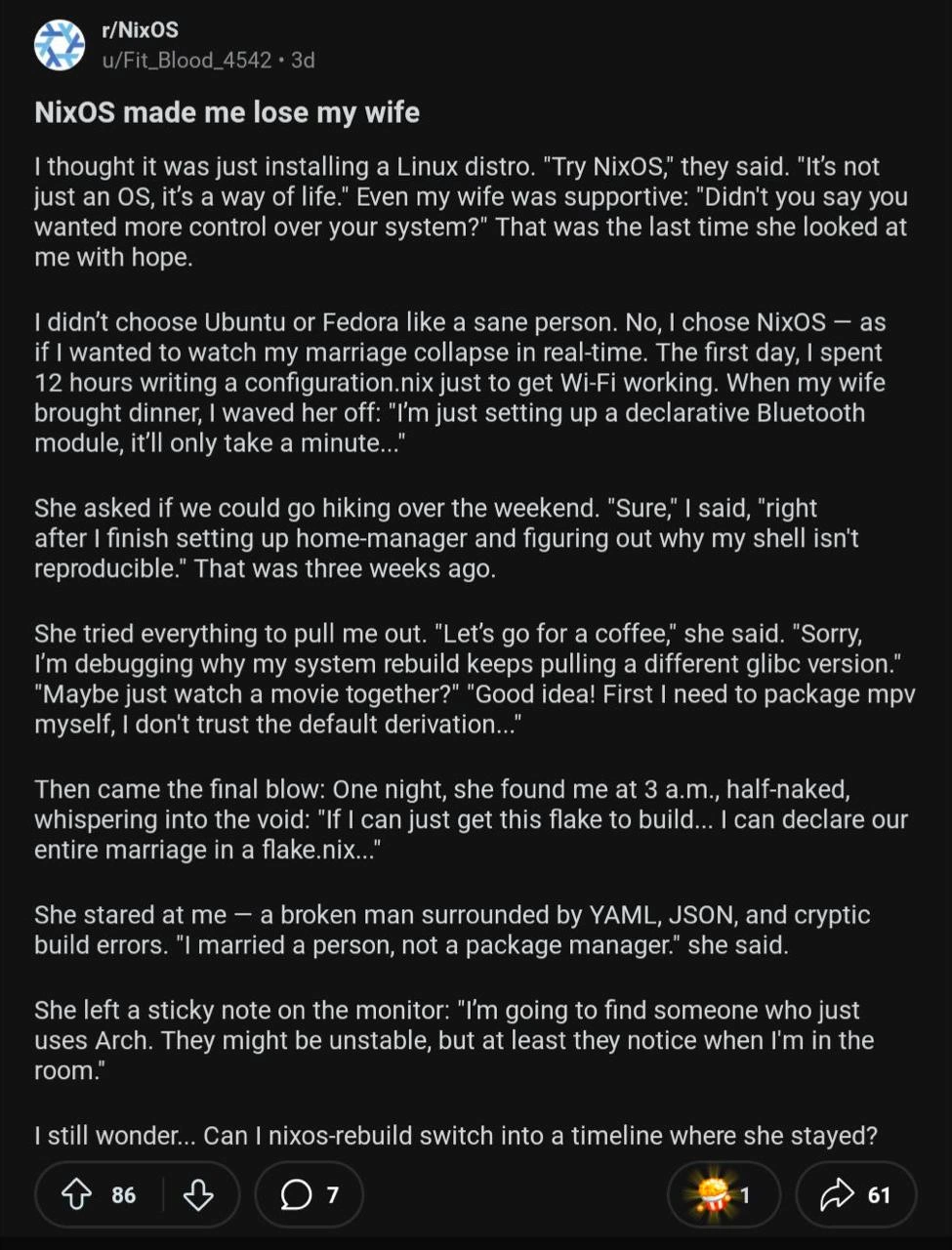
A Cautionary Tale of NixOS and Declarative Widowing
Why is this OperatingSystems meme funny?
Level 1: Too Busy to Play
Imagine a boy named Nick who got a big fancy LEGO set that lets him design anything. Nick starts building a super complicated castle. He wants it to be perfect – every brick in the ideal place. His best friend, Arch, comes over to play. Arch says, “Hey Nick, let’s play with the castle now or maybe play something else!” But Nick keeps saying, “Just a minute, I need to fix this one tiny thing... and this other part... and oh, maybe add this too!” Hours and hours go by. It gets dark outside. Nick’s still hunched over his LEGO castle, swapping little pieces in and out, determined to make it just a bit better, then a bit better again. Arch, the friend, waits and waits. Nick’s so busy concentrating on the castle that he doesn’t even look up when Arch asks if he wants to have a snack or go outside. Eventually Arch gets tired of waiting and leaves to find another friend to play with. Nick finally looks up from the perfectly engineered little castle, and his friend is gone. Now Nick is alone, with an “amazing” LEGO castle but no one to play with or admire it.
This story is kind of funny and a little sad – Nick thought making the perfect castle was the most important thing, but he missed the whole point of playing together. In the same way, the meme’s guy was so busy making his computer “just right” that he ignored his wife. It’s funny because it’s an exaggeration – we don’t really expect someone to choose tweaking a computer over spending time with their loved one – but it makes us smile and nod because it’s a bit like when someone’s so into their hobby that they forget everything else. The simple lesson: no matter how cool or perfect your toy (or computer) is, it doesn’t mean much if you’re playing alone. The meme uses this silly extreme example to remind us to notice the people in the room, not just the project in front of us.
Level 2: Declarative Distro Drama
Let’s break down the situation and terminology for those newer to this corner of tech. The meme is about a Linux user who got way too carried away with a particular operating system called NixOS. First, remember that Linux isn’t a single OS but a family of distributions (“distros”) – like different flavors of the same cake. NixOS is one of those flavors, and it’s pretty unique. Instead of setting up your system piece by piece (like installing programs with commands and editing lots of separate config files), NixOS uses one big declarative configuration file (commonly configuration.nix) where you describe everything you want in your system. When you run the magic command nixos-rebuild switch, the system reads that file and rebuilds the entire OS to match it. Think of it as writing down a recipe for your perfect computer setup – and then the computer actually follows the recipe exactly each time. This concept is known as Configuration as Code (very popular in DevOps and system administration nowadays). It means your OS setup is reproducible: if you take that same config file to another machine (or the same machine later), you’ll get the exact same setup, down to the same app versions and settings. Cool, right? It’s like the opposite of the usual messy manual tweaking; no more wondering “What did I install to get this working last time?” because it’s all listed in one place.
However, the flip side is that writing this giant recipe can be complex, especially for newcomers. In the story, the author says “I spent 12 hours writing a configuration.nix just to get Wi-Fi working.” On a simpler distro (say Ubuntu), getting Wi-Fi might be as easy as clicking your network name and entering a password. On NixOS, you might have to explicitly enable the Wi-Fi service or include firmware drivers in your config. For example, enabling Bluetooth or Wi-Fi on NixOS isn’t a click; you’d add lines to your configuration.nix like:
# Example snippet from configuration.nix
networking.networkmanager.enable = true; # use NetworkManager for Wi-Fi
services.bluetooth.enable = true; # turn on the Bluetooth service
hardware.bluetooth.enable = true; # ensure Bluetooth hardware support
This is illustrative – the real config might need specific options – but you get the idea. Our poor guy spent all day figuring out those incantations to simply get online. When his wife kindly brought him dinner, he brushed her off, saying “just a minute, I’m setting up a declarative Bluetooth module.” A module in NixOS is basically a packaged chunk of configuration (for example, a Bluetooth module would set up the needed packages and settings to make Bluetooth work). Declarative means he’s trying to do it the NixOS way: specifying it in the config file rather than just turning on Bluetooth through a graphical tool.
So why is this funny (and sad)? Well, as he got deeper, he didn’t stop at Wi-Fi and Bluetooth. He went on to set up home-manager, which is another tool in the Nix ecosystem. Home-manager lets you manage your user configuration (things like your shell, editor settings, dotfiles in your home directory) in the same declarative style. It extends the NixOS approach to your personal environment. That means instead of manually editing your .bashrc or choosing your editor theme through a menu, you’d write those preferences in a home.nix config file and apply it. It’s very powerful – you can re-create your whole work environment on another machine in one go – but again, it’s more code to write and debug. The meme says he was trying to figure out why his shell (the command-line environment) “isn’t reproducible.” In simpler terms, maybe he noticed that even after all his configurations, when he opened a terminal something was off – perhaps an environment variable or prompt didn’t look the same on a fresh rebuild, meaning he missed declaring something. For a NixOS perfectionist, that’s like an itch you just have to scratch. So he likely dived into more configuration tweaks to ensure even his shell behaves identically every time. By this point, what was meant to be a quick Linux install became a multi-week rabbit hole of fine-tuning. The meme explicitly says: “Sure,” I said, “right after I finish setting up home-manager and figuring out why my shell isn’t reproducible.” That was three weeks ago. It’s exaggerating, but it reveals how easily one can lose track of time when constantly fine-tuning a system.
Now let’s address some of the specific technical terms and jokes:
glibc: This stands for the GNU C Library, which is a core component of Linux systems (almost every program relies on it to interface with the kernel for basic functions). The post mentions “debugging why my system rebuild keeps pulling a different glibc version.” In NixOS, if your configuration isn’t pinned to specific versions (or if you mix channels), you might unexpectedly get a newer version of glibc for some packages after an update. Essentially, he was puzzled that each time he rebuilt his OS from the config, a slightly different version of this critical library was being used. That’s a pretty advanced (and frustrating) bug to chase – something only a hardcore user would notice or care about. It suggests he was mixing stable and unstable Nix package sources or perhaps using flakes incorrectly, resulting in inconsistent dependency resolutions. The humor here is that he’s solving problems most users never even think about (like which version of glibc is in use) while his real-life problem (ignoring his wife) goes unsolved.
“Maybe just watch a movie together?” – “Good idea! First I need to package mpv myself, I don’t trust the default derivation...” Here, mpv is a popular open-source media player (for playing movies, ironically). In NixOS, “packaging mpv” means writing a Nix derivation for it. A derivation is basically a recipe that tells Nix how to build a package from source. NixOS comes with thousands of pre-made derivations (the “default” ones maintained by the community). Not trusting the default derivation implies he insisted on custom-building the mpv player, maybe to enable a specific option or just out of an obsessive need for control. This is funny because it’s overkill: instead of just using the ready-made package to quickly watch a movie with his wife, he embarks on repackaging it himself. That’s like wanting to bake your own bread from scratch right when someone suggests ordering pizza for a quick dinner together. It shows how deep he is in this mindset – everything must be under his control, even if it’s already available and probably fine. The wife’s suggestion to relax was instantly turned into another technical task. This is a classic case of over-engineering in real life: solving a problem that doesn’t need to be solved (mpv’s default package would have been fine to play a movie).
flake.nix: Flakes are a newer feature of Nix/NixOS. A
flake.nixis a file that defines a Nix “flake,” which is a more structured, lockfile-equipped configuration. Flakes make it easier to pin exact versions of things and share configurations (like your whole config can be a flake that others can use or you can reuse on another machine exactly). In the story, late at night, he was “whispering into the void: ‘If I can just get this flake to build... I can declare our entire marriage in a flake.nix...’” This is both absurd and telling. It means he was struggling to get his flake (maybe a personal config project) to compile without errors. Being up at 3 AM muttering about it shows his obsession. The wild claim about declaring the marriage in a flake is him crossing from tech into insanity – joking (in a deranged way) that if only he could represent their marriage as code, maybe he could control or perfect it the way he’s trying to control his OS. Of course, that’s not how real life works, which is why his wife was so alarmed. This line is a huge red flag in the story that he’s lost perspective. It’s also a final straw for humor: even if you don’t understand flakes, you can gather that trying to encode a relationship in a computer file is a sign of misplaced priorities!YAML and JSON: These are common configuration file formats (YAML is a human-friendly data format often used for config files; JSON is a structured data format as well). The post says “She stared at me — a broken man surrounded by YAML, JSON, and cryptic build errors.” This paints a vivid picture of what his workspace probably looked like: multiple terminal windows or editor windows open, showing
.nixfiles (which have a syntax somewhat between JSON and a programming language) or perhaps logs in JSON format, and error messages from failed builds. Cryptic build errors are those horribly confusing messages you get when something fails to compile or install. They often take a lot of googling to figure out. So, essentially, the wife found him literally and metaphorically in the weeds — immersed in configuration files and error logs at a time when any sane person would be asleep. It’s a scene any developer who has worked late can visualize: cups of coffee, code on the screen, maybe some unintelligible error about a missing dependency… and a very tired, wild-eyed person in the middle of it.“I married a person, not a package manager.” This is what the wife tells him, and it’s a pretty straightforward admonishment. A package manager is a tool like
apt,yum, or in this case Nix, which manages software installation and configuration on a computer. By saying he turned into a package manager, she means all he does is manage packages and configs now, as if that’s his whole identity. It’s a humorous way to say, “you’re acting more like a machine or a tool than a living, loving partner.” In context, for someone not deeply technical: she’s basically saying he’s become one with his computer, forgetting to be a husband. It’s funny because she phrases it in tech terms to get through to him, but it’s also the emotional peak of the story – she’s clearly heartbroken and done with this behavior.Arch Linux vs NixOS: Arch Linux is another enthusiast-friendly Linux distro, famous for its tag line “Keep It Simple, Stupid” (KISS). Arch doesn’t use a single config file like Nix; instead, you manually set it up, and then you typically update it frequently to get the latest software. It’s called unstable in the sense that, since it’s always using the newest versions, things can occasionally break after an update. Arch users often enjoy tinkering too, but usually in a more immediate way (editing config files here and there, installing from the Arch User Repository for special packages, etc.), not via a centralized declarative system. The wife’s note says she’s leaving to find someone who “just uses Arch.” Implicitly, “just uses Arch” means a person who likes Linux but isn’t going to extremes with Nix’s complexity. It’s a lighthearted jab because Arch users are often seen as hardcore too – but compared to what her husband turned into, an Arch user seems downright balanced! The note’s humor is that she’d prefer someone whose computer might be less rigidly stable if that person is more personally stable and attentive. In non-tech terms: “I’d rather be with a slightly crazy guy who at least pays attention to me than with you, who’s obsessing over making everything perfect and ignoring me.” The mention of Arch vs NixOS will get a chuckle from Linux enthusiasts, because those two communities have distinct reputations, and here they’re used as shorthand for two types of nerds: the one who can’t stop tweaking their system and the one who – well – also can’t stop tweaking, but at least doesn’t treat it like a do-or-die mission.
All these technical pieces contribute to the central joke: the guy applied Infrastructure-as-Code principles so obsessively to his personal computer that he neglected his real infrastructure of life (his home, his relationship). In tech lingo, he automated himself out of a marriage. It’s a humorous warning about over-engineering: using a super advanced, complicated solution (like NixOS with flakes and custom packages) for your personal laptop can be educational and powerful, but it can also be a huge time sink. There’s even a common saying in IT: “I spent two days automating a task that takes 30 minutes, which I only need to do once a month.” Sometimes we geeks invest way too much time to save a little time, or to gain perfect control, and that trade-off can be questionable. Here, it’s beyond questionable – it’s portrayed as outright destructive (to his marriage). Of course, it’s an exaggerated joke – nobody actually expects an OS to literally cause a divorce – but it underscores a real feeling. Many developers have had partners or friends playfully scold them for being “married to the computer.” This meme just cranks that scenario up to 11 and sets it in the niche world of NixOS for comedic effect.
To a junior developer or someone new to these terms, the key takeaways are: NixOS is cool but very involved, declarative configuration means writing down everything you want as code, and overdoing it can lead to diminishing returns (or worse). The post blends real Linux config struggles (Wi-Fi setup, config files, package builds) with humor about personal life. It’s relatable if you’ve ever gotten so absorbed in solving a programming/config problem that you lost track of time. And it’s a bit of a parody of us tech folk: sometimes we treat our personal projects with the same seriousness as a mission-critical production system, forgetting that unlike servers, human beings (like a spouse) need attention and can’t just be “configured” to wait indefinitely. The mention of different distros (Ubuntu, Fedora, NixOS, Arch) also hints at an inside joke: every Linux user has their preferred distro and level of tinkering, and here an extreme tinkerer lost out to a moderate tinkerer. It’s all in good fun – a slice of DevOps humor mixed with life lessons. In short, declaring every aspect of your tech life in config files is powerful, but as this story comically shows, you shouldn’t forget to declare time for your loved ones too.
For comparison, here’s a quick summary contrasting NixOS’s approach with a more typical Linux approach (like Arch or Ubuntu):
| Typical Linux (Imperative) | NixOS (Declarative) |
|---|---|
Install software with manual commands (e.g., sudo apt install mpv). |
List all desired software in configuration.nix, then rebuild. |
| Change settings by editing config files or using GUIs one by one. | Change settings by writing them as options in the central config file. |
| System state can drift over time (unexpected differences between machines or after many manual changes). | System state is codified; you can reproduce the exact setup elsewhere, and old states remain available as “generations.” |
| Upgrades replace packages in-place (might break something unexpectedly, especially in rolling releases like Arch). | Upgrades create a new system generation. If something breaks, you can roll back to the previous generation easily. |
| Quick to set up initially (install and go), but long-term maintenance can involve ad-hoc fixes. | Slower to set up initially (must figure out the config syntax for everything), but once done, maintenance is theoretically just editing the config and rebuilding. |
This table isn’t to say one is better than the other universally – each approach has fans. In our meme, the husband was enticed by the NixOS side (maybe the promise of ultimate control and neatness) but got more than he bargained for in complexity and time sink. Meanwhile, the wife would have preferred he had just gone with something more straightforward (even if “unstable” Arch Linux) so he’d spend less time coding his OS and more time, you know, being present.
The final line, “Can I nixos-rebuild switch into a timeline where she stayed?”, might confuse a newcomer, so let’s unpack it plainly: It’s a poetic way of asking “Can I undo this and get her back?” using NixOS jargon. nixos-rebuild switch is how you apply changes — you switch the system to a new state. He’s wishing there was a command to switch his life to a different state, one where he made better choices and didn’t drive his wife away. Of course, in reality there is no such command, which is what gives that line a mix of humor and poignancy. It resonates with any techie who’s joked about git reset or hitting Ctrl+Z in real life after making a mistake. We’ve all fantasized about an “undo” button for life’s regrets, and he frames that desire in terms of the tool he knows – NixOS.
So, this meme is a humorous cautionary tale for tech enthusiasts: it’s great to be passionate and love your tools (whether it’s Linux, NixOS, or programming in general), but remember not to lose sight of real life. If you spend all your time optimizing your setup or chasing a perfect config, you might end up alone with a perfectly configured computer that has nobody around to appreciate it. In other words, don’t let your hobbies or projects make you forget to be a human being with friends and family. The scenario is exaggerated for effect, but it highlights the importance of balance – a lesson as valuable to a junior dev as it is to a senior one. And for those who are deep in the config game, it’s also poking a bit of fun at how absurd our DevOps/SRE obsessions can look from the outside. After all, declaring a marriage in a flake.nix is nonsense – some things in life just can’t be packaged or reproduced on demand, and that’s okay!
Level 3: Marital Config Drift
For seasoned developers and sysadmins, this meme hits that “it’s funny because it’s true” nerve. It exaggerates a scenario that is scarily relatable in tech circles: getting so deep into a complex DevOps project or configuration rabbit hole that you neglect the world around you. Here we have a Linux enthusiast who chose NixOS – notoriously powerful but over-engineered – instead of a more straightforward distro like Ubuntu or Fedora (which he jokingly calls “sane” choices). That decision sets the stage for a cascading saga of overengineering and unintended consequences. Each element of his story is a snapshot of real sysadmin pain points, just dialed up for comic effect. For example, spending 12 hours just to get Wi-Fi working on a new Linux install – many of us have been there. Maybe it wasn’t NixOS, but perhaps it was a tricky driver, an endless forum thread of fixes, or a configuration that just wouldn’t stick. It’s a classic SysadminPainPoint: something as simple as connecting to Wi-Fi can become an epic quest depending on your choice of tools. Our hero waved his wife off with “Just a minute, I’m setting up a declarative Bluetooth module” – the kind of optimistic underestimation tech folks laugh at because we constantly do this. “It’ll only take a minute…” is the famous last words before an all-nighter. The meme shines a light on that shared experience: the time sink of debugging and tuning. In real life, hours slip by in the blink of an eye when you’re neck-deep in config files and build errors.
The humor deepens with references to tools like home-manager and the user’s shell not being reproducible. To an experienced dev, this paints a picture of scope creep in his project. He didn’t stop at configuring system basics; he went on to manage every aspect of his user environment with Nix. This is a common pattern: what starts as a weekend project to try a new tool can spiral. “Sure, honey, we can go hiking – right after I figure out why my shell isn’t reproducible,” he says, and suddenly three weeks have passed. That timeline gets a knowing chuckle from those of us who have said “one more hour” only to surface from code at 3 AM. It’s an experience many senior engineers recognize: whether configuring Kubernetes, tweaking build systems, or yes, writing configuration.nix, there’s a dangerous point where hobby tech projects encroach on personal life. The meme dials it up to an extreme outcome (a marriage on the rocks), but it resonates because it’s a hyperbole of genuine work-life-tech balance failings.
We also see commentary on Linux distro fandom and the personalities often associated with them. There’s a long-standing tongue-in-cheek rivalry between the Arch Linux crowd and users of other niche distros. Arch users are known for saying “I use Arch, BTW” – proud of running a minimalist, unstable (rolling-release) system that they configured by hand. NixOS users, on the other hand, pride themselves on achieving ultimate stability and reproducibility through complex configuration. In the meme, the wife’s goodbye note, “I’m going to find someone who just uses Arch. They might be unstable, but at least they notice when I’m in the room,” cleverly plays on this. The double meaning of “unstable” is brilliant: Arch Linux’s software can be bleeding-edge (thus less stable), but here she implies that an Arch user (or their system) might have the occasional crash, yet that person would still pay attention to her. Meanwhile, her NixOS-obsessed spouse pursued system stability to such an extreme that his personal life became unstable. It’s a sly jab at the cost of obsessing over perfection. Everyone in the Linux world knows that one person who can’t stop tinkering with their dotfiles or window manager – this meme takes that archetype to the next level, humorously labeling him a “package manager widower.” That phrase itself – “I married a person, not a package manager” – is comedic gold to an experienced developer. It encapsulates the whole joke: he transformed from a loving partner into something like a human extension of his tools. We’ve all seen the stereotype of the engineer who talks about their tools and projects non-stop as if they were living beings; here it’s so literal that his wife feels she was effectively married to the NixOS package manager.
Another layer senior folks appreciate is the reference to nixos-rebuild switch and “timeline.” In NixOS, when you run nixos-rebuild switch, you apply your new config and literally switch the system to that state, but you can also roll back to previous states (NixOS keeps generations of configurations). The author wistfully asks if he can switch into a timeline where his wife stayed – a darkly humorous fantasy of using version control on life itself. This hits home for anyone who has deployed a bad config and wished for an easy rollback – or more profoundly, anyone who’s sacrificed personal happiness for work or tech obsession and later wished they could undo it. It’s a poignant punchline wrapped in nerdy language. Seasoned devs chuckle because they see echoes of their own experiences: maybe not losing a spouse, but missing a child’s recital, skipping a weekend with friends, or generally seeing relationships strain under the pull of that one last bug to fix at 3 AM. The meme’s OverEngineering critique is clear: just because you can manage every aspect of your system in code doesn’t always mean you should – at least not at the cost of your sanity or relationships. It’s a senior-level reminder that Not All Automation Saves Time; sometimes fiddling for ultimate perfection is the enemy of the good (and of good sleep and family harmony).
In essence, “NixOS made me lose my wife” is hilarious to veteran developers because it fuses a ridiculously extreme personal story with very real tech truths. It’s an absurdist parable: The quest for a perfectly reproducible environment leads to a perfectly lonely life. The melodrama – half-naked at 3am, whispering flake.nix incantations into the void – exaggerates what many of us have felt at some point debugging in the dead of night. We laugh, perhaps a bit nervously, because we recognize the underlying moral: balance matters. Even the most elegant tech solution (and NixOS is elegantly designed, in a nerdy way) can become a problem if you let it consume you. As the saying among programmers goes, “I’ll just fix one more thing...” often ends in “...oops, where did the last day go?” This meme just ups the stakes by saying “...oops, where did my marriage go?” – a punchline that’s both humorous and a little haunting for those of us who have walked the fine line between passion for tech and obsession.
Level 4: Purely Functional Fallout
At the heart of this meme is NixOS’s radical approach: treating your entire operating system configuration as a purely functional program. NixOS is built on the idea of declarative Linux configuration, meaning you don’t manually install packages or tweak settings step-by-step (imperatively) – instead, you declare what the system should be, and a specialized engine computes a complete system matching that description. It’s like solving a complex mathematical function where the input is your configuration.nix file and the output is a fully configured OS. This approach has deep theoretical roots: it draws from functional programming principles (no side effects, referential transparency) applied to systems management. Every package in NixOS is built in isolation with specific dependencies, producing an immutable output in the Nix store (usually hashed by its inputs). If any input changes – say a different version of a core library like glibc – Nix treats it as a totally new package rather than modifying the old one. This ensures unique, reproducible builds. In theory, it’s brilliant: no more “it works on my machine” problems, since your machine’s state is exactly described by code.
However, this reproducibility has a trade-off: the configuration becomes a labyrinth of interdependent declarations. Tweak one thing and you might trigger a rebuild of dozens of packages (notice the post complains the system rebuild “keeps pulling a different glibc version” – likely because some subtle config change or channel mix is causing a new dependency resolution each time). The meme exaggerates this complexity to comedic effect: our intrepid NixOS user spends days in pursuit of a perfectly declarative setup. This touches on a near-philosophical pursuit in DevOps and systems design – chasing the fixed point of configuration where everything is neatly defined and reproducible. In academic terms, he’s treating system configuration like solving a recursive equation, hoping to reach convergence (a stable system state) through many iterations. But as any theorist knows, certain problems are undecidable or at least intractable: here, the “problem” is a human life event (maintaining a marriage) which cannot be captured by config files. He muses about declaring his entire marriage in a flake.nix, as if love could be pinned to a git revision. This is a tongue-in-cheek nod to how infrastructure-as-code enthusiasts sometimes wish everything in life could be version-controlled and reproducible. It’s the ultimate overextension of a technical paradigm into the realm of human unpredictability – a purely functional approach colliding with the non-determinism of relationships.
From a theoretical perspective, Nix’s flakes (the new way to define and lock configurations) can be seen as an attempt to impose even more rigor – content-addressed, self-contained configurations that ensure builds don’t drift over time. Flakes enforce explicit declarations of all inputs (similar to a mathematical function’s parameters). The joke about “if I can just get this flake to build...” hints at the allure of achieving a complete, hermetic description of one’s system (or absurdly, one’s marriage). It’s as if the protagonist is searching for a stable equilibrium in state space – a perfectly reproducible world where nothing ever diverges unexpectedly. There’s irony in the fact that NixOS’s design aims to eliminate “configuration drift” (where systems unknowingly deviate from their intended state) through its rigorous methods, yet the title “NixOS made me lose my wife” suggests a marital drift of epic proportions. The fundamental humor emerges from a clash of domains: the formal, almost mathematical world of declarative configs versus the chaotic, NP-hard problem of real life. No amount of YAML or JSON wizardry can deterministically solve for human emotions. In other words, the meme is showing the fallout of taking a beautiful computer science concept – pure functions, immutable state, total reproducibility – and expecting human life to conform to it. The result is absurd and darkly funny: a scenario where achieving technological nirvana cost the user everything else. It’s a cautionary tale rooted in very real tech obsessions, magnified to a ridiculous extreme.
Description
This image is a screenshot of a Reddit post from the subreddit r/NixOS, presented in a dark mode interface. The post, titled 'NixOS made me lose my wife', is a lengthy, humorous, and satirical story written from the perspective of a user who becomes utterly consumed by the complexities of setting up the NixOS Linux distribution. The narrator recounts neglecting their wife and all aspects of their personal life to obsess over NixOS-specific tasks like writing a 'configuration.nix' file, setting up a 'declarative Bluetooth module', debugging 'home-manager', and packaging applications. The story culminates with the wife leaving him for an Arch Linux user, stating, 'They might be unstable, but at least they notice when I'm in the room.' The post ends with a poignant, technical pun: 'I still wonder... Can I nixos-rebuild switch into a timeline where she stayed?'. The humor is deeply embedded in the niche culture of Linux power-users, contrasting the promise of a perfectly reproducible system with the reality of its steep learning curve and potential for all-consuming obsession
Comments
13Comment deleted
The problem with `nixos-rebuild switch --upgrade` is that it can't rollback the dependency conflicts in your personal life
Idempotent systems are great, but after 300 "nixos-rebuild switch" runs I learned relationships don’t support rollback - state drift is irreversible
The real tragedy isn't losing the wife - it's that after all that declarative configuration, the relationship state wasn't even reproducible. Should've pinned her to a specific commit hash in the flake.lock
The real tragedy isn't the divorce - it's that after all those hours perfecting his declarative configuration, he still can't rollback to a previous relationship state. Turns out human relationships don't support atomic transactions or garbage collection, and there's no `nixos-rebuild switch --rollback` for life choices. At least with NixOS, when something breaks at 3 a.m., you can blame deterministic builds instead of your life decisions
NixOS: declarative purity for your system, imperative regret for your life
Nix guarantees reproducible builds; every nixos-rebuild switch also reproducibly triggered the same argument - flakes are easier to lock than human state
Trying to model a marriage in flake.nix is how you learn that humans are mutable, stateful services - and nix-collect-garbage will happily delete anything not in your flake.lock
Yes Comment deleted
Watch someone say that it's a skill issue Comment deleted
Linux distros are like God, everyone built one, totally worshipping many thousands Windows is like Satan, there is only one unified experience 😂🤌 Comment deleted
💻 Comment deleted
It seems that even LFS is easier Comment deleted
can't relate to this kind of devotion Comment deleted