Skip to content
DevMeme
6159 of 7435
A Weekend Celebration for Hardware Fans: It's SATADAY
Hardware Post #6754, on May 17, 2025 in TG

A Weekend Celebration for Hardware Fans: It's SATADAY

Why is this Hardware meme funny?

Level 1: It’s SATAday!

Imagine you have an old, slow toy car that you used to love, and now there’s a new, super fast remote-control car that everyone uses instead. The old car isn’t used much because it’s slow, but you decide to throw a party for it and call that day “Old Car Day” (which sounds a bit like “Saturday”). You even take the new fast car’s shiny cover and put it on the old slow car, just to be funny. Now the old car looks new on the outside but still drives slowly. Everyone cheers saying “Yay, it’s Old-Car-day!” even though they know it’s silly to celebrate something that’s not as good anymore.

That’s what this meme is doing, but with computer parts. SATA is like that old toy car – it’s a part that made computers run, but slower than the new parts (NVMe, the super fast car). The meme pretends that one day of the week (Saturday) is “SATA-day,” a special holiday for that old slow part. It shows a picture of a new-style computer chip dressed up to look like an old hard drive, kind of like putting a costume on it. It’s funny because usually we get excited about the newest, fastest things – but here we’re jokingly getting excited about the old, slow thing. In simple terms: the meme is celebrating a grumpy old hardware friend on a day that sounds like its name, just for laughs. Even if you don’t know the tech words, it’s like having a day to appreciate grandpa’s old gadgets in a world full of new gadgets – a little silly, a little sweet, and that’s why it makes people smile.

Level 2: From SATA to NVMe Explained

Let’s break down what’s going on for those newer to hardware lingo. The meme is a play on words and tech trends in storage hardware. First, the pun: “SATADAY” is making fun of the word “Saturday.” It swaps the SATA (Serial ATA) interface name into the word “Saturday,” so Saturday → SATA-day. Why SATA? Because SATA is a type of technology used to connect storage drives (like hard drives and solid-state drives) to your computer. So the meme title “Happy SATAday: The SATA interface finally gets its own holiday” is joking that there’s now a “holiday” to celebrate SATA. Imagine if every Saturday we appreciate our old hard drives — silly, right? That’s the humor! It’s hardware wordplay (sata_interface_pun ✓).

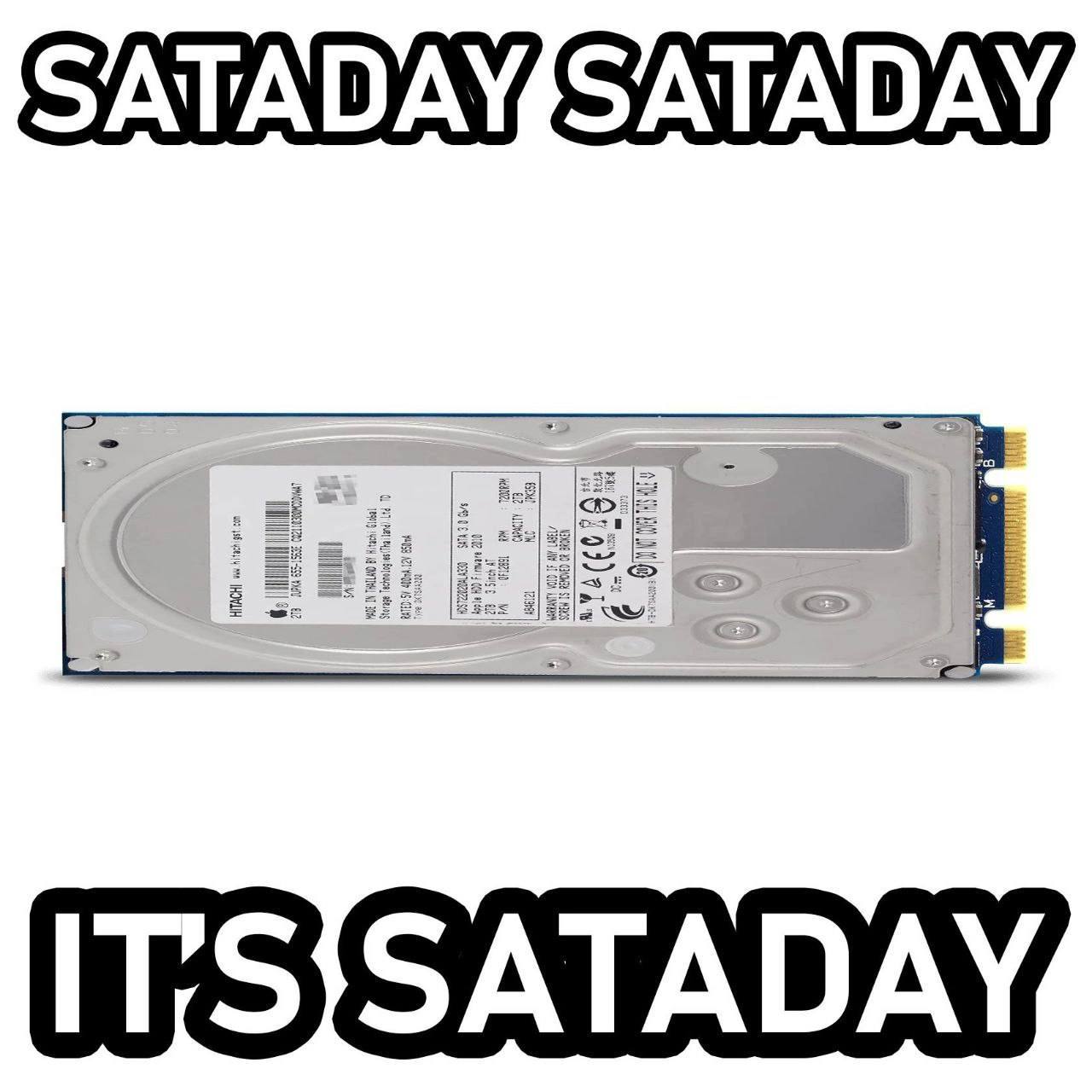
Now, what’s with the image of that blue circuit board? That’s actually shaped like an M.2 SSD – a very modern form factor for storage drives (these look like small flat sticks, common in newer laptops and desktops for super-fast storage). Normally, an M.2 SSD uses a technology called NVMe to communicate, which is really fast. But the twist is that this M.2 board’s design is printed to look like an old 2.5-inch hard disk. See the grey oval outlines that resemble disk platters and the white sticker with tiny text (spec label)? Those are all hallmark visuals of a traditional laptop hard drive or a SATA SSD. In other words, the meme shows a new-style drive dressed up as an old-style drive. This is intentionally goofy: it’s a storage_interface_mismatch joke. The different pieces here are:

  • SATA (Serial ATA)Pronounced “sah-tuh” or “say-tah”, this is an older interface used by most hard drives and early SSDs for the last couple of decades. It’s the cable/connector and communication method that maxes out around 600 MB/s. If you’ve built a PC, those thin red or orange cables that connect drives to the motherboard are SATA cables. SATA drives can be HDDs (Hard Disk Drives with spinning platters) or SSDs (Solid State Drives with flash memory). SATA was a huge improvement over even older ribbon-cable connectors (PATA/IDE), and it became ubiquitous for a long time. However, by today’s standards, it’s considered Legacy Tech for high-performance storage because it’s relatively slow.

  • NVMe (Non-Volatile Memory Express) – This is the newer interface/protocol for super-fast SSDs. Non-volatile memory just means storage that doesn’t forget when power is off (like flash chips), and Express refers to the fact that it uses the PCI Express bus. In plain terms, NVMe lets an SSD talk directly to the CPU over the PCIe lanes, which is way faster. We’re talking several gigabytes per second of data transfer, as opposed to SATA’s hundreds of megabytes per second. NVMe drives usually use the M.2 form factor or sometimes plug into PCIe slots. If you’ve heard of those tiny SSD sticks that make games load quickly or let your system boot in seconds, those are often NVMe drives.

  • M.2 – This is a physical form factor, not a communication protocol. M.2 is a small connector on the motherboard and the little board (like in the image) that can hold an SSD or other devices (Wi-Fi cards, etc.). An M.2 drive can actually be either a SATA drive or an NVMe drive, depending on the drive and the slot’s support. Some M.2 slots on motherboards will accept a SATA SSD in M.2 format. That means the drive is physically a tiny M.2 card, but it’s essentially a SATA drive in how it operates (often these have both B and M keys cut in the connector). Other M.2 drives are NVMe and use PCIe (those usually have an M key only). The meme plays on this fact by combining the two: it visually says “here’s an M.2 (usually NVMe) but haha, it’s actually SATA inside.” That’s the nvme_form_factor_irony – a modern form factor carrying old tech.

So, the joke in clearer terms: SATA drives (especially old-school hard drives) are slow and being replaced, but we’re pretend-celebrating them. The text “IT’S SATADAY” is like we’re all rejoicing that it’s time to honor SATA. For many tech folks, Saturday might be the day we replace old SATA drives during scheduled maintenance, not celebrate them! 😆 And the image – a comically hybrid drive – reinforces that theme: it’s like saying “even if SATA lived on in an M.2 body, it’s still the same old drive inside.”

Think about a relatable scenario: if you’ve used a computer with a regular hard disk (HDD) and then one with an SSD, the difference is huge – the SSD (even on SATA) is much faster. Now, NVMe SSDs are another leap beyond that, but they usually come in new shapes (like M.2 cards) and need new connections. Over the past years, tech folks have been migrating data and systems from SATA drives to NVMe drives for better performance. This transition is exciting (everything runs faster on NVMe), but it also means saying goodbye to the trusty SATA drives. RelatableHumor comes from that experience: we’re kind of mocking how we used to think SATA SSDs were super fast, and then NVMe came and spoiled us. It’s like remembering how DVDs felt high-tech until streaming in 4K came along.

Another bit to note: the word “Sataday” in the meme is deliberately misspelled to include SATA. It’s not a typo; it’s the pun. So the meme reads “SATADAY SATADAY – IT’S SATADAY,” echoing that excited tone of someone shouting “Saturday!” This could be referencing the way people hype up the weekend or even a lyric from a song (“Saturday night’s alright!” kind of vibe). The enthusiasm in the text is what makes it funny – nobody actually gets that excited about an interface spec like SATA, especially not in 2025 when faster stuff exists. By using over-the-top excitement, the meme maker is being sarcastic in a friendly way.

To sum up this level: The meme is comparing Saturday (fun day of the week) with SATA (old tech interface) as a pun. It mixes an old hard drive aesthetic with a new SSD shape to highlight the old-vs-new contrast. And it resonates with developers who know that storage technology has moved on (SATA → NVMe) but can laugh at the fact that we still have a soft spot (or an annoyance) for the older stuff. It’s a bit like a “remember when?” moment for hardware. Even if you’re new to these terms, you can appreciate that it’s essentially saying “Haha, let’s pretend the outdated thing is so cool we give it a holiday!” That’s the joke.

Level 3: SATAday Night Fever

For the seasoned engineers and hardware aficionados, this meme strikes an instantly relatable chord. It’s poking fun at the legacy of SATA drives in a world now ruled by NVMe. The very title “Happy SATAday” sets the tongue-in-cheek tone: it imagines that the SATA interface gets its own special day (SATA-day) as if we’re all supposed to throw a party for this aging technology. The meme text styled in bold, blocky letters – “SATADAY SATADAY … IT’S SATADAY” – reads like an exuberant chant. If you’ve ever seen people joyfully yell “Saturday! Saturday!” when the weekend hits, you’ll get the parallel: here we’re mock-cheering for SATA, that old storage workhorse, as though it’s something to celebrate every week. It’s an absurdly cheerful tribute to a tech that’s, well, a bit past its prime. 😄

Now, why would that be funny to a veteran developer or sysadmin? Because many of us have lived through (and personally executed) the transition from SATA to NVMe in data centers and rigs. We remember when SATA SSDs were the standard for fast storage – a huge leap over spinning disks – and we also remember when they suddenly felt sluggish because NVMe drives blew past them. It’s the relatable humor of having once revered a technology and now looking back at it with fond derision. Imagine working on a storage migration project: replacing racks of 2.5-inch SATA SSDs with blisteringly fast PCIe Gen4 NVMe drives. The first time you see an NVMe drive hit 5 GB/s throughput, your jaw drops and you realize SATA’s 600 MB/s cap was a tortoise in a world now full of hares. After that, SATA drives earn a kind of endearing “grandpa” status – you’re grateful for their service, but you wouldn’t use them for the new high-performance database if you could help it. This meme captures that sentiment: an affectionate roast of SATA.

The image itself is a brilliant visual pun. It shows a M.2 SSD (which normally signifies a cutting-edge NVMe device) made to look like an old-school 2.5″ hard disk. Senior engineers will instantly notice the circular platter outlines and the classic white info label printed on the blue M.2 board, mimicking the top of a laptop hard drive or SATA SSD. It’s a mash-up of two eras of storage hardware that normally never intersect. The humor here is partly physical irony: an ultra-modern form factor parading in vintage attire. It’s like seeing a Tesla Roadster custom-painted to look like a ’67 Volkswagen Beetle – a fast new car disguised as a classic. For anyone who’s dealt with hardware upgrades, it also evokes that weird in-between period where new and old tech coexisted. Remember when motherboards first added M.2 slots? Some of those slots, especially in early days, were wired to the SATA bus to support SATA M.2 drives (since pure NVMe drives weren’t ubiquitous yet). Installing a so-called “M.2 SATA SSD” was a strange concept: the drive was tiny and looked cutting-edge, but performance-wise it behaved like a regular SATA drive. The meme exaggerates this scenario for comedic effect, essentially saying, “Hey, it’s SATA-in-an-M.2-costume – let’s celebrate this awkward compromise!”.

Beyond the visuals, there’s a layer of shared experience satire. In many companies, legacy tech tends to stick around longer than we imagine. You might have the latest NVMe blazing away in prod, but somewhere in a corner of the infrastructure, there’s that one critical system still clinging to a SATA HDD or an old SATA SSD because “if it ain’t broke…”. Seasoned devs and ops folks joke about these things the way one jokes about a retired veteran who still shows up at the office: lovingly but with a hint of “why are you still here?”. Declaring “It’s SATAday!” is like saying, “Alright everyone, let’s humor our old friend SATA with its own holiday, because bless its heart, it’s still hanging on.” There’s an element of tech nostalgia in the joke. SATA isn’t as ancient as floppy disks or punch cards, but in the fast-paced world of hardware, a standard from the mid-2000s that’s been surpassed by a newer protocol can feel long in the tooth. We chuckle because we all know that somewhere deep in a storage closet or a legacy server rack, SATA drives are still spinning or still serving, even though NVMe drives dominate new deployments.

Another angle that tickles the senior engineers: the wordplay and timing. Posting “Happy SATAday” on a Saturday (which presumably this meme did, given the title and date) is a classic geeky pun move. It’s the kind of joke only our tribe appreciates – much like “May the 4th be with you” on May 4th for Star Wars fans. By framing a Saturday as “SATA-day,” the meme creator double-dips into humor: linguistic pun and situational irony. We’re basically invited to imagine that every Saturday is SATA interface appreciation day. For veterans, the absurdity is delicious. SATA drives were often the source of performance bottlenecks, late-night swap-outs, and firmware updates – not exactly something you celebrate weekly. Many of us have spent a Saturday or two performing maintenance on old storage arrays, swapping failing SATA disks out of RAID sets in the wee hours. So the notion of spending Saturday celebrating SATA is a tongue-in-cheek inversion of reality. Instead of cursing our slow disks on a weekend, we’re humorously “honoring” them.

From an engineering culture perspective, the meme also jabs at the persistence of legacy technology. In the tech world, we like to hype the newest standards – “PCIe Gen5 NVMe drives coming soon!” – yet we all know how common it is to find “old” tech still in active use. It’s relatable humor because it’s true: even in 2025, plenty of systems (especially budget laptops, bulk storage servers, or just anything not requiring top speed) still use SATA SSDs or even mechanical SATA HDDs for capacity. Senior folks grin at this because we’ve learned that “newer/faster” doesn’t instantly erase “older/slower” from the world. There are cost considerations, compatibility issues, and supply chain factors. Upgrading an entire fleet from SATA to NVMe isn’t trivial – it can be expensive, might require newer motherboards or HBA support, and often the older drives are “good enough” for some tasks. So yes, SATA deserves a bit of recognition if only for its tenacity. The meme’s hyperbole of giving SATA its own holiday is a lighthearted acknowledgment that legacy tech never goes quietly; sometimes you just have to laugh and give it a round of applause for sticking around.

In short, at the Level 3 perspective, the meme succeeds because it’s ridiculously relatable to anyone who’s managed hardware over time. It wraps up a lot of insider experience into one image: the punny text for the dev humor lovers, the visual of an out-of-place hard drive format for the hardware gurus, and the underlying truth that even outdated interfaces have a way of persisting in our lives. We laugh with a mix of nostalgia and relief – nostalgia for the SATA days (pun intended) when 500 MB/s felt blazingly fast, and relief that we now have NVMe so our “SATAdays” (the painful slow storage days) are mostly behind us.

Level 4: Buses and Bottlenecks

At the deepest technical level, this meme highlights a mismatch between physical form factor and interface protocol in computer storage. It’s a nod to how storage technology evolved: the physical packaging (size/shape of drives and connectors) often leapfrogs ahead of the interface standards (the way data travels). In this case, the meme depicts a blue M.2 drive (a sleek “gumstick” circuit board used by modern SSDs) humorously decorated to look like a classic 2.5-inch hard drive. Why is this funny to hardcore hardware geeks? Because it’s illustrating SATA inside an NVMe shape – a kind of Frankenstein combination that techies know shouldn’t exist outside of transition periods. Let’s unpack that:

SATA (Serial ATA) is an older storage interface (protocol and connector) that for years was the workhorse for HDDs and SSDs alike. NVMe (Non-Volatile Memory Express) is the newer protocol that rides directly over the PCI Express bus. The irony here is that M.2 is a physical slot that usually hosts NVMe drives on PCIe lanes, enabling far faster data transfer – yet the image shows an M.2 device dressed up like a SATA drive, implying it’s using the old slower interface. It’s like seeing a Ferrari chassis with a tractor engine under the hood. In real technical terms, the meme riffs on the scenario where a modern form factor is paired with a legacy data bus, highlighting a fundamental I/O bottleneck issue.

Under the hood, SATA devices use the AHCI controller interface (Advanced Host Controller Interface) which was originally designed with spinning disks in mind. AHCI has a single command queue (32 pending operations max, via NCQ – Native Command Queuing) and adds several layers of latency between the CPU and the storage device. This was fine for hard drives, which themselves had ~10 millisecond seek times – the storage medium was the slow part. But once NAND flash Solid State Drives (SSDs) came along, suddenly the interface (AHCI/SATA) became the limiting factor. By contrast, NVMe was designed to unleash flash storage’s potential: it supports massively parallel operation with up to 64K queues and 64K commands per queue, and communicates directly over the PCIe bus with far less overhead (utilizing doorbell registers and efficient interrupts rather than the legacy ATA command set). The result? NVMe drives can achieve orders of magnitude higher IOPS (input/output operations per second) and throughput. SATA III tops out around ~6 Gbps (roughly 600 MB/s maximum throughput) because of its bus limits, whereas a PCIe Gen4 x4 NVMe drive can hit 7–8 GB/s – over ten times faster. The latency per IO on NVMe is measured in a few microseconds of overhead, versus tens of microseconds on SATA/AHCI. In performance terms, SATA is a two-lane country road and NVMe is a multi-lane superhighway. Even if you put a sports car on that country road, it can’t go faster than the road allows. That’s the bottleneck.

To advanced hardware enthusiasts, the meme is practically conjuring the ghost of transitional tech. We actually did see awkward hybrids at one point: early in the NVMe era, many laptops and motherboards had M.2 slots that supported SATA drives electrically. You could plug a SATA SSD into an M.2 slot (these drives used an M.2 B&M key connector and internally just bridged to SATA signaling). It was a stopgap for compatibility: physically small like NVMe, but logically the same old SATA. The meme’s image takes that concept to an extreme visual joke by printing the platter and label artwork of a 2.5-inch HDD on an M.2 card. It’s a satirical nod to how legacy tech can linger in new shapes. For instance, enterprise datacenters saw 2.5-inch U.2 drives that actually carried NVMe over a cable (the inverse scenario: new interface in old form). The perpetual struggle with interface standards lagging behind physical packaging is a real engineering headache. Standards bodies and hardware manufacturers often maintain backward compatibility: we shrink the device (from 2.5" to M.2), but sometimes still run the old protocol through it (SATA) until the new protocol takes over completely.

In sum, at this deep level, the humor arises from an appreciation of hardware evolution quirks. It’s about how fundamental limitations (bus speeds, controller queue depths, latency) necessitated new interfaces like NVMe, and how during that evolution we got odd franken-hardware and compatibility hacks. The meme is winking at those of us who know the theory and history: we’re essentially laughing at the absurdity of celebrating a hard disk protocol (SATA) in an era dominated by NVMe. It’s a playful reminder that even as technology races forward, the old standards die hard – sometimes adorning a new costume, asking for one last dance.

Feature SATA (AHCI) NVMe (PCIe)
Max Transfer Rate ~6 Gbps (SATA III, ≈600 MB/s) Multiple GB/s (PCIe Gen4 x4 ≈ 8,000 MB/s)
I/O Queues Single queue, 32 commands (NCQ) 64K queues × 64K commands (massively parallel)
Typical Latency Higher protocol overhead (several µs) Lower overhead (few µs, direct to CPU)
Original Use-Case Designed for HDDs (high seek latency) Designed for SSDs (low seek latency)
Form Factor 3.5″/2.5″ drives with cables M.2 cards, U.2/2.5″ drives, PCIe add-in cards

Description

This is a simple, pun-based meme on a clean white background. At the top, the text 'SATADAY SATADAY' is displayed in a large, bold, white font with a heavy black outline. In the center of the image is a clear photograph of a 3.5-inch internal Hitachi hard disk drive (HDD), showing its metallic casing and the manufacturer's label. The label clearly indicates that it is a 'SATA 3.0 Gb/s' drive. At the bottom of the image, the punchline 'IT'S SATADAY' is written in the same prominent font. The humor comes from the phonetic wordplay, replacing 'Saturday' with 'SATA Day'. For tech professionals, especially those with a background in hardware or system administration, it's a lighthearted dad joke that connects the weekend with a ubiquitous and fundamental piece of computer hardware technology - the Serial ATA interface used for connecting storage devices

Comments

24
Anonymous ★ Top Pick Ah, SATADAY. A perfect day to reflect on how these old spinners hold our retired legacy systems together, quietly awaiting the day someone trips over the power cord to the SAN
  1. Anonymous ★ Top Pick

    Ah, SATADAY. A perfect day to reflect on how these old spinners hold our retired legacy systems together, quietly awaiting the day someone trips over the power cord to the SAN

  2. Anonymous

    Proof you can slap a SATA bus on an M.2 board and still ship - because throughput targets take weekends off too

  3. Anonymous

    After 20 years in the industry, I've learned that the only thing faster than NVMe speeds is how quickly your PM will ask why the migration from spinning rust isn't done yet - especially when they schedule it for 'SATADAY' maintenance windows

  4. Anonymous

    Every senior engineer knows that feeling when you realize your carefully architected distributed storage system with erasure coding and multi-region replication is ultimately just a bunch of spinning platters having their weekly celebration. Meanwhile, the NVMe drives are already planning their hostile takeover, promising sub-millisecond latencies and making SATA look like it's stuck in traffic on the PCIe bus. But hey, at 20TB per drive and $15/TB, these mechanical marvels still win the TCO spreadsheet battle - proving once again that in infrastructure engineering, physics and economics always have the final say over hype cycles

  5. Anonymous

    SATA: the interface that survives PCIe Gen5 hype like COBOL outlasting microservices

  6. Anonymous

    Happy SATADAY - the day procurement confuses form factor with protocol and your “M.2 upgrade” shows up speaking AHCI: 6 Gb/s, one queue, 32 entries, and all your SLAs start looking like a long weekend

  7. Anonymous

    Happy SA-TA-day - roadmap: “NVMe everywhere”; procurement: “put a SATA sticker on the M.2.” Result: AHCI latency in a PCIe slot, just like our “microservices” monolith

  8. @SpYvy 1y

    But it's m.2

    1. @peajack 1y

      shut the duck up its SATADAY

    2. @deandon 1y

      m.2 is form factor, sata is connector

  9. @chenxuuu 1y

    ngff is sata

    1. @ahmubashshir 1y

      sata ngff

  10. @H3R3T1C 1y

    SATA is protocol, Serial ATA

  11. @deadgnom32 1y

    i thought sata looks like this

  12. @ZgGPuo8dZef58K6hxxGVj3Z2 1y

    Wanna see my 16GB m.2 sata drive?

  13. @ZgGPuo8dZef58K6hxxGVj3Z2 1y

    LMFAOOOOOOOO

  14. @SamsonovAnton 1y

    The government doesn't want you to know what's inside those drives…

  15. Deleted Account 1y

    lol

  16. @SamsonovAnton 1y

    From the good old times when MLC was considered "inferior" and "a value solution". 😢

    1. @ZgGPuo8dZef58K6hxxGVj3Z2 1y

      Whats mlc?

      1. @SamsonovAnton 1y

        Multi-level cell, a type of Flash memory (most often a synonym for two-level cell)

        1. @ZgGPuo8dZef58K6hxxGVj3Z2 1y

          Ahhh that thing

        2. @ZgGPuo8dZef58K6hxxGVj3Z2 1y

          This kinda starts becoming storing 1's and 0's in analog chunks

  17. @qtsmolcat 1y

    Got any 256kb ones?

Use J and K for navigation