Programming Paradigms on Side Effects: Fear vs. Happy Accidents
Why is this FunctionalProgramming meme funny?
Level 1: Neat Freak vs Artist
Imagine two friends working on a painting. One friend is a total neat freak: before he even opens a paint jar, he covers the entire room with plastic sheets, tapes down the edges of the canvas, and is terrified of any paint splatter getting where it shouldn’t. He paints very carefully, making sure every stroke stays exactly inside the lines on the canvas. Now the other friend is a playful artist: she just puts the canvas up and joyfully starts splattering paint everywhere. If some paint gets on the table or the floor, she just laughs and says, “No problem, we’ll make that part of the art too!” She spreads color all over the place, not worrying at all about making a mess.
This meme is funny because it’s comparing those two friends to two styles of coding. The neat-freak friend is like functional programming – super careful about not letting any mess (unexpected changes) escape the canvas. The artist friend is like object-oriented programming – totally fine with spreading things around and embracing any little “happy accidents” that happen along the way. Seeing the strict friend and the carefree friend side by side makes us laugh, because we recognize these extremes in ourselves or our teammates when we write code. One approach isn’t necessarily bad or good, but the difference in attitude is huge – and that contrast is exactly what makes the joke work, even for someone who doesn’t know the technical details.
Level 2: Nice and Even Spread
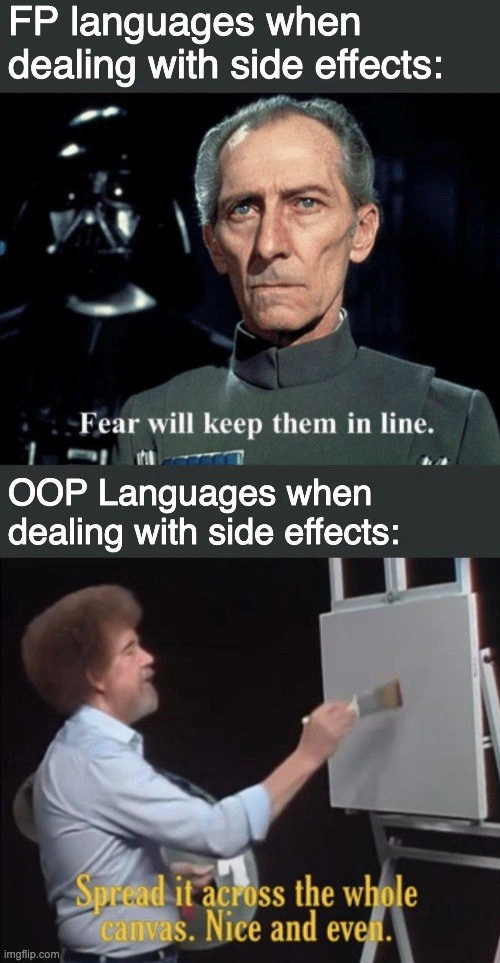
Let’s break down the meme in more straightforward terms. In the top panel, we have a scene from Star Wars: that stern-looking officer is Grand Moff Tarkin with Darth Vader lurking behind. The caption above him says “FP languages when dealing with side effects:” and on the image we see the famous quote: “Fear will keep them in line.” This implies that functional programming (FP) languages approach side effects very strictly, almost fearfully restraining them. In the bottom panel, we see the beloved painter Bob Ross in front of his canvas. The text says “OOP languages when dealing with side effects:” and Bob Ross is smiling with the subtitle “Spread it across the whole canvas. Nice and even.” This suggests that object-oriented programming (OOP) languages tend to let side effects spread freely everywhere, as if that’s a normal, even beautiful, thing. The contrast is humorous because it’s like night and day: the top is all about tight control (maybe even intimidation) of side effects, and the bottom is about embracing them calmly and broadly.
Now, what exactly are “side effects” in programming? A side effect is anything a piece of code does that affects the outside world or changes state beyond just returning a value. For example, if a function calculates a sum and returns it, that’s not a side effect – that’s just a pure computation. But if that function also writes to a file, prints something to the screen, modifies a global variable, or changes the input it was given, those are side effects. They’re like the “extra footprints” a function leaves behind. Side effects can be useful (you need output, you need to save data, etc.), but they can also make it harder to understand what a program is doing, because the function isn’t self-contained anymore – it’s affecting or relying on some external context.
Functional programming concepts emphasize writing functions without side effects when possible. A function that has no side effects is called a pure function. Pure functions are predictable: given the same input, they will always produce the same output and won’t mess with anything else (no changing variables elsewhere, no random file writes, nothing). This is great for testing and reasoning – you don’t have to worry that calling calculateTax(amount) is also secretly modifying some globalTaxRate or printing logs to the console. Languages like Haskell, Elm, or PureScript are designed so that functions are pure by default. In fact, in Haskell, you literally cannot have a side effect in a regular function – the language forces you to handle it in a special way (so you know when you’re dealing with a side effect). It’s as if the language is saying, “we’re a bit afraid of side effects, so we keep them on a tight leash.”
On the other hand, object-oriented languages (and many traditional imperative languages) are much more casual about side effects. In OOP, it’s common to have methods that update an object’s internal state or interact with other objects and the outside world. For instance, consider a simple BankAccount object: calling deposit(100) on it will likely change the account’s balance field (that change is a side effect on the object’s state) and maybe also print a confirmation or log an event (more side effects!). OOP languages like Java, Python, or C++ allow (and expect) you to do this all the time. It’s normal that calling a method changes something. That’s the “Spread it across the whole canvas” philosophy: you modify state here, you print something there, you update a database over there – the changes are spread out through the program as needed, much like Bob Ross calmly covering a canvas with paint. There’s an implicit trust that if you do it in a controlled, artful way, it will result in a correct and beautiful program.
To visualize the difference, here’s a simple example in Python (an OOP-friendly language):
# A function with side effects (impure) in a typical OOP/imperative style:
counter = 0 # global state
def increment_and_print(x):
global counter
counter += 1 # side effect: modifying a global variable
print("Incremented:", x+1) # side effect: printing to the console
return x + 1 # returns result, but also did other stuff
# A pure function (no side effects), more like a functional style:
def increment(x):
return x + 1 # no side effects, just uses input and returns output
In the increment_and_print function, every time you call it, it does two extra things besides computing x+1: it changes the counter and prints a line. Those changes persist outside the function (the counter stays incremented, and something actually appeared on the screen). That means the function has side effects. If you call it 5 times, counter will now be 5, and you’ll have 5 lines printed out. In contrast, the increment function simply takes x and returns x+1 with no external interaction. You could call it all day and nothing in the program or outside world would change except for you getting return values. If you pass the same number, you get the same result every time, and nothing else is different.
The meme is highlighting how these two philosophies feel. The Star Wars quote “Fear will keep them in line” is joking that FP languages treat side effects as something to almost be afraid of or at least very strict about – they will use the equivalent of strict rules and structure (like an Imperial officer enforcing order) to keep side effects contained in specific areas of the code. By contrast, Bob Ross’s quote about spreading across the canvas suggests that OOP languages are very liberal with side effects – they treat them like paint to be generously applied everywhere. Bob Ross isn’t literally talking about code, of course, but the meme humorously uses his easygoing painting style as a metaphor for how side effects in an OOP codebase can be widespread and anywhere the developer feels like putting them.
For a newcomer to programming, this is a fun way to learn that different languages and paradigms handle things differently. Some languages will almost scold you for trying to print something from inside a function (FP says: “Better to return a value and let the caller handle that printing elsewhere, if at all!”), while others let you freely mix printing, calculating, and state updates in one place (OOP says: “Sure, go ahead and do multiple things, just like painting freely on the canvas”). Neither approach is outright “wrong” – they each have their pros and cons. Functional style’s strictness can prevent a lot of bugs but might feel restrictive, whereas OOP’s freedom makes it easy to get things done quickly but can lead to surprises if you’re not careful. The meme uses a dramatic Star Wars fear versus a chill Bob Ross vibe to make this contrast clear and memorable (and pretty funny to anyone who’s experienced both styles!).
Level 3: Imperial Purity vs Happy Accidents
For those who have been around the block in software development, this meme hits on the almost cultural difference between two programming paradigms: functional vs object-oriented. The top half with the Star Wars reference shows Grand Moff Tarkin (with Darth Vader ominously behind him) saying “Fear will keep them in line.” This is a cheeky way of saying that functional programming languages treat side effects with strict discipline (almost fear). In a seasoned developer’s terms, FP folks are often purists about maintaining immutable state and pure functions. If you've worked in a pure FP language like Haskell or even a mostly-functional style in Scala or Clojure, you know there's essentially an unwritten rule: thou shalt not produce side effects, unless absolutely necessary and properly contained. It's not that FP devs are actually cowering in terror of side effects, but after enough painful debugging sessions, you develop a healthy fear/respect for what unrestrained side effects can do to a codebase. We've all experienced that 3 AM production issue where some seemingly innocuous piece of code was mutating a variable that it shouldn’t have, causing chaos somewhere else. In the FP mindset, the response is “let’s prevent that situation by design.” So FP languages build walls and checkpoints around anything that might cause a ripple in the global state. A veteran coder might joke that in a pure functional codebase, even printing "Hello World" feels like signing something in triplicate, getting approval from the Type Safety Department, and only then being allowed to execute it. Side effects in programming are treated like a volatile substance: handle with care, label clearly, and lock it away when possible.
Now contrast that with the bottom half of the meme: Bob Ross, the gentle painter known for saying “We don’t make mistakes, just happy little accidents,” is depicted calmly brushing paint with the caption “Spread it across the whole canvas. Nice and even.” This is the polar opposite attitude – and it humorously represents typical object-oriented programming (OOP) and imperative languages. In many popular OOP languages (think Java, Python, C#, JavaScript – the usual suspects), side effects are everywhere, and that’s just normal. Need to update an object’s field? Sure, go ahead and change it in place. Want to log something or print to console inside a method? Absolutely, do it wherever. The mantra here is more along the lines of “if you’ve got state, flaunt it.” Each object carries its own little world of state, and methods freely paint new values onto that state. Side-effect propagation is not seen as a big deal; it’s often even the intended design! The Bob Ross analogy is perfect: OOP design tends to spread state changes across the whole canvas of your application, hopefully in a “nice and even” way (in theory, every part of the code that needs to change some state does so as needed, and it all comes together in the end). When Bob Ross spreads a color across the canvas, he’s deliberately covering everything in a layer. Similarly, an OOP program might have dozens of objects each quietly modifying some shared or interconnected state as the program runs. To an FP purist, that scenario is like a horror movie ("The Global State Strikes Back"); to an OOP veteran, it's Tuesday.
The humor here works on multiple levels for seasoned devs. First, there’s the absurd but spot-on juxtaposition of fear vs. serenity: one paradigm treats unintended effects as the enemy (cue Imperial March music), while the other almost finds them soothing or at least harmless (relaxing Bob Ross music in the background). Many of us have seen passionate debates (the classic language wars) where a functional programming advocate will warn, almost with doomsday gravitas, about the dangers of mutable state: "If you start allowing side effects willy-nilly, you'll never be able to reason about your code! Bugs will strike from anywhere, and your tests will become unreliable." This person is basically Grand Moff Tarkin keeping developers in line with the fear of chaos. On the flip side, an OOP practitioner might shrug and say, "State changes are just a fact of life. We manage complexity with good abstractions and encapsulation. Don't be so paranoid—relax, we can handle a bit of mutation here and there. Look, we spread the state changes evenly throughout our objects—everything is an object canvas, after all!" That’s Bob Ross smiling while he adds happy little state changes across the codebase, confident that it will all work out as a beautiful picture in the end.
There’s also a historical context: over the years, best practices have oscillated. In the era of heavy OOP (think early 2000s enterprise Java), having objects with lots of internal state and side-effect-laden methods was the norm. Many large codebases became Big Ball of Mud architectures where the state was entangled everywhere — modifying one class could have ripple effects across the system (you change the color in one corner, and surprise, it tints the whole canvas). Seasoned engineers who survived those systems often carry some scars. They remember the bug that took days to track down because some singleton or global config was being modified in five different places. Those experiences often turn developers toward more FP-like practices over time (even if they still use an OOP language, they start avoiding shared mutable state and leaning on more pure functions). Hence, the meme’s exaggeration rings true: once bitten by side-effect-induced bugs, twice shy. Suddenly, the strict rules of FP — “no side effects unless you wrap them in three layers of monadic context” — start sounding reasonable, almost comforting!
On the other hand, proponents of OOP or imperative approaches might chuckle at how uptight the FP world can seem. From their perspective, building a system with no side effects or with every side effect heavily cordoned off can feel like overkill. Why go through contortions to avoid a simple thing like updating a variable? Bob Ross’s approach of casually brushing the paint everywhere is a gentle jab at how OOP folks view their code: we can always refactor or clean it up later; for now, just get the feature working. In practice, experienced OOP developers do try to manage complexity — they use design patterns, limit global state, and write unit tests — but the language isn’t preventing you from coloring outside the lines. It relies on developer discipline and experience to avoid the pitfalls of too many side effects. And truth be told, sometimes spreading a bit of state around does get the job done faster for a one-off task, akin to Bob Ross effortlessly blending a sky across the canvas without worrying about masking tape or clean edges.
Ultimately, the meme resonates because it encapsulates a shared understanding in developer culture: functional vs OOP paradigms have very different philosophies about side effects. One man’s caution (or fear) is another man’s freedom. Seasoned devs have seen both sides: they’ve wrangled untamed side effects in messy systems and they’ve admired the tranquility of a well-structured pure function pipeline. This meme playfully personifies those approaches: the FP side is the strict enforcer who will scare your code straight (no sneaky state changes, or else!), and the OOP side is the easygoing artist who says “let’s just sprinkle a little state over here and over there — nice and even, no worries.” The contrast is both funny and painfully relatable. Every senior developer has at least one war story about a side effect bug that made them momentarily wish all code was pure, and conversely has had moments where the FP way felt like using a sledgehammer to crack a nut. Seeing these experiences distilled into Tarkin vs Bob Ross is comedic gold for anyone familiar with these language quirks and paradigm idiosyncrasies.
Level 4: The Lambda Strikes Back
At the most theoretical level, this meme highlights a fundamental dichotomy in computing theory: pure functions versus stateful operations, which is essentially lambda calculus vs. Turing machine thinking. Functional programming (FP) languages strive for referential transparency – a fancy way of saying a function call can be replaced by its result without changing the program's behavior. This only holds true if the function has no side effects, as any hidden effect (like modifying a global variable or performing I/O) would break that substitution property. In academic terms, a pure function is like a well-behaved mathematical function: f(x) = x * 2 always yields the same result for the same input and doesn't secretly change anything else in the universe. This purity makes formal reasoning and proofs about code much easier (you can apply algebraic laws, reason about concurrency without worrying about race conditions on shared state, etc.). It's the principle behind FP concepts such as immutability (once a value is set, it never changes) and functional composition (building complex operations by combining pure functions, confident that none have hidden side effects).
But real programs need to interact with the world – read input, write output, update some state somewhere – which are inherently side effects. Pure FP languages have devised ingenious ways to accommodate this necessity without breaking the purity spell. The star tool for this is the monad, a concept borrowed from category theory (yes, the deep abstract math stuff). Monads allow FP languages to wrap and sequence effectful operations in a controlled manner. The classic example is Haskell’s IO monad: it’s as if Haskell says, “Okay, you want to perform I/O (which is like touching the dangerous external world)? I’ll let you, but you must lock those operations inside a special IO container.” Inside this monadic container, you can do side effects, but the pure part of the language views that container as one single opaque value. This is how Haskell maintains the facade (and benefits) of purity: the type system enforces that anything carrying out real-world actions has a type like IO Something, distinguishing it from plain pure values. You can almost hear the language sternly cautioning, “Side effects, huh? Fine, but fear will keep them in line.” The "fear" in this analogy is the rigid discipline of mathematics and type theory – it will not let a rogue side effect just wander off. It's reminiscent of Grand Moff Tarkin in Star Wars using the Death Star’s terrifying power to keep star systems obedient; similarly, an FP language uses the fearsome power of a strict type system and pure functional semantics to keep side effects under tight control.
From a theoretical perspective, this isn't just arbitrary strictness – it's solving a profound problem: how do you get the predictability of mathematical functions in programs that still need to do non-mathematical things (like printing to a console or updating a database)? That’s where monads (and related constructs like effect types or continuations) shine. They provide a structured way to thread state changes or I/O through a computation without letting those side effects leak out and infect everything. It's like constructing a special corridor in the Death Star where the wild beast of side effects can roam, but under guard, so it doesn't wreak havoc on the clean functional core of your program. In category theory terms, a monad is often defined as a monoid in the category of endofunctors, which is the kind of definition that can strike fear into even experienced developers. (No wonder FP languages have a reputation of being a bit like the Jedi Council, requiring discipline and training to master!) Yet, this abstraction has a very practical outcome: side effects become explicit and manageable. If you have a Haskell function of type Int -> Int, you know for sure it cannot do any I/O or mutate any variable—it's pure. Conversely, if a function might do I/O, its type will reflect something like Int -> IO Int. This explicitness is almost like the code is marked with a bright warning sign: "Beware, side effect inside!" The meme’s top panel nails this with the phrase “Fear will keep them in line.” Indeed, FP languages instill a kind of healthy fear (or respect) for side effects: they are treated as a potentially dangerous force to be isolated, much like the Dark Side of the Force in Star Wars that must be carefully controlled by the Jedi (or ruthlessly by the Empire).
So, at this deepest level, the humor emerges from recognizing this high-minded ideal: FP as the strict enforcer that treats side effects as unruly elements to be contained using heavy theoretical machinery. It's like an Imperial governance of code – no mutable state shall misbehave under the watch of the lambda calculus wizards! Meanwhile, Object-Oriented and imperative languages, in theoretical contrast, align more with the Turing machine model – they freely allow changing state (writing on the tape) as a primary mode of operation. There, side effects aren't a terrifying specter; they're just business as usual. The meme is comically framing that contrast as an almost moral or philosophical divergence: one paradigm builds a Death Star to control side effects, the other just cheerfully paints them everywhere as if saying “the more the merrier.” The Lambda (representing functional purity) is striking back against the messy universe of side effects, armed with category theory and type systems, ensuring that fear (of unpredictability) does indeed keep those side effects in check.
Description
A two-panel meme contrasting how Functional Programming (FP) and Object-Oriented Programming (OOP) handle side effects. The top panel, labeled 'FP languages when dealing with side effects:', features a scene from Star Wars with Grand Moff Tarkin saying, 'Fear will keep them in line.' This represents the strict, controlled, and often compiler-enforced discipline FP languages use to manage side effects, treating them as something to be contained. The bottom panel, labeled 'OOP Languages when dealing with side effects:', shows the painter Bob Ross cheerfully in front of a canvas, saying, 'Spread it across the whole canvas. Nice and even.' This humorously depicts the common practice in OOP where mutable state and side effects are often widespread throughout an application's objects, embraced as a natural part of the process, much like Bob Ross's happy little trees

Comments
7Comment deleted
Functional programmers treat side effects like nuclear waste, sealing them in monads. OOP programmers treat them like glitter - a little here, a little there, and soon it's on everything and you'll never get rid of it
Functional devs smuggle side-effects through an IO monad like it’s the Death Star plans; OOP devs just @Autowired them everywhere and call them “happy little services.”
After 15 years of arguing about paradigms, I've realized FP developers spend more time explaining monads than OOP developers spend debugging null pointer exceptions - and somehow both camps think they're winning
This perfectly captures the eternal struggle: FP devs spend three days wrapping side effects in IO monads and effect systems to maintain referential transparency, while OOP devs just mutate that private field and call it encapsulation. Both camps are convinced they're doing it right - one treats side effects like nuclear waste requiring containment protocols, the other treats them like paint on a canvas. The real irony? Both approaches work until you need to debug state mutations at 2 AM, at which point FP devs are grateful for their type system's 'fear,' and OOP devs are wondering which of the 47 objects in the call chain decided to 'spread it across the whole canvas.'
FP: side effects need a type-checked visa and an IO escort; OOP: give them a mutable singleton and a DI paint roller, then rebrand the splatter as “business logic.”
FP quarantines effects at the edges with types; OOP declares a Singleton ‘Utils’ and suddenly every method is a paint roller
FP: Side effects are the dark side. OOP: Side effects are just happy little accidents