WebP Creator Schools a Critic on Flash's Demise
Why is this WebDev meme funny?
Level 1: No Batteries Required
Imagine you had a super fancy toy robot that could do lots of cool tricks, but it only worked if you used a special battery made by one company. This toy was fun for a while, but it often caused trouble – it would stop working if you didn’t constantly update it, and sometimes it even broke other things in your room. Eventually, all the kids got tired of the hassle and decided to throw that toy robot away for good. Now, think of a plain bouncy ball. It’s not as flashy as the robot, but it’s simple and reliable. Anyone can get a bouncy ball, and it doesn’t need any special batteries or permissions to use – you just bounce it and play. There’s nothing to “kill” because it’s not causing a problem; it’s just there doing its job. In this story, the fancy battery-powered toy was like Flash – complicated and controlled by one company – and the trusty bouncy ball is like WebP – simple, open for anyone, and easy to use. We got rid of the troublesome toy, but we kept the easy, helpful one. That’s why Flash is gone, but WebP is still around.
Level 2: Why Flash Died, WebP Lived
Let’s break this down in simpler terms. Adobe Flash was a technology that let websites embed videos, games, and interactive content back in the day. It came in the form of a browser plugin – basically an add-on you had to install in your web browser (like Chrome or Firefox) to get certain content to work. Flash wasn’t just an image or a simple file; it was an entire mini-program running inside your browser. It could do a lot (play movies, run game logic, display animations), but that power came with complications. Flash was proprietary, meaning one company (Adobe) owned it and controlled how it worked. It wasn’t open for everyone to improve. Because it was complex and widely installed, it became a big target for hackers – Flash had tons of security issues over the years. It also was heavy on computer resources (ever hear your laptop’s fans scream because of a Flash game or ad? 🙃). Over time, open web technologies like HTML5, JavaScript, and CSS got better and could do most of the cool interactive stuff Flash did – but without needing a special plugin. Once browsers could natively play video and show animations, Flash’s days were numbered. By 2020, Adobe and all the major browsers officially deprecated (ended support for) Flash. If you try to load an old Flash game today, it simply won’t run in modern browsers – Flash is effectively dead on the web.
Now, WebP is something very different. WebP is an image file format – like JPEG or PNG. An image format’s job is simple: compress pictures to take up less space, so websites load faster. WebP was introduced by Google around 2010 as an open format. “Open” means its specifications are publicly available and anyone can implement it without paying licenses. Unlike Flash, WebP isn’t a program you run; it’s just a way to pack image data. Web browsers added support for WebP so that they can display images saved in this format. If a browser for some reason doesn’t support WebP (years ago, Safari didn’t, though now it does), the website can fallback to a JPEG/PNG. But in practice, today all major browsers support WebP out-of-the-box, so it’s become pretty common. You might notice images you download sometimes have a .webp extension – that means they’re using that format. From a developer’s perspective, using WebP can shrink image file sizes significantly, which is great for performance. For example, a photo that is 500 KB as a JPEG might be only 350 KB as a WebP with the same quality – that’s less data for users to download.
So why did we “kill” Flash but not WebP? It comes down to purpose and complexity. Flash was a legacy system we relied on for interactive content at one point, but it became a liability (security problems, not mobile-friendly, one company in control). Killing Flash meant removing a huge, complicated dependency from the web. WebP, on the other hand, is a simple data format. It doesn’t run code or expose your system to big risks; it just stores images more efficiently. There’s no urgent reason to “kill” an image format that is doing its job. Also, because WebP is open, it’s not hurting the ecosystem – no single company is making all the rules or holding websites hostage. In fact, if something better than WebP comes along (like the newer AVIF image format or others), WebP can naturally be phased out over time. But it won’t require a dramatic “killing” like Flash did, because adopting a new image format is as simple as browsers adding support for it, not ripping out a deep-rooted plugin.
For a newer developer, think of it this way: Flash was an old all-in-one tool that the web grew out of, whereas WebP is just one of many interchangeable parts in today’s web. You might still encounter legacy tech related to Flash – e.g., an old site or intranet app that says “Install Flash to view this content,” which nowadays is a dead end. You’ll definitely encounter WebP – when optimizing images or receiving assets from designers – and while you might have to learn which tools support it (your image editor might need an update to open .webp files), it’s part of the modern web toolkit. In summary, Flash died because it no longer fit the open web (and caused more trouble than it was worth), whereas WebP lives on because it quietly makes things better and plays nicely with everyone. Open and simple tends to stick around longer in the web world.
Level 3: The Standards Strike Back
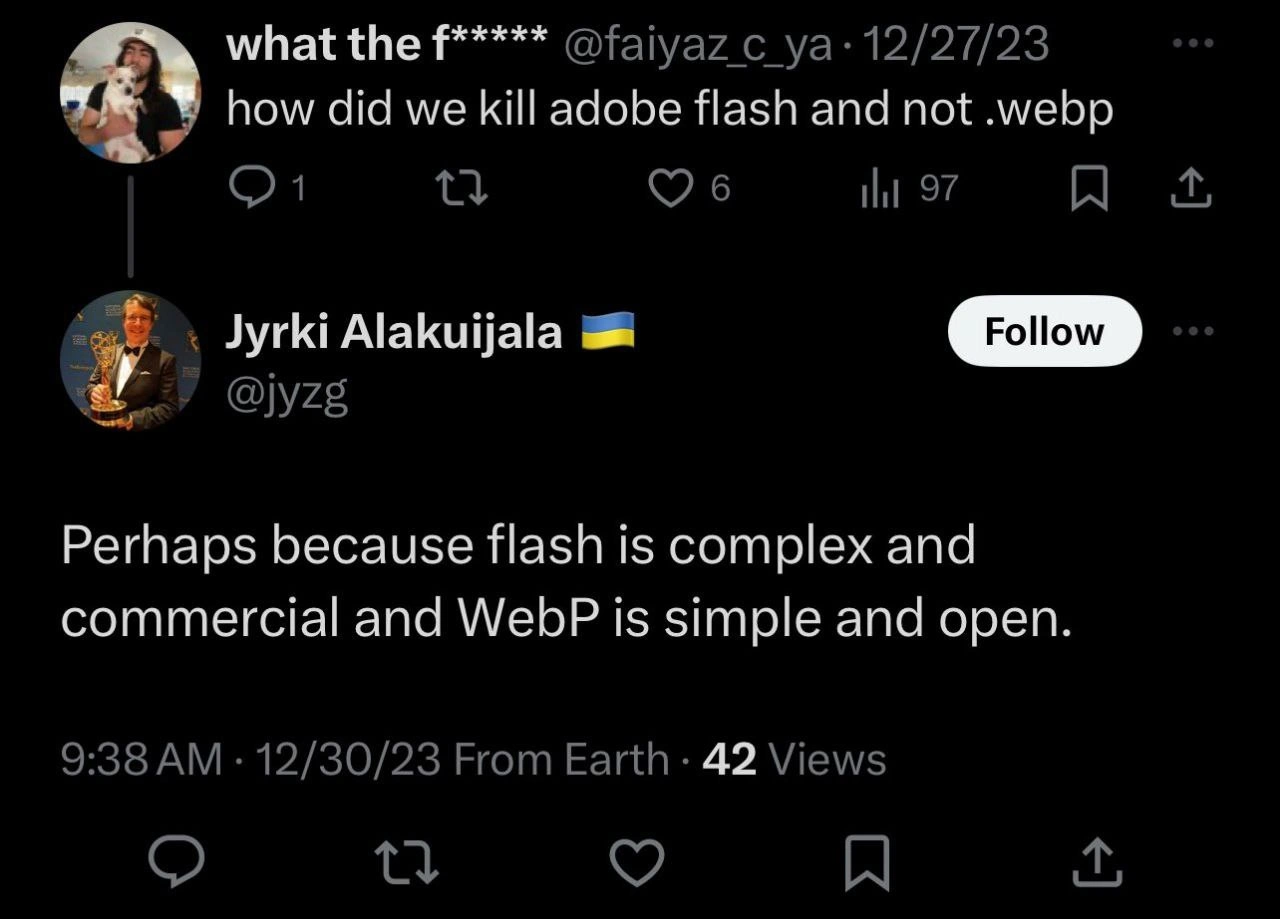
Adobe Flash was once the king of interactive web content – a ubiquitous browser plugin powering everything from video players to silly web games. But it was a monolithic, proprietary beast. It required its own runtime (the Flash Player), constant security patches, and often sent laptop fans into overdrive with its CPU hogging. By contrast, WebP is just an image format – a lightweight, single-purpose open standard. The meme pokes fun at why the industry eagerly axed one but not the other. An exasperated tweet asks, “How did we kill Adobe Flash and not .webp?” and a reply dryly answers, “Perhaps because Flash is complex and commercial and WebP is simple and open.” This lands as a mic-drop truth for senior devs: complex closed platform vs. simple open format is a David-and-Goliath story we’ve seen before on the web. The closed, Flash-y solution gets toppled by the simpler open alternative that plays nicer with standards.
Seasoned engineers remember the file format wars and the plugin era all too well. Flash (originally Macromedia Flash, later Adobe) was a closed-source, proprietary platform — essentially a mini virtual machine that ran ActionScript code, vector animations, and media embedded in .swf files. It was complex in scope: a whole graphics and programming stack inside a browser plugin. This complexity made Flash brittle and notoriously security-prone (zero-day exploits galore). It also made web developers overly dependent on one company’s roadmap. When mobile browsing rose, Flash couldn’t keep up – Apple’s ban on Flash in iOS (circa 2010) was a harbinger. By the late 2010s, even Adobe had to admit defeat and send Flash to the graveyard (EOL in 2020). Many of us happily danced on its grave; no more “Please update your Flash Player” pop-ups at 3 AM deployments. 🎉
Meanwhile, WebP flew a very different flag. It’s an image compression format devised by Google (circa 2010) as an open, royalty-free alternative to JPEG/PNG, trimming file sizes for faster page loads. Importantly, WebP isn’t a plugin or a program – it’s just data, decoded by the browser’s image engine. Browser vendors can implement support in their rendering engines, which they did (Chrome, Firefox, Edge, and eventually Safari all added WebP decoding). There’s no extra install for users, no scripting runtime, and far fewer security worries. In short, WebP slipped into the web ecosystem as just another format – simple purpose, clear benefit, no gatekeeper company charging fees or forcing updates. It’s not trying to be a whole platform; it just makes image files smaller. Kind of hard to justify “killing” that, right?
The humor here comes from the false equivalence and the shared trauma behind it. The frustrated tweet lumps Flash and WebP together as if they’re comparable nuisances to be eliminated. Any battle-scarred dev knows that’s apples and oranges. Flash was a colossal pain – a source of site crashes, security nightmares, and endless “this page requires Flash” support tickets. Many of us spent late nights ripping out phantom <object> embeds of .swf files from legacy codebases like ghost traps, finally freeing our sites from the haunt of a defunct plugin. We wanted Flash gone, collectively driving a stake through its heart by embracing open web standards (HTML5 Canvas, <video> tags, JavaScript APIs) that made Flash’s features redundant. In contrast, WebP is a quiet workhorse. Sure, it’s a newer format and initially caused some headaches (like seeing a design handoff full of .webp assets when your pipeline only supported PNG – cue the dev muttering and converting files). But that inconvenience is minor league compared to Flash’s reign of complexity. WebP didn’t try to hijack the web or spawn an entire development paradigm; it just silently shaves kilobytes off images. For senior devs, the meme’s punchline – “Flash was complex/commercial, WebP is simple/open” – is a one-sentence history lesson. It encapsulates why the open simplicity of a good standard tends to outlive the legacy complexity of a closed system. In the end, the open standard usually wins – not by flashy heroic battles, but by quietly being the path of least resistance. 🚀
Description
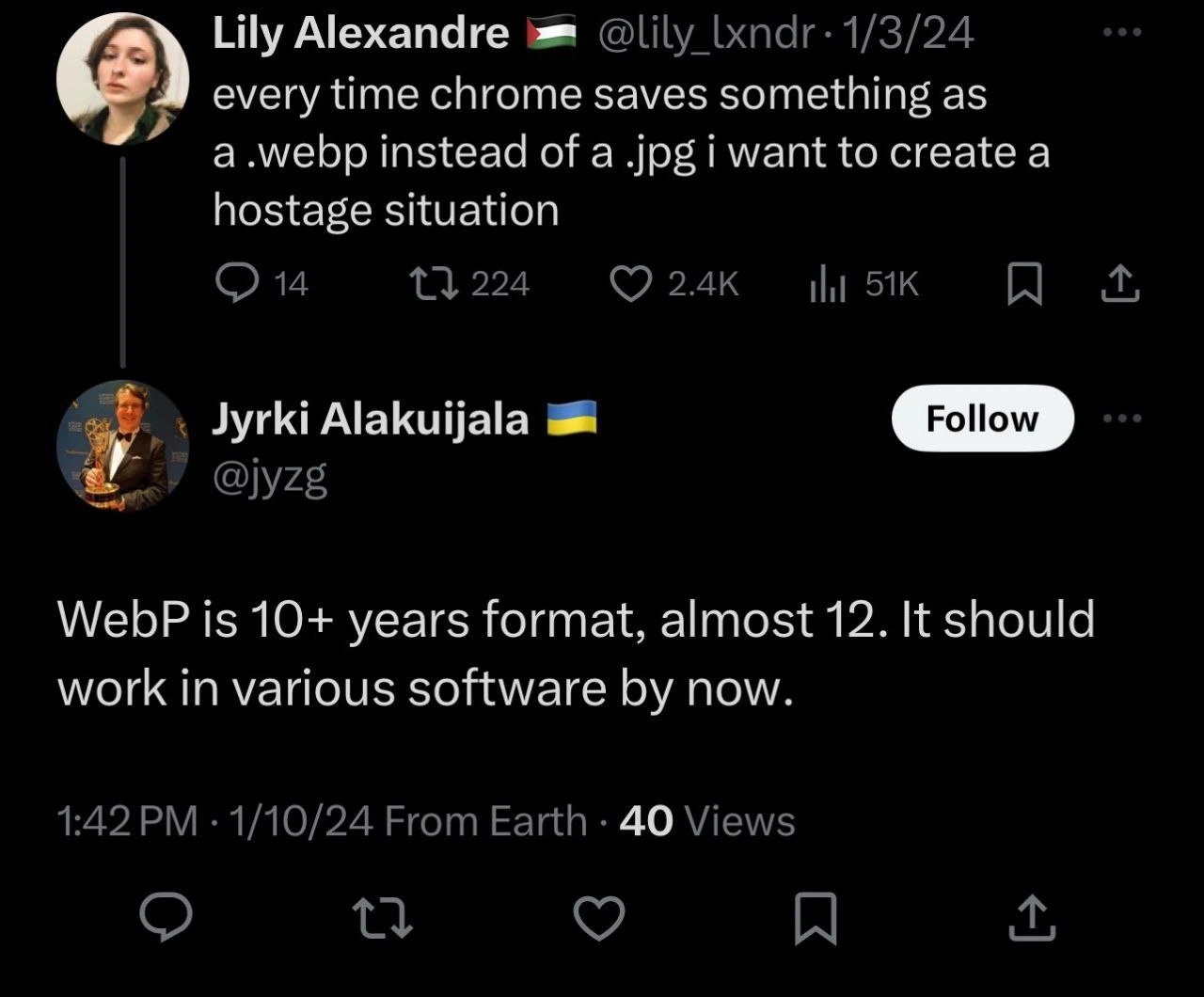
A screenshot of a Twitter conversation. The first tweet, from user "@faiyaz_c_ya," expresses frustration, asking, "how did we kill adobe flash and not .webp". Below it is a reply from Jyrki Alakuijala (@jyzg), the creator of WebP. He holds an Emmy award in his profile picture and calmly states, "Perhaps because flash is complex and commercial and WebP is simple and open." The image captures a classic developer complaint being directly and authoritatively addressed by the source. The technical context is the transition from proprietary web technologies like Adobe Flash to open standards like WebP. The humor lies in the expert's concise and definitive response to a user's rant, a scenario deeply appreciated by developers who value technical merit and open-source principles over user frustration with new standards
Comments
7Comment deleted
Complaining about WebP is a developer rite of passage, but getting publicly corrected by its creator is the final boss of that tutorial level
Flash needed its own VM to render a rectangle; WebP just needs Chrome’s marketing team to keep pretending it’s a JPEG upgrade - survival by lower orchestration overhead
We successfully coordinated a global effort to kill Flash because it was a security nightmare, but we can't agree on WebP because our biggest complaint is having to add another line to our nginx config
The beautiful irony: we collectively murdered Flash for being a bloated security nightmare, yet WebP - created by the same company - persists despite universal developer disdain. Turns out the secret to format immortality isn't being good or secure, it's being 'simple and open' enough that browsers can't justify the PR nightmare of removing it. Flash had plugins; WebP has plausible deniability
Web tech Darwinism: anything needing a plugin, updater, and quarterly CVE budget dies; anything that fits in Content-Type: image/webp and a GPU decode path lives forever
Flash was proprietary quicksand - easy to hate-kill. WebP's the open-source tar pit: inescapable because 'standards'
We killed Flash because it was a runtime with a CVE schedule - WebP survives because you can’t sunset a file extension in change control