WebP Inventor Faces a User's Wrath
Why is this DevCommunities meme funny?
Level 1: Careful What You Wish For
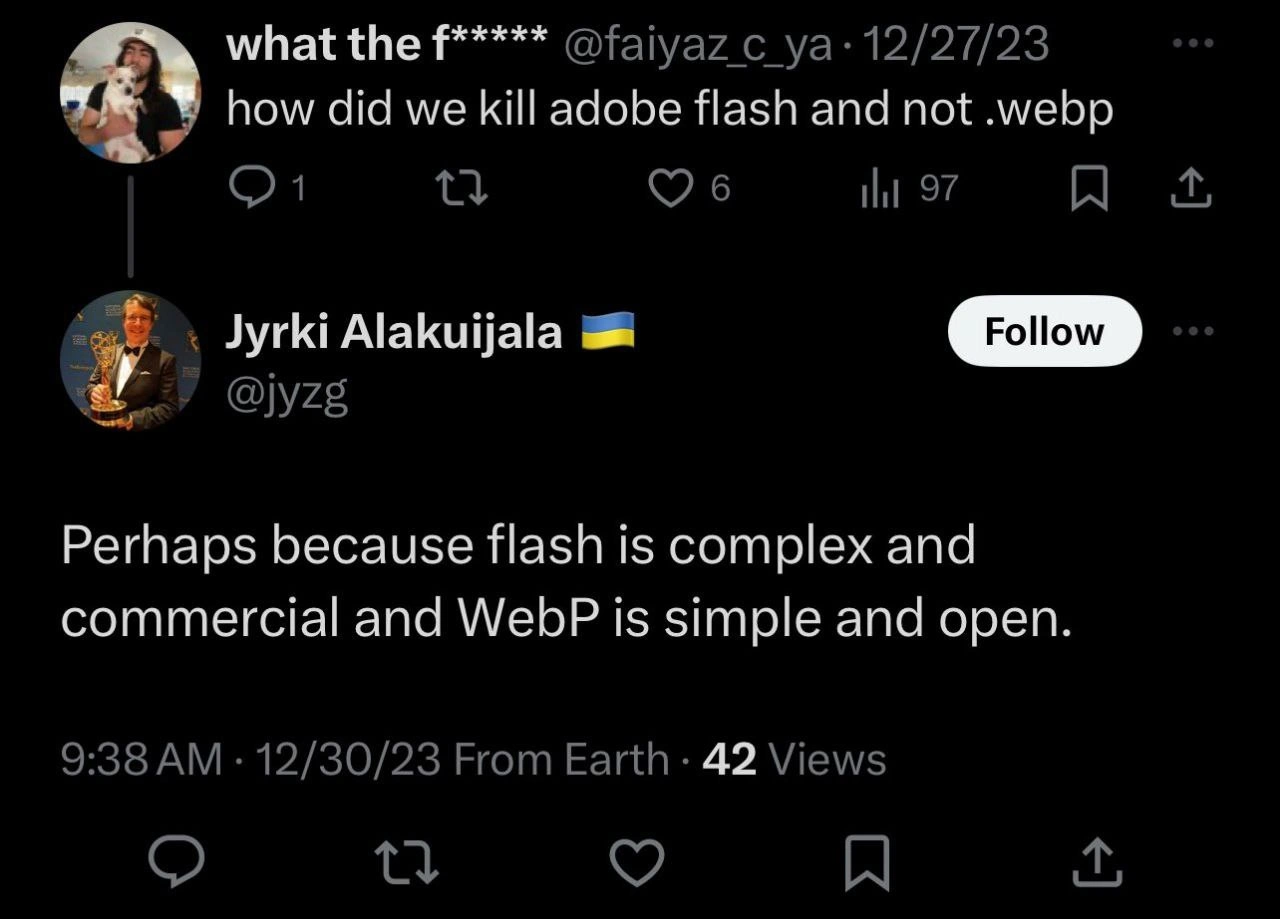
Imagine you’re complaining at a restaurant, saying “Ugh, whoever cooked this meal did a terrible job, I hope they get in trouble,” and then the chef walks right up to your table and says, “Hello, I’m the chef who made that.” This meme is just like that, but in the world of computer stuff. A developer was really annoyed with a new kind of picture file (called WebP) because it was causing them problems. They basically shouted into the internet, “Whoever created this, I hope something bad happens to them!” They didn’t think that person would ever hear it. But lo and behold, the actual person who invented WebP showed up and said, “Hey, I’m the one who invented that format.” Surprise! The funny (and awkward) part is the huge reversal: the complainer suddenly realizes the person they were angry at is real and right there listening. It’s a bit embarrassing for them, but for everyone else it’s like a scene out of a comedy — seeing someone get caught by the very person they were ranting about. The lesson in simple terms: be careful what you say online, because you never know who’s reading. And also, maybe the thing you’re angry about has more to it — someone worked hard to make that WebP format, and they might be proud of it. In the end, it’s funny because it shows how small the world can be: you curse the “inventor” of something, and the inventor magically appears to say “Hi, that’s me!” It’s the classic case of a rant coming full circle, and it made a lot of people laugh (and probably made one person blush bright red).
Level 2: WebP Woes 101
Let’s break down what’s going on here in simpler terms. WebP is an image file format, just like JPEG or PNG. It was introduced by Google around 2010 as a new way to store pictures more efficiently. The big idea was that a WebP image could be much smaller in file size than a JPEG or PNG while maintaining the same quality. Smaller files mean websites load faster, which is a huge deal in web development. WebP actually has two modes: lossy (where it compresses images by cleverly discarding some details, similar to JPEG) and lossless (where it compresses without losing any detail, more like PNG, and even supports transparency). The person who replied in the tweet, Jyrki Alakuijala, was one of the inventors of WebP’s lossless mode — essentially, he helped create the version of WebP that doesn’t throw any data away when compressing an image.
Now, why would someone be upset about an image format like WebP? Well, when WebP first came out, not every web browser or image program knew how to handle it. For example, for a long time Apple’s Safari browser and some older image editors didn’t support WebP. Imagine you’re a developer or just an everyday user: you find a cool image on a website, try to save it, and it saves as something.webp. Later you attempt to open it in your presentation or editing software, and boom — “Unknown format”. It’s like trying to play a new video game cartridge on an old console: the pieces just don’t fit. This incompatibility caused a lot of BrowserCompatibility headaches. Developers had to add extra work to convert WebP images to PNG/JPEG on the fly for unsupported browsers, and regular folks often had to use conversion tools just to view or use the images they downloaded. These are the DeveloperPainPoints and frustrations behind that angry tweet. The tweet’s author basically said, “I hate this WebP format so much, I wish whoever made it gets hit by a bus.” That’s obviously an extreme way to express annoyance — a classic example of DeveloperHumor being a bit dark and over-the-top to vent about tech frustrations.
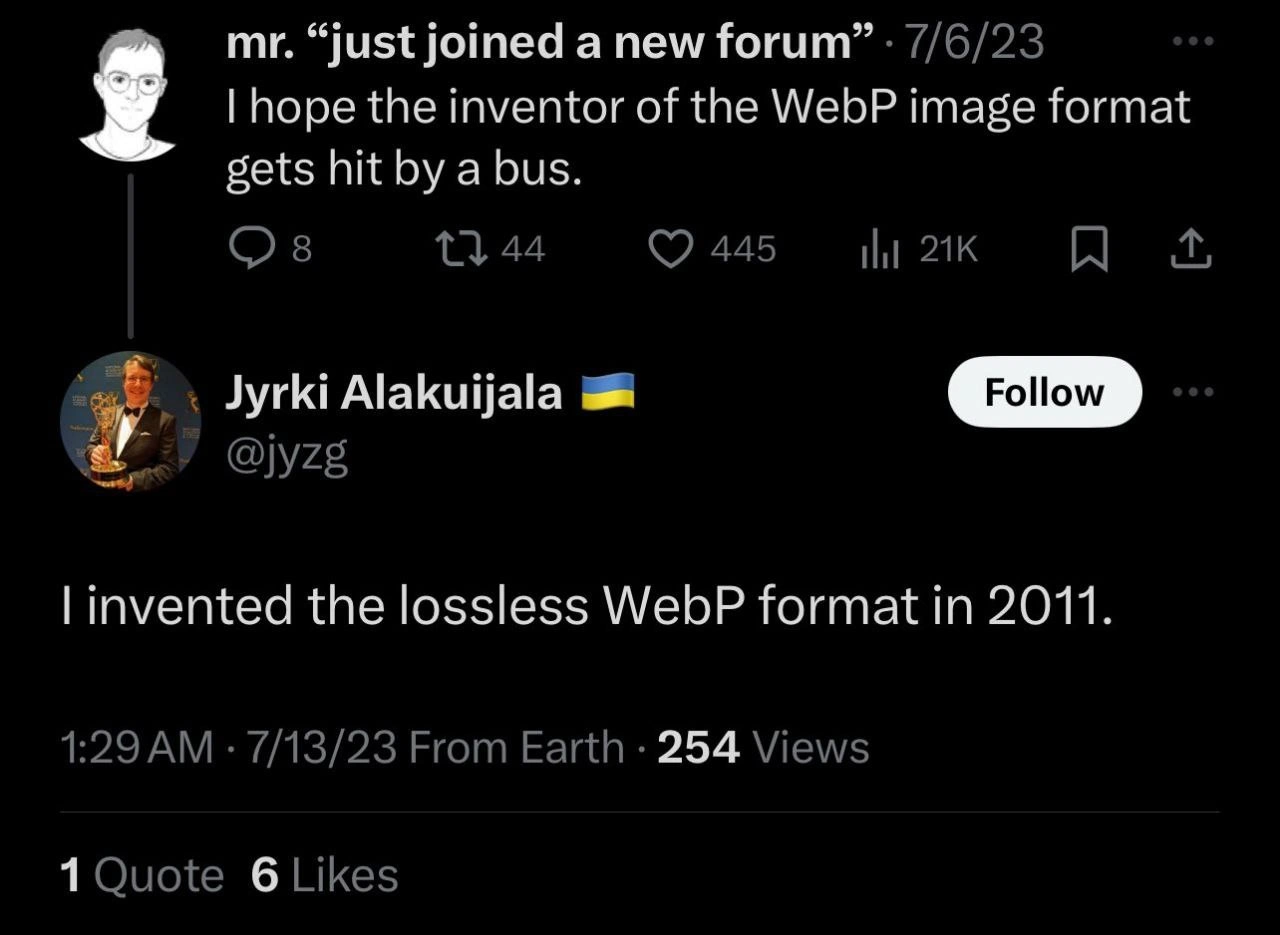
Now, here’s the twist that makes the meme funny (and a bit like a sitcom moment): the actual person who helped create WebP saw that complaint and decided to reply. In internet slang, he “slid into the thread” — meaning he jumped into the conversation unexpectedly. And he replied in a very calm, factual way: “I invented the lossless WebP format in 2011.” Imagine complaining loudly in a room, “Whoever made this new gadget should step on a Lego!” and then someone taps you on the shoulder and says, “Hi, I’m the one who made it, nice to meet you.” It’s both embarrassing and oddly comical. On Twitter (now known as X), this kind of thing can happen because many tech creators and experts hang out there. The first tweet got quite a bit of attention (likes and retweets), meaning many developers agreed or found it relatable. But the reply from Jyrki likely left everyone in amused disbelief. It’s not every day that you curse a tech invention and the inventor himself appears out of the blue. The humor here comes from that role-reversal and surprise. The original complainer went from feeling righteously annoyed to probably thinking, “Oh no… the one person I targeted is here.” It’s an unexpected meeting of dev rant and diplomatic reality check. In short, the situation moved from a regular online gripe to a memorable cautionary tale: always remember, there’s a human behind the tech you’re griping about.
To put it simply: WebP is a newer image format that not everyone liked because it caused some hassle. A developer was so frustrated they made a dramatic joke about the inventor. Then, surprise! – the real inventor replied directly, making everyone go “Whoa, that just happened.” It’s a mix of tech insider stuff (image formats and browser support) and the very human side of tech communities (be careful what you say, because the unexpected_author_reply could be waiting around the corner!).
Level 3: Bus Factor Burn
For seasoned developers, this scenario hits home on multiple levels. First, there’s the ongoing file format saga that many of us have lived through. Web developers have a long memory of the “format wars” for images: from the days of grainy JPEG vs. bulky BMP, through the rise of PNG for crisp lossless graphics, and into modern contenders like WebP (and its newer cousin AVIF). Each new format promises smaller files or better quality, but comes with compatibility headaches. WebP, developed by Google, offered a tantalizing combination: JPEG-like compression efficiency with optional lossless quality and alpha transparency (transparency was something JPEG could never do, and PNG couldn’t do in a lossy, size-efficient way). Sounds great, right? Until you hit the classic browser compatibility wall. For years, Safari (and older iOS devices) dragged their feet on supporting WebP. Early on, a front-end dev might implement a picture in WebP, only to have to set up a fallback to PNG or JPEG for the one colleague or customer whose browser said “Huh, what’s a .webp?”. This “works on my Chrome, breaks on your Safari” dance went on for a while. It’s the kind of DeveloperPainPoint that spawns dozens of frustrated blog posts and Stack Overflow questions. By the time of that July 2023 tweet, WebP had become common enough that many sites defaulted to it — meaning a developer trying to save or use an image might frequently encounter the dreaded .webp extension when they really wanted a quick .png or .jpg. If their image editing tool or pipeline didn’t support WebP (or if they simply weren’t expecting it), cue the DeveloperFrustration. We’ve all been there: “Why on earth is this image not opening? Oh great, it’s WebP… now I need to find a converter or plugin.”
So the first tweet captures that raw frustration. It’s hyperbolic TechHumor in a nutshell: “I hope the inventor of the WebP image format gets hit by a bus.” No one literally means it (we hope!), but in dev-speak, this is how you vent about a tool or format that’s been giving you grief all day. It’s an emotional exaggeration aimed at an inanimate thing (or its anonymous creator) because you can’t exactly throw your laptop out the window. The tweet’s author even styles their display name humorously as “mr. ‘just joined a new forum’”, which might imply they see themselves as a newcomer or outsider voice daring to complain loudly. Little did they know the internet’s halls have thin walls. In the age of devs on Twitter (or X, as it’s now known), the people who create the tech we use are often only a few clicks away — and many actively ego-search or follow discussions about their creations. It’s a real DevCommunities phenomenon: you gripe about a programming language or a library on social media, and suddenly one of its core maintainers or the original author might just pop up with a friendly “Hey, I made that. What’s the issue?”. It’s both wonderful and terrifying.
In this case, it’s deliciously awkward and poetic. Jyrki Alakuijala — the actual inventor of the WebP format’s lossless compression — slides into the thread with a calm one-liner: “I invented the lossless WebP format in 2011.” Talk about a mic-drop moment. For veteran developers, this is the classic foot-in-mouth scenario we warn younger engineers about. It’s why your senior coworker might chuckle and say, “Careful trashing a tool publicly; the person who wrote it might be listening.” Here the OP’s curse boomerangs right back. Instead of an army of fellow complainers joining in (which is what usually happens in a rant thread), the actual authority shows up. And he doesn’t even scold them — he just states a fact, which in context reads as the politest burn imaginable. It’s as if to say, “Well, you’ve now told me to my face.” You can almost sense the original tweeter’s shock through the screen. In developer terms, this is a code review comment from the software’s author that you didn’t expect to get. It’s both humbling and a bit hilarious. Jyrki even specifically notes “the lossless WebP format”, which is an interesting detail. It subtly educates the thread: WebP has a lossless variant and that part was his baby back in 2011. For those in the know, it’s a gentle reminder that WebP wasn’t an overnight whim; it’s been around for over a decade, crafted with care. And yes, the guy you just wished under a bus is actually a respected engineer with an Emmy in his profile picture (a technical Emmy awarded for engineering achievements, no less!). The social_media_burn here is incredibly civil and thus even more scorching – a real-life example of how reality can one-up any “epic clapback” a comedian could script.
Beyond the embarrassment factor, senior devs also recognize a deeper truth in this meme: it highlights the sometimes strained relationship between developers and the technologies they use. We often personify our tools (“curse you, WebP!”) and forget there are real people behind them. It’s a reminder that the DevCommunity is smaller and more interconnected than it seems. Today’s rant target might be lurking in the very same Slack channel, forum, or Twitter thread. In an era where a tweet can directly reach a format’s creator, this kind of encounter is both a cautionary tale and a relatable laugh. It’s the modern developer equivalent of complaining about code and discovering the original author of the code is in the room. Everyone cringes a little on the inside, because we’ve all seen it or done it. The meme perfectly captures that “open mouth, insert foot” moment that could only happen in our hyper-connected tech world. And let’s be honest: after the initial shock, most of us would love to buy Jyrki a coffee (or a beer) and ask him all about WebP’s design decisions — you know, once we’ve apologized for the whole bus comment.
Level 4: Lossless Clapback
In deep technical terms, this meme is a collision of advanced image compression theory with real-time developer feedback loops. WebP isn’t just a random format plucked out of thin air to annoy front-end developers — it’s the product of serious algorithmic ingenuity. Under the hood, WebP’s lossy mode is built on the VP8 video codec’s intra-frame compression: essentially treating a single image like a keyframe in a video. This means it uses techniques like predictive coding (where the encoder predicts pixel values from neighbors to reduce redundancy), followed by transformation and quantization (akin to JPEG’s DCT but optimized for VP8). The lossless WebP mode (which Jyrki Alakuijala proudly mentions he invented in 2011) pushes the envelope further. It employs advanced entropy coding tricks — think LZ77 compression combined with Huffman coding, but finely tuned for image data. It even introduces clever innovations like color cache dictionaries and spatial local palette reuse to squeeze out every unnecessary bit. In theory-speak, WebP is all about maximizing compression efficiency and approaching the lower bound of image entropy (a nod to Claude Shannon’s information theory). The format was a modern answer to the classic trade-off: how to retain visual quality (or perfect lossless fidelity) while minimizing file size and bandwidth usage. It’s a genuine achievement in computing, blending mathematics and computer science to reduce millions of pixels into a much smaller packet of data without noticeable loss.
Now, overlay this with the social dynamic in the meme. The disgruntled tweet “hope the inventor gets hit by a bus” unintentionally invokes the infamous “bus factor” concept in software engineering. (Ironically, bus factor measures how many key developers can disappear — e.g., via an unfortunate bus accident — before a project collapses from lost knowledge.) By cursing out the inventor, the poster basically suggested the WebP format should lose its chief contributor. But WebP’s bus factor isn’t 1 anymore: over a decade since its inception, it’s an open standard with many contributors and wide adoption. The format’s survival doesn’t hinge on a single person now, even if one person originally spearheaded it. This disconnect — between an individual’s frustration and the collaborative reality of tech formats — sets the stage for the punchline. The inventor himself appears, delivering a reply as terse and precise as a Huffman-coded message: “I invented the lossless WebP format in 2011.” It’s a lossless clapback in every sense: nothing is exaggerated or lost in translation, it’s pure, uncompressed fact. The elegance here is almost algorithmic — the shortest possible message that completely flips the context. The author of a complex image codec, armed with compression algorithms and credibility, responds in one line that carries the weight of an entire file-format war’s history. In a way, it’s a real-life demonstration of efficient encoding: maximum informational impact with minimum words, leaving the original ranter momentarily compressed into silence.
Description
A screenshot of a Twitter exchange that captures a moment of dark humor in the tech community. The first tweet, from a user named "mr. 'just joined a new forum'", aggressively states, "I hope the inventor of the WebP image format gets hit by a bus." Directly below, a reply comes from Jyrki Alakuijala, whose profile picture shows him holding an Emmy award. His response is a simple, factual statement: "I invented the lossless WebP format in 2011." The humor arises from the stark contrast between the user's violent hyperbole and the inventor's calm, identity-claiming response. For senior developers, this resonates as an ultimate 'well, this is awkward' moment, highlighting the often-unseen human creators behind technologies that users love to hate, and the absurdity of online rage when confronted by the source
Comments
7Comment deleted
Some developers handle frustration by filing a detailed bug report; others just wish a fatal exception upon the original author
WebP hatred is the new XML rant - careful, though; the spec might be reading your timeline
Nothing quite like watching someone wish death upon you for solving a 30% bandwidth problem while creating a 300% tooling problem
Nothing quite captures the essence of web development like publicly wishing harm upon a format's creator, only to have them politely introduce themselves with their credentials. It's the technical equivalent of complaining about your company's legacy codebase in Slack, then realizing the original architect is in the channel. WebP: solving the bandwidth problem while creating a compatibility nightmare that makes IE6 support look straightforward. At least when we curse at CORS policies, Tim Berners-Lee doesn't show up to remind us he invented the web
WebP compresses bytes, not grudges - tweet about it and the bus factor of your mentions drops to 1 when the inventor replies faster than your CDN negotiates Accept: image/webp
WebP: the only format that shrinks payloads and grows the bus factor - after the right‑click save fails, every incident routes to the one engineer who still remembers cwebp, srcset, and Safari’s alpha‑channel mood swings
Lossless WebP since 2011: invented to shrink payloads, perfected at summoning inventor ghosts for eternal dev salt