When the projection matrix turns your car model into a carnival mirror ride
Why is this Graphics meme funny?
Level 1: Funhouse Mirror Car
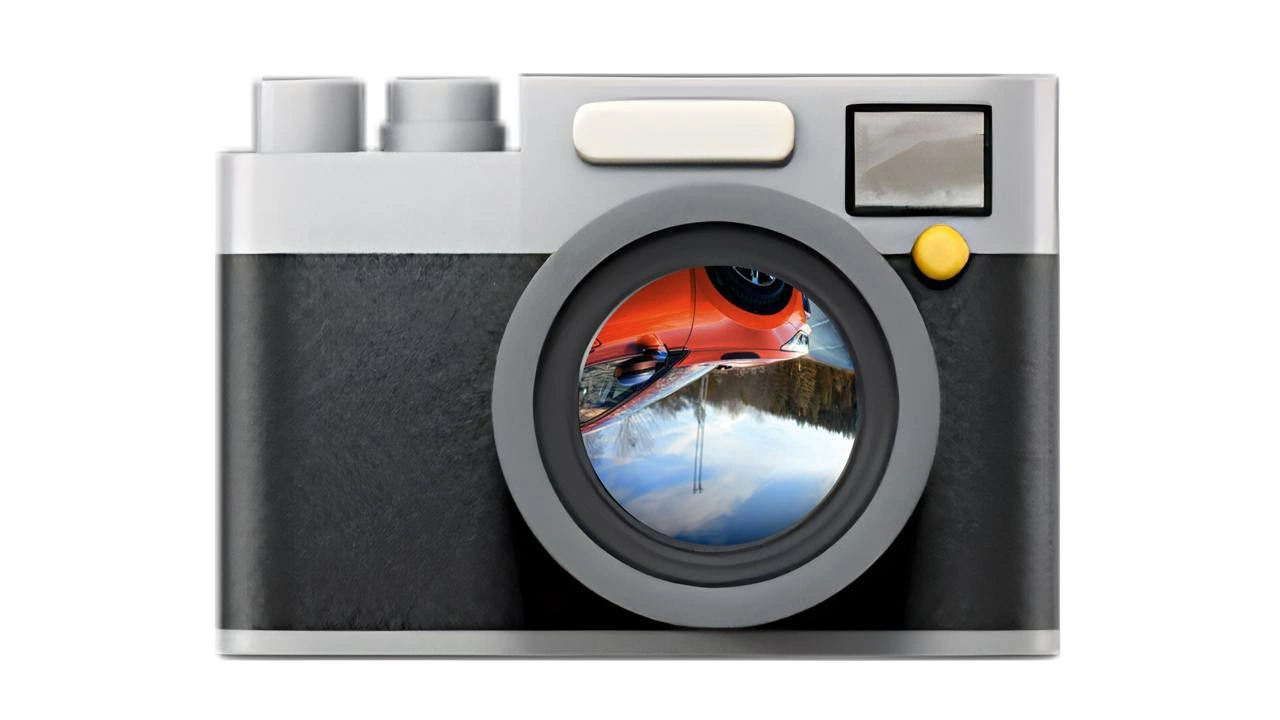
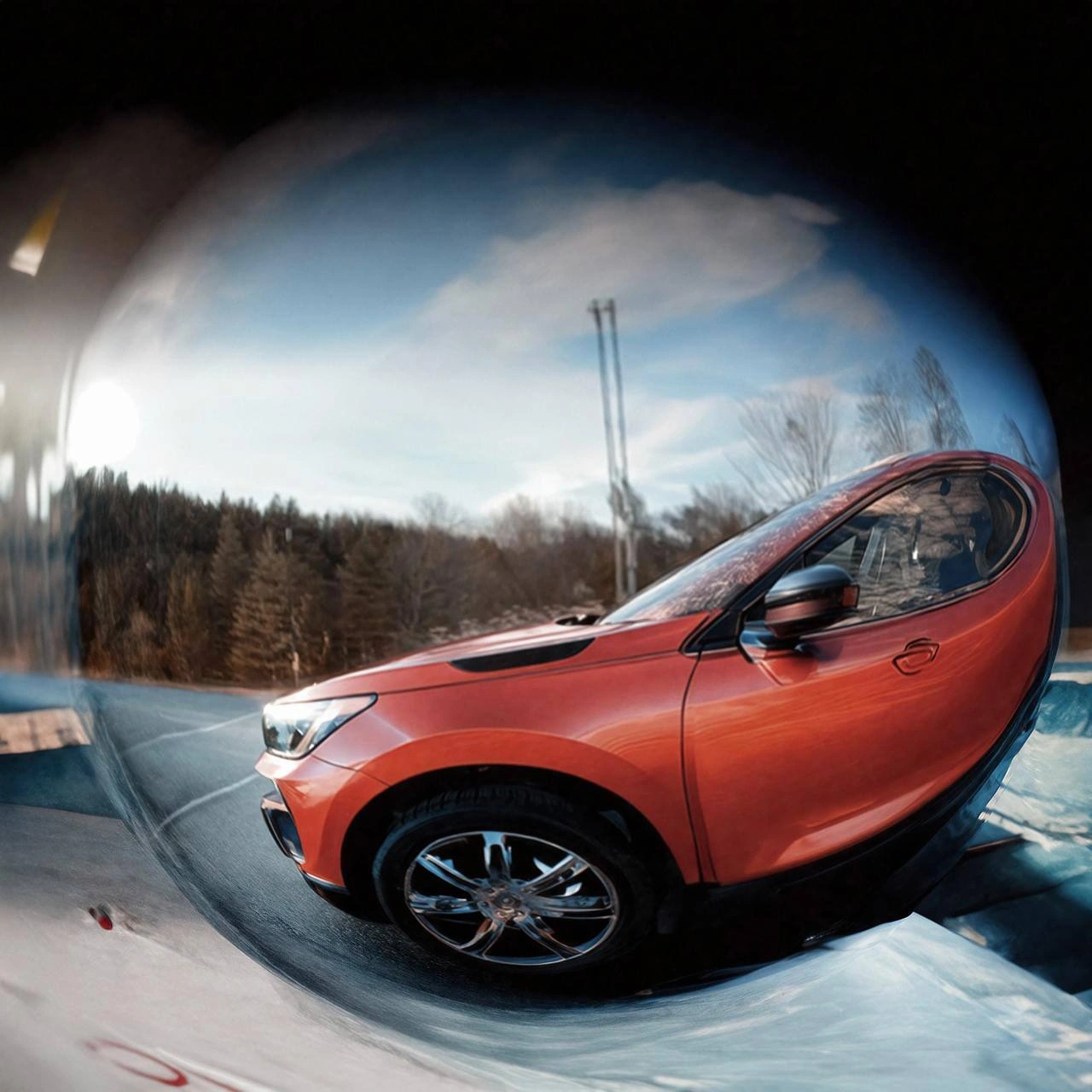
Imagine you’re at a carnival and you step into the funhouse with those wacky mirrors. You stand in front of one and suddenly your body looks totally goofy – maybe your head is huge, your legs are tiny, or you’re stretched out like a piece of taffy. You know it’s just the mirror making you look silly. Well, that’s exactly what’s happening to the orange car in this picture! The car itself is normal, but the “camera” or lens that took the picture in the computer had a silly mistake, so it behaved like a funhouse mirror. The front of the car (where the wheel is) got stretched really big and towards us, and the back of the car got squished and small. The whole world around it (the road, the trees, the sky) looks bent as if everything is inside a big shiny bubble.
It’s funny because the people who made this 3D scene never wanted the car to look like a wobbly cartoon. It happened by accident – a little error in the code – and the result is super extreme and unexpected. It turned a serious-looking SUV into something you’d see in a circus mirror. Even if you don’t know anything about programming, you can laugh at the result because it’s so obviously wrong-looking in a lighthearted way. It’s like if someone tried to take a normal photo but accidentally used a crazy warp filter on the camera. The meme’s caption basically blames the “projection matrix” (that’s the technical term for the camera’s math) for giving the car a carnival ride. In plain words, the computer’s method of drawing the car messed up, and we ended up with a funhouse mirror effect. It’s the digital equivalent of putting the wrong lens on a camera and getting a ridiculously warped photo. And just like a funny mirror at a carnival, it gives us a good laugh!
Level 2: Field-of-View Follies
Alright, let’s break this down in simpler terms. The picture shows a 3D-rendered orange car that looks like it’s been sucked into a carnival funhouse mirror. What should be a normal SUV now has a gigantic stretched front and a tiny squished back. In a video game or any 3D program, this kind of view distortion comes from the camera settings being wrong. In computer graphics, we use something called a projection matrix, which you can think of as the computer’s camera lens settings. It’s supposed to mimic how a real camera (or your eyes) see the world: things closer to the camera appear bigger, things farther away appear smaller. That’s how we convey depth on a flat screen.
One of the main settings in this camera model is the field of view (FOV). This is basically how wide the camera’s perspective is. A small FOV is like a telescope (very zoomed in on a narrow area), and a large FOV is like a GoPro or wide-angle lens (you can see a lot around you, but the image might look curved at the edges). Usually, games use a moderate FOV so the scene looks normal to the player. If the FOV is set way too high, you get a fisheye effect – kind of like those peephole lenses on doors that let you see a whole hallway, but everything is bent in a circle.
Now, how do you accidentally set an insane FOV? A common mistake is mixing up degrees and radians when specifying the camera’s field of view in code. Degrees are what we use in everyday life (360° in a circle). Radians are a different way to measure angles that many programming libraries use (2π radians in a circle, which is about 6.28318). If a function expects the angle in radians but you give it in degrees, the number is way larger than it should be. For example, 60 degrees is a typical nice wide-ish field of view. But 60 radians is an enormous angle (about 3438 degrees)! That doesn’t even make physical sense, but the computer will still try to plug that in. The result is the camera looking almost all the way around at once. The scene will appear wrapped into a ball. The front of the car, being closest to the camera, gets blown up huge (as if it’s practically touching the camera), and the back of the car, only a little farther, looks super small. Everything gets exaggerated. If you’ve ever seen a photo through a very strong fisheye lens, you’ll recognize the bulging effect. Here, it was likely caused by a tiny bug in the code giving the wrong number for the lens.
There are other ways this kind of warping can happen too. In 3D graphics, objects go through several steps of positioning: we move the object with a model matrix, position the camera view with a view matrix, and set the lens with the projection matrix. These have to be applied in the right order. If a developer accidentally does something in the wrong place – for example, if they applied a movement to the projection matrix instead of the model matrix – it would be like moving the camera’s lens incorrectly rather than moving the car. That can distort the whole scene. Think of it like this: you want to take a photo of your car, and normally you’d move the car or move yourself to get it in frame. But imagine instead you somehow warped your camera’s lens in a funky way while trying to move – the photo would turn out bizarre. In code, mixing up those transformations yields a similar level of bizarre!
Let’s mention shaders too. A shader is a little program that runs on the graphics card to handle details of rendering. There are vertex shaders (which can move the points of models) and fragment shaders (which color in the pixels). If the vertex shader has a bug, it might move the car’s vertices (the points defining its shape) incorrectly. For instance, maybe the programmer wrote a shader to make a flag wave in the breeze by moving its vertices with a sine wave. If by accident that formula ran on the car model, the car could wobble or stretch in unintended ways (imagine the car body flapping like a flag – whoops!). That would be a vertex_warping bug. In the image we have, though, the trees, road, and car all seem consistently bent, which implies the camera’s view itself was warped. A per-object shader glitch usually messes up one object at a time (just the car would look wrong but the background would be fine, or vice versa). Here it’s like the entire world is seen through a bent lens, so the camera math is the prime suspect.
In any case, what happened is a classic graphics mistake: the math that translates the 3D scene to the 2D image had an error. The result is that our nice realistic car turned into a droopy, stretchy cartoon version of itself. As a newcomer to coding or 3D, it’s important to know these things happen even to experienced folks. You might one day run your program and gasp, “Why is my car a pancake?!” or “Why did my character turn upside down and inside out?” The good news is, these wild visual bugs are usually obvious and you can often trace them to a single wrong value or line of code. And honestly, once you fix the issue, you kind of cherish that crazy screenshot. It’s like a rite of passage in GraphicsProgramming to have a few “look what went wrong” images. They’re frustrating in the moment but hilarious in retrospect. This meme is basically one of those moments frozen in time and shared for a laugh. It tells young developers: don’t worry, this happens to everyone — and here’s a funny example! Now you know that if your whole scene ever looks like it’s reflected in a spoon, you should double-check your camera math (it’s almost always that!).
Level 3: Funhouse Transform Fiasco
For seasoned developers, this image immediately evokes a mix of empathy and amusement. It perfectly captures a type of Graphics bug that’s both terrifying and hilarious. We’ve all been there: you’re tweaking some transformation code or calibrating the camera, and suddenly your beautiful 3D model looks like it’s being reflected in a funhouse mirror. That bright orange SUV stretching and drooping is basically the “oh no!” moment every graphics programmer recognizes, followed by an eventual chuckle. The humor comes from the absurdity — one moment you have a realistic car, the next it’s a clownish cartoon, all because of a tiny math mistake. It’s the kind of UnusualBug where the outcome is so visibly ridiculous that you can’t help but laugh (at least after you recover from the initial heart attack).
What combination of elements makes this so funny? First, there’s the element of surprise and excess: the car isn’t just a little off, it’s dramatically warped. The front wheel is comically huge and lunging out of the frame, while the rear has crumpled into a stub. This tells any experienced dev that the bug is likely in the camera projection or coordinate transform stage, because the distortion affects the entire shape in a smooth gradient (classic sign of a malformed projection). In our heads, a little alarm goes off: “This has projection_matrix_bug written all over it.” We’ve seen smaller scale versions: maybe an aspect ratio mix-up making things look a bit stretched, or a mis-typed FOV making the view slightly fish-eyed. But this? This is the scenario cranked up to 11. It tickles the seasoned developer’s funny bone because it’s an exaggerated case of a very familiar mistake.
Take the common blunder of mixing up degrees and radians for a camera FOV – nearly every graphics dev has done it once. The code snippet might look innocent, but the result is catastrophic (in a comedic way):
// Intended to set a 60-degree field of view for the perspective camera
float fovDegrees = 60.0f;
glm::mat4 proj = glm::perspective(fovDegrees, aspectRatio, 0.1f, 100.0f);
// Oops! glm::perspective expects the FOV in radians, not degrees.
In this example, because the function thinks that 60.0f is in radians, it actually uses ~3438° as the field of view. That’s like trying to make the camera see everything in every direction at once. The scene effectively turns into a bubble around the camera. A bug like this literally transforms a normal view into a fisheye funhouse. When something like that happens during development, you get an image almost exactly like the meme: the world taking on a spherical appearance, with near objects blown way out of proportion. Any graphics veteran reading this will probably nod and grin, remembering the first time they saw their carefully modeled scene turn into what looked like a reflection in a spoon. It’s a classic “learn from this” moment in GraphicsProgramming.
Beyond the specific FOV mishap, this meme resonates because it exemplifies the fragility of the graphics pipeline. Maybe you applied the camera transform twice by accident. Perhaps the order of matrix multiplications got jumbled (it matters immensely if you do projection then view vs. view then projection!). Or you might have left an old transformation in the stack. One colleague might joke, “Looks like someone accidentally implemented a spherical lens shader.” Another might say, “I’ve seen this — check if the near plane or coordinate handedness got messed up.” These quips come from real war stories. For instance, using a projection matrix intended for a left-handed coordinate system in a right-handed one can flip the scene in weird ways (imagine everything inside-out or mirrored). Or consider forgetting to initialize the projection matrix entirely; if you send uninitialized junk data to the GPU, it will still try to interpret it as a valid matrix – the result can literally be psychedelic, as if the world imploded or stretched infinitely. Compared to those, this car looks almost artistic!
The RelatableDeveloperExperience here is strong. It highlights that dichotomy of dev life: the frustration of a bug coupled with the ridiculous output that you almost want to screenshot and share. Many developers actually keep a folder of their funniest bug screenshots. Seeing your work go haywire in such a visual way is shocking at first, but then it becomes an anecdote to share over lunch. “Remember that time the character models all flattened out like pancakes because of a bad matrix? Good times.” This meme is basically that memory in image form. It’s comforting and comical because it’s a shared experience — we’ve all had a moment where our code made the scene look absolutely nonsensical.
And let’s appreciate the silver lining: as far as bugs go, a wildly warped car is hard to miss! There’s no subtlety here. It’s not some minor calculation error that you have to hunt for in logs; it’s right there on screen screaming, “Something’s wrong with the transformations!” In that sense, it’s almost a relief. Debugging is often easier when the bug makes itself as obvious as a carnival mirror car. You know exactly which part of the pipeline to inspect. The tags like shader_glitch or vertex_warping hint at other causes of crazy visuals (like a bad vertex shader making one model freak out), but the fact that the whole scene is uniformly warped is a dead giveaway to experienced eyes: the issue is with the camera/projection math. So, the meme also contains a nugget of insight — it’s practically pointing the debugger at the projection matrix.
In summary, this warped SUV image is a perfect inside joke for developers. It says: “I bungled my 3D math, and now my realistic car looks like a wacky cartoon.” We laugh because we’ve been that person, staring at the screen, equal parts horrified and amused. It’s a bonding moment across the community — a reminder that even the pros screw up a matrix now and then. Funhouse transform fiasco, indeed.
Level 4: Glitch in the Matrix
At the deepest technical level, this meme illustrates a projection_matrix_bug that graphics engineers know all too well: a miscomputed camera projection turning a scene into a warped nightmare. In a modern 3D rendering pipeline, vertices of a model (like that orange car) go through a series of transformations. The final step uses a 4x4 projection matrix to map 3D coordinates into a 2D view. This matrix encodes the virtual camera’s field of view, aspect ratio, and near/far clipping planes. After applying it, the GPU performs a perspective divide by the special w component of each vertex, creating the illusion of depth (objects farther away appear smaller). However, if something in that matrix (or the subsequent viewport mapping) is mis-specified, all bets are off — straight lines can bend, proportions skew, and the scene turns into a digital hall of mirrors. The image shows exactly that: the car and environment are distorted as if seen through a giant curved lens, strongly suggesting a projective-transform glitch. One likely cause is an extreme or incorrect FOV in the projection matrix. For instance, if a developer mistakenly provided an FOV in degrees where radians were expected (say passing 60.0 when the code expects 60 radians), the math would interpret it as a ~3438° wide lens! The resulting projection would be so ultra-wide that the scene effectively wraps around on itself, like a panorama gone wrong. In homogeneous coordinate terms, many vertices would end up with an outlandish w value (very small or negative), so when the GPU computes screen positions (x/w, y/w, z/w), those numbers blow up or flip sign. The front of the car might then appear magnified far beyond normal (since its vertices got divided by a tiny w), while the rear might collapse into a vanishing point. In short, the perspective math that’s supposed to shrink things with distance has gone off the rails, making near stuff too big and far stuff too small – a total violation of normal geometry.
This glitch can also arise from mixing up coordinate spaces or applying transforms in the wrong order. A classic mistake from the OpenGL fixed-function era was doing object transformations while still in GL_PROJECTION mode. The projection matrix is meant only for the camera’s lens parameters; if you accidentally applied a translation or scaling to it, you’d introduce rogue terms that break the perspective calculation. The result is a non-linear warp of the entire scene. It’s as if part of the scene got projected onto a curved surface instead of a flat plane. The meme’s car, with its front end bulging toward us and rear end pinched, is exactly the kind of artifact you get when the projection matrix has a stray transformation or an improper value. It essentially turned the viewing frustum into a funhouse tube. Even a small error, like using a left-handed projection matrix in a right-handed engine (or vice versa), can cause a mirror-like inversion or distortion of geometry. Another angle: consider the viewport_transformation_error possibility. After projection, the normalized device coordinates are mapped to screen pixels. If the viewport dimensions or aspect ratio were fed incorrectly (say, telling the system the screen is twice as wide as it really is), you would stretch the image in one direction. However, the perfectly spherical “fishbowl” warping we see – where the world appears inside a glossy bubble – points back to the projection itself (likely an exaggerated FOV or an accidentally applied distortion formula) rather than a simple x-y stretch.
From a theoretical standpoint, what we’re seeing is a breakdown of the assumptions of projective geometry. A correct perspective projection (the kind pioneered by Renaissance artists to depict 3D scenes) has the property that straight lines in the world remain straight in the image (think railroad tracks converging but not curving). In this image, formerly straight features like the guardrail or tree trunks appear curved, indicating that the transform is no longer a simple linear projection. It’s akin to introducing a higher-order lens distortion (like a spherical or barrel distortion) on top of the perspective. This could happen if, say, the perspective divide was done at the wrong time or a custom vertex program applied a radial offset based on position. Indeed, a crafty (or buggy) shader_glitch could produce such an effect: imagine a vertex shader that mistakenly warps positions outward in a radial fashion (perhaps using a formula intended for a reflection or refraction effect). The fact that everything in the scene is bent along a continuous curve suggests a uniform distortion – as if the entire camera view was rendered onto a shiny ball. In summary, the meme humorously exposes how delicate the graphics pipeline is. A single mathematical slip – a flipped sign, a swapped matrix, a unit conversion error – can shatter the illusion of normalcy and send us tumbling into a world of fisheye_distortion. It’s a glitch in the matrix in the most literal sense: the matrix that should faithfully project the world decided to have some fun instead, turning our realistic car model into a carnival-curved spectacle.
Description
The image shows a bright orange compact SUV dramatically warped as if trapped inside a glossy fish-eye bubble: the front wheel and fender are stretched toward the viewer while the rear has collapsed into a teardrop, creating a crescent-shaped vehicle. The surrounding scene - a gray roadway, winter trees, a guardrail, and a pale blue sky - appear equally bent along the sphere’s curvature, with no visible text anywhere. Visually it evokes a graphics pipeline failure where a faulty projection or UV mapping shader deforms geometry. For developers, it’s the quintessential ‘funhouse mirror’ bug you see when the perspective matrix, vertex normals, or viewport transform go off the rails in a 3-D rendering engine
Comments
6Comment deleted
Turns out if you swap view × projection order the SUV compresses like gzip - 9; marketing is now calling it “edge-to-edge aerodynamics” and wants it in prod by Friday
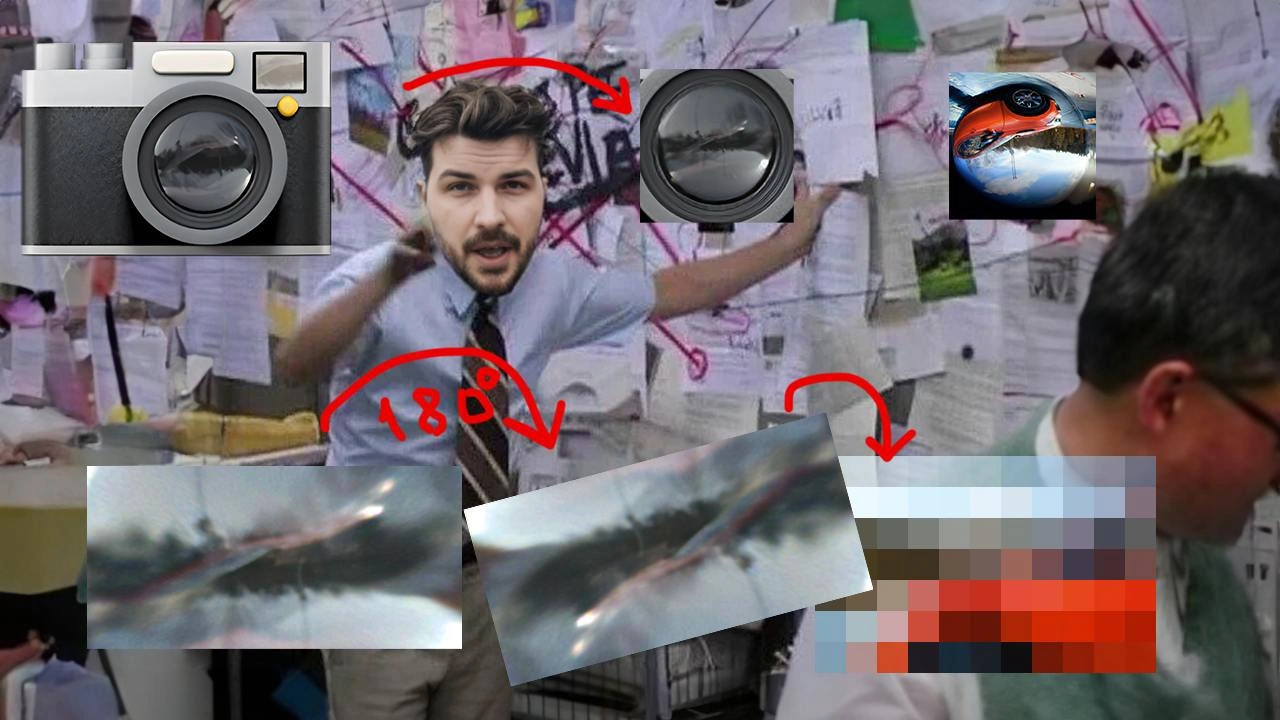
When the PM asks why the computer vision model works perfectly in the lab but fails in production, and you have to explain that real-world lens distortion isn't just a float you can hardcode to 0.0
When your computer vision model trained on ImageNet encounters real-world fisheye camera data and suddenly thinks every car is a Möbius strip. This is why camera calibration matrices exist - because sometimes the hardest part of autonomous driving isn't the AI, it's convincing your perception pipeline that straight lines actually exist in the physical world
Forgot the fisheye undistortion matrix in OpenCV - now prod looks just like this
Barrel distortion is cute until your demo car looks like a croissant - k1/k2 aren’t feature flags; they’re the difference between “camera MVP” and modern art
Skipped calibrateCamera, shipped K=I with k1..k3≈0; marketing calls the barrel‑distorted SUV “curvature UX” and pushes for GA