Skip to content
DevMeme
4416 of 7435
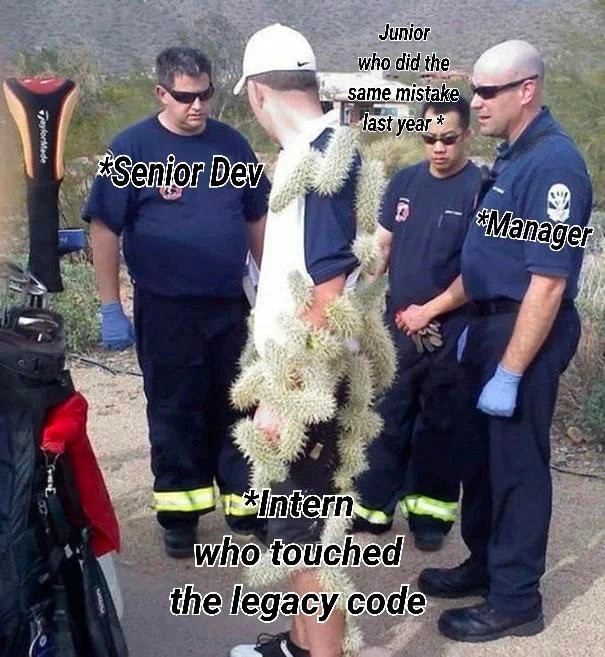
Intern touches legacy code; the team arrives like paramedics to assess damage
LegacySystems Post #4836, on Aug 31, 2022 in TG

Intern touches legacy code; the team arrives like paramedics to assess damage

Why is this LegacySystems meme funny?

Level 1: Hugging a Cactus

Imagine your parents or older siblings point to a big cactus plant and warn you, “Don’t touch that, it’s sharp.” Now, you’re new and curious, and you think, “It can’t be that bad,” and you give the cactus a little hug or poke. Ouch! In an instant you’ve got painful cactus spines stuck all over you. You’re hurting and realize you made a mistake. Your family rushes over like emergency helpers: they carefully pull out each thorn and put ointment on your wounds while gently scolding, “See, this is why we told you not to touch it.”

This meme is just like that, but for computer code. The cactus is an old, fragile computer program that everyone said not to mess with because it could cause trouble. The intern (a newbie) is the one who didn’t listen and tried to change something in that old program – essentially, he “hugged” the dangerous cactus. The result? The program “pricked” him with lots of problems (just like the cactus did with its needles). The team – the experienced developers and the manager – come running to help fix everything, kind of like how your family helped you with the cactus spines. They aren’t mad (well, maybe a little annoyed), but they knew this could happen and they want to help make it right. It’s funny because everyone except the intern sort of saw this disaster coming, and the picture exaggerates it by showing him literally covered in spikes. In the end, just like you learned not to hug a cactus, the intern learns to be extra careful with that old code. The humor makes a simple point: some lessons in life (and coding) are learned the hard way, and it’s a little bit funny (after the fact) when the whole crew has to jump in to rescue the situation.

Level 2: When Code Bites Back

For a less experienced developer or someone newer to this world, here’s what’s going on: this meme compares working on old legacy code to accidentally getting covered in cactus spines. Legacy code means an older codebase or system that a company still uses, even though it was written ages ago (often by developers who have since moved on). Think of it like an old machine that’s still running the factory – it does the job, but none of the current staff were around when it was built, and nobody is entirely sure how all its parts work. Changing something in a legacy system is risky because you might not realize how one part connects to others. A tiny change can break things you didn’t even know were related.

In the picture, the intern is the new developer who made a change to such an old system. The dozens of cactus spines stuck to him represent all the unexpected bugs and problems that popped up because of that change. It’s like he tried to fix a small thing and suddenly a bunch of error messages and broken features “stuck” to him as a result. This is a classic case of TechnicalDebt in action. Technical debt is a term developers use to describe the consequences of quick-and-dirty coding solutions. Over years, a legacy project accumulates these messy patches (debt), and eventually someone has to deal with the “interest” – meaning, when you try to improve or modify the code later, it’s much harder and more painful than it should be. In our scenario, the intern is the one paying off that debt in pain: he touched the code and now is dealing with a bunch of prickly issues that were hidden under the surface.

Let’s break down the roles and why each person is there, just like in the meme text:

  • Senior Dev: This is the experienced developer (the person on the left in the meme). They’ve been around this codebase for a while and probably knew it was delicate. In real life, a senior dev is often the go-to “firefighter” when something goes wrong with an old system. As soon as the intern’s change caused problems (e.g., parts of the application crashing or users encountering errors), the senior dev would rush in to help diagnose and fix it. They’re like the lead paramedic who has seen this kind of injury before. They might say things like, “Alright, show me what you changed,” and they know how to carefully undo the damage (pull out those “spines” one by one) without causing further harm. The senior dev isn’t there to scold, but you can bet they’ll later explain to the intern what went wrong so it doesn’t happen again.
  • Junior Dev (Did the same mistake last year): This is a newer developer who, not long ago, was in the intern’s shoes. Maybe last year they tried to refactor or clean up a piece of the same legacy system and caused a similar snafu. Now a year wiser, they stand alongside the senior dev in the meme. In a real workplace, this junior might have spoken up when the intern started tinkering: “Careful, I messed with that code last summer and things went haywire.” If they didn’t warn in time, they’ll certainly be empathetic now. They’re basically saying, “Yep, I’ve felt those thorns. It hurt, but I survived.” Their presence highlights a learning pattern in tech: many Juniors learn about a legacy system’s hazards only after triggering a problem themselves. On the bright side, having gone through it, that junior can now help fix the issue and guide the intern. They become part of the response team, applying the lesson they learned the hard way.
  • Manager: The person on the right in the meme with the Manager label isn’t working on the code directly; he represents the team’s or project’s manager. When something breaks badly – especially if it’s a user-facing product or critical service (we sometimes call this “breaking production”) – managers get involved to coordinate and to understand the impact. The manager in this scenario likely got a notification that something is wrong (say, an outage alert or customer complaints) and hurried over to see the status. Managers have to report to other stakeholders or management about what happened, so they need to know: how bad is it, how long will it take to fix, and what do we tell people affected by it? In the image, the manager looks concerned but calm, just observing. In reality, they might be calling other teams or preparing a statement like, “We’re experiencing technical difficulties due to an unexpected issue; our engineers are on it.” They’re basically there to support the team (and yes, sometimes to make sure the team is indeed fixing it ASAP). And after things are resolved, this manager might organize a meeting to discuss how to prevent such incidents – maybe setting a rule that interns or new developers get more code reviews or training before touching sensitive legacy modules.

So what exactly did the intern likely do, and why did it cause so much trouble? It could be any number of innocent mistakes:

  • Changing something you shouldn’t: Perhaps the intern saw a piece of code that looked outdated or wrong and thought, “I’ll clean this up.” In older systems, there are often bits of code that only exist for historical reasons (like a weird workaround). If you remove or alter them without knowing the history, the system can break. It’s like pulling a random fuse out of an old car because it looks unused – suddenly the headlights stop working.
  • Lack of tests or documentation: Modern projects usually have tests (automated checks) to catch if a change breaks something. Legacy projects often don’t — or the tests are as unreliable as the code. That means the intern’s change might have seemed fine (it ran, it compiled, whatever) until it hit the real system. Only then do all the hidden problems surface. This is akin to not knowing a cactus is super spiky until you actually grab it. If documentation was missing, the intern had no map of the minefield they were stepping into. They simply didn’t know touching that one variable would, say, overflow a database or crash a service.
  • Everything is connected: Old systems can be very tightly coupled, meaning different parts depend on each other in complex ways. For instance, changing the format of an output in Module A might silently break Module B that was expecting the old format. The intern might have changed a function or a config setting, thinking it was isolated, but in truth dozens of other parts relied on it. This is why a small change ended up causing a big mess. It’s a bit like removing what looks like a random bolt from a machine, and then the whole machine starts shaking because that bolt was actually supporting a crucial gear.

When such a mess happens, the situation becomes a code emergency. We often use the term “production incident” for serious problems in the live system. Companies have on-call rotations and incident response procedures that feel a lot like emergency services. The senior dev and junior dev are effectively the “on-call responders” here, doing things like:

  • Checking logs and error messages to diagnose what went wrong (like a doctor examining wounds).
  • Possibly rolling back the intern’s change (removing that new code and deploying the old version to stabilize things). In meme terms, that’s like gently pulling out the largest cactus spines to stop further damage.
  • Applying quick patches or hotfixes to keep the system running. (In a cactus scenario, think of this as bandaging the spots to prevent infection once the spines are out.)
  • Communicating with others – perhaps one of them is telling the manager, “We’ve identified the issue and are fixing it, give us 30 minutes.”

For the intern, this is undoubtedly a painful learning experience. They probably feel embarrassed or upset – much like someone who has literal cactus needles sticking out of their skin! The phrase “painful resignation” in the description captures it: the intern realizes they messed up and there’s not much to do except endure the situation and learn from it. Every developer has been there at least once – it’s a mix of “Ouch, that hurt” and “I guess I know better now.” The good news is that most teams won’t crucify you for an honest mistake. Notice the other devs in the meme aren’t laughing at the intern; they’re concerned and focused on helping. That’s exactly how a healthy team reacts: fix first, blame later (or never). Often afterwards, the senior might even commend the intern for taking initiative, while advising them on safer ways to do it next time (like asking for a code review or writing tests around the change).

From a cultural standpoint, this meme is popular because it’s WorkplaceHumor that many in tech can relate to. It highlights the gap between Senior vs Junior Developers: seniors have that battle-hardened wisdom about legacy systems, whereas juniors sometimes only learn it by getting “bitten.” But it’s all in good humor – almost a hazing ritual of engineering. The image of the team “arriving like paramedics” is an exaggeration, of course, but not by much! If you’ve ever been in an office when a production incident happens, people rush over to the person who made the change or to the war-room chat channel just like in that photo. There’s urgency, and maybe a bit of quiet judgment too (“We probably should have warned the intern better…” or “Why didn’t he test that first?”). Yet ultimately, it’s a team effort to put things right.

And those cactus spines? They’re a funny stand-in for bugs, alerts, and system failures that prick the developer. Each spine could be seen as a JIRA ticket suddenly filed or a monitoring alarm going off due to the intern’s change. The poor intern is covered in issues now. It humorously visualizes what an intern’s inbox or Slack might look like right after a bad deploy: dozens of pings from monitoring systems, teammates, and managers – each one a little “thorn” saying something is wrong. The senior dev and junior dev are essentially the folks coming over to help untangle all those alarms and get things back to normal. Meanwhile, the manager might be metaphorically on the phone with customers or higher management, explaining the situation (like calling the ambulance or hospital to be ready).

In simpler terms, the meme warns: Touching legacy code can be as unexpectedly painful as touching a cactus. It’s developer humor that educates at the same time. Any junior dev seeing this meme can chuckle but also take note – there’s usually a reason older devs treat some parts of the codebase with reverence (or fear). The next time you see a file that hasn’t been updated since 2009 and nobody wants to touch it, remember the cactus: proceed with caution, ask questions, and maybe wear some thick gloves (i.e., do extra testing, code review, backups) before you give it a hug. That way, hopefully, you won’t need your team to swarm in with the tweezers and first aid kit!

Level 3: Cactus Code Triage

This meme nails a scenario every seasoned engineer recognizes: a well-meaning newcomer tweaking a LegacyCodebase and triggering a full-on code emergency. In the photo, an intern is absolutely covered in cactus spines after an ill-advised touch – a perfect metaphor for touching brittle legacy code and getting skewered by hidden bugs. The other three figures – labeled Senior Dev, Junior (who made the same mistake last year), and Manager – are gathered like an incident response team of paramedics. The humor comes from how absurdly true-to-life this feels in software development: messing with old, fragile code can prick you with dozens of unexpected side effects, and then the whole team has to scramble to triage the situation. It’s basically a MaintenanceNightmares reenactment, with the poor intern learning the hard way why everyone says “if it ain’t broke, don’t fix it” – especially not on a Friday.

Why is this combination of elements so funny to experienced devs? It exaggerates a reality we’ve all lived through:

  • Hidden Side-Effects Everywhere: Legacy systems are notorious for their tight coupling and spooky action-at-a-distance. Change one line in a dusty file and suddenly an unrelated module (that no one knew was connected) falls over. Those cactus spines stuck all over the intern represent dozens of TechnicalDebt booby traps going off at once – configuration flags not updated, null-pointer exceptions in far modules, perhaps even a 3 AM pager alert. One innocent change cascades into a domino effect of errors and breakages.
  • Tight Coupling & Fragile Design: The cholla cactus in the image is known for its barbed segments that cling stubbornly if you so much as brush against it. Similarly, legacy code often has a “clingy” architecture: everything is so intertwined (think spaghetti code or a Jenga tower of hacks) that touching any piece causes multiple pieces to snag. In software design terms, high coupling and low cohesion mean parts of the system can’t be adjusted in isolation. The intern thought he was making a local fix, but ended up yanking a whole cluster of prickly code ownership hazards. It’s a textbook legacy pitfall – you fix one bug and ten others spring up.
  • Institutional Memory (or Lack Thereof): The meme pointedly labels one bystander as the "Junior who did the same mistake last year". Translation: this exact disaster has happened before. In many organizations, there’s an oral history of “Remember when Alice tried to optimize the email parser and took down production?” Each new generation of developer is at risk of repeating these mistakes if knowledge isn’t shared. The junior in the meme isn’t just rubbernecking; he’s a survivor of the same cactus attack, now slightly wiser and wincing in sympathy. This cycle (“new dev triggers legacy bug, chaos ensues, lesson learned”) is practically a rite of passage on some teams. The humor has a dark edge: Senior vs Junior Developers often bond over war stories of being skewered by legacy systems.
  • Senior Devs as First Responders: In the image, the senior engineer stands over the intern like a calm paramedic, probably saying, “Alright, let’s see what you touched and how bad it is.” Senior devs in real life become crisis doctors when legacy code blows up. They’ve seen these thorns before and carry the antidote (like knowing which feature toggle to flip or which ancient script to run to patch things up). While the intern is slumped in painful resignation, the senior dev’s expression is a mix of concern and weary I-told-you-so. They’ve likely been warning about that legacy module for years (“touch that code and it will bite”). Now their job is to stabilize the system (pull out the spikes one by one) and educate the newbie – after applying some metaphorical antiseptic.

The manager’s presence in this meme is another layer of comedy and truth. Managers often aren’t hands-on with code, but when an incident strikes a critical system, they appear on the scene like a supervisor at an accident site. The Manager in the photo looks equal parts concerned and quietly assessing blame. In reality, a manager in such a scenario might be coordinating the response: informing other teams or stakeholders, scheduling an emergency meeting, and later conducting a post-mortem (“How did we allow an intern to deploy code that brought down the server?”). The meme captures that awkward dynamic: the technical folks fix the immediate problem while the manager hovers, calculating the impact and making sure “this never happens again.” It’s a snapshot of CorporateCulture around legacy systems – everyone knows it’s fragile, but it’s mission-critical, so when it breaks, even higher-ups swarm in to contain the fallout.

Another reason this resonates with veteran developers is the implicit critique of TechnicalDebt. Those cactus spines didn’t grow overnight – they’re the result of years of quick fixes, outdated hacks, and neglect. A legacy codebase accumulates “debt” like interest on a bad loan: eventually someone has to pay in pain. The intern, sadly, just made a huge “interest payment” by stumbling into a minefield of old bugs. The seniors have likely been avoiding this refactor precisely because they know the code is a house of cards. It’s funny in an ouch kind of way: the poor intern had no idea that a seemingly small tweak would trigger a production 911. It underscores why seasoned engineers are so cautious (some say paranoid) about touching stable legacy code – they treat it like a bomb squad treats an undetonated device. In fact, there’s a darkly humorous rule passed around: “Never rewrite the legacy system unless you’re ready to own the consequences.” The intern in this meme learned that the hard way, and now he’s literally stuck with the consequences (spines and all), awaiting help from the old-timers.

To drive home how these situations play out, imagine a snippet of legacy code and the kind of well-intentioned “fix” an intern might do:

# A simplistic legacy code example:
critical_flag = True

def run_crucial_task(data):
    if critical_flag:
        legacy_setup()  # Hidden setup needed for system stability
    process(data)      # Perform main task
    # (No one documented that legacy_setup() must run first)

# Intern sees an always-true condition and "cleans it up"
critical_flag = True
def run_crucial_task(data):
    # Intern removed the condition as it's always True
    # legacy_setup() is now never called
    process(data)      # This will break something because setup didn't run

run_crucial_task("test")  # Everything blows up here

In this contrived example, the intern noticed critical_flag is always True and removed an “unnecessary” if – inadvertently preventing a vital legacy_setup() call. This is the kind of subtle trap legacy code holds: what looked like dead code or a simple refactor ends up causing a system crash. Suddenly, alerts are blaring (just like the intern hollering in pain with cactus spines in his arms), and the senior devs scramble to apply a hotfix (reinsert the spiky flag code) to stop the bleeding. The code comment “No one documented that legacy_setup() must run first” is key – often in legacy systems the rationale for odd code paths is tribal knowledge at best. Without that context, a newcomer’s “logical cleanup” is actually breaking a crucial but invisible dependency. This is why the meme hits home for experienced developers. It wryly illustrates that touching legacy code without guidance is like handling a cactus bare-handed: you’re going to get poked in places you didn’t even know existed.

In sum, the meme is equal parts hilarious and painfully accurate. It captures the unwritten rule in many dev shops: LegacySystems are to be approached with extreme caution, preferably under supervision. The intern’s predicament is an exaggeration of reality – you might not literally end up in bandages, but your code and confidence can take a beating. And just as paramedics don’t judge (too much) when rescuing someone from a silly mistake, good senior engineers will rush to help fix the mess while gently reminding you, “Now you see why we warn against poking that old module.” The whole scene is developer humor gold because it turns a common DeveloperMistake into a dramatic rescue operation. It’s a comedic way to warn: “Legacy code fights back! Treat it carefully, or prepare for the prickly aftermath.”

Description

The meme is a real-world photo of three uniformed paramedics standing around a fourth man who is completely covered in dozens of cholla-cactus segments. Over each person is overlaid white, italic text: the left responder is labeled "*Senior Dev", the middle responder "Junior who did the same mistake last year", the right responder "*Manager", and the cactus-covered victim "*Intern who touched the legacy code". The intern’s body language is slumped in painful resignation while the others look on with mixed concern and quiet judgment, visually mirroring how production veterans gather when a newcomer breaks fragile, undocumented legacy systems. The cactus spines represent the hidden side-effects, tight coupling, and technical debt that punish anyone who attempts changes without guidance. For developers, the image humorously warns that meddling with legacy codebases can be as unexpectedly painful as hugging a cactus, and that senior engineers and managers often act as first responders to contain the fallout
Comments

7
Anonymous ★ Top Pick Every undocumented C module is basically a cactus: touch one line, 17 hidden globals latch onto you, and now the incident bridge is debating anesthesia versus rollback
  1. Anonymous ★ Top Pick

    Every undocumented C module is basically a cactus: touch one line, 17 hidden globals latch onto you, and now the incident bridge is debating anesthesia versus rollback

  2. Anonymous

    The only difference between this and actual legacy code extraction is that with the cactus, you can at least see all the pain points up front, whereas legacy code reveals new thorns every time you think you've safely refactored something

  3. Anonymous

    The intern discovered why that 15-year-old Perl script has a comment saying 'DO NOT MODIFY - LAST PERSON WHO TRIED IS NO LONGER WITH THE COMPANY.' Turns out it wasn't about job performance - it was a warning about the psychological trauma of debugging regex written by someone who's now retired in Bali. The senior dev's seen three juniors fall into this trap; the manager's just calculating the incident report's impact on next quarter's velocity metrics

  4. Anonymous

    Legacy code is a cholla optimized for side effects - touch a “one‑line change” and hidden global state replicates everywhere; extraction is O(n^2) and still leaves needles, yet the estimate stays 15 minutes

  5. Anonymous

    Our monolith implements tight coupling literally: touch a ‘helper’ and a swarm of global singletons, ORM triggers, and the Friday cronjob cling like cholla - ask the junior, he remembers the postmortem

  6. Anonymous

    Legacy code: the one artifact where 'hands-off architecture' is battle-tested wisdom, until an intern ignores the warning labels

  7. @skal_ler 3y

    Whay in the name of god this is anyway?

Use J and K for navigation