Feature Complexity Meets Client Whiplash
Why is this Stakeholders Clients meme funny?
Level 1: The Canceled School Project
This is like spending days building a huge school project, explaining every difficult part, and then the teacher calmly says the assignment changed and nobody needs it anymore. It is funny because one person is full of effort and stress, while the other is quietly waiting to erase the whole reason for that effort.
Level 2: Changed Requirements
Requirements are descriptions of what software should do. Scope creep happens when the requested work keeps expanding. Last-minute changes happen when stakeholders alter the request after implementation is already underway or complete. Project managers and product managers often sit between clients, business goals, and developers, so they become the messenger when priorities shift.
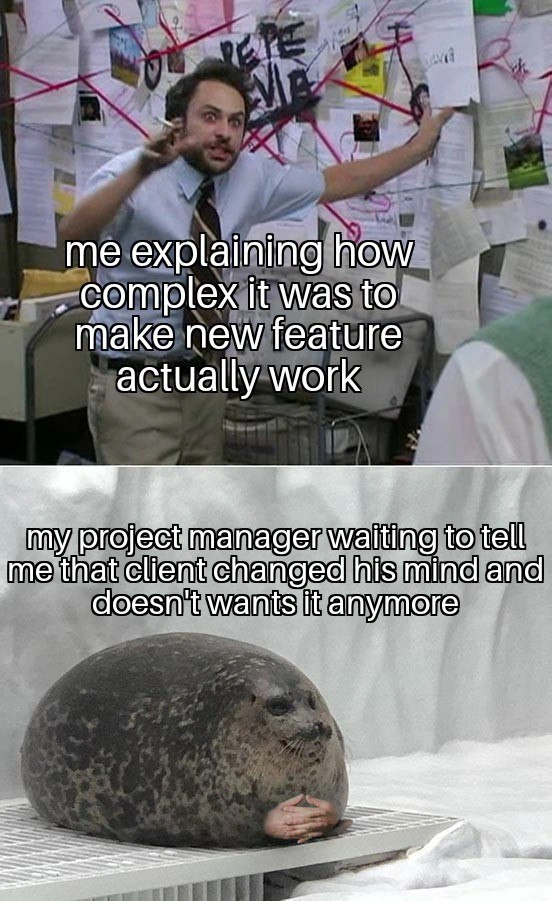
In the image, the top person represents the developer's mental load. Making a feature "actually work" can require far more than adding a button. The lower panel represents the message that cancels all that effort: the client no longer wants the feature.
For newer developers, the lesson is that software work is not only code. Clear communication, early demos, written acceptance criteria, and quick validation can save weeks of engineering effort. Without that, a technically impressive solution can still become unused work.
Level 3: Sunk Cost Ceremony
me explaining how complex it was to make new feature actually work
my project manager waiting to tell me that client changed his mind and doesn't wants it anymore
The top panel uses the frantic conspiracy-board pose to show a developer explaining implementation complexity: dependencies, edge cases, data flow, integration failures, weird states, probably one ancient service nobody admits still exists. The bottom panel shows a calm, waiting project manager, which is where the joke becomes painful. The PM is not listening because the implementation is about to become irrelevant. The client changed their mind.
This is the classic collision between feature complexity and requirements change management. Developers experience the work as a chain of hard technical decisions: schema changes, API contracts, permissions, UI states, migration logic, tests, monitoring, rollback plans. Stakeholders often experience the same feature as a negotiable idea: "Can we try it?" followed by "Actually, never mind." Both perspectives can be rational in isolation, but together they produce the exact facial expression in the top panel.
The deeper satire is that teams often discover requirements too late because feedback loops are broken. A feature goes from vague request to Jira ticket to implementation to demo, and only then does the client reveal they wanted something else, or no longer want it at all. By that point, the code may work, which is somehow worse, because now the team has paid the cost of correctness for a product decision that evaporated. Nothing says "agile" like delivering working software directly into the bin.
Good product process tries to reduce this blast radius with prototypes, acceptance criteria, design reviews, staged delivery, feature flags, and frequent stakeholder check-ins. The meme is funny because those safeguards are exactly the things teams skip when everyone is rushing. Then the developer gives a war-room explanation while the PM waits with the emotional energy of someone holding a calendar invite titled "small change."
Description
A two-panel meme pairs the frantic conspiracy-board scene from It's Always Sunny with a calm seal waiting below. The top caption says, "me explaining how complex it was to make new feature actually work," while the bottom says, "my project manager waiting to tell me that client changed his mind and doesn't wants it anymore." The humor comes from the mismatch between deep implementation effort and a casually reversed requirement, a familiar stakeholder and product-management failure mode.
Comments
4Comment deleted
Nothing improves velocity like deleting the only feature that finally passed integration tests.
"doesn't want" Comment deleted
👌 Comment deleted
боль Comment deleted